If you are confused about onsite vs on site, you are not alone. Both forms are used in English, but they do not always work in the same way. The correct choice depends on how the words are being used in a sentence.
In simple terms, onsite usually works as an adjective or adverb meaning “at a particular place.” On site is the traditional two-word form and is especially common when you mean that something happens at the actual location. In many cases, both forms can be understood, but the sentence structure helps you choose.
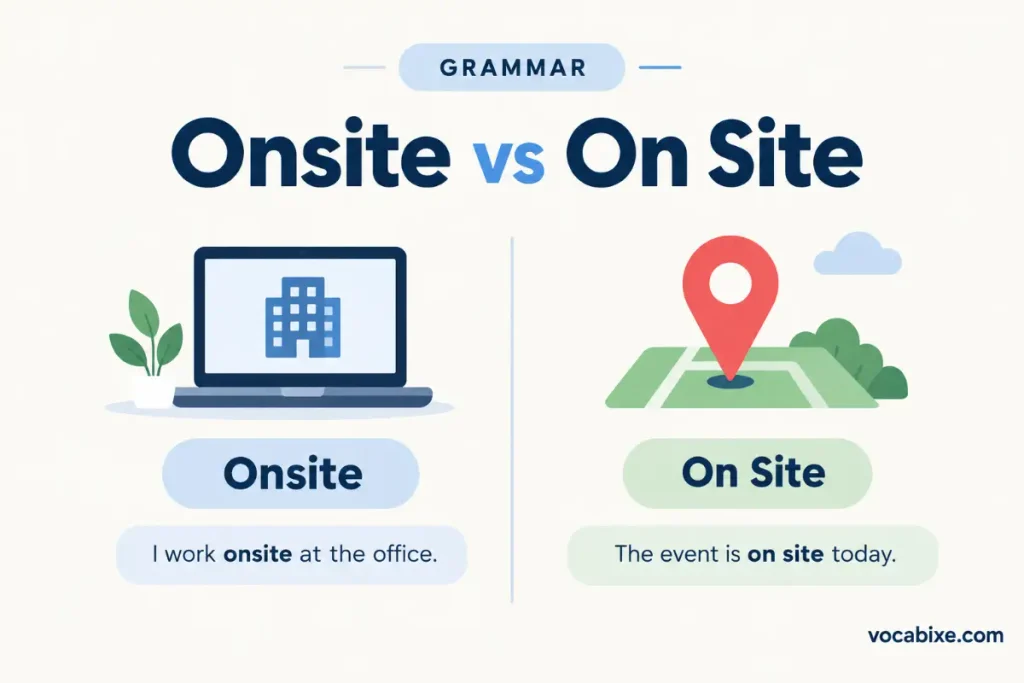
For example, you might say, “We have an onsite technician.” Here, “onsite” describes the technician. You might also say, “The technician is on site.” Here, “on site” tells us where the technician is.
Simple Answer in One Look
Onsite and on site can both be correct.
- Onsite is commonly used as an adjective before a noun: “onsite training.”
- On site is commonly used as a phrase showing location: “The workers are on site.”
A simple rule is: Use “onsite” before a noun when it describes something. Use “on site” when you mean that someone or something is physically at the location.
What Does Onsite vs On Site Mean?
The basic meaning of both forms is connected to being at a particular place.
Onsite means available, located, or happening at the place where an activity takes place.
For example:
We offer onsite support.
This means the support team can come to or work at the location where help is needed.
On site has the same basic idea, but it is written as two words.
The engineer is on site.
This means the engineer is physically at the location.
Think of a building project. A company may have an onsite manager. The manager works at the project location. You could also say:
The manager is on site today.
The meaning is closely related, but the sentence structure is different. Visit more like elieving vs reliving.
What Is the Difference Between Onsite and On Site?
The main difference is how each form fits into a sentence.
Onsite
Onsite is often used to describe a person, service, activity, or thing connected with a specific location.
Examples:
- onsite staff
- onsite training
- onsite parking
- onsite support
- onsite interview
- onsite meeting
- onsite technician
In these examples, “onsite” gives information about the noun that follows it.
On site
On site is commonly used when you are talking about someone’s or something’s location.
Examples:
- The doctor is on site.
- The workers are on site.
- We arrived on site.
- The manager stayed on site.
- The equipment is on site.
Here, “on site” tells us where the person or thing is.
Quick comparison
| Form | Common use | Example |
|---|---|---|
| onsite | Describes a noun | We have onsite parking. |
| on site | Shows location | The staff are on site. |
There is an important detail, though. English usage is not perfectly fixed here. Some style guides and dictionaries may prefer on-site when the word comes before a noun.
For example:
We provide on-site training.
You may also see:
We provide onsite training.
Both forms appear in modern English. The hyphenated form is often used to make the connection between the words clear.
Is Onsite One Word or Two Words?
Onsite is one word, while on site is two words.
You may also see on-site, which is hyphenated.
These three forms can appear in English:
- onsite
- on-site
- on site
The choice can depend on the dictionary, style guide, publisher, or sentence structure.
For example:
We offer onsite support.
We offer on-site support.
Our support team is on site.
The first two examples describe the support. The third example tells us where the team is.
If you are writing for a company, school, newspaper, or website, it is a good idea to follow that organization’s preferred style.
Which One Should You Use?
Use onsite when it naturally acts as a describing word.
We provide onsite training.
Use on site when you are talking about being at the location.
The trainer is on site.
When the phrase comes directly before a noun, on-site may also be preferred in careful writing.
We offer on-site training.
A useful memory trick is:
Before a noun: onsite or on-site.
Showing location: on site.
This is not an absolute rule for every dictionary or style guide, but it works well for everyday writing.
Easy Examples in Real Sentences
Here are some simple examples you can use in real life.
- We provide onsite support for our customers.
- The technician is on site today.
- The company offers onsite training.
- Our manager will be on site tomorrow.
- The school has an onsite library.
- The workers are already on site.
- I have an onsite interview next week.
- The doctor will be on site during the event.
Notice the pattern. “Onsite” describes something. “On site” usually tells us where someone or something is.
Why Do People Get Confused?
People often get confused because onsite, on-site, and on site have almost the same meaning.
They also sound very similar when spoken.
When we hear someone say:
The technician is onsite.
we may not know whether the writer would spell it as onsite or on site.
There is another reason for the confusion. English has many expressions that started as separate words and later developed different written forms.
For example, words such as “online,” “offline,” and “onsite” are often written as single words in modern business English.
At the same time, “on site” remains common.
This means readers may see different forms in different places.
Common Mistakes to Avoid
Mistake 1: Treating every use as one word
Incorrect for many contexts:
The workers onsite yesterday.
Better:
The workers were on site yesterday.
The phrase is describing their location.
Mistake 2: Assuming “on site” is always wrong
It is not wrong.
The engineer is on site.
This is a natural and correct sentence.
Mistake 3: Ignoring the hyphen
Before a noun, you may see:
on-site training
This form is common in edited English because the hyphen makes the phrase easier to read.
Mistake 4: Using one style randomly
A website might use:
onsite support
in one paragraph and:
on-site support
in another.
Neither choice necessarily changes the meaning, but consistent style looks more professional.
Where Does Onsite Come From?
The phrase on site is made from ordinary English words: “on” and “site.”
The word site refers to a place or location. It comes from the Latin word situs, meaning a position or place.
Over time, expressions involving “site” became common in business, construction, education, technology, and other areas.
As English changed, compounds such as onsite became increasingly common.
Modern workplace English often uses “onsite” for services and activities that happen at a physical location rather than remotely.
This is especially noticeable because of the growth of remote work.
People now commonly compare:
- onsite work
- remote work
- onsite meetings
- virtual meetings
- onsite training
- online training
The contrast has made the word onsite more visible in everyday English.
Onsite vs On Site in Modern English
Modern English gives writers several choices. That can feel confusing at first, but the main meaning is simple.
If you say:
She works onsite.
you mean she works at the physical workplace or location.
If you say:
She works on site.
you are expressing the same basic idea with two words.
If you say:
She has an onsite job.
you are using “onsite” to describe the job.
The important point is not to panic when you see different forms. English spelling can vary by context and style.
The deeper question is how people use these forms in real situations. That becomes especially clear in work, school, construction, healthcare, and travel.
How Is This Word Used in Real Life?
At Work
The word onsite is very common in workplace English.
You may hear:
onsite employees
onsite training
onsite support
onsite interview
onsite meeting
For example:
The company requires onsite work three days a week.
This means employees must work at the physical workplace on those days.
You can also use the two-word form:
The manager is on site today.
The sentence focuses on the manager’s location.
In Technology
Technology companies often use “onsite” when talking about technical support.
For example:
We can send an onsite technician.
This means a technician can visit the customer’s location.
You might also hear:
Our technician is on site.
This means the technician has arrived at the location.
In Construction
Construction is one of the clearest examples.
You may hear:
The onsite team is ready.
Here, “onsite” describes the team.
You may also hear:
The builders are on site.
Here, “on site” tells us where the builders are.
In Schools
Schools may use the term for services and activities that happen at the school.
The school offers onsite tutoring.
You could also say:
The tutor is on site today.
Again, the meaning is closely connected.
In Healthcare
Hospitals and clinics may use “onsite” for services provided at the same location.
The clinic has an onsite pharmacy.
This means the pharmacy is located at the clinic.
You could say:
The pharmacist is on site.
This means the pharmacist is physically there.
In Events
Events can also have onsite services.
The event has onsite parking.
This means parking is available at the event location.
You could say:
Security staff will be on site.
This tells us where the security staff will be.
Is Onsite Formal or Informal?
Onsite is widely used in professional and everyday English.
It is not a slang word.
You can see it in business writing, job advertisements, school information, construction documents, company websites, and technical writing.
For formal writing, consistency matters more than choosing one form in every situation.
For example, if your company style uses on-site, use that form throughout the document.
If your style uses onsite, keep using it consistently.
For simple location statements, on site is a clear and natural choice.
The team is on site.
That sentence works well in both casual and professional communication.
Onsite vs On Site in Job Ads
Job advertisements are a common place to see these forms.
For example:
This is an onsite position.
This means the employee works at the company’s physical workplace.
Another job ad might say:
This is an on-site position.
The meaning is almost the same.
You may also see:
Employees must work on site.
Here, “on site” tells us where the employees must work.
A job seeker should not assume that one spelling changes the basic meaning. The company is usually saying that the work takes place at a physical location rather than fully remotely. Visit more in process vs in progress.
Onsite vs Remote
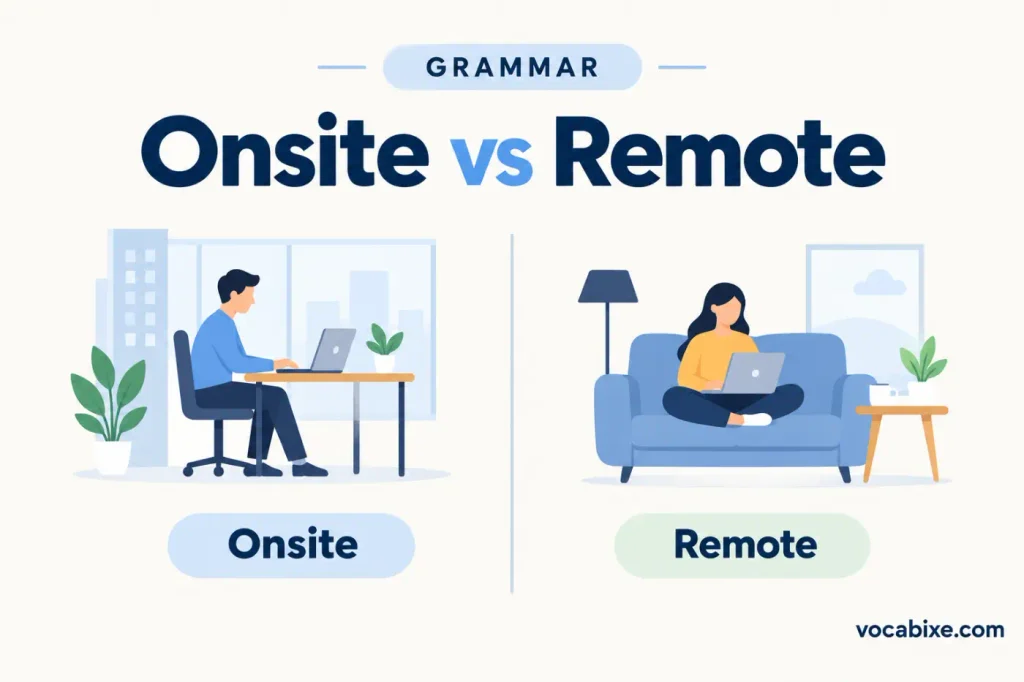
One of the easiest ways to understand onsite is to compare it with remote.
Onsite
You work at a physical location.
I have an onsite job.
Remote
You work away from the normal workplace, often from home.
I have a remote job.
Hybrid
You work partly at the workplace and partly somewhere else.
I have a hybrid job.
These words are now common in workplace English.
For example:
The company offers remote and onsite positions.
This means some workers can work away from the office, while others must work at the physical workplace.
How to Use Onsite vs On Site Correctly
A simple approach is to ask yourself one question:
Am I describing something, or am I saying where someone is?
If you are describing something, onsite or on-site may fit.
onsite service
onsite employee
onsite training
on-site interview
If you are saying where someone or something is, on site is often the clearest choice.
The employee is on site.
The equipment is on site.
The doctor is on site.
This simple test will help in most everyday situations.
Does Onsite Need a Hyphen?
This is one of the most common questions.
The answer is: sometimes you will see “on-site” instead of “onsite.”
When two words work together before a noun, writers sometimes use a hyphen to make the phrase clear.
For example:
on-site training
on-site staff
on-site service
But many modern writers and businesses use the closed form:
onsite training
onsite staff
onsite service
So you may encounter both onsite and on-site.
If you are following a specific style guide, use its preferred form.
If you are writing normal web content, consistency and clarity are usually the most important goals.
Real-Life Usage Examples
Here are more examples showing how the forms work.
Example 1: Office
The company has onsite employees in several cities.
“Onsite” describes the employees.
Example 2: Location
The employees are on site now.
“On site” tells us where they are.
Example 3: Training
We provide onsite training for new workers.
The training takes place at the physical location.
Example 4: Technician
An onsite technician can repair the machine.
The technician works at the customer’s location.
Example 5: Technician’s location
The technician is on site.
The technician is physically there.
Example 6: School
The school provides onsite counseling.
The counseling service is available at the school.
Example 7: Event
Food will be available onsite.
The food will be available at the event location.
Example 8: Construction
The project manager is on site.
The manager is physically at the construction location.
Example 9: Interview
I have an onsite interview tomorrow.
The interview will take place at a physical location.
Example 10: Support
Customers can request onsite support.
The support can be provided at the customer’s location.
How Does Context Change the Meaning?
The basic meaning stays similar, but the sentence changes the focus.
Compare these:
We have onsite security.
This tells us about the type of security.
Now compare:
Security is on site.
This tells us where the security staff are.
The difference is small but useful.
Another pair:
The company offers onsite repairs.
This describes the repair service.
The repair team is on site.
This tells us where the repair team is.
This pattern appears again and again in English.
Related Words You Should Know
On-site
This is the hyphenated form often used before a noun.
We provide on-site support.
On location
This means at the actual place where something is happening.
The film crew is working on location.
In person
This means physically present rather than communicating online.
We need to discuss this in person.
Remote
This means working or operating away from the main physical location.
She has a remote position.
Hybrid
This means combining remote and physical work.
He has a hybrid work schedule.
Workplace
A workplace is a place where people work.
The company has a large workplace downtown.
Location
A location is a particular place.
Please send me the meeting location.
On premises
This means within a particular building or property.
Food is prepared on the premises.
“On premises” is similar to “on site,” but it can have a more specific meaning depending on the situation.
Is Onsite the Same as In Person?
Not always.
These expressions are related, but they are not identical.
Onsite focuses on a physical location.
In person focuses on people meeting physically instead of communicating remotely.
For example:
We have an onsite meeting.
The meeting takes place at a particular physical location.
We need to meet in person.
This emphasizes that the people should physically meet.
In many situations, an onsite meeting will also be an in-person meeting. However, the two expressions focus on different ideas.
Is Onsite the Same as Local?
No.
Local usually means nearby or connected with a particular area.
Onsite means at the actual location.
For example:
We hired a local technician.
The technician is from or works in the nearby area.
We hired an onsite technician.
The technician will provide service at the physical location.
A local technician does not necessarily have to work onsite.
How Do Americans Use Onsite?
In American English, onsite is common in modern workplace and business writing.
You may see it in:
- job descriptions
- company websites
- service pages
- employee handbooks
- construction documents
- technology support pages
- event information
The hyphenated on-site is also common.
The two-word form on site remains natural when the expression describes location.
For example:
Our team is on site.
This is easy to understand and widely used.
What About British English?
British English also uses on-site and on site.
You may see onsite as well, especially in modern business writing.
There is no simple rule saying that one form belongs only to American English and another belongs only to British English.
The differences are more often related to house style, dictionaries, publishers, and the role of the phrase in the sentence.
Cultural Meaning of Onsite vs On Site
There is no special hidden cultural or symbolic meaning behind onsite vs on site.
The expressions mainly describe physical presence or work at a particular location.
However, “onsite” has become especially common in workplace culture because people often compare physical work with remote work.
For example:
onsite employees
and:
remote employees
This contrast tells us something about how modern workplaces are organized.
The word itself is not emotional or symbolic. Its meaning comes from the situation where it is used.
Biblical and Mythological Meaning
There is no meaningful biblical or mythological meaning connected specifically with onsite or on site.
These are modern English expressions used mainly to describe location, services, work, and activities.
They should not be given a symbolic or religious meaning simply because the word “site” can refer to a place.
Symbolism Explained in Simple Words
There is no standard symbolic meaning for onsite or on site.
What the Word Can Represent
In ordinary communication, these expressions can suggest physical presence.
For example:
The support team is on site.
This shows that the team is physically present and ready to help.
How the Meaning Changes by Context
The exact idea depends on the situation.
At work, “onsite” may mean working at an office.
At a construction project, it may mean being at the building location.
At an event, it may mean being at the event venue.
The word does not have a fixed deeper symbolic meaning. More articles sound alike amateur vs amatuer.
Common Questions People Have
People often search for answers such as:
- Is onsite one word?
- Is on-site correct?
- Should I write on site or onsite?
- Is onsite formal English?
- Does onsite mean in person?
- Is onsite the opposite of remote?
- Is on site grammatically correct?
The answers are easier than they first seem.
Onsite is a common modern form.
On-site is also widely used, especially before a noun.
On site is a natural two-word phrase when showing location.
All three forms can appear in correct English depending on the sentence and style.
Final Teacher Explanation
Think about the sentence before you think about the spelling.
If you are using the word to describe something, onsite or on-site can work.
onsite training
on-site training
If you are telling someone where a person or thing is, on site is a natural choice.
The trainer is on site.
The main thing to remember is that English spelling is not always a simple one-word-versus-two-word question. Some expressions change over time. Different publishers may also use different styles.
For everyday writing, focus on clear meaning and consistent spelling.
If your sentence says that something is physically at a particular place, on site is usually easy and clear. If the word comes before a noun to describe it, onsite or on-site may be appropriate.
Final Answer — Quick Recap
Onsite vs on site are closely related forms. Onsite is commonly used to describe something connected with a physical location, while on site commonly shows that someone or something is physically at that location.
You may also see on-site, especially before a noun. Follow the style used by your school, workplace, publisher, or website, and keep your choice consistent.
The easiest rule is simple: “onsite/on-site” describes; “on site” shows location.
Conclusion
Understanding onsite vs on site does not need to be difficult. The two forms share the same basic idea of being connected with a physical location. The biggest difference is how they fit into a sentence.
Use onsite or on-site when the expression describes something, such as onsite training or on-site support. Use on site when you are saying that a person or thing is physically at the location.
Once you notice this pattern, the choice becomes much easier. When in doubt, read the whole sentence aloud and ask what you are trying to describe. Clear writing is more important than worrying about a small spelling difference.
FAQs
Is onsite one word?
Yes. Onsite is a recognized and commonly used one-word form, especially in modern business English.
Is on site two words?
Yes. On site is a common two-word phrase used to describe physical location.
Is on-site correct?
Yes. On-site is also widely used, especially when the phrase comes before a noun, such as “on-site training.”
Which is correct, onsite or on site?
Both can be correct. Use onsite when describing something and on site when showing where someone or something is.
Is onsite formal English?
Yes. Onsite is commonly used in professional, business, technical, and workplace English.
Does onsite mean in person?
They can have similar meanings in some situations, but they are not exactly the same. “Onsite” focuses on a physical location, while “in person” focuses on physical presence.
Is onsite the opposite of remote?
Often, yes. In workplace English, onsite usually means working at a physical workplace, while remote usually means working away from it.
Should I write onsite or on-site before a noun?
Both forms are used. If you follow a style guide, use its preferred form. Otherwise, choose one form and use it consistently.
Pingback: Emersion vs Immersion: Clear Difference Explained - Vocabixe
Pingback: How Tos or How To's? Correct Spelling and Usage Explained - Vocabixe