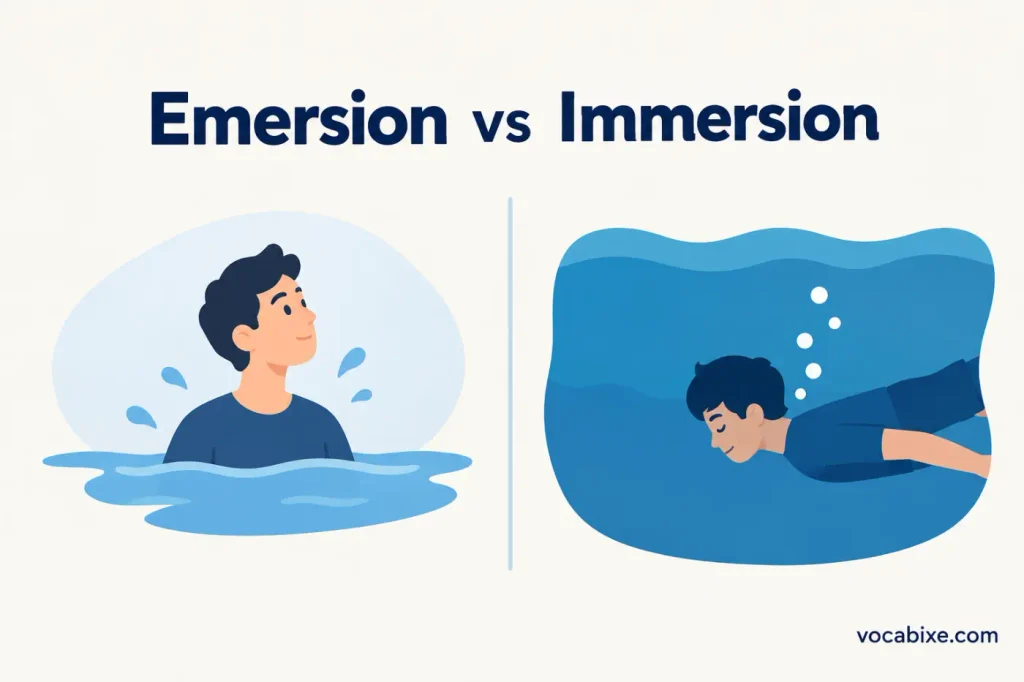
The difference between emersion vs immersion is simple: emersion means coming out of something, especially coming out of water or becoming visible after being hidden. Immersion means going into something deeply, especially going into water or becoming deeply involved in an activity.
For example, if a diver goes under the water, that is immersion. When the diver comes back out, that can be called emersion.
These words look and sound similar, so they are easy to mix up. The first letters give you a useful clue: immersion is connected with going in, while emersion is connected with coming out.
What Does Emersion vs Immersion Mean?
To understand emersion vs immersion, first look at the basic idea behind each word.
Emersion means the act of coming out of something or becoming visible after being covered or hidden. It is often used when something comes out of water. It can also be used in astronomy when one object becomes visible after being hidden by another object.
Immersion means the act of putting something into a liquid or being completely surrounded by it. It can also mean becoming deeply involved in an activity, language, culture, or experience.
Think about a swimming pool.
When you jump into the pool and your body goes under the water, you are experiencing immersion.
When you come back out of the water, you are experiencing emersion.
The easiest way to remember the basic difference is:
- Immersion = going in
- Emersion = coming out
This simple idea can help you choose the right word in many situations.
What Is the Correct Spelling?
Both emersion and immersion are correct English words.
They are not two spellings of the same word. They have different meanings.
Emersion is spelled:
E-M-E-R-S-I-O-N
Immersion is spelled:
I-M-M-E-R-S-I-O-N
The word immersion has two m’s at the beginning. The word emersion has only one m.
The confusion happens because the words look almost the same. They also have related meanings because both can describe movement involving water or being surrounded by something.
Here are some simple examples:
- The diver’s immersion lasted several minutes.
- The swimmer’s emersion happened near the edge of the pool.
- The teacher used language immersion to help students learn Spanish.
- The emersion of the object was visible after the water level dropped.
A useful point to remember is that emersion is a real word. It is not simply a misspelling of immersion.
What Is the Difference Between Emersion and Immersion?
The main difference between emersion vs immersion is the direction of movement.
Immersion describes going into something or being deeply surrounded by something.
Emersion describes coming out of something or becoming visible after being hidden.
Here is a simple comparison:
| Word | Basic Meaning | Easy Idea |
|---|---|---|
| Emersion | Coming out or becoming visible | Coming out |
| Immersion | Going into or being deeply involved | Going in |
You can also remember them with these examples:
Immersion:
The child was immersed in the water.
The child went into the water and was surrounded by it.
Emersion:
The child emerged from the water.
Here, the child came out of the water.
There is another important difference. Immersion has many everyday uses. You can talk about language immersion, cultural immersion, learning immersion, and immersion in a book or activity.
Emersion is much less common. You are more likely to see it in scientific, technical, astronomical, or specialized writing.
Why Do People Get Confused?
People often confuse these words because they share most of their letters.
Look at them closely:
emersion
immersion
They both contain “mersion.” The main difference is the beginning.
There is also a connection in their meanings. Both words can describe a change in position.
Imagine a person underwater.
Going under the water is immersion.
Coming back above the water is emersion.
This relationship can make the words even harder to remember. A person may know the meaning but still choose the wrong spelling.
Another reason is that immersion is much more common in everyday English. People see and hear it often. Emersion is less common, so some readers may think it is simply a spelling mistake.
Typing can also cause confusion. A person who wants to write “immersion” may accidentally leave out one of the m’s. That creates “imersion,” which is incorrect.
On the other hand, someone may see the word “emersion” and assume that it should have two m’s because of the familiar word “immersion.”
The key is to remember that they are separate words. Related article how tos or how tos.
Which One Should You Use?
Use immersion when you mean:
- Going into water
- Being covered or surrounded by something
- Becoming deeply involved in an activity
- Learning through constant exposure
- Becoming deeply involved in a language or culture
Use emersion when you mean:
- Coming out of water
- Coming out from behind something
- Becoming visible after being hidden
- A specialized scientific or astronomical event involving something becoming visible again
A simple rule is:
If something is going in, think immersion.
If something is coming out, think emersion.
For example:
“The swimmer went into the water.”
This relates to immersion.
“The swimmer came out of the water.”
This relates to emersion.
For most everyday situations involving deep involvement, choose immersion.
Easy Examples in Real Sentences
Here are some simple examples to make the difference clearer.
- The swimmer’s immersion lasted for two minutes.
The swimmer was under the water.
- The diver slowly came out of the water after immersion.
The diver had been underwater and then returned to the surface.
- The school offers Spanish immersion classes.
Students learn Spanish by using the language often.
- The tourist enjoyed cultural immersion during her trip.
She became deeply involved in the local culture.
- The book gave me complete immersion in the story.
The reader became deeply involved in the story.
- The emersion of the object could be seen after the water dropped.
The object became visible after being covered.
- The astronomer recorded the emersion of the moon from behind another object.
The moon became visible again.
- The device needs full immersion in water for the test.
The device needs to be completely placed in water.
Common Mistakes to Avoid
Mistake 1: Using “imersion”
Incorrect:
“The child was in imersion therapy.”
Correct:
“The child was in immersion therapy.”
Immersion has two m’s at the beginning.
Mistake 2: Treating emersion as a spelling mistake
Incorrect idea:
“Emersion is always a misspelling of immersion.”
Correct idea:
“Emersion is a real word with a different meaning.”
It is less common, but it has its own meaning.
Mistake 3: Using immersion when you mean coming out
Incorrect:
“The emersion describes going into the water.”
Correct:
“The immersion describes going into the water.”
Emersion describes the movement or appearance coming out.
Mistake 4: Using emersion for deep involvement
Incorrect:
“I had a wonderful emersion in French culture.”
Better:
“I had a wonderful immersion in French culture.”
Deep involvement is normally described with immersion.
Mistake 5: Adding an extra letter
Incorrect:
“emmersion”
Correct:
“emersion”
Do not add an extra m to emersion.
Where Do These Words Come From?
The two words are related to older forms connected with the idea of coming out of or going into something.
Immersion comes from a Latin word related to putting or plunging into something. The idea of going into water became an important meaning of the English word.
Emersion comes from a Latin word related to coming out or rising from something. This is why it can describe something becoming visible after being hidden.
The connection between the two words makes sense. They describe opposite directions.
One moves inward.
The other moves outward.
This is also why their meanings can be remembered as a pair.
The words are not common opposites in every situation, but their basic water-related meanings make a useful comparison.
A Quick Memory Trick for Emersion vs Immersion
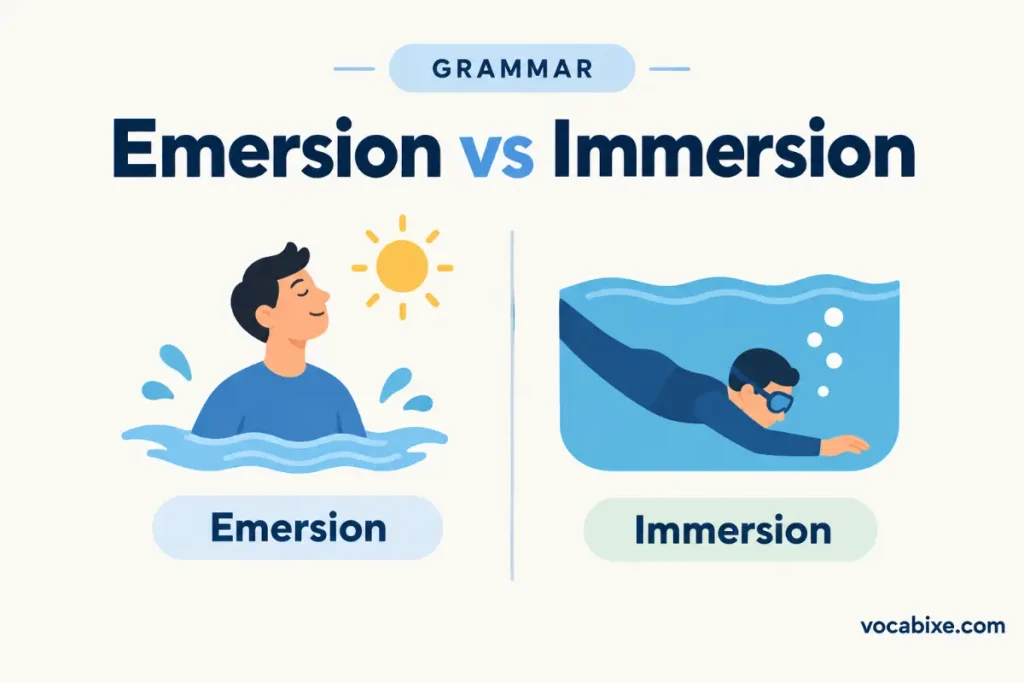
Try this simple trick:
I = In
The word immersion starts with I.
Think:
I → In → Immersion
You go into the water.
For emersion, think:
E → Exit → Emersion
You come out of the water.
This is not the historical meaning of the letters. It is simply a memory trick.
It can help you remember the difference when you are writing quickly.
The Most Important Difference to Remember
If you remember only one thing from this section, remember this:
Immersion means going into something or becoming deeply involved in it. Emersion means coming out or becoming visible after being hidden.
The words look similar, but they are not interchangeable.
Now that the basic difference is clear, we can look at how these words appear in real English, science, learning, culture, and everyday writing.
How Is Emersion vs Immersion Used in Real Life?
The two words do not have the same level of everyday use.
Immersion is very common.
You may hear it at school, at work, while traveling, in language learning, in sports, and in discussions about books, games, or movies.
For example, a teacher may say:
“Language immersion helps students practice English every day.”
A traveler may say:
“I wanted full cultural immersion during my trip.”
A reader may say:
“The novel gave me complete immersion in the story.”
A gamer may say:
“The sound effects improve the game’s immersion.”
In each case, the person means deep involvement or being surrounded by an experience.
Emersion is much less common in ordinary conversation.
You may see it in scientific writing, astronomy, technical descriptions, or discussions about something becoming visible after being hidden.
For example:
“The astronomer observed the emersion of the moon.”
A scientist may also use the word when describing something coming out of a liquid.
Because emersion is uncommon, many people do not use it in daily speech. That does not make it incorrect.
It simply has a narrower range of common uses.
How Is Immersion Used in Language Learning?
One of the most common modern uses of immersion is language learning.
A language immersion program surrounds learners with the language they are studying.
For example, imagine a student learning Spanish.
The teacher may speak Spanish during class. The books may be in Spanish. Students may hear Spanish songs and have conversations in Spanish.
This creates a form of language immersion.
The student is not just memorizing a few words. The student is spending a lot of time around the language.
You can also experience language immersion while traveling.
Suppose you visit France and spend most of your day speaking French. You read French signs and will hear French conversations. You order food in French.
That experience can be called language immersion.
The main idea is simple:
Immersion gives you a lot of direct exposure to something.
How Is Immersion Used in Culture?
The word immersion is also common when people talk about culture.
Cultural immersion means spending time in a culture and taking part in its everyday life.
For example, a traveler may stay with a local family. They may eat local food, learn local customs, visit local places, and talk with local people.
That person is experiencing cultural immersion.
The word does not mean that someone must completely change who they are.
It simply means that the person is deeply experiencing another culture.
You may see this idea in travel writing, documentaries, books, and personal stories.
For example:
“Living with a local family gave him a strong sense of cultural immersion.”
The sentence says that he experienced the culture closely.
How Is Immersion Used in Stories and Movies?
Immersion is also used when people talk about entertainment.
A movie can create immersion by making viewers feel deeply involved in the story.
Good sound, realistic settings, strong characters, and interesting scenes can help people feel as if they are inside the story.
The same idea applies to video games.
A game may have realistic sounds, detailed environments, and a strong story. Players may feel deeply involved in the game.
Someone might say:
“The game’s music creates a strong sense of immersion.”
Here, immersion does not involve water.
It means deep involvement in an experience.
This is one reason immersion has a much wider meaning than emersion in modern everyday English.
What Does Emersion Mean in Science?
Emersion has a more specialized use in science.
It can describe something becoming visible after it has been hidden or covered.
Astronomy provides a clear example.
Imagine that one space object passes in front of another object. For a period of time, the second object cannot be seen.
When it becomes visible again, this can be described as an emersion.
The word can also appear in descriptions of objects entering or leaving water.
The exact meaning depends on the scientific context, but the basic idea stays the same:
Something that was hidden or covered becomes visible again.
This is why emersion is useful even though most people rarely use it in casual conversation.
How Does Immersion Appear in Everyday English?
Immersion appears in many areas.
At School
“Students joined an English immersion program.”
This means students spent a lot of time learning through English.
While Traveling
“We wanted complete cultural immersion.”
This means the travelers wanted to experience the local culture closely.
In Water
“The doctor recommended water immersion exercises.”
Here, immersion refers to being placed in water.
In Reading
“I was so immersed in the novel that I forgot the time.”
This sentence uses the related form “immersed.” It means the person was deeply involved in the book.
In Technology
“The virtual reality headset creates a feeling of immersion.”
The user feels deeply surrounded by the digital experience.
Emersion vs Immersion in Simple Sentences
Here are more examples that show the difference clearly.
Immersion:
“The baby enjoyed water immersion during the swimming lesson.”
The baby was placed in the water.
Immersion:
“Her immersion in the new language helped her improve quickly.”
She spent a lot of time using the language.
Immersion:
“The museum’s design gives visitors a feeling of immersion.”
Visitors feel deeply surrounded by the experience.
Immersion:
“I became lost in the story through complete immersion.”
The reader became deeply involved.
Emersion:
“The emersion of the object was easy to see.”
The object became visible after being covered.
Emersion:
“The astronomer recorded the emersion of the star.”
The star became visible again.
Emersion:
“The emersion occurred shortly after the object left the water.”
The object came out of the water.
These examples show why context matters.
Related Words You Should Know
Learning a few related words can make emersion vs immersion easier to understand.
Immerse
Immerse means to put something deeply into something else, especially a liquid.
Example:
“Immerse the cloth in warm water.”
It can also mean becoming deeply involved.
Example:
“She immersed herself in her studies.”
Immersed
Immersed describes someone or something that is deeply involved or surrounded.
Example:
“He was immersed in his work.”
This does not mean that he was necessarily underwater.
Immersive
Immersive describes an experience that makes you feel deeply involved.
Example:
“The game has an immersive story.”
Emerse
Emerse is a less common verb connected with coming out or becoming visible.
It is much less common than “immerse.”
Emergence
Emergence means the act of appearing or coming into view.
Example:
“The emergence of the sun ended the darkness.”
Emergence is more common than emersion in general English, but they are not the same word.
Submerge
Submerge means to put something completely under water or another liquid.
Example:
“Do not submerge the phone in water.”
Emerge
Emerge means to come out or become visible.
Example:
“The bird emerged from the nest.”
This word is useful because its basic idea is close to the “coming out” side of emersion. More related article is onsite vs on site visit it.
Emersion vs Immersion: How to Use Each Correctly
A good way to choose the right word is to ask one question:
Is something going in, or is something coming out?
If it is going in, immersion may be the right word.
If it is coming out or becoming visible again, emersion may be the right word.
But there is another rule.
If you are talking about deep involvement in an activity, language, culture, story, or experience, use immersion.
For example:
“Her immersion in English helped her speak more confidently.”
Do not use “emersion” here.
Emersion does not normally mean deep involvement.
Formal and Informal Use
Immersion works in both formal and informal English.
You can use it in:
- School writing
- Business writing
- Travel writing
- Conversations
- Articles
- Academic writing
- Technology discussions
For example:
“Language immersion can help students gain practical experience.”
This is suitable for formal writing.
You could also say:
“I loved being immersed in the local culture.”
That sounds natural in everyday conversation.
Emersion, however, is more specialized.
If you use it in a casual conversation, the listener may not know the word.
That does not mean it is wrong. It simply means you should consider your audience.
In many everyday situations, a simpler word such as “coming out,” “appearing,” or “emerging” may sound more natural.
Can Emersion and Immersion Be Used as Opposites?
In some situations, yes.
Their water-related meanings can describe opposite movements.
For example:
- Immersion: going into the water
- Emersion: coming out of the water
However, do not assume that they are direct opposites in every sentence.
Immersion has many meanings that have nothing to do with physically entering water.
For example:
“She experienced immersion in Japanese culture.”
There is no physical water involved.
In this sentence, emersion would not be the opposite.
The meaning is deep involvement.
So, always look at the context.
Why “Immersion” Is More Common
There is a simple reason you will probably see immersion much more often.
The word has developed several common meanings.
People use it for:
- Water
- Education
- Languages
- Culture
- Movies
- Books
- Video games
- Virtual reality
- Work
- Hobbies
Emersion has a narrower use.
It mainly appears when something comes out or becomes visible after being hidden, especially in technical or scientific contexts.
This difference in frequency is useful when writing.
If you are describing a person becoming deeply involved in something, immersion is almost certainly the word you need.
Common Questions About Emersion vs Immersion
Is “emersion” a real English word?
Yes. Emersion is a real English word. It can describe coming out of something or becoming visible after being hidden.
Is “immersion” the same as “emersion”?
No. They have different meanings. Immersion usually means going into something or becoming deeply involved, while emersion can mean coming out or becoming visible.
Is emersion a misspelling of immersion?
No. Emersion is a valid word. However, “emersion” may sometimes appear when someone accidentally leaves out an m from “immersion.”
Which word is used for language learning?
Use immersion. A language immersion program gives learners frequent exposure to the language.
Which word means going into water?
Use immersion for the act of going into or being placed in water.
Which word means coming out of water?
Emersion can describe coming out of water, especially in technical or specialized writing. In everyday English, “coming out of the water” is often more natural.
Is immersion common in English?
Yes. Immersion is a common English word and has many uses beyond water.
Is emersion common in everyday English?
No. Emersion is much less common. You are more likely to find it in scientific or technical contexts.
A Simple Way to Remember the Difference
Picture a swimmer.
First, the swimmer jumps into the pool.
That is immersion.
Next, the swimmer climbs out.
That can be emersion.
Now imagine a student learning French.
The student listens to French, speaks French, reads French, and spends a lot of time around French.
That is language immersion.
There is no need to use emersion.
This picture gives you three easy ideas:
Immersion = into
Emersion = out
Immersion = deep involvement
If you remember those three points, you can usually choose the correct word. More to visit elieving vs reliving.
Final Teacher Explanation
Here is the classroom version.
Imagine I write two words on the board:
EMERSION
IMMERSION
They look almost like twins, but they do different jobs.
Immersion is the word you will use much more often. It can mean going into water, being surrounded by something, or becoming deeply involved in an experience.
You can have water immersion
Emersion is much less common. Its basic idea is coming out or becoming visible after being hidden. It can be useful in scientific or technical writing.
So, if you are writing about a student learning a language through constant practice, choose immersion.
If you are describing an object becoming visible after being hidden, emersion may be the correct word.
Do not think of emersion as a bad spelling of immersion. Both words are real. The important thing is knowing what each word means.
Final Answer — Quick Recap
Emersion and immersion are both correct English words, but they have different meanings.
Immersion means going into something or becoming deeply involved in it. Emersion means coming out or becoming visible after being hidden. For everyday writing, immersion is far more common.
The easiest memory trick is: immersion means in, while emersion means out.
If you are writing about language learning, culture, water, books, games, or deep involvement, immersion is usually the word you need.
If you are describing something becoming visible again after being hidden or covered, emersion may be appropriate, especially in technical or scientific writing.
Knowing this small difference can prevent a common spelling and word-choice mistake. The words look almost identical, but their meanings point in different directions.
Frequently Asked Questions
What does emersion mean in simple English?
Emersion means coming out of something or becoming visible after being hidden. It can also describe coming out of water.
What does immersion mean in simple English?
Immersion means going into something or being completely surrounded by it. It can also mean becoming deeply involved in an activity, language, or culture.
Is emersion or immersion correct?
Both are correct words. The correct choice depends on your meaning.
Why do people confuse emersion and immersion?
They look and sound very similar. They also share related meanings connected with entering and leaving something.
Is emersion a common word?
No. Emersion is much less common than immersion. It often appears in scientific, technical, or specialized writing.
Is immersion used in language learning?
Yes. Language immersion means learning through frequent exposure to the language.
Can immersion mean deep involvement?
Yes. Someone can be immersed in a book, job, hobby, culture, game, or other activity.
Is emersion the opposite of immersion?
They can describe opposite movements in some water-related or technical contexts. However, they are not opposites in every use because immersion also means deep involvement.
Conclusion
The difference between emersion vs immersion becomes much easier when you focus on direction and context. Immersion is connected with going in or becoming deeply involved. Emersion is connected with coming out or becoming visible again.
When you see the word immersion, think about a swimmer going into water, a student learning a language through constant exposure, or a reader becoming lost in a book. When you see emersion, think about something coming out from a hidden position or becoming visible again.
The two words are both correct, but they are not interchangeable. Remember the simple rule: immersion means in, and emersion means out. That small memory trick can help you choose the right word with confidence.
Pingback: Submission vs Submittion: Correct Spelling Explained Clearly - Vocabixe
Pingback: Endure vs Indure: Clear Spelling and Usage Explained 2026 - Vocabixe