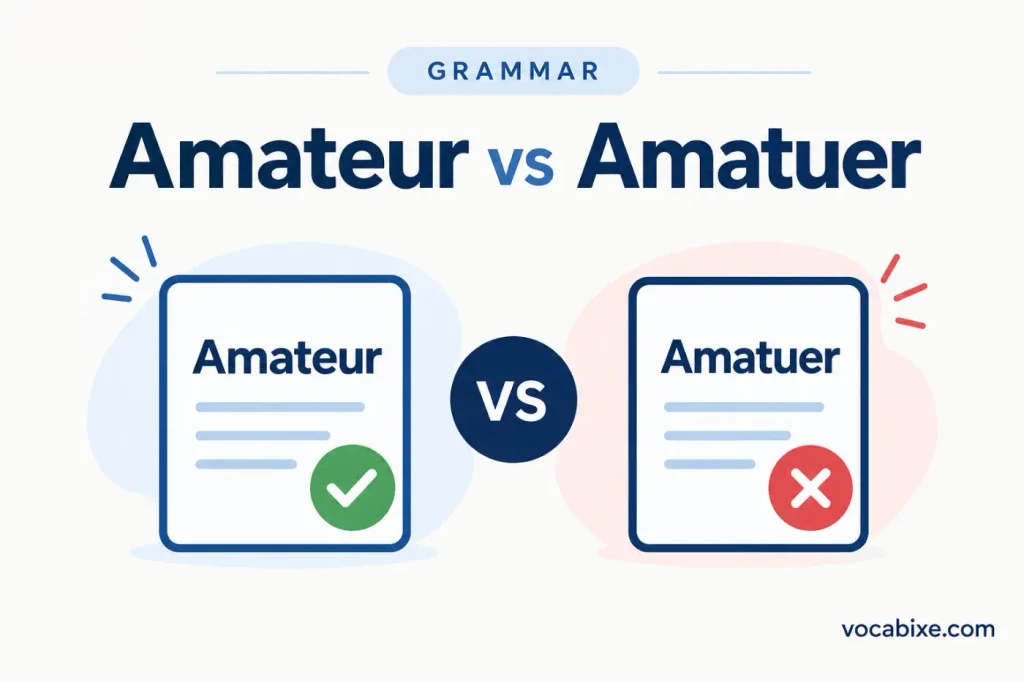
If you have ever paused while typing the word amateur, you are not alone. Many people write amatuer by mistake. In the amateur vs amatuer question, only one spelling is correct in standard English, and that spelling is amateur. Amatuer is a common misspelling that happens because of how the word sounds when we say it quickly.
This word shows up everywhere. You hear it in sports, hobbies, photography, cooking shows, and everyday conversation. So getting the spelling right matters, whether you are writing a school essay, a work email, or a caption for social media.
In this article, you will learn the correct spelling, what the word means, why so many people misspell it, and how to use it correctly in real sentences. By the end, you will never have to guess again.
Simple Answer in One Look
The correct spelling is amateur. The spelling amatuer is incorrect and does not appear in any standard English dictionary. The mix-up happens because the letters u and e near the end of the word get flipped or swapped when people type fast or spell from memory. If you remember one thing from this article, remember this: amateur ends in e-u-r, not u-e-r.
What Does Amateur Mean?
Amateur is a word that describes someone who does an activity because they enjoy it, not because they get paid for it. It is also used to describe something that is not fully professional in quality.
Think about a person who plays soccer every weekend just for fun. They are not paid to play. They are an amateur soccer player. Compare that to someone who plays soccer as their job and earns money from it. That person is a professional.
The word can also describe a skill level. If a photo looks a little messy or unpolished, someone might say it looks amateur. This does not always mean something bad. It simply means it was made without professional training or equipment.
Here is a simple breakdown:
- Amateur (noun): a person who does something as a hobby, not as a paid job
- Amateur (adjective): describing something done without professional training or payment
What Is the Correct Spelling?
The correct spelling is amateur: a-m-a-t-e-u-r.
The incorrect spelling amatuer swaps the order of the u and the e near the end of the word. This is one of the most common spelling mistakes in English because the word does not sound the way it is spelled. Native English speakers and English learners both make this mistake often.
Here are a few examples of the correct spelling in use:
- She is an amateur painter who sells her art on weekends.
- This is an amateur video, but the lighting looks great.
- He joined an amateur boxing club near his house.
- The contest is only open to amateur bakers.
If you ever see the word written as amatuer, know that it is a spelling mistake, not an accepted alternative. Must view post society synonym.
Why Do People Get Confused?
People misspell amateur as amatuer for a few clear reasons.
First, the word comes from French, and its spelling does not follow typical English sound patterns. When we say the word out loud, it is easy to lose track of which vowel comes first near the end.
Second, many English words that end in a similar sound are spelled with u-e, like statue or value. This makes people guess that amateur should follow the same pattern, when it does not.
Third, typing speed plays a role. When people type quickly on a phone or keyboard, letters near the end of longer words are easy to swap without noticing.
Fourth, some people simply memorize the word by ear instead of by sight. Since the spelling is unusual, memorizing it from sound alone often leads to mistakes.
Which One Should You Use?
Always use amateur. There is no situation in standard English writing where amatuer is correct. This is not a case of two accepted spellings, like color and colour in American and British English. This is a straightforward misspelling.
Use this simple rule to remember it: think of the word “eur” like the currency “euro.” Amateur ends the same way a euro sounds. If you can remember that connection, you will always spell it correctly.
Easy Examples in Real Sentences
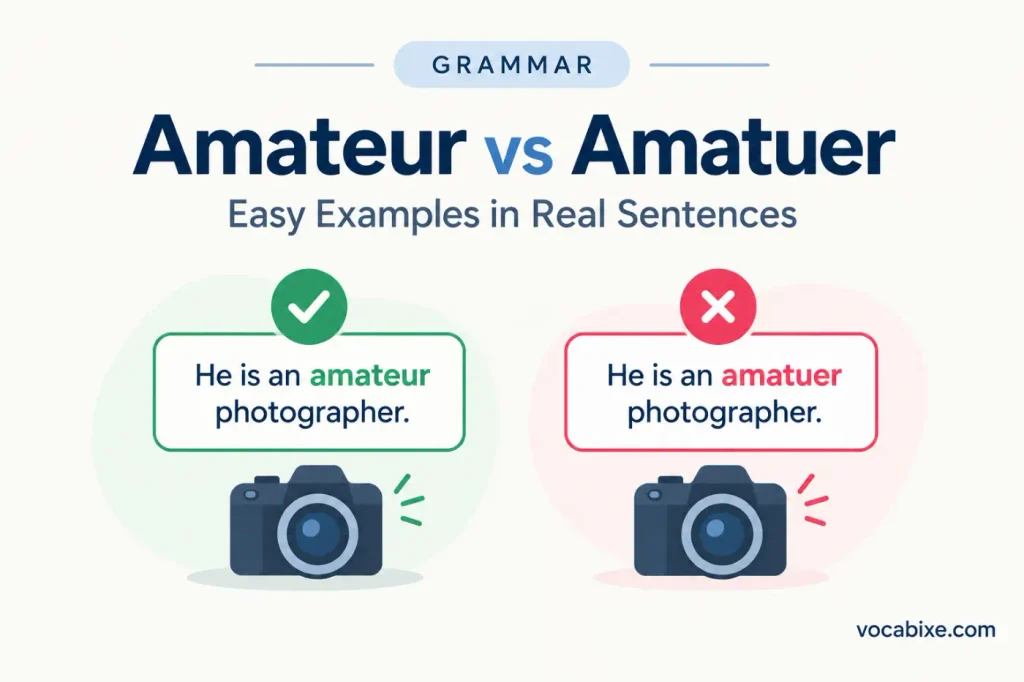
Here are natural examples that show how amateur is used in everyday English.
- My brother is an amateur chef, but his pasta tastes like a restaurant made it.
- The school held an amateur talent show on Friday night.
- I love amateur astronomy, so I bought a small telescope.
- That was clearly an amateur mistake, but everyone starts somewhere.
- She used to be an amateur runner before she started competing professionally.
- The photos from the trip look a bit amateur, but they still capture the memory.
- He plays chess at an amateur level, just for fun with friends.
- Our neighborhood has an amateur book club that meets every month.
Notice how the word fits naturally into daily topics like hobbies, skills, and everyday activities.
Common Mistakes to Avoid
Here are the most common mistakes people make with this word.
- Its Incorrect: amatuer Correct: amateur Explanation: The u and e are swapped near the end of the word.
2. Incorrect: amature Correct: amateur Explanation: This version drops a letter and changes the ending sound.
3. Incorrect: amuture Correct: amateur Explanation: This spelling changes the middle of the word completely.
4. Incorrect: Using “amateur” to mean careless or lazy Correct meaning: Amateur simply means unpaid or non-professional, not low effort Explanation: An amateur can still be very skilled, just not paid for the activity.
Where Does the Word Come From?
Amateur comes from the French word amateur, which itself comes from the Latin word amator, meaning lover or one who loves something. The root idea is someone who does something out of love, not for money.
This history explains why the word feels connected to passion and enjoyment. An amateur is someone who loves an activity enough to do it without needing payment. That original meaning still shapes how we use the word today.
When people first started using this word in English, it described someone who admired or practiced an art or skill purely for personal enjoyment. Over time, English speakers expanded the meaning to include sports, science, and many other fields.
Understanding where a word comes from often makes the meaning easier to remember. In this case, the connection between amateur and love or passion is more than just interesting trivia. It also shows up in how people are described in real life, in stories, and in everyday conversation, which we will look at next.
How Is Amateur Used in Real Life?
Native English speakers use the word amateur in many everyday situations.
In speaking, people use it casually to describe hobbies. Someone might say, “I’m just an amateur cook,” even if their food tastes amazing.
In writing, the word appears in resumes, articles, and descriptions to explain someone’s experience level. For example, a photography portfolio might state, “These are amateur photos taken during weekend trips.”
In texting and social media, people often use the word lightly and without judgment. A caption might say, “Amateur hour, but I tried,” showing a friendly, joking tone.
In school settings, students may take part in amateur competitions, such as amateur science fairs or amateur art contests, which are open to students rather than professionals.
In work environments, the word is used carefully, since calling someone’s work amateur can sound like criticism if it is not meant kindly. It is often safer to describe work as “still developing” or “early stage” in professional feedback, unless the amateur status is simply a fact, like an amateur sports league.
In formal situations, such as official competitions or legal contexts, amateur has a specific meaning. For example, in the Olympics, amateur athletes historically were not allowed to earn money from their sport, though these rules have changed over time.
How Is This Word Understood in Culture and Stories?
The word amateur appears often in movies, books, and everyday storytelling. It is commonly used to describe a character who is new to something but eager to learn. Think of movies about underdog sports teams, where the players are amateurs who work hard to compete against skilled professionals.
In books, an amateur detective is a popular character type. This is someone who is not a trained police officer but solves mysteries anyway, using curiosity and clever thinking instead of professional training. This trope appears in countless mystery novels and shows.
In music and entertainment, talent shows often celebrate amateur singers, dancers, and performers who are discovered before becoming professionals. The word carries a hopeful, inspiring tone in these stories, representing potential and passion rather than lack of skill.
Related Words You Should Know
Learning related words can help you understand amateur even better.
Professional: someone who is paid for their skill or work Beginner: someone who is new to an activity, regardless of payment Hobbyist: someone who does an activity for personal enjoyment Novice: someone with little experience in a skill Enthusiast: someone who is very interested and passionate about a topic Rookie: a person who is new to a job or activity, often used in sports Dilettante: someone who dabbles in an activity without deep commitment Expert: someone with advanced knowledge or skill in a subject Trainee: someone who is currently learning a skill through training Volunteer: someone who does work without payment, often for a cause
These words connect to amateur because they all describe different levels of experience, payment, or passion related to a skill or activity.
How to Use Amateur Correctly
Here are simple rules for using this word the right way.
Use amateur when describing someone who is unpaid for an activity, regardless of their skill level. A person can be extremely talented and still be an amateur if they do not earn money from it.
Avoid using amateur as an insult unless the context clearly allows for playful or neutral use. Since the word technically just means non-professional, using it to mean “bad” can confuse readers or sound unfair.
In formal writing, use amateur to describe official categories, such as amateur leagues, amateur competitions, or amateur radio operators.
In casual writing or speech, feel free to use amateur in a lighthearted way, such as joking about your own cooking or crafting skills.
Always double check the spelling before publishing anything, since amatuer is one of the most common typing errors for this word. Same like article divet or divot.
.
Real-Life Usage Examples
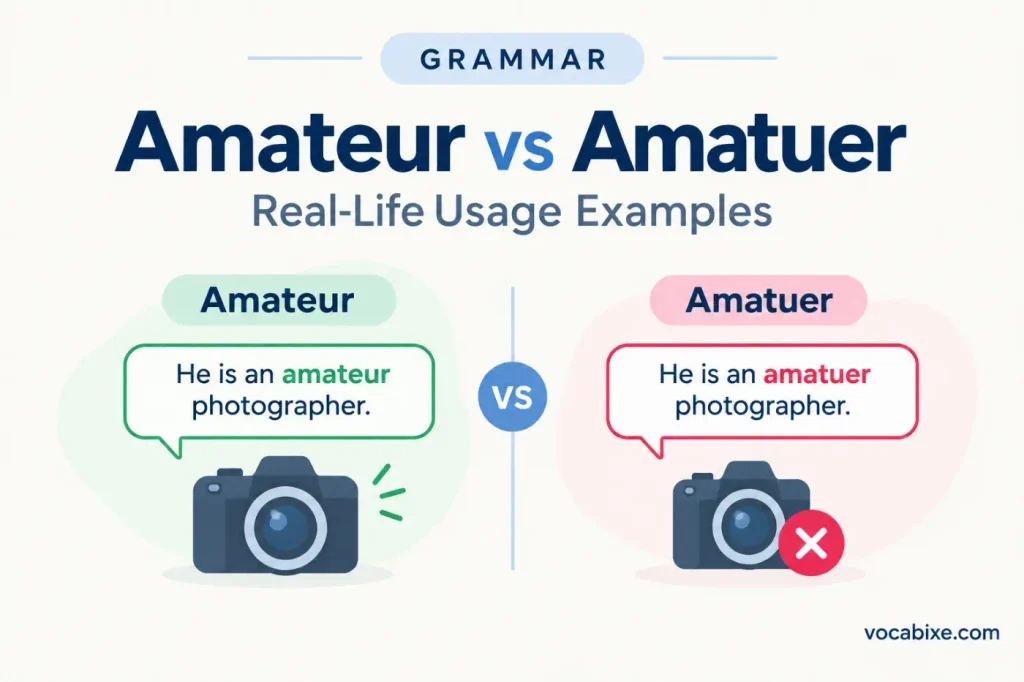
Here are more examples showing the word in different situations.
- The amateur radio community meets every year for a big convention.
- I still consider myself an amateur when it comes to baking bread.
- The company sponsors amateur athletes who show strong potential.
- This app is designed for amateur photographers who want to learn faster.
- My uncle collects vintage cars as an amateur hobby.
- The judges were impressed, even though most contestants were amateurs.
- She started as an amateur blogger before turning it into a full-time career.
- Local amateur theater groups often perform in community centers.
- He built the birdhouse using amateur woodworking skills he learned online.
- The amateur astronomy club hosts a stargazing night every full moon.
Common Questions People Have
Many readers search for quick answers about this word, so here are some direct explanations.
People often want to know if amateur can describe someone skilled. Yes, an amateur can be very skilled. The word describes payment and status, not talent level.
People also wonder if amateur is only used for sports. No, it applies to almost any hobby or skill, including art, cooking, writing, and science.
Some readers ask if amatuer is a British spelling. It is not. Amatuer is a spelling mistake in both American and British English.
Final Teacher Explanation
Here is the one idea to remember from this whole lesson. Amateur describes someone who does something because they love it, not because they are paid for it. The spelling always stays the same: a-m-a-t-e-u-r. The version amatuer simply switches two letters near the end, and that small switch turns a correct word into an incorrect one.
If you keep the word “euro” in your mind, tied to the ending of amateur, you will never misspell it again. Meaning-wise, remember that being an amateur is not a bad thing. It often represents passion, curiosity, and the joy of learning something simply because you want to.
Final Answer — Quick Recap
The correct spelling is amateur. Amatuer is incorrect and should never be used in formal or informal writing. The word describes someone who does an activity for enjoyment rather than payment, and it can apply to many areas of life, from sports to art to everyday hobbies.
Now that you know the correct spelling and meaning, you can use this word with full confidence in essays, emails, captions, and conversations. Small spelling details like this one make a big difference in how clear and polished your writing looks.
Words like amateur remind us that English spelling does not always match pronunciation, which is exactly why learning the reasoning behind a word helps more than simply memorizing letters.
Frequently Asked Questions
What does amateur mean in simple English?
Amateur means someone who does an activity for fun or love, not for money. It can also describe something that is not professional in quality.
Is amateur or amatuer correct?
Amateur is correct. Amatuer is a common misspelling and is not accepted in standard English.
How do I use amateur in a sentence?
You can say, “He is an amateur photographer who takes beautiful pictures on weekends.” This shows the word describing someone’s hobby.
Why do people confuse amateur and amatuer?
People confuse them because the word does not sound the way it is spelled, and the u and e near the end are easy to swap while typing or spelling from memory.
Is amatuer ever an accepted spelling?
No. Amatuer is not accepted in any English dictionary. It is always considered a spelling mistake.
Can I use amateur in formal writing?
Yes. Amateur is a standard English word and is completely appropriate in formal writing, official documents, and academic work.
Is amateur an American or British English word?
Amateur is used the same way in both American and British English. There is no regional difference in spelling or meaning.
Does amateur always mean low quality?
No. Amateur only describes payment and professional status, not skill level. An amateur can be highly talented.
Conclusion
Spelling mistakes like amatuer are easy to make, especially with words borrowed from other languages like French. The good news is that once you understand why the mistake happens, it becomes much easier to avoid.
Remember that amateur is the only correct spelling, and it describes someone who does something out of genuine interest rather than for payment. Whether you are talking about an amateur artist, an amateur sports team, or your own amateur cooking skills, you can now write and speak with confidence. Next article to view lieing or lying.
Keep this simple trick in mind: think of the ending like “euro,” and you will spell amateur correctly every time.
Pingback: In Process vs In Progress: Key Differences Explained - Vocabixe
Pingback: Onsite vs On Site: Clear Difference Explained Simply 2026 - Vocabixe