If you have ever stopped in the middle of a sentence and asked yourself, “Wait, is this in process or in progress?” you are not alone. Many people use these two phrases like they mean the exact same thing. But there is a small difference between them, and once you see it, you will never mix them up again.
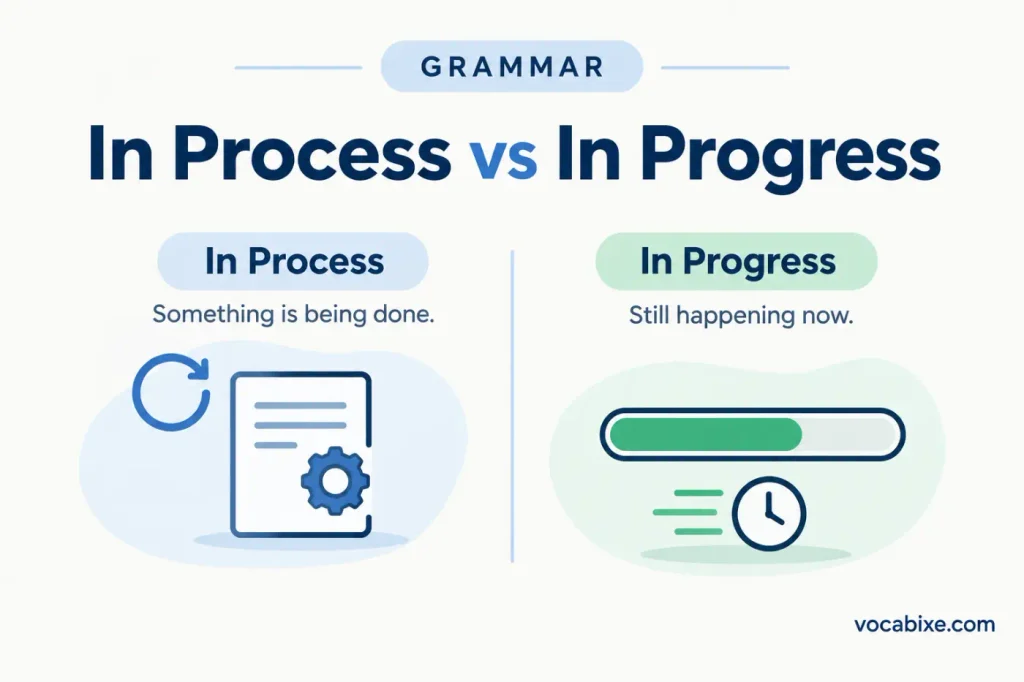
In process vs in progress comes down to one simple idea: focus. And “In progress” talks about something that is happening right now and moving forward. And “In process” talks about something that is going through a series of steps, often steps that involve other people or a system. Both phrases are correct English, but they are not always interchangeable.
By the end of this article, you will know exactly which phrase fits your sentence, why people confuse them so often, and how to use each one with confidence at school, at work, or in a text message.
Simple Answer in One Look
Here is the short version. Use “in progress” when you want to say something is happening right now, like a task, a project, or an event. Use “in process” when you want to say something is moving through a set of steps or a system, like an order, an application, or a request. Both are grammatically correct. The difference is about what kind of action you are describing, not about which one is “right” or “wrong.”
What Does In Process vs In Progress Mean?
Let’s break down each phrase on its own.
“In progress” means something is currently happening and is not finished yet. Think of a movie that is playing right now. It is in progress. Think of homework you started but haven’t finished. It is in progress.
“In process” means something is going through steps, stages, or a system before it is complete. Think of a passport application sitting in a government office. It is in process. Think of a pizza order that has been placed but not yet cooked. It is in process.
Here is an easy way to picture it. “In progress” is like a clock ticking. Something is actively moving forward right now. “In process” is like a conveyor belt. Something is being carried through different stages, one after another.
What Is the Difference Between In Process and In Progress?
Let’s look at the real difference in plain terms.
- “In progress” focuses on the action happening now, in this moment.
- “In process” focuses on a series of steps or a system that something must pass through.
- “In progress” works well for tasks, projects, meetings, and events.
- “In process” works well for orders, applications, requests, and paperwork.
- “In progress” feels more personal and immediate.
- “In process” feels more formal and system-based.
Both phrases describe something unfinished. But “in progress” puts the spotlight on the doing, while “in process” puts the spotlight on the steps something must go through.
For example, if you are writing a report, you would say the report is “in progress” because you are actively working on it. But if you sent a document to be reviewed by three different departments, you would say it is “in process” because it is moving through a system, and you may not be the one actively touching it right now. Next article to view amateur vs amatuer.
Why Do People Get Confused?
People mix up in process vs in progress for a few honest reasons.
- Both phrases start with the word “in,” which makes them feel similar.
- Both phrases describe something that is not finished yet.
- Many workplaces use them loosely, so employees copy what they hear.
- Emails and customer service messages often use both phrases for similar situations, like order updates.
- The words “process” and “progress” look alike and are easy to mix up while typing quickly.
- Some people think one phrase is more “formal” than the other, so they swap them without thinking about meaning.
None of these reasons mean you are using bad English. They just show why so many people search for this exact topic every day.
Which One Should You Use?
Here is a simple rule you can remember.
Use “in progress” when you mean something is actively happening right now. Use “in process” when you mean something is moving through steps, stages, or a system.
If you can replace the phrase with “happening now,” choose “in progress.” If you can replace the phrase with “going through steps,” choose “in process.”
Example test: “My essay is (in progress / in process).” Since you are actively writing it, “in progress” is the better choice.
“My visa application is (in progress / in process).” Since it is moving through government steps, “in process” is the better choice.
Easy Examples in Real Sentences
Here are some everyday examples to help the difference stick in your mind.
School: “My science project is in progress, and I hope to finish it by Friday.”
Work: “The new hire’s background check is in process and should be done next week.”
Family: “Dinner is in progress, so please set the table.”
Text messages: “Order confirmed! Your package is in process and will ship soon.”
Conversations: “Don’t worry, the repair is in progress. It should be ready by tonight.”
Shopping: “Your refund is in process and will appear in your account in three to five days.”
Travel: “Boarding is in progress, so please have your ticket ready.”
Social media: “Big announcement in progress! Stay tuned for updates.”
Common Mistakes to Avoid
Here are the mistakes people make most often with in process vs in progress, along with the fix.
Mistake: “My homework is in process.” Fix: “My homework is in progress.” You are actively doing it, so “in progress” fits better.
Mistake: “The building construction is in process.” Fix: “The building construction is in progress.” Construction is an active task happening in real time.
Mistake: “My loan application is in progress.” Fix: “My loan application is in process.” A loan application moves through several review steps, so “in process” is more accurate.
Mistake: “The meeting is in process.” Fix: “The meeting is in progress.” A meeting is happening live, so it should use “in progress.”
Mistake: Mixing them randomly in the same email, such as writing “your request is in progress” in one line and “your order is in process” in another, without a clear reason. Fix: Pick the phrase that matches the meaning of each specific action, not just whichever one sounds nicer.
Where Does the Phrase Come From?
Both “process” and “progress” come from Latin. “Process” comes from the Latin word “processus,” which means “a going forward” or “advance.” “Progress” comes from the Latin word “progressus,” which also relates to moving forward. Over time, English speakers shaped these words into slightly different uses. “Progress” became linked to forward movement and improvement, while “process” became linked to a formal series of actions or steps, especially in business, government, and manufacturing. This shared Latin root is actually another reason people confuse the two phrases today.
Understanding where these words came from helps explain why they still feel so close in meaning, even though modern English has given each one its own job to do. Once you see how each phrase grew into its everyday use, it becomes much easier to notice the difference in real conversations, workplaces, and stories, which is exactly what we’ll look at next. Our popular and detailed article is divet or divot.
How Is In Process vs In Progress Used in Real Life?
Native English speakers use both phrases every single day, often without thinking about the grammar behind them.
In speaking, “in progress” is more common because people usually talk about things happening right now, like a task, a game, or an event. You might hear a teacher say, “Quiet, please, a test is in progress.”
In writing, especially business writing, “in process” appears often because companies describe orders, refunds, applications, and requests that move through internal systems.
In texting, both phrases show up, but “in progress” tends to sound more casual, while “in process” sounds a little more official, almost like an automatic system message.
At work, “in progress” is common on task boards and project management tools, where tasks are labeled “To Do,” “In Progress,” and “Done.” Meanwhile, “in process” is more common in customer service, HR, and government settings, where something is being handled through several steps.
In formal situations, such as legal documents or official government letters, “in process” is often preferred because it sounds systematic and neutral. In informal situations, like chatting with a coworker, “in progress” feels more natural and personal.
How Is This Phrase Understood in Culture and Stories?
You have probably seen “in progress” flash on a screen while a video is loading or a download is happening. It is a phrase we associate with movement, patience, and waiting for something to finish. In movies and TV shows, characters sometimes use “work in progress” to describe themselves, meaning they are still growing, learning, and improving as a person.
“In process,” on the other hand, shows up more in stories about bureaucracy, government offices, and big organizations. It carries a slightly more formal, systematic feeling, almost like something is being handled by a machine or a large team rather than one single person.
Neither phrase carries any deep symbolic meaning, but both have become part of everyday cultural language, especially in the age of online shopping, tracking numbers, and instant updates.
Related Words You Should Know
Here are some related words and phrases that connect to in process vs in progress.
Ongoing: something that continues without stopping, similar to “in progress.”
Underway: something that has started and is moving forward, close in meaning to “in progress.”
Pending: something that is waiting to be completed or approved, often used alongside “in process.”
Processing: the action of moving something through steps, closely related to “in process.”
Developing: something that is growing or changing over time, often used for stories or situations that are still unfolding.
Incomplete: something that is not finished yet, a broader word that can apply to both phrases.
In the works: an informal way to say something is being planned or developed, similar to “in progress.”
Being handled: a phrase often used interchangeably with “in process” in customer service language.
How to Use In Process vs In Progress Correctly
Here are simple rules to help you choose the right phrase every time.
Use “in progress” when you are describing an action that is happening in real time, especially something you or someone else is actively doing.
Use “in process” when you are describing something that must pass through several steps or a system, especially when other people or departments are involved.
In formal writing, such as business emails or official letters, “in process” often sounds more professional for requests, applications, and orders.
In spoken English or casual writing, “in progress” is usually the safer and more natural choice for tasks and projects.
If you are ever unsure, ask yourself this question: “Is this happening right now through action, or is this moving through steps?” If it’s action, choose “in progress.” If it’s steps, choose “in process.” for synonym knowledge view this article society synonym.
Real-Life Usage Examples
Work: “The quarterly report is in progress and should be finished by Thursday.”
Customer service: “Your return is in process, and you will receive a confirmation email shortly.”
School: “Our group project is in progress, and everyone has a specific job.”
Government: “Your passport renewal is in process and may take four to six weeks.”
Social media: “New video in progress! Can’t wait to share it with you all.”
Business: “The merger is currently in process, pending final approval from both companies.”
Home life: “The laundry is in progress, so please don’t turn off the machine.”
Technology: “Your download is in progress. Please do not close this window.”
Healthcare: “Your insurance claim is in process and will be reviewed within ten business days.”
Personal growth: “I’m still in progress as a writer, and I learn something new every day.”
Common Questions People Have
People often wonder if one phrase is more correct than the other. Neither is more correct. They simply describe different situations.
People also wonder if these phrases are American or British English. Both phrases are used in American and British English, though “in process” appears slightly more often in formal American business writing.
Another common question is whether you can use both phrases in the same sentence. You usually should not, since each phrase serves a different purpose and mixing them can confuse the reader.
Final Teacher Explanation
Here is the one thing to remember about in process vs in progress. “In progress” is about action happening right now. “In process” is about steps happening over time, often through a system. If you picture “in progress” as a person actively working and “in process” as an item moving down a conveyor belt, you will almost never choose the wrong phrase again.
Both phrases are useful, both are correct, and both describe something that is not finished yet. The real skill is noticing whether you are talking about direct action or a step-by-step system, and picking the phrase that matches.
Final Answer — Quick Recap
Use “in progress” for something actively happening right now, like a task, project, meeting, or event. Use “in process” for something moving through steps or a system, like an order, application, or request. Neither phrase is wrong. They simply highlight different parts of an unfinished action.
Once you notice this small shift in focus, from action to steps, you will use in process vs in progress correctly in emails, conversations, schoolwork, and everyday writing. Small differences like this one are exactly what make your English sound clear, natural, and confident.
Keep this simple rule in your back pocket, and you’ll never have to pause mid-sentence wondering which phrase fits again.
Frequently Asked Questions
What does “in progress” mean in simple English?
It means something is happening right now and is not finished yet, like a task you are currently working on.
What does “in process” mean in simple English?
It means something is moving through a series of steps or a system, like an order or application being reviewed.
Is “in process” or “in progress” correct?
Both are correct. “In progress” fits active tasks happening now, while “in process” fits things moving through steps or a system.
How do I use “in progress” in a sentence?
Example: “The soccer game is in progress, so we can’t leave yet.” Use it for something actively happening.
How do I use “in process” in a sentence?
Example: “Your loan application is in process and should be approved soon.” Use it for something going through steps.
Why do people confuse in process and in progress?
Both phrases sound similar, both come from Latin roots about “moving forward,” and both describe unfinished actions, which makes them easy to mix up.
Can I use “in process” in formal writing?
Yes. “In process” is common and appropriate in formal business, legal, and government writing.
Is this difference used in both American and British English?
Yes, both phrases appear in American and British English, though “in process” is slightly more common in formal American business language.
In process vs in progress may look like two versions of the same idea, but each phrase has its own small job to do in English. Once you understand that “in progress” points to action happening now and “in process” points to steps moving through a system, choosing the right one becomes second nature.
Keep practicing with real sentences from your own school, work, or daily life, and soon you won’t even have to think twice. That is the real goal of learning English well: using the right words naturally, without stress, and with full confidence in what you are saying.
Pingback: Elieving vs Reliving: Understanding the Difference - Vocabixe
Pingback: Onsite vs On Site: Clear Difference Explained Simply 2026 - Vocabixe
Pingback: How Tos or How To's? Correct Spelling and Usage Explained 2026 - Vocabixe