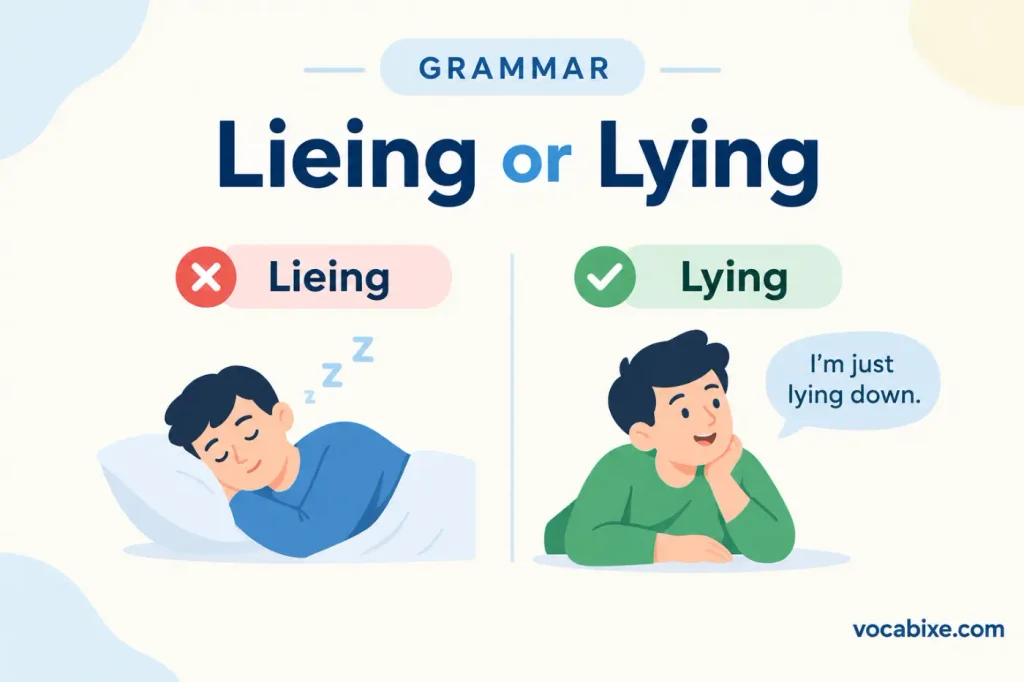
Many people search for lieing or lying because they are not sure how to spell this word. The correct spelling is lying, not lieing. This mistake happens because English spelling rules are tricky when a word ends in “ie” and you need to add “ing.”
If you have ever paused while writing and asked yourself, “Is it lieing or lying?”, you are not alone. This is one of the most common spelling questions in English. Once you learn the simple rule behind it, you will never make this mistake again.
In this article, you will learn the correct spelling, the meaning of the word, why people get confused, and how to use it correctly in real sentences.
Simple Answer in One Look
The correct spelling is lying. The spelling lieing is incorrect and is never used in proper English. This confusion happens because of a special spelling rule for words that end in “ie.” When you add “ing” to a word like “lie,” the “ie” changes to “y” before adding “ing.” That is why “lie” becomes “lying,” not “lieing.”
What Does Lying Mean?
Lying comes from the word “lie.” A lie is something you say that is not true. When someone is lying, they are saying something false on purpose.
For example, if a child says, “I did not eat the cookie,” but they really did, that child is lying.
Lying can also relate to a different word, “to lie down,” which means to rest your body in a flat position. In this case, “lying” means resting or being placed somewhere. For example, “The cat is lying on the bed.”
So the word lying has two meanings:
- Saying something untrue
- Resting your body in a flat position
Both meanings use the same spelling, lying, even though they come from two different base words, “lie” (not true) and “lie” (to rest).
What Is the Correct Spelling?
The correct spelling is lying.
The incorrect spelling lieing is a common mistake, but it is never correct in English.
Here are some examples showing the correct spelling in use:
- She is lying about her age.
- The dog is lying near the door.
- He got caught lying to his teacher.
- Stop lying to me.
You will never see lieing used correctly, because English spelling rules do not allow the “ie” to stay in place when adding “ing.” Related article guidance vs guidence.
.
Why Do People Get Confused?
People confuse lieing and lying for a few simple reasons:
- The base word is “lie,” so it feels natural to just add “ing” at the end.
- Many English words simply add “ing” without changing spelling, like “walk” becomes “walking.”
- The rule for words ending in “ie” is less common, so many people forget it.
- Fast typing and texting often lead to spelling mistakes.
- English learners are not always taught this specific rule early on.
This mix-up is very common, even among native English speakers. It is not a sign of poor grammar skills. It is simply a tricky spelling rule that trips up many writers.
Which One Should You Use?
Use lying every time you need the “ing” form of the word “lie.”
Remember this simple rule:
When a word ends in “ie,” change the “ie” to “y” before adding “ing.”
Examples of this same rule:
- Tie becomes tying
- Die becomes dying
- Vie becomes vying
This rule is not unique to “lie.” It applies to a small group of English words that end in “ie.” Once you learn the pattern, you can apply it to all similar words.
Easy Examples in Real Sentences
Here are simple, everyday examples using the word lying correctly:
- My brother is always lying about his homework.
- The baby was lying peacefully in the crib.
- I think she is lying, but I am not sure.
- Please stop lying to your parents.
- He was lying on the couch all afternoon.
- They caught him lying during the interview.
- The keys were lying on the kitchen table.
- She admitted she was lying the whole time.
These examples show both meanings of lying, saying something false and resting in a flat position. Notice how the spelling stays the same in both cases.
Common Mistakes to Avoid
Here are the most common mistakes people make with this word:
Incorrect: He is lieing to his boss. Correct: He is lying to his boss.
Incorrect: The papers were lieing on the desk. Correct: The papers were lying on the desk.
Incorrect: Stop lieing to me. Correct: Stop lying to me.
A simple way to avoid this mistake is to remember that the “ie” always changes to “y” before “ing.” If you find yourself typing “lieing,” stop and change the spelling to “lying” before you finish your sentence.
Where Does the Word Come From?
The word “lie,” meaning to say something untrue, comes from Old English “leogan.” The word “lie,” meaning to rest in a flat position, comes from a different Old English word, “licgan.” These two words developed separately, but over time, English speakers began spelling both forms the same way when adding “ing,” which is why lying works for both meanings today.
Understanding where this word comes from is not required to spell it correctly, but it explains why English can feel confusing sometimes. Two different old words ended up sharing the same modern spelling.
Now that you understand the basic spelling and meaning, let’s look deeper at how this word is used in real life, how it shows up in stories and conversations, and what related words can help you build a stronger vocabulary.
How Is This Word Used in Real Life?
Native English speakers use the word lying very often, both in speaking and writing. Here is how it appears in different situations:
In conversation, people use lying casually, such as “I know you’re lying” or “Why are you lying to me?”
In writing, lying appears in stories, news reports, and essays whenever someone needs to describe dishonesty or a resting position.
In texting, people often shorten sentences but still keep the correct spelling, such as “ur lying” instead of “you’re lying.”
At school, teachers may use lying when discussing honesty, character, or classroom behavior.
At work, lying can come up in serious situations, such as lying on a resume or lying to a manager.
On social media, people often use lying in comments or captions, such as “This photo isn’t real, someone is lying.”
In every one of these situations, the spelling stays the same: lying.
How Is This Word Understood in Culture and Stories?
The idea of lying appears often in books, movies, and everyday storytelling. Many children’s stories teach lessons about honesty and the problems that come from lying. A well-known example is the story of the boy who cried wolf, where a young shepherd lies about seeing a wolf so many times that no one believes him when a real wolf appears.
In movies and TV shows, characters who are lying often create tension or conflict in the story. Detectives, parents, and friends frequently try to figure out when someone is lying, which makes it a common theme in storytelling.
This shows that lying is not just a grammar topic. It is also an important idea in human behavior and relationships, which is part of why the word appears so often in daily conversation.
Related Words You Should Know
Learning related words can help you understand and use lying more naturally. Here are some helpful related words:
Lie: A false statement, or the act of resting flat.
Liar: A person who lies often or habitually.
Deceive: To make someone believe something false.
Dishonest: Not truthful or fair.
Fib: A small, often harmless lie.
Mislead: To guide someone toward a wrong belief.
Untrue: Not correct or factual.
Fabricate: To make up a false story or detail.
Truthful: The opposite of lying, meaning honest.
Recline: A word related to the resting meaning of lying, meaning to lean or lie back.
These words can help you describe honesty and dishonesty with more variety in your writing.
How to Use Lying Correctly
Here are simple guidelines for using lying correctly in everyday English:
Use lying as the “ing” form of “lie” whenever you talk about dishonesty. Example: “She is lying about her homework.”
Use lying as the “ing” form of “lie” whenever you talk about resting in a flat position. Example: “He was lying in bed all morning.”
Lying is appropriate in both formal and informal writing, since it is simply the correct grammatical form of the word.
In spoken English, lying is used constantly in daily conversations, especially when discussing trust, honesty, or relationships.
In written English, such as essays, reports, or stories, lying is used the same way, with no change in spelling based on formality.
There is no situation in standard English where lieing would be considered correct, formal or informal. Must view memento vs momento.
.
Real-Life Usage Examples
Here are more natural examples using lying in different situations:
- The witness was accused of lying in court.
- My phone was lying under a pile of clothes.
- Why do you keep lying about small things?
- The dog was lying quietly by the fireplace.
- I could tell from her face that she was lying.
- The letter had been lying unopened for weeks.
- He lost his job after lying on his application.
- The children were lying on the grass, watching clouds.
- She hates being accused of lying when she is telling the truth.
- The old photos were lying forgotten in a drawer.
These examples show how flexible and common the word lying is in everyday English, across many different situations.
Common Questions People Have
Many readers wonder about small details related to this word. Here are quick answers to common questions.
Is lieing ever correct? No, lieing is never correct in standard English.
Is lying used the same way in British and American English? Yes, the spelling and usage are the same in both.
Can lying describe more than just dishonesty? Yes, it can also describe resting in a flat position.
Is lying considered rude to say? No, the word itself is neutral. It simply describes an action.
Does lying have a negative meaning? Only when it refers to dishonesty. When it refers to resting, it has no negative meaning at all.
Final Teacher Explanation
Here is the one thing you should remember from this lesson. When a word ends in “ie,” you change the “ie” to “y” before adding “ing.” This is why “lie” becomes “lying,” not “lieing.” This same rule applies to other similar words like “tie” and “die.” Once you understand this pattern, spelling these words correctly becomes automatic.
Lying is a simple, everyday word, but the spelling rule behind it confuses many writers. Now that you know the rule, you can use lying with full confidence in any sentence, whether you are talking about honesty or simply resting.
Final Answer — Quick Recap
The correct spelling is lying, not lieing. This word can mean saying something false or resting in a flat position. The spelling rule is simple: change “ie” to “y” before adding “ing.”
Once you understand this small but important spelling pattern, you will never second-guess yourself again. Whether you are writing a text message, an email, or a school essay, you can use lying correctly every time.
This spelling rule is a great example of how English rewards pattern recognition. When you learn one rule, you can often apply it to several other words that follow the same pattern, which makes your writing stronger overall.
Conclusion
Understanding the difference between lieing and lying comes down to one simple spelling rule. Once you know that words ending in “ie” change to “y” before adding “ing,” the confusion disappears completely.
This small rule can make a big difference in how confident you feel about your writing. Whether you are describing someone being dishonest or something simply resting in place, lying is always the correct spelling to use.
Keep this rule in mind the next time you write, and you will never have to second-guess this word again.
FAQs
What does lying mean in simple English?
Lying means saying something that is not true, or it can mean resting in a flat position, depending on the sentence.
Is lieing or lying correct?
Lying is correct. Lieing is always incorrect in standard English.
How do I use lying in a sentence?
You can say, “She is lying about her age,” or “The book was lying on the table.”
Why do people confuse lieing and lying?
People confuse them because the spelling rule for words ending in “ie” is easy to forget when adding “ing.”
Is this spelling accepted in any form of English?
No, lieing is not accepted in any standard form of English, formal or informal.
Can I use lying in formal writing?
Yes, lying is appropriate in both formal and informal writing.
Is lying different in American and British English?
No, the spelling and meaning of lying are the same in both American and British English.
What other words follow this same spelling rule?
Words like tie, die, and vie follow the same rule, becoming tying, dying, and vying.
Pingback: Divet or Divot: Which Spelling Is Correct? - Vocabixe
Pingback: Society Synonym: 10+ Another Words for Society - Vocabixe
Pingback: Amateur vs Amatuer: Which Spelling Is Actually Correct 2026 - Vocabixe