Have you ever typed wether or weather or whether and stopped because you were not sure which spelling to use? You are not alone. These three words sound very similar, but they have different meanings and uses. One is about the sky, one is used when talking about choices or conditions, and one is a special word related to sheep.
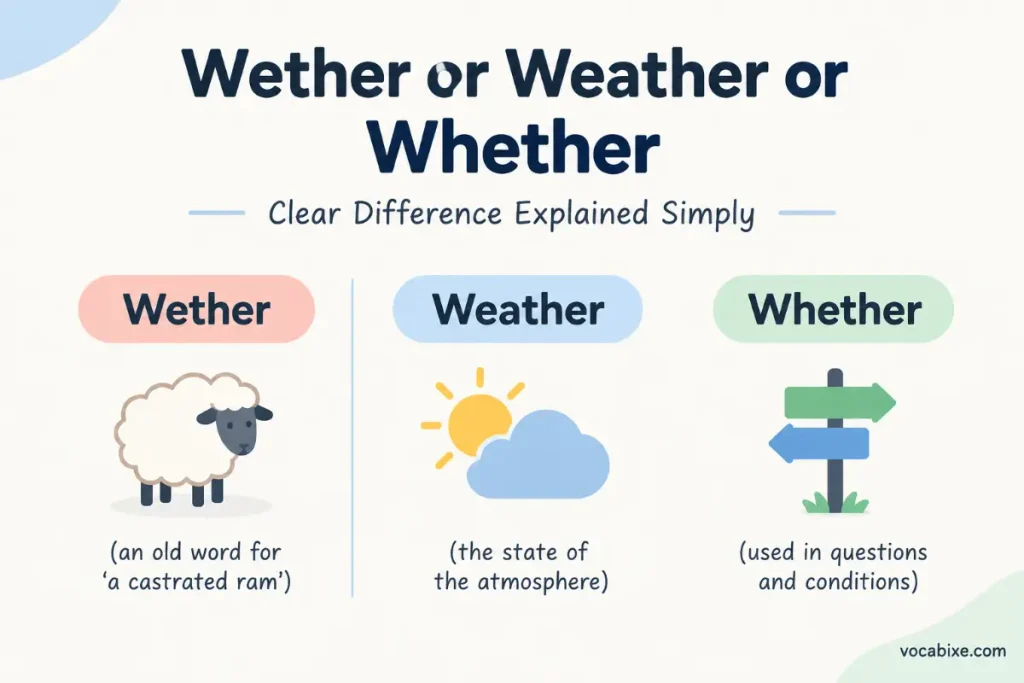
The correct word depends on what you want to say. Weather means the condition of the air outside. Whether is used when talking about two choices, possibilities, or conditions. Wether is a male sheep that has been castrated. It is a real English word, but you will not use it often in everyday conversation.
The easiest way to remember them is this: weather = sky and conditions, whether = choice or possibility, wether = a type of male sheep. Once you connect each spelling with its meaning, the difference becomes much easier.
Simple Answer in One Look
Here is the quick answer:
- Weather = the condition outside, such as rain, snow, heat, or wind.
- Whether = used when talking about a choice, possibility, or condition.
- Wether = a castrated male sheep.
So, if you are talking about rain or sunshine, use weather. If you are talking about a choice, use whether.
What This Means in Simple English
Think about three different situations. See more high-school-or-highschool.
First, imagine you look out your window. The sky is dark, and rain is falling. You might say:
“The weather is rainy today.”
Here, weather talks about what is happening outside.
Now imagine your friend asks if you will go to the park. You are not sure yet. You might say:
“I don’t know whether I will go.”
Here, whether shows that there is a possibility or choice.
Now imagine you are reading a book about farming. The book talks about a male sheep that has been castrated. It may call that animal a wether.
These words can sound almost the same when spoken. That is why people sometimes mix them up. But their meanings are very different.
A simple memory trick is:
Weather has “heat.”
The word weather contains the idea of outdoor conditions. Think of heat, rain, wind, and snow.
Whether has “choice.”
When you see whether, think about choosing between possibilities.
Wether has “sheep.”
You can connect this less common word with farming and sheep.
You do not need to memorize a long grammar rule. Just remember what each word means.
Why People Mix These Words
The biggest reason is sound.
In many forms of English, weather and whether are pronounced very similarly. In some accents, they sound exactly the same. This means you cannot always tell which word someone means just by hearing it.
For example, listen to this sentence:
“I don’t know whether it will rain because the weather keeps changing.”
The two words appear close together, but they have different jobs.
Whether talks about a possibility.
Weather talks about outdoor conditions.
This is called a homophone problem. In simple words, homophones are words that sound the same or almost the same but have different spellings and meanings.
English has many words like this.
For example:
- to, too, two
- there, their, they’re
- your, you’re
- hear, here
- right, write
The same kind of confusion can happen with weather and whether.
Wether is different because it is much less common. Many people only see it when reading about sheep, farming, agriculture, or animal science.
Another reason for the confusion is the letters.
Look closely:
- weather
- whether
- wether
All three have the same basic letters: W, E, T, H, E, R.
The difference is the extra a in weather and the placement of the letters in whether.
That small spelling difference changes the meaning completely.
Clear Difference Explained Simply
| Word | Simple Meaning | Example |
|---|---|---|
| Weather | Conditions outside | The weather is cold today. |
| Whether | A choice or possibility | I don’t know whether she will come. |
| Wether | A castrated male sheep | The farmer owns a wether. |
Here is another easy way to see it:
Weather → outside
Think about:
- rain
- snow
- sunshine
- wind
- heat
- cold
- storms
Whether → choice
Think about:
- if
- one possibility or another
- yes or no
- two possible situations
Wether → sheep
Think about:
- farming
- sheep
- livestock
- male sheep
If you remember those three ideas, you can usually choose the correct spelling.
Which Form Should You Use?
Use weather when you are talking about the conditions outside.
Examples:
“The weather is beautiful.”
“The weather is getting colder.”
“We had bad weather yesterday.”
Use whether when you are talking about a choice, possibility, or condition.
Examples:
“I don’t know whether he is coming.”
“She asked whether I needed help.”
“We will go whether it rains or not.”
Use wether only when you are talking about a specific kind of male sheep.
Example:
“The farmer bought a young wether.”
For most everyday writing, you will probably use weather and whether much more often than wether.
Easy Real-Life Sentences You Can Use
Here are some simple examples.
- “The weather is warm today.”
- “I checked the weather before leaving home.”
- “The weather may change tonight.”
- “I don’t know whether he is at home.”
- “She asked whether I wanted tea.”
- “We have to decide whether to stay.”
- “The farmer raised a wether.”
- “We will go whether it rains or not.”
Notice how the meaning tells you which spelling to choose.
If the sentence is about the sky, temperature, rain, or wind, think weather.
If the sentence is about a decision or possibility, think whether.
If the sentence is about a particular type of sheep, think wether.
Where These Words Come From: A Simple History
The three words have different histories.
Weather has very old roots in English and is connected to ideas about air, wind, storms, and conditions around us. Over time, its meaning developed into the word we use today for the condition of the atmosphere.
Whether also has a very old history. It comes from an old English word connected with the idea of choosing between possibilities. Its basic idea has stayed connected to alternatives and uncertainty.
Wether has an old farming history. It has been used for a castrated male sheep for many centuries.
This history explains why the words look related but have completely different meanings. English has developed over a very long time, and many words that look or sound similar do not have the same meaning.
How to Remember Wether or Weather or Whether
A small memory trick can help.
For weather, remember:
Weather → wind, water, and temperature.
For whether, remember:
Whether → choice.
For wether, remember:
Wether → sheep.
You can also use a question.
Ask yourself:
“Am I talking about what is happening outside?”
If yes, use weather.
Ask:
“Am I talking about a choice or possibility?”
If yes, use whether.
Ask:
“Am I talking about a male sheep?”
If yes, use wether.
This quick test works in most everyday situations.
Wether or Weather or Whether in Common Sentences
The difference becomes clearer when we place the words in normal sentences.
“The weather is terrible today.”
This tells us about outdoor conditions.
“I am not sure whether the store is open.”
This tells us about uncertainty.
“The farmer separated the wether from the other sheep.”
This tells us about an animal.
Now compare these:
“I don’t know whether we should leave because the weather is bad.”
This sentence uses both whether and weather correctly.
The first word is about a choice.
The second word is about outdoor conditions.
That is one of the best ways to understand the difference.
A Quick Test for the Correct Spelling
Try these sentences yourself. See more buoy-vs-bouy.
- “The ______ is sunny today.”
- “I don’t know ______ she will come.”
- “The farmer has a ______.”
- “Will the ______ improve tomorrow?”
- “We need to decide ______ to wait.”
The answers are:
- weather
- whether
- wether
- weather
- whether
If you got these right, you understand the basic difference.
The next step is learning how these words appear in real conversations, stories, and writing.
How This Word Is Understood in Culture and Stories
Weather has a strong place in everyday life and storytelling.
People often use weather to describe the mood of a place or scene.
A bright sunny day can make a story feel happy or peaceful.
Rain can make a scene feel quiet, sad, or serious.
A storm can make a story feel dangerous or exciting.
For example:
“Dark clouds covered the town as the storm moved closer.”
The weather helps the reader imagine the scene.
Weather is also a common topic in conversation. People may talk about a hot day, a cold morning, heavy rain, or a coming storm.
You might hear:
“Beautiful weather today.”
“It’s going to rain later.”
“Did you see the weather forecast?”
These are normal everyday uses.
Whether has a different role in stories and conversation. It often appears when a character has to make a decision.
For example:
“She could not decide whether to stay or leave.”
The word whether shows the two possible choices.
Wether does not have the same cultural role. It is mainly connected with farming and sheep.
Biblical and Mythological Meaning
There is no special biblical or mythological meaning that you need to learn for weather, whether, or wether.
However, weather appears often in religious and ancient stories because people have always depended on nature.
Stories may mention rain, storms, wind, drought, or sunshine. These natural events can help create the setting or explain what is happening.
The word wether, because it refers to a sheep, can sometimes appear in discussions of older farming practices or historical animal use.
But do not give these words a special religious meaning just because they may appear in religious or ancient texts.
Their everyday English meanings remain simple:
weather = outdoor conditions
whether = possibility or choice
wether = a type of male sheep
Symbolism Explained in Simple Words
Words can sometimes suggest ideas beyond their dictionary meanings.
What Weather Represents
Weather can represent change.
A sunny day can suggest happiness or peace.
Rain can suggest sadness, calmness, or renewal.
A storm can suggest trouble or conflict.
This does not mean weather always has one fixed meaning. A writer chooses how to use it.
For example, rain may be sad in one story but joyful in another.
Weather can also represent something we cannot control. People can prepare for weather, but they cannot simply command the rain to stop.
What Whether Represents
Whether often represents uncertainty.
When someone says:
“I don’t know whether I should go.”
The person has not made a final decision.
The word can therefore connect with ideas such as:
- choice
- doubt
- possibility
- uncertainty
- alternatives
It helps show that more than one outcome is possible.
What Wether Represents
Wether has a much more specific meaning.
It represents a particular animal used in farming.
There is no common emotional symbolism attached to the word itself. If a writer uses a wether in a story, the meaning usually comes from the situation around the sheep.
Related Words You Should Know
Learning a few related words can make the difference easier.
Climate
Climate means the usual weather conditions of a place over a long period.
Example:
“The climate in this region is dry.”
Weather can change from day to day. Climate describes a longer pattern.
Forecast
A forecast is a prediction about future weather.
Example:
“The weather forecast says it will rain tomorrow.”
Storm
A storm is a period of strong or dangerous weather.
Example:
“The storm damaged several trees.”
Rain
Rain is water that falls from clouds.
Example:
“We stayed inside because of the rain.”
Whether or Not
Whether or not means that the result is true in either situation.
Example:
“We will play whether or not it rains.”
If
If introduces a possible condition.
Example:
“If it rains, we will stay home.”
In many sentences, if and whether can look similar, but they are not always interchangeable.
Choice
A choice is something you decide between.
Example:
“You have a choice between tea and coffee.”
This idea can help you remember whether.
Sheep
A sheep is a farm animal raised for wool, meat, and other uses.
A wether is a specific kind of male sheep.
How People Actually Use It in Daily English
Let’s look at natural examples.
Example 1: Talking About the Sky
“The weather looks nice today.”
This is a very common sentence.
You are talking about outdoor conditions.
Example 2: Planning a Trip
“Let’s check the weather before we leave.”
Again, weather is correct because you are checking outdoor conditions.
Example 3: Making a Choice
“I don’t know whether I should call him.”
Here, whether is correct because the speaker is thinking about a choice.
Example 4: Asking About a Decision
“She asked whether I wanted to come.”
The person is asking about a possible choice.
Example 5: Two Possible Results
“We don’t know whether the team will win.”
There are two possible results: the team may win, or it may not.
Example 6: Weather and Choice Together
“We need to decide whether to go because the weather is getting worse.”
This sentence is useful because both words appear together.
Whether relates to the decision.
Weather relates to outdoor conditions.
Example 7: Farming
“The farmer bought a wether for the flock.”
This is a specialized use.
You are talking about sheep, so wether is correct.
Example 8: Everyday Conversation
“Do you know whether the restaurant is open?”
This is a normal way to ask about a possibility.
Example 9: Weather Forecast
“The weather forecast says snow is coming.”
The word weather is connected to the forecast.
Example 10: A Final Decision
“I will go whether you come or not.”
Here, whether shows that the speaker’s decision will stay the same.
Common Mistakes People Make
One common mistake is using weather when the sentence is about a choice. See more repore-or-rapport.
Incorrect:
“I don’t know weather she will come.”
Correct:
“I don’t know whether she will come.”
Why?
Because the sentence is about a possibility, not outdoor conditions.
Another common mistake is using whether when talking about rain or sunshine.
Incorrect:
“The whether is cold today.”
Correct:
“The weather is cold today.”
Why?
Because the sentence is about outdoor conditions.
A third mistake is using wether as a general spelling for weather.
Incorrect:
“The wether is beautiful today.”
Correct:
“The weather is beautiful today.”
Wether is not the normal spelling for outdoor conditions.
It has a completely different meaning.
Another mistake is thinking that wether is simply an old or unusual spelling of weather.
It is not.
It is a separate English word.
Weather vs. Whether: The Most Important Difference
The easiest difference is this:
Weather is a thing you experience outside.
You can see, feel, or observe the weather.
You can experience:
- rain
- heat
- cold
- snow
- wind
- storms
Whether is a word you use when thinking about possibilities.
You might wonder:
- whether to go
- whether to stay
- whether he will come
- whether she knows
- whether it is true
This simple contrast will solve most spelling questions.
Wether vs. Weather: Why the A Matters
Look at the spelling:
weather
It contains an a after the first few letters.
wether
It does not.
That small letter creates a completely different word.
Compare:
“The weather is cold.”
“The farmer has a wether.”
The first sentence is about outdoor conditions.
The second is about an animal.
This is a good reminder that one letter can change the meaning of an English word.
English spelling often works this way.
Words that look almost identical may have completely different meanings.
Whether vs. If
Students often ask whether whether and if mean the same thing.
Sometimes they can be used in similar sentences.
For example:
“I don’t know whether he will come.”
“I don’t know if he will come.”
Both sentences can express uncertainty.
But whether is especially useful when there are two possibilities.
For example:
“She must decide whether to stay or leave.”
The two choices are clear:
stay or leave.
You should not simply replace every use of whether with if. The words have different uses in some sentence patterns.
For basic writing, remember that whether often appears when you are talking about choices or possible outcomes.
Common Expressions With Whether
You will often see whether in certain sentence patterns.
Whether or Not
Example:
“I will go whether or not you come.”
This means the speaker will go in either situation.
Whether to
Example:
“I don’t know whether to laugh or cry.”
The speaker is choosing between two actions.
Whether…or
Example:
“We must decide whether to walk or drive.”
There are two choices.
Whether or Whether Not
Example:
“She wondered whether he knew.”
This simply shows uncertainty.
Learning these common patterns can help you recognize whether quickly.
Common Expressions With Weather
Weather also appears in many everyday phrases.
Bad Weather
“Bad weather delayed the flight.”
Good Weather
“We had good weather during our vacation.”
Cold Weather
“Cold weather can be hard on plants.”
Hot Weather
“I drink more water in hot weather.”
Weather Forecast
“Check the weather forecast before you leave.”
Weather Conditions
“The weather conditions are dangerous.”
Weather Report
“I watched the weather report this morning.”
These expressions all use weather because they relate to outdoor conditions.
Why Spelling Matters
You may think that spelling is a small issue. But spelling can change the meaning of a sentence.
Consider:
“I don’t know weather he will come.”
A reader can probably understand what you mean. However, the correct word is whether.
Good spelling helps your writing look clear and professional.
This matters in:
- school assignments
- emails
- job applications
- websites
- social media
- business writing
- messages
You do not need perfect spelling all the time. But learning common confusing words can make your writing much stronger.
A Simple Memory Story
Imagine three friends.
The first friend loves looking at the sky. His name is Weather.
He talks about:
“Rain!”
“Snow!”
“Sunshine!”
“Wind!”
The second friend is always making decisions. Her name is Whether.
She says:
“I don’t know whether I should go.”
“I need to decide whether to stay.”
The third friend lives on a farm. His name is Wether.
He takes care of sheep.
This little story gives each spelling a separate picture.
Weather = sky
Whether = choice
Wether = sheep
When you see the words, picture the right situation.
Final Teacher Explanation
If I were explaining this on a classroom board, I would write three words:
WEATHER
WHETHER
WETHER
Then I would draw three simple pictures.
For weather, I would draw a cloud, sun, and rain.
For whether, I would draw two doors with a person choosing one.
For wether, I would draw a sheep.
That is enough to understand the main difference.
You do not need a complicated rule.
If you are talking about rain, snow, wind, sunshine, temperature, or conditions outside, write weather.
If you are talking about a choice, possibility, or uncertainty, write whether.
If you are talking about a castrated male sheep, write wether.
The most useful two words to remember are weather and whether because they appear much more often in everyday English.
When you hear them, do not depend only on the sound. Think about the meaning of the sentence.
Ask yourself:
“Is this about the sky?”
If yes, choose weather.
“Is this about a choice?”
If yes, choose whether.
“Is this about a sheep?”
If yes, choose wether.
That simple method will help you choose the correct word.
Final Answer: Wether or Weather or Whether?
The three words are all real English words, but they have different meanings.
Weather means conditions outside. Whether is used for choices, possibilities, and uncertainty. Wether means a castrated male sheep.
Remember: weather = outside, whether = choice, wether = sheep.
The next time you wonder about wether or weather or whether, stop and think about the meaning first. The correct spelling will usually become clear.
The main lesson is simple: do not choose the word only because it sounds right. Choose it because its meaning fits your sentence. This is one of the easiest ways to improve your English spelling.
Frequently Asked Questions (FAQs)
What is the difference between weather and whether?
Weather means the conditions outside. Whether is used when talking about a choice, possibility, or uncertainty.
Is wether a correct English word?
Yes. Wether is a real English word. It means a castrated male sheep, but it is not commonly used in everyday conversation.
Is it correct to say “I don’t know weather”?
No. When you mean a choice or possibility, use whether: “I don’t know whether he will come.”
When should I use weather?
Use weather when talking about rain, snow, sunshine, wind, temperature, storms, or other outdoor conditions.
When should I use whether?
Use whether when talking about a choice, possibility, or uncertain result. For example: “I don’t know whether she will come.”
Why do people confuse weather and whether?
They are pronounced very similarly in many forms of English. Their similar sounds can make their different spellings easy to mix up.
Can weather and whether be used in the same sentence?
Yes. For example: “I don’t know whether we should leave because the weather is getting worse.”
How can I remember the difference?
Use this simple trick: weather = outside, whether = choice, wether = sheep.
Pingback: Pieces vs Peices: Which Spelling Is Correct? - Vocabixe
Pingback: Frescade Meaning: Complete Definition, Origin, and Usage Guide - Vocabixe
Pingback: Stich vs Stitch Difference: Easy Guide 2026 - Vocabixe