Have you ever typed stich when you meant stitch? If so, you are not alone. The stich vs stitch difference can be confusing because the two words look almost the same. However, they do not normally mean the same thing.
If you are talking about sewing, clothing, knitting, a wound, or a sharp pain in your side, the correct word is usually stitch. The spelling stich is a real English word, but it is rare and has different meanings. It can refer to a line or verse of poetry, or a special trick in some card games.
So, if you want to say, “I need to stitch this shirt,” use stitch. If you are writing about a line of poetry in a special literary context, stich may be the word you need. This simple difference will help you choose the right spelling.
Simple Answer in One Look
Stitch is the usual word for sewing, repairing, knitting, medical stitches, and a sharp pain in your side.
Stich is a rare word that can mean a line of poetry or a special card-game trick. It is not the normal spelling of the sewing word.
What This Means in Simple English
Think about a needle and thread.
You put the needle through a piece of cloth. You pull the thread through. That small piece of sewing is called a stitch.
For example:
- I made one stitch.
- She stitched the button onto her shirt.
- The dress has neat stitches.
- My grandmother taught me how to stitch.
- The doctor used stitches to close the cut.
In all of these examples, stitch is the correct word.
Now look at stich.
It is not the normal spelling used for sewing. In English dictionaries, stich has other, much less common meanings. One meaning is a line or verse of poetry. Another meaning is a trick in certain card games.
This is why the two words should not simply be treated as two spellings of the same word.
For most everyday writing, especially when you are talking about clothes or sewing, remember:
Sewing = stitch
That one rule will solve most spelling problems.
Why People Mix These Words
There are several simple reasons people confuse stich and stitch.
The first reason is that they look almost identical.
Compare them:
stich
stitch
The only difference is the extra t in stitch.
When people type quickly, they may leave out that extra letter. This happens often with words that contain repeated or closely placed letters.
The second reason is pronunciation.
In normal English, stitch is pronounced with the ending sound /tʃ/. Cambridge and Merriam-Webster both give the common pronunciation as /stɪtʃ/.
The word stich, however, has a different pronunciation when it is used as the rare English noun. Merriam-Webster gives it as /stɪk/.
That means the words are not only different in spelling. They can also sound different.
The third reason is that many people learn the word through speech first.
Imagine someone says:
“I need to stitch this shirt.”
If you have never seen the word written down, you may guess the spelling from the sound. English spelling can be tricky, so a learner might write “stich.”
The fourth reason is simple typing error.
People often make small mistakes such as:
- stich instead of stitch
- wich instead of which
- becuase instead of because
- recieve instead of receive
A missing letter does not always mean the writer does not know the word. Sometimes it is simply a typing mistake.
Clear Stich vs Stitch Difference Explained Simply
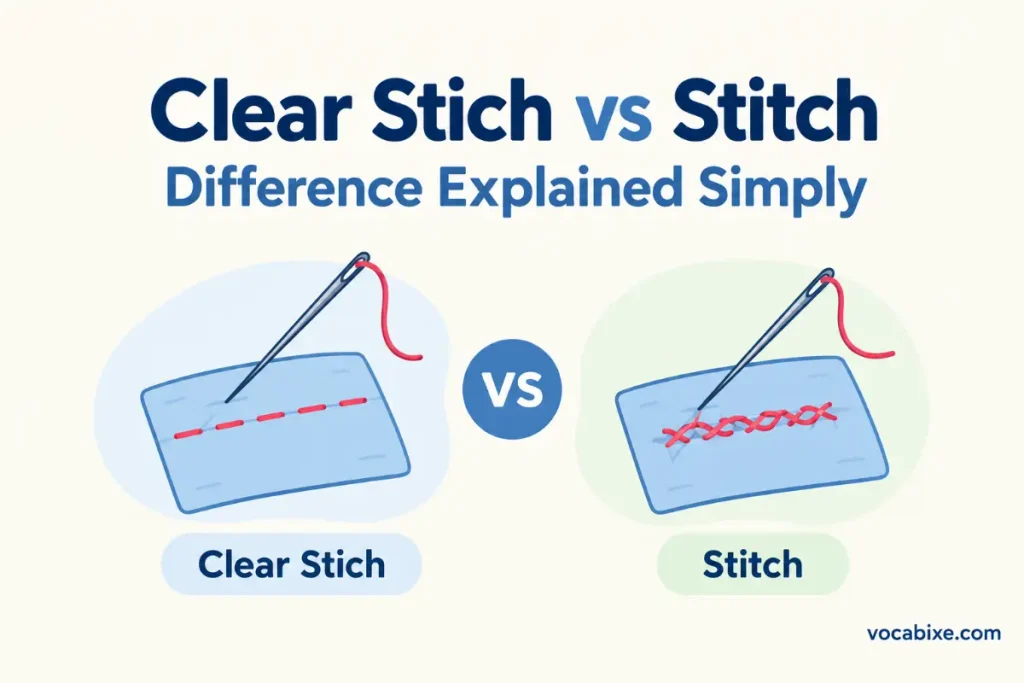
Here is the easiest comparison:
| Word | Main meaning | Common use |
|---|---|---|
| stitch | A piece or movement of sewing | Clothes, fabric, knitting |
| stitch | To sew something | Sewing and repairing |
| stitch | A medical thread used to close a wound | Healthcare |
| stitch | A sharp pain in your side | Running or exercise |
| stich | A line or verse of poetry | Rare literary use |
| stich | A special trick in some card games | Rare use |
The important point is that stitch is a common everyday English word. Stich exists, but its uses are much less common.
For most readers, the difference can be remembered this way:
Stitch = sewing
Stich = rare literary or card-game word
If you are writing about a shirt, needle, thread, wound, or running pain, choose stitch.
Which Form Should You Use?
Use stitch in normal everyday English when you mean sewing or anything connected with the common meanings of the word.
For example:
- Stitch the hole in my jeans.
- She made a beautiful stitch.
- The doctor put three stitches in the cut.
- I got a stitch while running.
- The blanket has hundreds of stitches.
Use stich only when the context clearly calls for the rare word.
For example, a person studying poetry may encounter stich as a term for a line or verse. A person studying certain card games may also see the word.
So, if you are unsure and you mean sewing, do not choose stich.
Choose stitch.
Easy Real-Life Sentences You Can Use
Here are some simple examples with stitch:
- I need to stitch this hole in my shirt.
- She used a needle to make a small stitch.
- My mother can stitch clothes very well.
- The doctor gave me three stitches.
- I got a stitch in my side while running.
- She stitched the button back onto her coat.
- This sweater has a beautiful stitch pattern.
- I learned how to stitch when I was young.
These are normal uses of stitch. Dictionaries define stitch as a piece of thread or a movement of a needle through material, and the verb means to sew or repair something with stitches.
Where This Word Comes From
The history of stitch is surprisingly old.
The word comes from Old English stice, which referred to a puncture, stab, or similar sharp action. The word is related to the idea behind “stick.” Later, its meaning developed into the sewing sense we know today. Merriam-Webster traces stitch through Middle English stiche to Old English stice.
The sewing meaning developed in Middle English. Over time, the word became connected with the movement of a threaded needle going in and out of fabric.
This history helps explain something interesting.
A stitch is made when a needle passes through material. The action is similar to a small prick or puncture. That old idea helped shape the modern word.
The rare word stich has a different history. Its literary meaning comes from Greek stichos, meaning a row, line, or verse. Its card-game meaning has a different German origin.
So the two words may look like close spelling relatives, but their histories are not the same.
Why the Extra “T” Matters
One small letter can change a word.
Look at:
stich
and
stitch
The extra t is not just decoration. It belongs to the spelling of the common word.
Think of it like a label.
If you write stitch, your reader knows you mean sewing, a medical stitch, or another common meaning of stitch.
If you write stich, your reader may think you mean the rare word, or they may assume you made a spelling mistake.
This is why correct spelling matters even when the difference looks very small.
Is Stich Always Wrong?
No.
This is an important part of the stich vs stitch difference.
It would be wrong to say that “stich” is never a word.
Stich is a real English word.
Merriam-Webster lists it as a noun meaning a measured part of something written, especially a line or verse. It also lists another noun meaning a special trick in certain card games.
However, these uses are uncommon in everyday English.
So if someone writes:
“I need to stich my pants.”
They probably mean:
“I need to stitch my pants.”
But if a literature book uses “stich” to discuss a line of poetry, the spelling may be correct.
The meaning depends on the context.
What Is a Stitch?
A stitch can be one small movement made with a needle and thread.
For example, imagine you are sewing two pieces of cloth together. You push the needle through the cloth and pull the thread through. That creates a stitch.
The word can also refer to the thread or finished part created by that action.
Stitch is also used in knitting and crochet. A stitch can be a small loop of yarn made with a needle or hook.
The word is also used in medicine.
If someone has a deep cut, a doctor may close the wound with stitches. In this case, stitch refers to the thread or medical fastening used to close the wound.
There is another everyday meaning.
When you run or exercise, you may sometimes feel a sharp pain in your side. English speakers can call this a stitch.
So one common word can have several meanings.
What Is a Stich?
A stich is a rare English word.
One meaning is a line or verse of poetry. This use comes from the Greek word stichos, which means a row, line, or verse.
Another meaning relates to card games. In some games, a stich can refer to a special trick that has scoring value, especially a final trick.
This is not the word you normally want when talking about sewing.
That is the key point.
If your sentence is about a needle and thread, you almost certainly need stitch. More words like high-school-or-highschool
.
The Most Common Confusion
One of the most common mistakes is writing:
“Can you stich this shirt?”
The correct sentence is:
“Can you stitch this shirt?”
Another common mistake is:
“She learned how to stich.”
Correct:
“She learned how to stitch.”
And:
“The doctor put five stichs in the wound.”
Correct:
“The doctor put five stitches in the wound.”
Notice another small detail here.
The plural of stitch is stitches, not “stichs.”
That extra t stays in the word.
Stich vs Stitch Difference in Writing
When you are writing an email, school assignment, blog post, social media post, or everyday message, use stitch when you mean sewing.
For example:
“Please stitch the torn part of the dress.”
That sentence is clear.
Writing:
“Please stich the torn part of the dress.”
will normally look like a spelling error.
The rare word stich should only appear when you actually mean its special literary or card-game meaning.
This is a good example of why spelling and meaning work together.
A Quick Memory Trick
Here is an easy trick for remembering the spelling.
Think:
Thread needs two Ts: stitch.
The extra t can remind you that you are talking about the common sewing word.
You can also connect the word with:
needle → thread → stitch
If you see a needle and thread in your mind, think stitch.
This little memory trick can help students remember the spelling without trying to memorize a complicated rule.
Transition: From Spelling to Meaning
Now that the spelling is clear, there is one more useful step. The word stitch is much richer than it first appears. People use it for sewing, medicine, exercise, clothing, knitting, and even laughter. Understanding these uses will help you recognize the word naturally when you read or hear it.
How This Word Is Understood in Culture and Stories
The word stitch often carries the simple idea of joining things together.
When two pieces of cloth are separate, stitches can connect them.
That makes the word easy to understand in stories.
A character may stitch a torn shirt.
A parent may stitch a child’s costume.
A person may stitch a blanket for someone they love.
A doctor may stitch a wound.
Because of these uses, stitch can sometimes suggest repair, care, patience, or bringing separate pieces together. This is a simple cultural idea rather than a special dictionary meaning.
Sewing has also appeared in stories, movies, family traditions, and crafts for a very long time. People often connect handmade stitching with care because someone has taken time to make or repair something.
But remember that the basic dictionary meaning is still simple: a stitch is connected with sewing, thread, or a related action.
The rare word stich has a different cultural connection. Because it can refer to a line of poetry, it belongs more naturally to literary discussions. It may appear when someone is talking about the structure of a poem or verse.
So the cultural feeling of the two words is very different.
Stitch connects naturally with making, fixing, sewing, and joining.
Stich connects with rare literary or card-game language.
Biblical and Mythological Meaning
There is no special biblical or mythological meaning that you need to learn for the basic difference between stich and stitch.
The Bible may contain references to clothing, sewing, thread, garments, or related objects, but that does not give the modern word stitch a special biblical definition.
The same is true for mythology.
You do not need a mythological story to understand the difference between these two spellings.
For ordinary English learning, the useful point is much simpler:
Stitch is the common word connected with sewing and several related meanings.
Stich is a rare word with separate meanings.
The history of stitch reaches back to Old English, while the literary word stich comes from Greek stichos.
Symbolism Explained in Simple Words
Words can sometimes suggest ideas beyond their basic dictionary meanings.
What One Version Represents
The common word stitch can naturally suggest connection and repair.
Imagine a torn piece of cloth.
Before sewing, there is a gap.
After several stitches, the pieces are joined.
That is why people may use stitching as a simple image for fixing something or bringing things together.
For example:
“Every small stitch helped repair the blanket.”
The literal meaning is about sewing, but a story could also use the idea of stitching to show patience and care.
Again, this is a symbolic idea. It is not a separate dictionary definition.
What the Other Version Represents
The rare word stich has a different connection.
Because it can mean a line or verse of poetry, it can represent a small part of a larger written work.
A poem has lines.
A group of lines can create a larger piece of writing.
So, in a literary setting, stich is connected with written verse and structure.
This gives us a simple contrast:
Stitch → joining or repairing
Stich → a line or verse in a rare literary use
The two words look close, but their meanings can take you in very different directions.
Related Words You Should Know
Sew
To sew means to join or repair material with a needle and thread.
Example: “My aunt can sew very well.”
Sewing
Sewing is the activity of joining material with thread.
Example: “Sewing is one of her favorite hobbies.”
Stitched
Stitched is the past form of stitch.
Example: “She stitched the hole yesterday.”
Stitching
Stitching refers to the act or process of making stitches.
Example: “The stitching on this jacket is neat.”
Stitches
Stitches is the plural form of stitch.
Example: “The doctor gave him five stitches.”
Thread
Thread is the thin material that is pulled through cloth with a needle.
Example: “I need some blue thread.”
Needle
A needle is a thin tool with a sharp end and a hole for thread.
Example: “Be careful with the needle.”
Embroidery
Embroidery is decorative sewing done on fabric.
Example: “The shirt has beautiful embroidery.”
Knitting
Knitting uses yarn and needles to create fabric.
A stitch can also mean a small loop made during knitting.
Crochet
Crochet uses a hook to create loops of yarn.
The word stitch is also used for different crochet patterns.
Suture
Suture is a more formal medical term connected with closing a wound. In everyday speech, people often simply say stitches.
How People Actually Use It in Daily English
The word stitch appears in many everyday situations.
Talking About Clothes
You might say:
“I need to stitch this pocket back onto my shirt.”
Here, stitch means to sew.
Talking About a Torn Shirt
You might say:
“There is a small tear in my jacket. I can stitch it.”
Again, stitch means repair with thread.
Talking About a Button
You might say:
“Can you stitch this button back on?”
This is a very natural everyday sentence.
Talking About a Medical Wound
You might say:
“He needed stitches after the accident.”
Here, stitches are used to close a wound.
Talking About Running
You might say:
“I had to stop because I got a stitch in my side.”
Here, stitch means a sharp pain, often associated with exercise.
Talking About Knitting
You might say:
“I dropped a stitch while knitting.”
Here, stitch refers to a loop in the knitted work. See more words like buoy-vs-bouy
.
Talking About a Funny Show
You may hear:
“That movie had us in stitches.”
This is an idiom. It means the people were laughing a lot. Oxford gives “in stitches” as an informal expression for laughing a lot.
Talking About Clothing
You may also hear:
“He wasn’t wearing a stitch.”
This means he was wearing no clothes. This is an informal expression, especially found in British English.
Talking About a Saying
You may know the saying:
“A stitch in time saves nine.”
The basic idea is simple: fixing a small problem early can prevent a much bigger problem later.
This is one reason the word stitch is familiar even to people who do not sew.
Common Mistakes People Make
Mistake 1: Writing “stich” for sewing
Wrong:
“I can stich this dress.”
Correct:
“I can stitch this dress.”
The common sewing word needs the extra t.
Mistake 2: Writing “stiching”
Wrong:
“The stiching looks good.”
Correct:
“The stitching looks good.”
The base word is stitch, so the form is stitching.
Mistake 3: Writing “stichs”
Wrong:
“The doctor put three stichs in his hand.”
Correct:
“The doctor put three stitches in his hand.”
Mistake 4: Thinking stich is never a word
This is also a mistake.
Stich is a real English word. It has rare meanings connected with poetry and card games.
So the best explanation is not:
“Stich is always wrong.”
The better explanation is:
“Stitch is the correct common word for sewing. Stich is a different and uncommon word.”
Mistake 5: Assuming similar spelling means similar meaning
English has many words that look similar but have different meanings.
The same idea applies here.
A small spelling change can create a completely different word.
How to Choose the Right Word Every Time
Ask yourself one simple question:
Am I talking about sewing, thread, clothing, a wound, knitting, or a sharp pain while running?
If the answer is yes, you probably need stitch.
For example:
- sewing a shirt → stitch
- repairing jeans → stitch
- closing a wound → stitch
- knitting → stitch
- crochet → stitch
- pain while running → stitch
Now ask a different question:
Am I talking about a line of poetry or a special card-game term?
If yes, stich may be the correct word.
This simple check is better than memorizing a long rule.
Stich vs Stitch Difference in School Writing
Students often worry about small spelling differences.
That is normal.
When writing a school assignment, always think about the meaning first.
Suppose your assignment says:
“Explain how the character repaired her dress.”
You could write:
“She stitched the torn part of the dress.”
That is correct.
Writing “stich” would usually be a spelling error in this context.
Now imagine your English teacher gives you a lesson about rare literary terms.
If the lesson defines stich as a line or verse, then you should follow that meaning.
The context tells you which word you need.
Stich vs Stitch Difference in Search Queries
People often search for:
- stich vs stitch
- stich or stitch
- stich vs stitch difference
- is stich a word
- is stitch correct
- which is correct stich or stitch
- how to spell stitch
- stich spelling mistake
- stitch meaning
- stich meaning
These searches usually come from one basic problem: the writer is unsure about the extra t.
The fastest answer is this:
If you mean sewing, use stitch.
If you mean the rare literary or card-game word, stich may be correct.
This distinction gives a better answer than simply calling stich a typo.
Is Stitch a Verb or a Noun?
Stitch can be both.
As a noun:
“I made a stitch in the fabric.”
Here, stitch names a thing.
As a verb:
“I will stitch the fabric.”
Here, stitch describes an action.
It can also appear in other forms:
- stitch
- stitches
- stitched
- stitching
Examples:
“She stitches clothes.”
and
“She stitched the dress.”
and
“She is stitching the fabric.”
“The dress has neat stitches.”
The basic word stays easy to recognize.
Is Stich a Verb?
The rare word stich is mainly listed as a noun in major dictionary entries for its literary and card-game meanings.
That is another reason not to use it when you mean the everyday verb stitch.
If you want to say someone is sewing, write:
“She is stitching.”
Not:
“She is stiching.”
Pronunciation Difference
Pronunciation can also help you remember the difference.
The common word stitch is pronounced /stɪtʃ/.
The rare English noun stich is pronounced /stɪk/.
Notice the ending.
Stitch ends with a “ch” sound.
Stich, in its rare English uses, ends with a “k” sound.
This is useful because the words are not simply two spellings with the same pronunciation.
If you hear someone talking about sewing and the word sounds like “stitch,” the spelling you need is stitch.
A Simple Classroom Test
Imagine these sentences.
1. I need to ___ my shirt.
Answer: stitch
2. The doctor gave me five ___.
Answer: stitches
3. She learned how to ___ a dress.
Answer: stitch
4. I got a ___ while running.
Answer: stitch
5. The poem was discussed in terms of each ___.
Answer: stich, if the writer is using the rare literary term.
This test shows why meaning matters.
A Quick Difference Chart
| Question | Stitch | Stich |
|---|---|---|
| Is it a common English word? | Yes | No, it is uncommon |
| Used for sewing? | Yes | No |
| Used for clothing repair? | Yes | No |
| Used for medical stitches? | Yes | No |
| Used for a running pain? | Yes | No |
| Can it relate to knitting? | Yes | No |
| Can it mean a line of poetry? | No | Yes |
| Can it be a card-game term? | No | Yes |
| Common in everyday writing? | Yes | Rare |
This is the simplest way to understand the stich vs stitch difference.
Final Teacher Explanation
If I were explaining this to a class, I would write two words on the board:
STICH
STITCH
Then I would ask:
“Which one do we normally use when we talk about sewing?”
The answer is:
STITCH.
If you are talking about a needle, thread, clothing, knitting, a wound, or a sharp pain in your side, use stitch. Dictionaries list these as common meanings of the word.
Then I would explain that stich is not simply a bad spelling in every situation.
It is a real but uncommon English word. It can mean a line or verse, especially in poetry, and it can also refer to a special trick in certain card games.
So remember this:
Stitch is the everyday word.
Stich is a rare word with different meanings.
If you are writing about sewing, choose stitch.
That one simple rule will prevent most mistakes.
Final Answer: Quick Recap
The correct word for sewing, clothing repair, knitting, medical stitches, and a sharp pain in your side is stitch.
Stich is also a real English word, but it is rare and has different meanings, such as a line of poetry or a card-game trick.
So if you are asking, “Which spelling should I use for sewing?” the answer is clear:
Use stitch.
Conclusion
The stich vs stitch difference becomes easy once you focus on meaning. Stitch is the common word you use for sewing, thread, clothing, wounds, knitting, and certain other everyday meanings. Stich is a separate and uncommon word used mainly in special literary or card-game contexts.
The best memory trick is simple: when you think of a needle and thread, think of stitch with the extra t. If you see stich, check the context before assuming it is a mistake. This small habit can help you become a more careful and confident English writer.
Frequently Asked Questions
What is the difference between stich and stitch?
Stitch is the common word for sewing, medical stitches, knitting, and a sharp pain in your side. Stich is a rare word connected with poetry or certain card games.
Is stich a correct word?
Yes. Stich is a real English word, but it is uncommon. It can mean a line or verse of poetry or a special trick in some card games.
Is stitch the correct spelling for sewing?
Yes. If you mean sewing fabric with a needle and thread, the correct spelling is stitch.
Should I write stich or stitch?
For normal everyday English, especially when talking about sewing, write stitch.
Why do people spell stitch as stich?
The words look very similar, and people may accidentally leave out the second t when typing or spelling the word from memory.
Is stich a misspelling of stitch?
Sometimes it is a spelling mistake, especially when someone means sewing. However, stich is also a real but rare English word with separate meanings.
How do you spell the word for sewing?
The correct spelling is stitch.
What does stitch mean in simple English?
A stitch is a small piece or movement of thread used in sewing. The word can also mean a medical thread used to close a wound or a sharp pain in your side.
What is the plural of stitch?
The plural is stitches.
What is the past tense of stitch?
The past tense is stitched.
What is the -ing form of stitch?
The -ing form is stitching.
Does stitch have more than one meaning?
Yes. It can relate to sewing, knitting, wounds, exercise pain, clothing, and informal expressions such as “in stitches,” meaning laughing a lot.
Pingback: Frescade Meaning: Complete Definition 2026 - Vocabixe
Pingback: Pieces vs Peices: Correct Spelling 2026 - Vocabixe