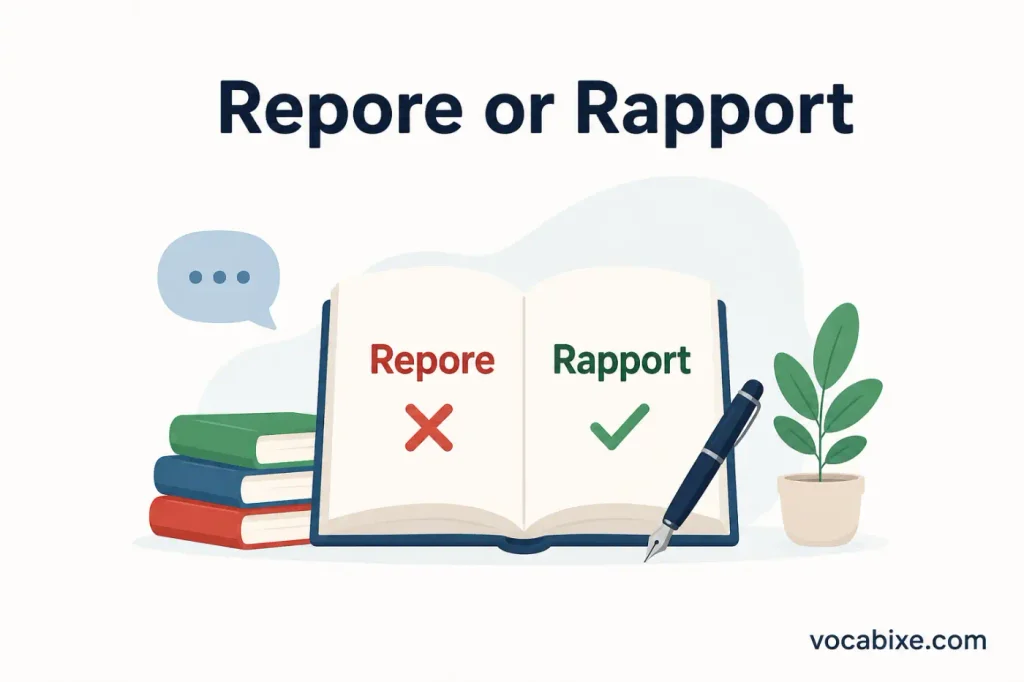
Have you ever wondered whether repore or rapport is the correct spelling? You are not alone. Many people get confused because the word sounds different from how it looks when written. If you mean a friendly, comfortable, or positive relationship between people, the correct spelling is rapport. The spelling repore is a common mistake, not the standard English form. For example, a teacher may have good rapport with students when they feel comfortable talking, asking questions, and sharing ideas. Knowing the correct spelling can help you write clearly in school, work, emails, and everyday English.
In this guide, you will learn everything you need to know about repore or rapport in simple English. We will explain the meaning of rapport, why people often spell it as “repore,” how to use it in real sentences, and the difference between similar words such as relationship, trust, and connection. By the end, you will know exactly which spelling to use and how to remember rapport easily.
Simple Answer in One Look
Rapport is the correct spelling.
Repore is a common spelling mistake.
Correct: rapport
Incorrect: repore
Rapport means a friendly and comfortable relationship between people.
Example:
The teacher has a good rapport with her students.
What This Means in Simple English
The word rapport describes a good connection between people.
Think about a teacher and a student.
If the student feels safe talking to the teacher, and the teacher understands the student, they may have good rapport.
Now think about two friends.
They can talk easily, laugh together, understand each other, feel comfortable around each other.
That is also rapport.
So, in simple English:
Rapport is a good relationship where people understand and feel comfortable with each other.
It does not simply mean that two people know each other.
You can know someone without having rapport with them.
For example, you may know your neighbor because you see them every day. But you may not talk much. You may not feel comfortable sharing ideas with them.
That means you know the person, but you may not have much rapport.
Rapport is about the quality of the connection.
A simple example
Imagine a new student joins your class.
On the first day, the student is quiet. The teacher talks to the student kindly. The teacher asks about the student’s interests. After a few weeks, the student feels comfortable asking questions.
The teacher and student have built rapport.
You can also build rapport with:
- Friends
- Teachers
- Students
- Customers
- Coworkers
- Managers
- Patients
- Clients
- Team members
The word is especially common when people talk about communication and relationships.
Why People Mix These Words
The main reason people write repore instead of rapport is pronunciation.
The spelling does not look exactly like the way many English speakers expect the word to look.
When you hear someone say “rapport,” the ending can sound like “por” or “pore.”
Because of this, someone may think the word is spelled repore.
This is called a spelling-by-sound mistake.
You hear a word and try to write the sounds you hear.
This happens with many English words.
For example, someone may hear a word and think:
“I know how it sounds, so I know how to spell it.”
But English does not always work that way.
Some words have spellings that come from other languages NOT Some have old spellings NOR Some have silent letters.
Rapport is one of those words.
Why “repore” looks believable
The spelling repore may look like a normal English word.
The ending -pore appears in some English words, such as:
- pore
- spore
- explore
So your brain may try to create a spelling that looks familiar.
But repore is not the standard spelling of the relationship word.
The spelling you should remember is:
rapport
A useful memory trick
Think:
RAPPORT = relationship
Both words start with R.
You can remember that rapport is about a relationship or connection.
Another trick is to notice the double p:
rap + port = rapport
You do not need to think of it as a perfect spelling rule. Just remember that the correct word has two p’s and ends in -port.
Clear Difference Explained Simply
The difference between repore or rapport is very simple.
| Spelling | Correct? | Meaning |
|---|---|---|
| rapport | Yes | A friendly or comfortable relationship |
| repore | No | Not the standard spelling of this word |
So if you are writing about a good connection between two people, use rapport.
Correct
The coach has a strong rapport with the players.
Incorrect
The coach has a strong repore with the players.
The second sentence uses the wrong spelling.
Which Form Should You Use?
Use rapport when you mean a friendly, comfortable, or trusting relationship between people.
Do not use repore for this meaning.
The simple rule is:
If you mean a good connection or relationship, spell it rapport.
This rule works in school writing, emails, business writing, conversations, and professional documents.
Use “rapport” with people
For example:
She has a good rapport with her students.
I quickly developed a rapport with my new coworker.
The doctor built a strong rapport with the patient.
Good salespeople often build rapport with customers.
These sentences all describe a positive connection.
Do not write “repore”
If you are writing:
“He built a good repore with his team.”
Change it to:
“He built a good rapport with his team.”
That small spelling change makes the sentence correct.
Easy Real-Life Sentences You Can Use
Here are some simple sentences with rapport.
- She has a good rapport with her students.
- The coach built a strong rapport with the team.
- I have a great rapport with my coworkers.
- The doctor quickly developed rapport with the patient.
- Good communication can help build rapport.
- He has a friendly rapport with his customers.
- The two teachers have a good rapport.
- It takes time to build rapport with new people.
Notice that the word often appears with words such as good, strong, friendly, and build.
These combinations are very common.
What Does Rapport Mean?
Rapport means a friendly and comfortable relationship between people.
It often suggests that people understand each other and communicate easily.
For example, imagine a customer enters a store.
The worker is friendly. The customer feels comfortable. They talk easily. The worker listens carefully and understands what the customer needs.
The worker and customer have good rapport.
Rapport does not mean that the people must be close friends.
A teacher can have rapport with a student.
A doctor can have rapport with a patient.
A manager can have rapport with an employee.
A salesperson can have rapport with a customer.
The relationship can be professional.
What matters is that there is a comfortable connection.
Is Rapport a Relationship?
Yes, rapport is a type of positive relationship or connection.
But it is a little more specific than simply saying “relationship.”
The word relationship can describe many kinds of connections.
For example:
- family relationships
- romantic relationships
- business relationships
- friendships
- working relationships
Rapport focuses more on comfort, trust, understanding, and easy communication.
For example:
I have a relationship with my manager.
This only tells us that you and your manager are connected in some way.
But:
I have good rapport with my manager.
This tells us that you communicate well and have a comfortable connection.
That is the key difference.
Is Rapport the Same as Friendship?
No.
Rapport and friendship are related, but they are not the same.
A friendship is usually a personal relationship.
Rapport can exist in a professional situation.
For example, a teacher and student can have excellent rapport without being friends.
A doctor and patient can have good rapport without being friends.
A customer and salesperson can have good rapport without knowing each other personally.
So remember:
Rapport is about connection and communication. Friendship is a personal relationship.
What Is the Difference Between Rapport and Relationship?
A relationship is a general connection between people.
Rapport describes a positive connection in which people communicate comfortably and understand each other.
For example:
The manager has a relationship with his employees.
This is a broad statement.
But:
The manager has good rapport with his employees.
This gives us more information about how they interact.
They probably communicate well or they may trust each other or they may feel comfortable sharing ideas.
That is why the word rapport can be useful when you want to describe the quality of communication.
What Is the Difference Between Rapport and Trust?
Rapport and trust are also connected, but they are not identical.
Trust means believing that someone is honest, reliable, or safe.
Rapport means having a comfortable and positive connection with someone.
You can have rapport with someone while you are still building trust.
For example, you meet a new coworker.
You talk easily and get along well. You may have good rapport.
But you may not yet trust the person with an important secret.
Over time, rapport and trust may grow together.
What Is the Difference Between Rapport and Respect?
Respect means treating someone with care and recognizing their value.
Rapport means having a comfortable connection with someone.
You can respect someone without having much rapport.
For example, you may respect your school principal but rarely speak with them.
You can also have rapport with someone because you communicate easily with them.
The two ideas can work together, but they mean different things.
How Do You Pronounce Rapport?
The pronunciation of rapport can also cause confusion.
The word comes from French, so its spelling does not perfectly match the spelling patterns many English learners expect.
In common American English, the final t is not pronounced.
The word has two syllables.
The stress is usually on the second syllable.
Because people often learn the word by hearing it first, they may create spellings such as repore.
That is one reason the spelling mistake is so common.
Where Does the Word Rapport Come From?
The word rapport comes from French.
The French word is related to the idea of bringing or carrying something back, and it developed into a meaning connected with a relationship or connection between people.
English later adopted rapport as a word for a good understanding or connection between people.
This is why the spelling may look unusual to an English learner.
English has borrowed thousands of words from other languages.
Some borrowed words keep spellings that do not follow the easiest English spelling patterns.
Rapport is one example.
You do not need to know its full history to use it correctly.
The most useful thing to remember is:
Rapport is the correct English spelling for a good relationship or connection.
Why Is Rapport Spelled With “Rap”?
The first part of the word is spelled rap, not rep.
That is another reason people sometimes write repore.
When you hear the word quickly, the first vowel can be difficult to identify.
But the standard English spelling is:
rapport
Not:
repore
Nor:
rapore
Not:
repor
The correct spelling is simply rapport.
Is “Repore” a Word?
In standard modern English, repore is not the normal spelling of the word meaning a friendly relationship.
If you are writing an essay, school assignment, article, email, resume, or professional document, use rapport.
You may see “repore” online because people make spelling mistakes.
Seeing a spelling on the internet does not automatically make it correct.
For formal English, choose rapport.
Can Rapport Be Used in a Sentence?
Yes.
Rapport is usually used when talking about how two or more people interact.
Here are some examples.
The teacher developed a good rapport with her class.
The nurse had excellent rapport with her patients.
He built rapport with the new members of the team.
The manager has a strong rapport with his employees.
She quickly established rapport with the children.
Good listeners often build rapport more easily.
These examples show that rapport can be used in school, health care, business, sports, and everyday communication.
How Do You Use Rapport Correctly?
There are several common ways to use rapport.
Build rapport
This means to create a good connection.
The teacher worked hard to build rapport with her students.
Develop rapport
This means to gradually create a comfortable relationship.
It took a few weeks to develop rapport with the new team.
Establish rapport
This means to create a positive connection, often at the beginning of a relationship.
The counselor tried to establish rapport with the child.
Have rapport
This means that two people already have a good connection.
She has excellent rapport with her coworkers.
Good rapport
This is one of the most common expressions.
They have good rapport.
Strong rapport
This means the connection is especially good.
The coach has a strong rapport with his players.
Can You Say “Build a Rapport”?
Yes, you will often see build rapport and build a rapport.
However, build rapport is a very common natural expression.
For example:
Good teachers know how to build rapport with students.
You may also see:
The doctor built a rapport with the patient.
Both forms can appear in English, but when you are learning the word, the phrase build rapport is a useful one to remember.
Rapport in School
Teachers often talk about rapport because a good teacher-student connection can make communication easier.
Imagine two classrooms.
In the first classroom, students are afraid to ask questions.
They stay quiet even when they do not understand the lesson.
In the second classroom, students feel comfortable asking questions.
They can tell the teacher when something is confusing.
The teacher listens to them and responds kindly.
The second classroom may have stronger rapport between the teacher and students.
For example:
The new teacher quickly built rapport with the class.
This means the teacher created a friendly and comfortable connection with the students.
Rapport in the Workplace
Rapport is also common in business English. See difference between chief vs cheif.
People may talk about building rapport with:
- Customers
- Clients
- Coworkers
- Managers
- Employees
- Business partners
For example:
Good communication helps employees build rapport with their coworkers.
Or:
The salesperson built rapport with the customer before discussing the product.
In these examples, rapport helps describe a positive working connection.
Rapport in Customer Service
Customer service workers often try to build rapport.
Why?
Because customers usually communicate more easily when they feel comfortable.
A customer service worker may:
- Listen carefully
- Speak politely
- Show understanding
- Ask useful questions
- Respond calmly
- Remember important details
These actions can help create rapport.
For example:
The customer service agent quickly built rapport with the caller.
The sentence means the agent created a comfortable connection with the person.
Rapport in Medicine
Doctors, nurses, therapists, and other health professionals may also need good rapport with patients.
A patient may need to share personal information.
If the patient feels uncomfortable, they may not communicate clearly.
Good rapport can make communication easier.
For example:
The doctor developed a strong rapport with her patients.
This does not mean the doctor is friends with every patient.
It means the doctor has a good professional connection with them.
Rapport in Sports
Rapport can also describe relationships between athletes and coaches.
For example:
The coach has a great rapport with his players.
This suggests that the coach and players communicate well and understand each other.
You can also use the word for teammates.
The two players have excellent rapport on the field.
This can mean that they understand each other’s actions and work well together.
Can You Build Rapport Quickly?
Sometimes you can.
Sometimes it takes time.
It depends on the people and the situation.
You may meet someone and immediately feel comfortable talking to them.
That can create quick rapport.
With other people, you may need weeks or months.
For example, a new student may need time to feel comfortable with a new teacher.
A new employee may need time to develop rapport with coworkers.
Rapport usually grows through good communication and positive interactions.
How Can You Build Rapport?
You do not need special words to build rapport.
Simple actions can help.
Listen
Pay attention when someone speaks.
Do not always think about what you will say next.
Ask questions
Show interest in the other person.
For example:
“How was your weekend?”
Be friendly
A polite and friendly attitude can make communication easier.
Find common interests
Maybe you both like cricket, books, music, or movies.
Shared interests can help people connect.
Show respect
Treat the other person kindly.
Be honest
People often feel more comfortable when communication is honest.
These simple actions can help build rapport.
Common Mistakes With Rapport
The biggest mistake is spelling the word as repore.
But spelling is not the only possible problem.
Learners may also use the word in situations where they really mean something else.
For example:
“I have rapport with my car.”
That sounds unusual because rapport normally describes a connection between people.
A better sentence would be:
“I have a good relationship with my mechanic.”
Another mistake is thinking that rapport always means friendship.
It does not.
Rapport can exist in a professional relationship.
Repore or Rapport in a School Essay
If you are writing a school essay, always use rapport.
For example:
A good teacher builds rapport with students by listening to their questions.
This sentence is clear and correct.
Avoid:
A good teacher builds repore with students.
The second sentence contains a spelling mistake.
If you are unsure, remember the simple spelling:
rapport
Repore or Rapport in an Email
The same rule applies to emails.
Imagine you are writing to your manager:
I have developed a good rapport with the new team.
That is correct.
If you write:
I have developed a good repore with the new team.
The meaning may still be understood, but the spelling is incorrect.
For professional writing, always choose rapport.
Repore or Rapport on a Resume
A resume should use the correct spelling.
You might write:
Built strong rapport with customers.
This is a useful professional phrase.
It tells the employer that you communicate well with customers.
You could also write:
Developed positive rapport with clients.
Again, the correct spelling is rapport.
Repore or Rapport in Business English
In business English, rapport is common.
You may hear phrases such as:
- Build rapport with clients
- Develop rapport with customers
- Establish rapport with a team
- Maintain good rapport
- Strong rapport
- Positive rapport
For example:
Building rapport with customers can improve communication.
The spelling does not change.
Is Rapport Formal or Informal?
Rapport is a fairly common word, but it can sound more formal than simple words such as friendship or connection.
You may see it often in:
- Business
- Education
- Health care
- Psychology
- Communication
- Customer service
- Workplace writing
In casual conversation, someone might simply say:
“We get along well.”
In a more professional setting, they might say:
“We have good rapport.”
Both can communicate a similar idea, but the style is different.
Rapport vs. “Get Along”
These expressions are close, but they are not exactly the same.
Get along means that people have a good relationship and do not have many problems with each other.
Rapport focuses more on a comfortable connection and communication.
Compare:
I get along well with my coworker.
This means you have a good relationship.
I have good rapport with my coworker.
This suggests that you communicate comfortably and understand each other.
Both sentences are natural.
Rapport vs Connection
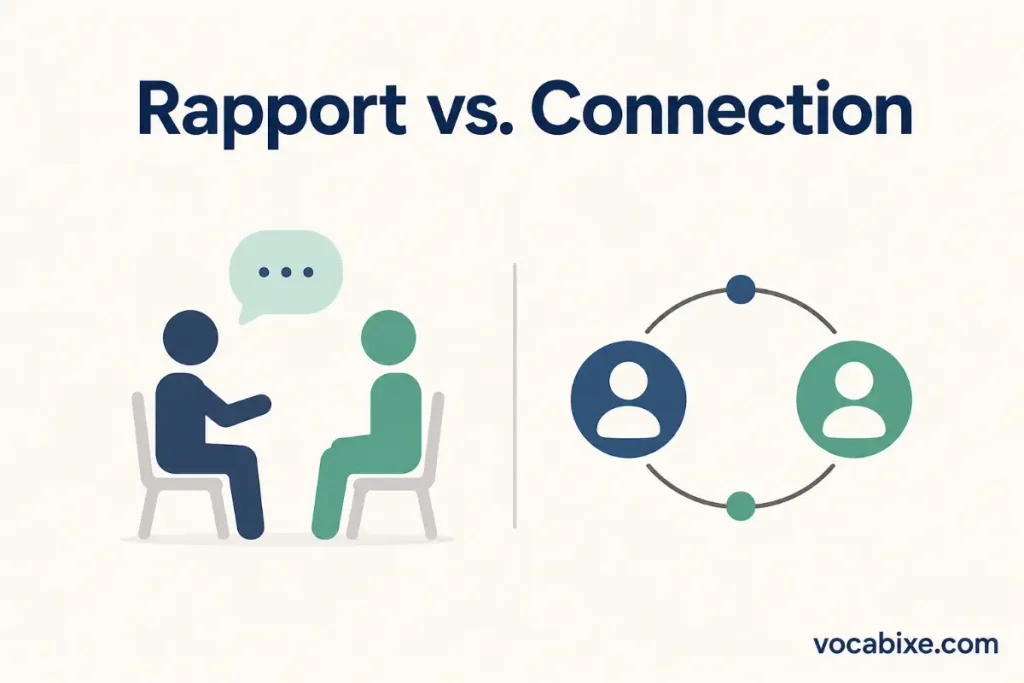
Connection is a very broad word.
It can describe many types of links.
You can have a connection with:
- A person
- A place
- An idea
- A story
- A subject
Rapport is more specific.
It usually describes a positive connection between people.
So if you are talking about a teacher and student who communicate well, rapport is a good choice.
Rapport vs. Chemistry
You may also hear people talk about “chemistry” between people.
For example:
The two actors have great chemistry.
This usually means they work or interact very naturally together.
Rapport is similar in some situations, but it often focuses more on communication, understanding, and comfort.
For example:
The teacher has great rapport with her students.
This sounds natural.
Why Spelling Matters
You may wonder why you should care about the difference between repore or rapport if people can understand what you mean.
Spelling matters because correct spelling makes your writing clear and professional.
A spelling mistake may not change the meaning of a sentence, but it can affect how your writing looks.
This is especially important in:
- School assignments
- Exams
- Job applications
- Resumes
- Business emails
- Articles
- Reports
Learning the correct spelling now can help you avoid the same mistake later.
A Quick Memory Test
Try this simple test.
Which sentence is correct?
A. The teacher has good repore with her students.
B. The teacher has good rapport with her students.
The answer is:
B. The teacher has good rapport with her students.
Here is another one.
Which spelling means a friendly connection?
A. repore
B. rapport
The answer is:
B. rapport
If you remember that rapport means a good relationship, you will be much less likely to write repore.
A Simple Spelling Trick
Break the word into two parts:
rap + port
Then remember:
rapport = good connection
The word has:
- Two p’s
- An o after the p’s
- A final t
So:
r-a-p-p-o-r-t
Not:
r-e-p-o-r-e
Not:
r-a-p-o-r-e
The correct spelling is:
rapport
Quick Comparison: Repore or Rapport
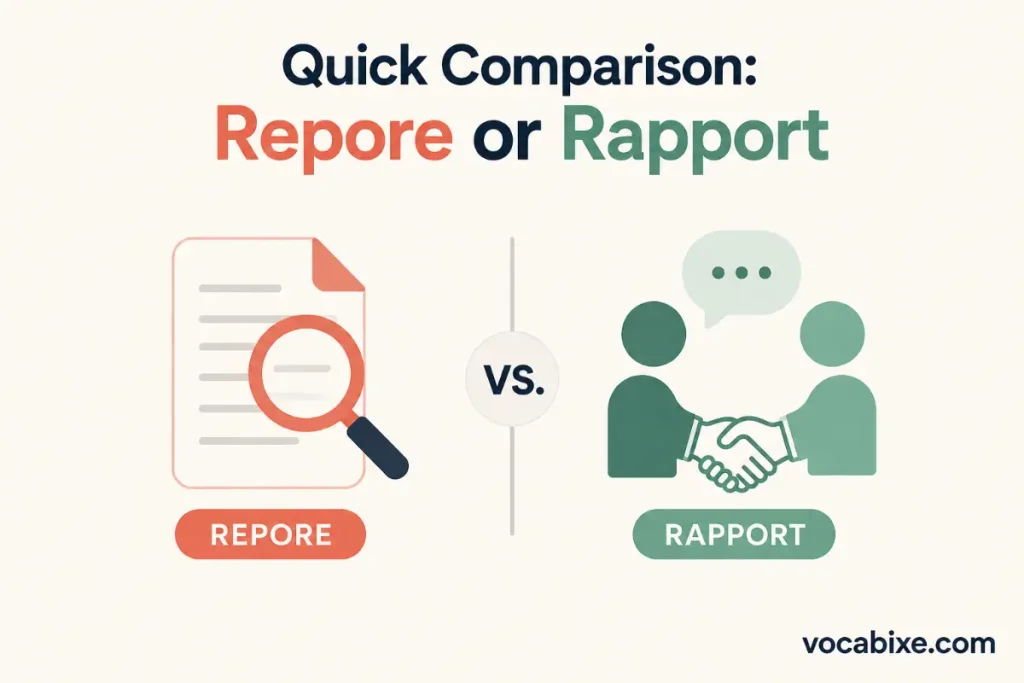
Here is the answer one more time:
| Question | Answer |
|---|---|
| Which spelling is correct? | rapport |
| Is “repore” correct for this meaning? | No |
| What does rapport mean? | A friendly and comfortable relationship |
| Can you have rapport at work? | Yes |
| Can teachers have rapport with students? | Yes |
| Can customers and workers have rapport? | Yes |
| Is rapport the same as friendship? | No |
| Is rapport the same as trust? | No |
| Is rapport a positive connection? | Yes |
Transition: From Spelling to Meaning
Now you know the basic answer: rapport is the correct spelling, while repore is a common misspelling.
But knowing the spelling is only the first step.
To use the word naturally, you also need to understand the feeling behind it. Rapport is not simply about knowing someone. It is about creating a comfortable connection where people can communicate well.
That deeper idea helps you choose the word correctly in real conversations, school writing, and professional situations.
Understanding Rapport in Real-Life English
What Does Having Rapport Feel Like?
Having rapport with someone often feels easy.
You do not have to force every conversation.
You can speak naturally.
The other person listens.
You listen to them.
or
You understand each other.
or
You may laugh together or share ideas without feeling nervous.
For example, imagine that you meet a new classmate.
At first, you barely speak.
After a few days, you discover that you both enjoy the same sport.
You start talking more.
Soon, you feel comfortable asking questions and sharing jokes.
You are building rapport.
The relationship may still be new, but communication feels natural.
How Do You Know If You Have Good Rapport?
There are some simple signs.
You may notice that:
- Conversation feels natural.
- Both people listen.
- People feel comfortable asking questions.
- People understand each other.
- There is mutual respect.
- People can share ideas easily.
- Small misunderstandings are handled calmly.
- Both people enjoy communicating.
These signs can show that good rapport exists.
Of course, every relationship is different.
Rapport does not mean that two people agree about everything.
You can disagree and still have good rapport.
Does Rapport Mean People Always Agree?
No.
This is a useful point.
Two people can have different opinions and still have good rapport.
For example, two coworkers may disagree about how to complete a project.
One wants to finish it quickly.
The other wants to spend more time checking the details.
They have different views.
But they listen to each other and speak respectfully.
They may still have good rapport.
So rapport is not about always agreeing.
It is about communicating well and having a positive connection.
Can You Lose Rapport?
Yes.
Rapport can become weaker.
For example, imagine a manager who normally listens carefully to employees.
One day, the manager becomes rude and refuses to listen.
The employees may feel uncomfortable.
The good rapport may begin to disappear.
This shows that rapport is connected to how people treat and communicate with each other.
Good communication can build it.
Poor communication can damage it.
How Long Does It Take to Build Rapport?
There is no fixed amount of time.
Sometimes rapport develops quickly.
Sometimes it takes much longer.
It depends on the people, the situation, and how often they communicate.
A teacher may build rapport with a student over several classes.
A salesperson may build rapport with a customer in a few minutes.
Coworkers may build rapport over several months.
There is no single correct time.
Can Rapport Be Used for Groups?
Yes.
Rapport can describe a positive connection involving more than two people.
For example:
The coach has good rapport with the entire team.
Or:
The teacher has developed strong rapport with her class.
You can also say:
The team has good rapport.
In that sentence, the idea is that team members communicate and work well together.
Is Rapport Always Positive?
Usually, yes.
The word rapport normally describes a positive relationship or connection.
That is why phrases such as good rapport, strong rapport, and excellent rapport are common.
You would not normally use rapport to describe a hostile relationship.
If two people constantly fight and cannot communicate, words such as conflict, tension, or poor relationship may be better.
What Words Commonly Go With Rapport?
Learning common word combinations can make your English sound more natural.
Some useful combinations are:
build rapport
The teacher built rapport with her students.
develop rapport
The doctor developed rapport with the patient.
establish rapport
The counselor established rapport with the child.
have good rapport
We have good rapport.
strong rapport
They have strong rapport.
positive rapport
The manager has positive rapport with the team.
rapport with someone
She has good rapport with her coworkers.
These phrases are useful because you can use them in many situations.
How This Word Is Understood in Culture and Stories
The word rapport is often connected with good human relationships. In stories, movies, schools, and everyday life, we see people trying to understand each other and build trust.
Think about a teacher who understands a shy student. At first, the student may not talk much. The teacher listens, speaks kindly, and gives the student time. Slowly, the student becomes more comfortable. This is a simple example of rapport.
You may also see rapport between a coach and a player in a sports story. The coach knows how the player thinks. The player trusts the coach. They communicate easily. Their strong connection can help the team work better.
Rapport can also appear between friends in stories. Two characters may meet for the first time, but they quickly feel comfortable with each other. They laugh, talk, and understand each other. A writer might describe this as good rapport.
The idea is easy to understand in many cultures because people everywhere need good communication.
However, the exact word “rapport” is more common in English when talking about communication, work, education, business, health care, and other relationships.
It does not mean that everyone must become close friends.
A teacher can have rapport with a student.
A doctor can have rapport with a patient.
A manager can have rapport with an employee.
A customer can have rapport with a salesperson.
The main idea stays the same: people feel comfortable communicating with each other.
Biblical and Mythological Meaning
The word rapport does not have a special biblical meaning or a special mythological meaning.
It is a French word that entered English with the meaning of a good connection or understanding between people.
However, the idea behind rapport can be found in many religious stories, myths, and traditional stories.
Many stories show people building trust, helping each other, listening to one another, or working together.
For example, a story may show a wise teacher guiding a student. Another story may show two people becoming trusted friends after facing a difficult situation together.
These stories can show ideas that are similar to rapport.
But we should not say that rapport itself is a special biblical or mythological word.
It is simply an English word used to describe a positive human connection.
So if you are asking, “Does rapport have a hidden biblical meaning?” the answer is no.
The normal meaning is still:
Rapport means a comfortable and positive connection between people.
Symbolism Explained in Simple Words
The word rapport is not a symbol in the same way that a heart may symbolize love or a dove may symbolize peace.
Still, the idea of rapport can represent several simple human qualities.
It can represent:
- Understanding
- Trust
- Comfort
- Respect
- Communication
- Cooperation
- Friendship
- Connection
These ideas help explain why rapport is useful in many situations.
What One Version Represents
There is only one correct spelling for the relationship word:
rapport
It represents a positive connection between people.
For example, when a teacher and student communicate easily, rapport can represent their understanding.
When coworkers cooperate well, rapport can represent their comfortable working relationship.
When a doctor listens carefully to a patient, rapport can represent the trust and comfort that develops during communication.
So the correct word, rapport, is connected with positive human interaction.
What the Other Version Represents
Repore does not represent a different type of relationship.
It is simply a common misspelling of rapport.
This is an important point.
Sometimes people think that if two spellings look different, they must have different meanings.
That is not true here.
Repore does not mean a weaker form of rapport.
It does not mean a different kind of relationship.
It is not the “casual” version of rapport.
The problem is spelling.
So the comparison is very simple:
Rapport = correct spelling and a positive connection.
Repore = incorrect spelling of rapport.
Related Words You Should Know
Learning related words can help you understand rapport more clearly.
Relationship
A relationship is a connection between people.
It can be personal, family-based, professional, or social.
Connection
A connection is a link between people or things.
When talking about people, it can mean that you feel close or comfortable with someone.
Trust
Trust means believing that someone is honest, reliable, or safe.
or
Trust can grow as people spend more time together.
Respect
Respect means treating someone well and recognizing their value.
Good respect can help people communicate better.
Friendship
Friendship is a personal relationship between friends.
Rapport does not always mean friendship.
Understanding
Understanding means knowing what another person thinks, feels, or means.
Good understanding can help create rapport.
Communication
Communication is the way people share ideas, information, and feelings.
Good communication often helps build rapport.
Cooperation
Cooperation means working together to reach a goal.
People with good rapport may find it easier to cooperate.
Empathy
Empathy means trying to understand another person’s feelings.
Showing empathy can help people feel comfortable with you.
Chemistry
Chemistry can describe a natural feeling of connection between people.
It is often used when people work or interact very well together.
How People Actually Use It in Daily English
The word rapport is more common in some situations than others.
You may not use it every day when talking with close friends.
Instead, you might simply say:
“We get along well.”
But rapport is very useful when you want to describe communication and relationships more clearly.
Here are some natural examples.
Example 1: Teacher and Student
The teacher has a good rapport with her students.
This means the students feel comfortable with the teacher and communicate well with her.
Example 2: Coworkers
I have a good rapport with my coworkers.
This means you have a comfortable and positive working relationship with them.
Example 3: Customer Service
The agent quickly built rapport with the customer.
This means the agent created a comfortable connection during the conversation.
Example 4: Doctor and Patient
The doctor developed good rapport with the patient.
This means the doctor and patient developed a comfortable professional connection.
Example 5: Coach and Player
The coach has strong rapport with the players.
This means the coach and players understand and communicate with each other well.
Example 6: New Team
It took some time to build rapport with my new team.
This means it took time to become comfortable with the team.
Example 7: Business
Good salespeople know how to build rapport with customers.
This means good salespeople know how to create a comfortable connection with customers.
Example 8: Friends
We developed a great rapport after working together.
This means the two people became comfortable communicating with each other.
Common Mistakes People Make
The biggest mistake is writing repore instead of rapport.
For example:
Incorrect: She has good repore with her students.
The correct sentence is:
Correct: She has good rapport with her students.
There are also a few other mistakes worth knowing.
Mistake 1: Adding an extra “e”
Some people write:
rapore
This is not the correct spelling.
Remember:
rapport
Mistake 2: Writing “repore”
This spelling is very common because it follows the sound people hear.
But the correct spelling is still:
rapport
Mistake 3: Thinking rapport means friendship
Rapport can happen between people who are not friends.
A doctor and patient can have rapport.
A teacher and student can have rapport.
A customer and salesperson can have rapport.
Mistake 4: Thinking rapport means agreement
Two people do not have to agree about everything to have rapport.
They can have different opinions and still communicate respectfully.
Mistake 5: Using rapport for objects
Rapport normally describes a relationship between people.
For example:
The teacher has good rapport with the student.
This sounds natural.
But:
I have good rapport with my laptop.
This does not sound natural because a laptop is not a person.
A better choice would be:
I have a good connection with my laptop.
Mistake 6: Using the word everywhere
Rapport is useful, but you do not need to use it in every situation.
Sometimes simple English is better.
Instead of:
“I have developed a strong rapport with my brother.”
You could simply say:
“My brother and I get along well.”
Both can work, but the second one sounds more natural in casual conversation.
How to Remember Rapport Forever
Here is a simple classroom trick.
Write this on a piece of paper:
RAPPORT = GOOD CONNECTION
Now look at the spelling:
R-A-P-P-O-R-T
Notice the two p’s.
Then connect the word with situations you already know.
Teacher + student = rapport.
Coach + player = rapport.
Doctor + patient = rapport.
Coworker + coworker = rapport.
Customer + salesperson = rapport.
This makes the word easier to remember because you are connecting the spelling with real situations.
When you see repore, stop and ask:
“Am I talking about a good relationship between people?”
If the answer is yes, use rapport.
Final Teacher Explanation (Very Important)
Okay, class, here is the simple answer.
If you are choosing between repore or rapport, choose rapport.
The spelling repore is a common mistake. It happens because the word does not sound exactly the way many people expect it to be spelled.
The correct spelling is:
rapport
Rapport means a friendly, comfortable, and positive connection between people.
You can have rapport with a teacher, student, friend, coworker, customer, patient, coach, or manager.
or
You do not have to be close friends with someone to have rapport.
or
You also do not have to agree with everything they say.
The key idea is comfortable communication and understanding.
Think about two people who can talk easily.
They listen to each other.
or
They respect each other.
or
They understand each other.
That is rapport.
And remember the spelling:
R-A-P-P-O-R-T
If you remember “rapport = good connection,” you will know both the meaning and the correct spelling.
Final Answer (Quick Recap)
Rapport is the correct spelling.
Repore is a common misspelling.
Use rapport when you mean a friendly, comfortable, or positive connection between people.
A simple example is: “The teacher has a good rapport with her students.”
The next time you are unsure about repore or rapport, choose rapport.
The word may look unusual, but its meaning is simple. Rapport is about people feeling comfortable, communicating well, and understanding each other. Once you connect the spelling with the meaning, the word becomes much easier to remember.
For school, work, emails, articles, and professional writing, use rapport. Avoid repore when you mean a good relationship. That one spelling choice will keep your sentence correct.
Frequently Asked Questions (FAQs)
What does rapport mean in simple words?
Rapport means a good, friendly, and comfortable connection between people.
Is it repore or rapport?
Rapport is correct. Repore is a common misspelling.
When should I use rapport?
Use rapport when talking about a positive relationship where people communicate easily and understand each other.
Why do people spell rapport as repore?
People often spell it as repore because they write the word based on how they hear it.
Can I use rapport in formal writing?
Yes. Rapport is commonly used in professional, school, business, and workplace writing.
Is rapport the same as friendship?
No. Rapport means a comfortable connection. People can have rapport without being friends.
Can a teacher have rapport with students?
Yes. A teacher can have good rapport with students when they communicate well and feel comfortable with each other.
How do I remember the spelling of rapport?
Remember R-A-P-P-O-R-T and connect it with the simple meaning: rapport = good connection.
Pingback: Chief vs Cheif: Correct Spelling Guide 2026 - Vocabixe
Pingback: High School or Highschool: Ultimate 2026 Usage Guide - Vocabixe
Pingback: Buoy vs Bouy: Correct Spelling Guide 2026 - Vocabixe
Pingback: Putting vs Puting: Correct Spelling and Simple Examples 2026 - Vocabixe