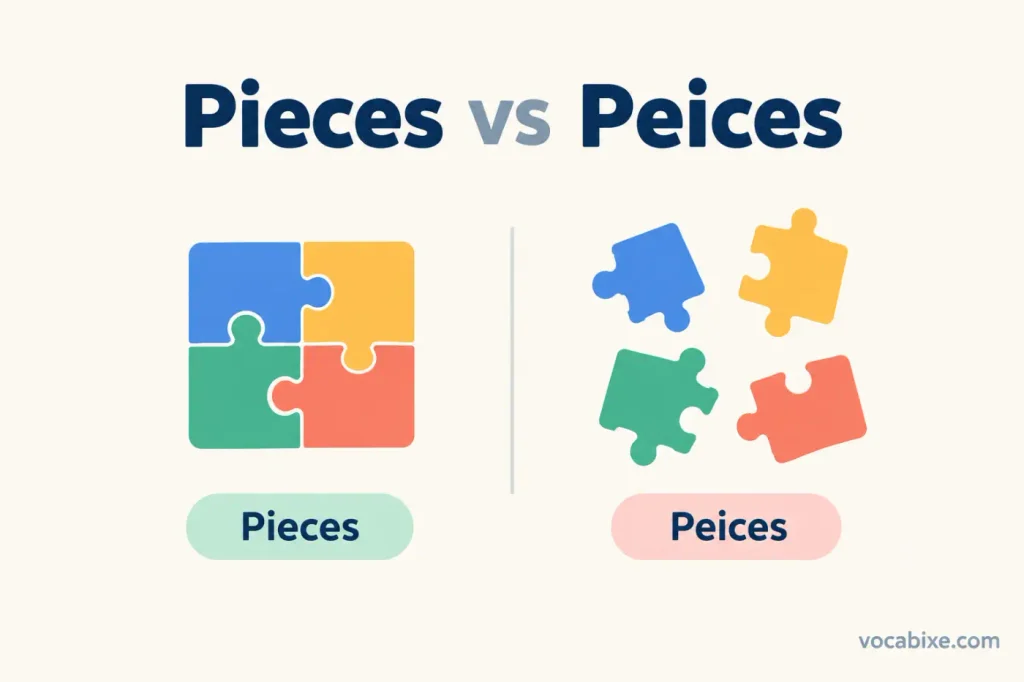
If you have ever paused while typing the word “pieces,” you are not alone. Many people wonder if it should be pieces or peices. This mix-up happens because English spelling rules can feel tricky, especially with words that have the letters “i” and “e” next to each other.
The good news is that this question has one simple answer. Only one of these spellings is correct in English, and the other one is a common mistake that many people make without noticing.
In this article, you will learn the correct spelling, why people get confused, and how to use the word correctly in your own writing. By the end, you will never second guess yourself again.
Simple Answer in One Look
The correct spelling is pieces. Peices is not a real word in English. It is a common spelling mistake that happens because people mix up the order of the letters “i” and “e.” Whenever you want to talk about parts of something, always write pieces.
What Does Pieces Mean?
Pieces is the plural form of the word piece. A piece means one part of something bigger, or a single item that belongs to a group.
For example, if you break a cookie in half, you now have two pieces of cookie. If you own a puzzle with 500 parts, you have a 500-piece puzzle. Once you put more than one part together, you use the word pieces.
Here are two simple ideas the word can express:
- A part or section of something whole, like a piece of cake
- A single item in a set or group, like pieces in a board game
Both meanings are common in everyday English, and both use the same spelling: pieces.
What Is the Correct Spelling?
The correct spelling is pieces, with the letters arranged as p-i-e-c-e-s. The incorrect spelling peices places the “e” before the “i,” which does not match the real English word.
People often write peices because they are thinking of the classic spelling rule “i before e, except after c.” Since the word piece does not have a “c” right before the ei sound, some writers guess that the letters should flip. This guess is wrong for this word, even though the rule feels like it should apply.
Here are a few quick examples to help the spelling stick in your memory:
- Correct: She cut the pizza into eight pieces.
- Incorrect: She cut the pizza into eight peices.
- Correct: He collected pieces of old coins.
- Incorrect: He collected peices of old coins.
Once you see the correct version a few times, it becomes much easier to remember. explore this article frescade meaning
.
What Is the Difference Between Pieces and Peices?
There is only one real difference between these two spellings: one of them is a real English word, and the other is not.
- Pieces is the correct, real word used in English writing and speech.
- Peices is a misspelling that does not appear in any English dictionary.
There is no situation where peices is the right choice. It is not a British spelling, an informal spelling, or an older version of the word. It is simply a mistake that comes from mixing up the letter order.
If you remember only one thing from this article, remember this: always choose pieces, never peices.
Why Do People Get Confused?
Most spelling mix-ups happen for clear reasons, and this one is no different. Here are the main reasons people accidentally write peices instead of pieces:
- The famous rule “i before e, except after c” gets misapplied to this word
- The two letters “i” and “e” sound similar when spoken quickly
- Autocorrect sometimes misses the mistake if typing is fast
- The word is common, so people rely on memory instead of checking the spelling
- Some similar-sounding words, like receive, do follow the “except after c” rule, which adds confusion
None of these reasons make the mistake embarrassing. Many strong writers have typed peices by accident at least once. The goal now is simply to remember the correct order going forward.
Which One Should You Use?
The rule here is simple, since there is only one correct choice.
Use pieces whenever you are talking about parts of something or separate items in a group. Never use peices, since it is not a real word in English.
If you are ever unsure while typing, say the word slowly in your head as “pee-eces.” This can help you remember that the “i” comes right after the “p” sound, followed by “e-c-e-s.”
Easy Examples in Real Sentences
Reading real examples can help the correct spelling feel natural. Here are several everyday situations where the word pieces appears.
- School: The teacher gave each student three pieces of paper for the art project.
- Work: My manager asked me to review the last few pieces of the report before lunch.
- Family: My little brother broke his toy into several pieces this morning.
- Text messages: Can you grab a few pieces of fruit from the store on your way home?
- Conversations: I only understood bits and pieces of what she was explaining.
- Shopping: This furniture set comes with five pieces, including two chairs.
- Travel: We packed our luggage carefully so nothing would break into pieces.
- Social media: She posted pieces of her vacation photos throughout the week.
Notice that in every sentence, the spelling stays the same: pieces.
Common Mistakes to Avoid
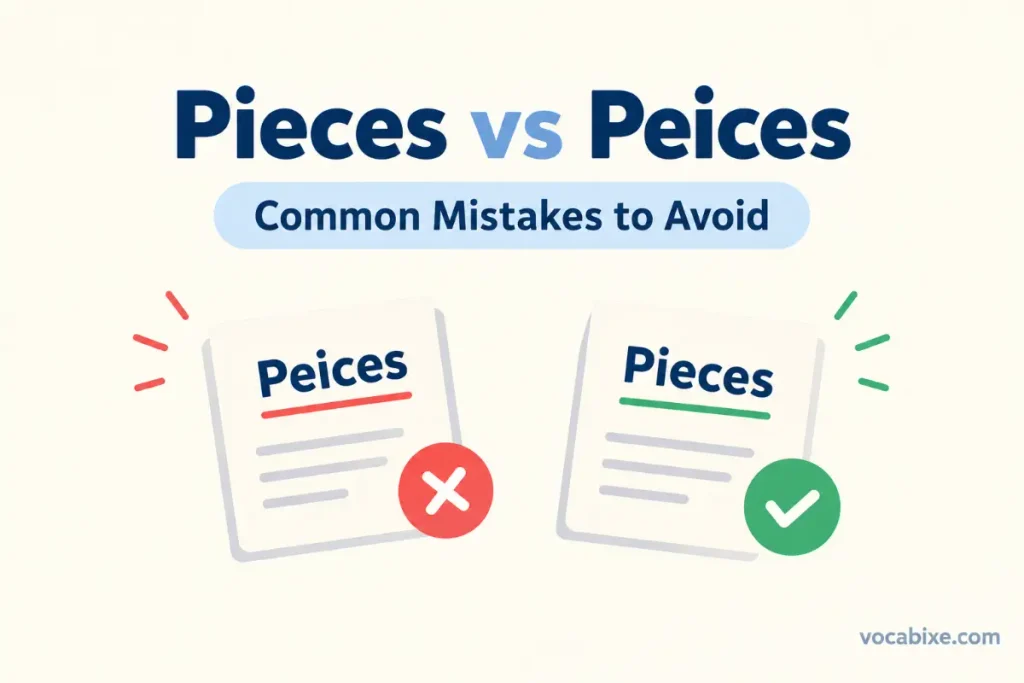
Here are the most common mistakes people make with this word, along with quick corrections.
- Incorrect: He gave me two peices of advice. Correct: He gave me two pieces of advice. Peices is never correct, no matter the context.
- Incorrect: The vase broke into tiny peices. Correct: The vase broke into tiny pieces. Always place the “i” before the “e” in this word.
- Incorrect: I need a few more puzzle peices. Correct: I need a few more puzzle pieces. This mistake is especially common when typing quickly.
- Incorrect: She wrote several peices for the school newspaper. Correct: She wrote several pieces for the school newspaper. This meaning refers to written works, and the spelling stays the same.
Avoiding these small mistakes can make your writing look more polished and professional.
Where Does the Word Come From?
The word piece comes from Old French, where it referred to a part or portion of something. Over time, English speakers adopted the word and it slowly became part of everyday vocabulary. The plural form, pieces, simply follows the standard English rule of adding an “s” to show more than one.
The spelling has stayed steady for a long time, which is one reason peices stands out clearly as an error rather than an accepted older version of the word.
Understanding where a word comes from will not always fix spelling problems, but it can help you see why English sometimes borrows unusual letter patterns from other languages. Once you know pieces has always used this order, the confusion becomes easier to let go of.
Spelling is only one part of understanding this word well. Knowing how pieces is used in daily life, in stories, and in different types of writing can help the word feel even more natural. Let’s look deeper at how English speakers use pieces beyond just the basic definition, and how the word shows up in culture, conversation, and practical writing.
How Is This Word Used in Real Life?
Native English speakers use the word pieces constantly, in both speaking and writing. It shows up in casual chats, business emails, school assignments, and creative writing alike.
In spoken English, people use pieces when describing food, objects breaking apart, or items in a collection. For example, someone might say, “Pass me a few pieces of bread,” during a casual meal.
In written English, pieces often appears in more formal contexts too. A news website might publish several opinion pieces in a single week. A student might submit two writing pieces for a class project. A company report might discuss the different pieces of a larger business plan.
Because pieces works in both casual and formal settings, it is considered a completely neutral, safe word to use in nearly any type of writing.
How Is This Word Understood in Culture and Stories?
The word pieces appears often in books, movies, songs, and everyday storytelling. Writers frequently use it to describe both real, physical objects and deeper emotional ideas.
For example, a character in a story might say their heart feels like it broke into a million pieces after a sad event. This is a common way English speakers describe strong emotions using physical, easy-to-picture language.
In music, many song titles and lyrics use the word pieces to talk about feelings of loss, healing, or putting life back together after a hard time. This use is symbolic rather than literal, but it still relies on the same basic meaning: separate parts that once formed something whole.
Symbolism Explained in Simple Words

What the Word Can Represent
Beyond its literal meaning, pieces often symbolizes something being broken, incomplete, or in the process of coming back together. When someone says they are “picking up the pieces,” they usually mean they are recovering from a difficult situation, not literally gathering broken objects.
How the Meaning Changes by Context
The meaning of pieces shifts depending on the sentence around it. In a math class, pieces might refer to fractions of a pie. In a conversation about feelings, pieces might refer to emotional recovery. In a shopping context, pieces usually refers to items in a set. Paying attention to the surrounding words helps you understand which meaning applies.
Related Words You Should Know
Learning a few related words can help you use pieces with more confidence.
- Piece: The singular form, meaning one part or item.
- Portion: A part of something, often used with food or resources.
- Fragment: A small broken part of something, often used for objects like glass.
- Segment: A distinct part of something larger, often used in structured topics like segments of a market.
- Section: A separate part of a larger whole, often used for documents or spaces.
- Chunk: An informal word for a thick or solid piece of something.
- Bit: A small, informal word similar to piece, often used in casual speech.
- Component: A formal word for a part of a system or machine.
Each of these words connects to the idea of a part of something, but pieces remains the most common and flexible choice in everyday English.
How to Use Pieces Correctly
Using pieces correctly comes down to a few simple habits. Explore this also stich vs stitch difference.
Use pieces when talking about more than one part or item. Use the singular piece when talking about only one part. Avoid peices completely, since it is never correct in any situation.
In formal writing, such as reports, essays, or professional emails, pieces is completely acceptable and commonly used. In informal writing, such as texts or social media posts, pieces is equally natural and requires no special adjustment.
There is no different spelling for spoken versus written English. The word pieces stays exactly the same in every situation, which makes it one of the more reliable words in the English language once you learn it correctly.
Real-Life Usage Examples
Here are more natural examples showing pieces in different everyday situations.
- The chef arranged the pieces of chicken neatly on the plate.
- We found several pieces of broken glass near the window.
- The teacher collected all the writing pieces before grading them.
- I still have a few puzzle pieces missing from the box.
- The band played three pieces during their evening performance.
- My grandmother has beautiful pieces of jewelry from her wedding.
- The mechanic replaced two small pieces inside the engine.
- The museum displayed ancient pieces of pottery from the region.
- She kept the broken pieces as a reminder of that day.
- The company released new pieces of software this year.
These examples show how flexible and common the word pieces really is across different topics.
Common Questions People Have
Many readers search for quick answers about this word. Here are simple responses to the most common questions.
Is peices ever correct? No, peices is always incorrect in English.
Is pieces singular or plural? Pieces is plural. The singular form is piece.
Does British English spell it differently? No, both American and British English use the same spelling: pieces.
Can pieces be used in formal writing? Yes, it is appropriate for both formal and informal writing.
Final Teacher Explanation
Here is the simple lesson to remember. English spelling rules do not always apply perfectly to every word, and pieces is a great example of that. Even though many people expect the “i before e except after c” rule to flip the letters, this word does not follow that pattern. The correct order is always i before e, giving you pieces.
Once you practice writing the word a few times, the correct spelling becomes automatic. The mistake usually fades quickly once you notice the pattern.
Final Answer — Quick Recap
The correct spelling is pieces. Peices is a common misspelling that does not exist in proper English. Whenever you are describing parts of something or multiple items in a group, always write pieces with the i before the e.
Spelling mistakes like this one are extremely common, and noticing them is the first step toward fixing them for good. With a little practice, writing pieces correctly will start to feel effortless.
The next time you type this word, take one extra second to check the letter order. That small habit can help you avoid this mistake permanently, whether you are writing a school assignment, a work email, or a quick text message to a friend. Next article wether or weather or whether.
.
FAQ
What does pieces mean in simple English?
Pieces means more than one part of something, or several separate items that belong together, like pieces of a puzzle.
Is pieces or peices correct?
Pieces is correct. Peices is a common spelling mistake and is not a real English word.
How do I use pieces in a sentence?
Use it to describe parts of something, such as: “The plate broke into several pieces.”
Why do people confuse pieces and peices?
People often misapply the rule “i before e, except after c,” which does not fit this word, leading to the incorrect spelling peices.
Is peices accepted in any form of English?
No, peices is not accepted in American English, British English, or any other standard form of English.
Can I use pieces in formal writing?
Yes, pieces is appropriate for formal writing, including reports, essays, and professional documents.
Is pieces the same in American and British English?
Yes, both American and British English spell the word the same way: pieces.
What is the singular form of pieces?
The singular form is piece, which refers to just one part or item.
Pingback: Tomorrow vs Tommorow: Correct Spelling Explained 2026 - Vocabixe