If you are confused about submission vs submittion, you are not alone. These two forms look very similar, but only one is the correct English spelling. The correct word is submission. Submittion is a common spelling mistake and should not be used in standard English writing.
Submission is a real English word. It means the act of giving something for review, approval, or consideration. For example, you may make a homework submission, job application submission, or online form submission.
The confusion usually happens because the verb is submit. Some people think that adding “-tion” directly to “submit” creates “submittion.” English does not work that way here. The correct noun form changes the ending to submission.
Simple Answer in One Look
Submission is the correct spelling.
Submittion is incorrect in standard English. If you mean the act of submitting something, always use submission.
Example:
- Correct: “Your submission has been received.”
- Incorrect: “Your submittion has been received.”
What Does Submission Mean in Simple English?
Submission means something that you give, send, or present for someone to check, review, approve, or consider.
It can also mean the act of submitting something.
Think about a student turning in homework. The student completes the work and gives it to the teacher. That work can be called a submission.
For example:
“I made my assignment submission before the deadline.”
Here, submission means the assignment that was turned in.
The word can also describe something sent through a website.
“Please check your email after making your online submission.”
Here, submission means the information or form that was sent.
Submission is common in school, work, business, competitions, websites, applications, and many other situations.
What Is the Correct Spelling?
The correct spelling is:
Submission
The incorrect form is:
Submittion
The difference is small, but it matters.
Correct
- submission
- submissions
- submit
- submitted
- submitting
Incorrect
- submittion
- submittion
- submittional, when intended as a form based on the incorrect word
The correct noun is formed from submit in a different way. The spelling does not keep the extra “t” before “ion.”
Here are some examples:
“The deadline for submission is Friday.”
“Please complete your submission today.”
“Her application submission was successful.”
“We received more than 100 submissions.”
Notice that submission has one “t” before “ion.”
What Is the Difference Between Submission and Submittion?
The main difference is simple:
- Submission is the correct English word.
- Submittion is a misspelling.
- Submission is used in standard writing.
- Submittion should not be used in school, work, business, or formal writing.
There is no special meaning that belongs to “submittion.” It is not a second form of submission.
If you see submittion online, it is usually just a spelling mistake. View emersion vs immersion.
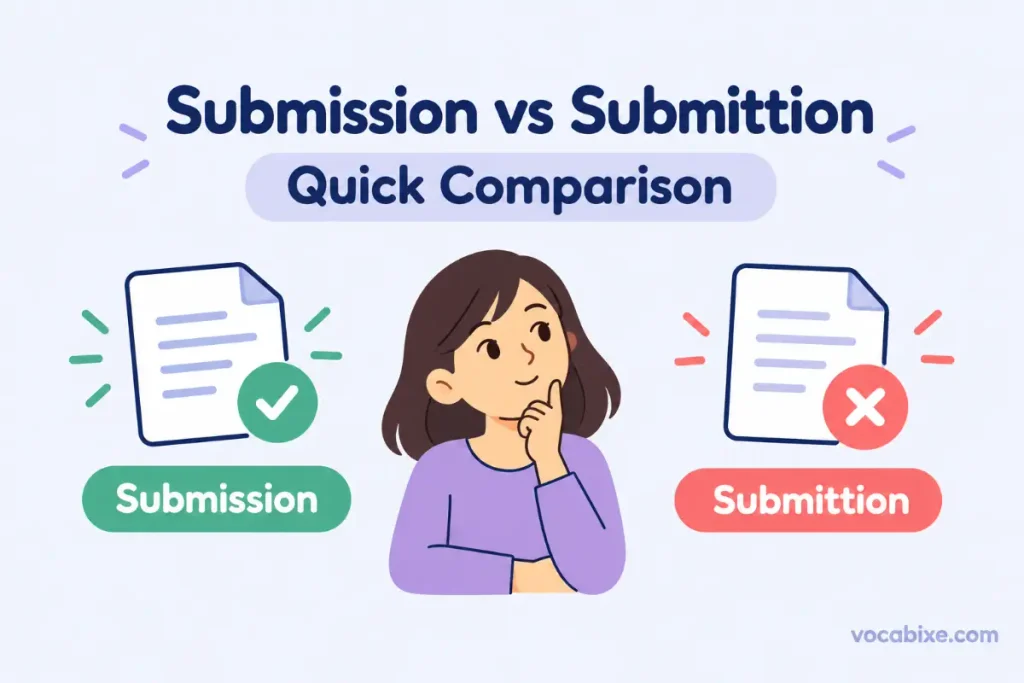
Quick Comparison
| Word | Correct? | Meaning |
|---|---|---|
| Submission | Yes | Something sent or given for review |
| Submittion | No | Common misspelling of submission |
| Submit | Yes | To give or send something |
| Submitted | Yes | Already gave or sent something |
| Submitting | Yes | Giving or sending something |
This makes the rule easy to remember: Use submission, not submittion.
Why Do People Get Confused?
The main reason is the verb submit.
The word submit ends with the letter “t.” When people want to turn it into a noun, they may think they can simply add “-tion.”
They may imagine:
submit + tion = submittion
That looks logical at first.
But English word formation does not always work by simply adding letters to the end of a word. The standard noun is submission.
The spelling also sounds close when spoken. This makes the mistake harder to notice.
For example, if someone says:
“Please send your submission.”
A learner may hear the ending and later write submittion.
Another reason is that English has many words ending in -tion. Learners often see patterns such as:
- inform → information
- educate → education
- operate → operation
- submit → submission
The last example does not follow the simple spelling pattern that some learners expect.
Which One Should You Use?
Use submission when you mean something that has been submitted or the act of submitting it.
Use submit when you mean the action itself.
For example:
“Please submit your homework.”
Here, submit is the action.
“Your homework submission was received.”
Here, submission refers to what was submitted or the act of submitting it.
A simple memory rule is:
Submit → Submission
Not:
Submit → Submittion
If you are writing an email, assignment, application, report, or business document, choose submission.
Easy Examples in Real Sentences
Here are simple examples you can use in everyday English.
- “My assignment submission is complete.”
- “Please make your submission before Friday.”
- “The online submission form is easy to use.”
- “I forgot to check my submission.”
- “Your submission has been received.”
- “The teacher reviewed every submission.”
- “Her job application submission was successful.”
- “The contest received hundreds of submissions.”
These examples show how common the correct word is.
Common Mistakes to Avoid
Mistake 1: Writing submittion
Incorrect:
“The submittion deadline is tomorrow.”
Correct:
“The submission deadline is tomorrow.”
The noun is submission.
Mistake 2: Adding “-tion” directly to submit
Incorrect thinking:
submit + tion = submittion
Correct:
submit → submission
English spelling often changes when words form related forms.
Mistake 3: Using submit when you need submission
These words are related, but they do different jobs.
“Please submit the form.”
This tells someone to send the form.
“Your submission was accepted.”
This talks about the form that was sent or the act of sending it.
Mistake 4: Thinking submittion is an alternative spelling
It is not a standard alternative spelling.
Use submission in standard English.
Where Does the Word Submission Come From?
Submission comes from the verb submit.
The English verb submit has roots in Latin. It developed through French before becoming part of English. Its older sense was connected with placing something under another person’s authority or control.
Over time, the word gained several related meanings.
Today, one very common meaning is to give something for consideration or review.
That is why we use phrases such as:
- assignment submission
- application submission
- document submission
- online submission
- paper submission
- final submission
- late submission
The spelling submission developed as the standard noun form. Submittion is not the standard English noun.
The history also helps explain why adding “-tion” directly to the modern spelling of submit does not give the correct result.
A Simple Way to Remember Submission
Try this memory trick:
Submit has one “t” before the ending in submission.
Write:
SUBMISSION
Break it into parts visually:
SUB + MISSION
You do not need to use this as a real word breakdown for grammar. It is simply a spelling trick.
Another useful method is to remember a sentence:
“I submit my work for submission.”
The first word is the action. The second word is the noun.
This can help you keep submit and submission separate.
Transition to Section 2
Now that the spelling is clear, we can look at how submission works in real English. The word is useful in many settings, from school assignments to online forms and business documents. Its meaning can change slightly depending on the situation.
Section 2: Deep Meaning, Culture, and Practical Use
How Is Submission Used in Real Life?
Submission is widely used in written English.
You may see it at school, at work, on websites, in competitions, and in applications.
At school, a teacher may ask for a homework submission.
“Your submission must be uploaded by 8 p.m.”
At work, an employee may prepare a report submission.
“The report is ready for submission.”
On a website, you may see:
“Thank you for your submission.”
In a competition, people may send their work for judging.
“The competition received 500 submissions.”
In a job application, an applicant may submit a resume and other documents.
“Your application submission is complete.”
These are all normal uses of submission.
Submission in School English
Students often see this word in online learning systems.
A school website may have a button that says:
Submit Assignment
After you click it, the system may show:
Submission received.
The two words are connected.
Submit is the action.
Submission is the thing sent or the act of sending it.
For example:
“I submitted my science project.”
Then:
“My science project submission was accepted.”
This difference is easy once you see the words in real situations.
Submission in Work and Business English
The word is also common at work.
A company may ask an employee for a report submission.
A customer may make a form submission.
A contractor may send a proposal submission.
A worker may say:
“I finished the document and sent it for submission.”
You may also see the word in instructions:
“All submissions must be received by Monday.”
This means everything that people send must arrive by Monday.
In business writing, submission is usually clear and professional.
Submission in Online Forms
Many websites use the word submission.
For example, after you fill out a contact form, the website may display:
“Your submission was successful.”
This means the information you entered was sent successfully.
You may also see:
- Form submission
- Email submission
- Online submission
- Data submission
- Application submission
- Document submission
These phrases are common in digital systems.
Submission in Competitions
Competitions often ask people to send work.
A writing contest may ask for story submissions.
A photography contest may ask for photo submissions.
A school competition may ask for project submissions.
For example:
“The contest deadline for submissions is June 30.”
Here, submissions means the pieces of work sent by participants.
Another example is:
“Only original submissions will be accepted.”
This means only original work can be entered.
Submission in Formal Writing
Submission works well in formal English.
You may use it in:
- Emails
- Reports
- Applications
- School documents
- Business documents
- Online forms
- Official instructions
For example:
“Please confirm receipt of my submission.”
This sounds professional.
However, in casual conversation, people may choose simpler words.
Instead of:
“I have completed my submission.”
A friend might say:
“I sent my work.”
Both can be correct. The best choice depends on the situation.
Is Submission American or British English?
Submission is used in both American and British English.
The spelling does not change between the two varieties.
American English:
“Your submission was received.”
British English:
“Your submission was received.”
So this is not an American-versus-British spelling issue.
The same correct spelling applies in both.
How Do You Pronounce Submission?
The word submission is commonly pronounced approximately like:
sub-MISH-un
The middle sound can make the spelling less obvious to learners.
This is another reason why someone may write submittion after hearing the word.
Remember that pronunciation does not always show every letter clearly.
When spelling the word, focus on the standard written form:
submission
How to Use Submission Correctly
There are several common patterns.
1. Submission as something sent
“Your submission is ready.”
Here, submission means the thing that was sent.
2. Submission as an act
“The submission of the form took two minutes.”
Here, submission refers to the act of sending the form.
3. Submissions as multiple items
“We received 200 submissions.”
Here, each submission is something sent by a person.
4. Submission deadline
“The submission deadline is Friday.”
This means Friday is the final time for sending the work.
5. Online submission
“Online submission is required.”
This means the work must be sent through an online system.
Real-Life Usage Examples
Here are more natural examples.
At school
“I uploaded my homework submission before class.”
At work
“The report is ready for submission.”
On a website
“Your form submission was successful.”
In a competition
“The judges reviewed every submission.”
Application
“Please check your application before submission.”
“I am writing to confirm my submission.”
In a writing contest
“The contest accepts submissions from students.”
Online class
“Late submissions may not be accepted.”
In a company
“We received your document submission.”
In everyday speech
“I sent my submission this morning.”
Submission vs Submit: What Is the Difference?
This is another useful distinction.
Submit is the action.
Submission is the noun.
Compare these sentences:
“Please submit your application.”
“Your application submission was received.”
In the first sentence, someone is being asked to do something.
In the second sentence, the focus is on the application that was submitted.
Another example:
“I will submit my assignment tonight.”
“My assignment submission is due tonight.”
Both sentences talk about the same general event, but the words are used differently. Related post how tos or how tos.
Common Questions About Submit and Submission
People often confuse the two because they are related.
Can I say “I submission my work”?
No.
Use:
“I submit my work.”
Or:
“I submitted my work.”
Submission is not normally used as the action word.
Can I say “My submit is complete”?
No.
Use:
“My submission is complete.”
The noun is submission.
Can I say “I made a submission”?
Yes.
For example:
“I made a submission to the contest.”
This is a normal use of the noun.
Why Submittion Looks Correct at First
Spelling mistakes are often based on patterns that seem logical.
Someone may know:
submit
They may also know many nouns ending in:
-tion
So they put the two together and write:
submittion
The problem is that English has many word changes that cannot be predicted by simply adding an ending.
The correct form is already established in standard English:
submission
This is why memorizing the correct form is useful.
Is Submittion Ever Correct?
In standard modern English, submittion is not the correct spelling for the noun meaning the act or thing submitted.
If you are writing a school assignment, email, resume, application, website, or business document, do not use submittion.
Use submission.
If a spell checker marks submittion as wrong, that is because the standard word is submission.
Related Words You Should Know
Submit
To give or send something for review.
“Please submit your form.”
Submitted
The past form of submit.
“I submitted my application yesterday.”
Submitting
The form used when the action is happening.
“She is submitting her assignment now.”
Submission
The act of submitting something or the thing submitted.
“Your submission was accepted.”
Submissions
More than one submission.
“The editor received many submissions.”
Resubmit
To submit something again.
“Please fix the error and resubmit the form.”
Resubmission
Something submitted again.
“The resubmission was accepted.”
These words are all connected, but their uses are different.
How to Remember Submission vs Submittion
A good spelling habit is to connect the correct word with a sentence.
Remember:
“My submission was accepted.”
Then remember:
Submission is correct. Submittion is not.
You can also write the word several times:
submission
submission
submission
Writing the correct form helps your eyes remember it.
Another helpful trick is to remember related forms together:
submit → submitted → submitting → submission
Seeing the whole family can make the spelling easier to remember.
Common Mistakes People Make
“Submittion deadline”
Incorrect:
“The submittion deadline is Monday.”
Correct:
“The submission deadline is Monday.”
“Submittion form”
Incorrect:
“Complete the submittion form.”
Correct:
“Complete the submission form.”
“My submittion”
Incorrect:
“My submittion was accepted.”
Correct:
“My submission was accepted.”
“Send your submittion”
Incorrect:
“Please send your submittion.”
Correct:
“Please send your submission.”
“Submittion received”
Incorrect:
“Submittion received.”
Correct:
“Submission received.”
Submission in Digital English
The word has become especially common because so much work is sent online.
You may submit:
- Forms
- Assignments
- Applications
- Reviews
- Comments
- Articles
- Photos
- Videos
- Documents
- Contest entries
After you send something, a website may call it a submission.
For example:
“Your photo submission has been received.”
Or:
“We could not process your submission.”
These messages are common on websites and apps.
Submission and Deadline
The word submission often appears with deadline.
A submission deadline is the final time or date when something should be sent.
For example:
“The submission deadline is Friday at 5 p.m.”
This means your work should be sent before that time.
You may also see:
“Late submissions will not be accepted.”
This means work sent after the deadline may be rejected.
Submission and Acceptance
Another common combination is submission and acceptance.
For example:
“Your submission has been accepted.”
This means the work you sent has been approved or chosen.
You may also see:
“Your submission was rejected.”
This means it was not accepted.
In a writing contest, an editor may accept or reject a submission.
Submission in Writing and Publishing
Writers often use submission when sending their work to publishers, magazines, or contests.
For example:
“The writer sent a story submission to the magazine.”
A magazine may have a page called:
Submission Guidelines
This page tells writers what they can send and how they should send it.
A writer may prepare:
- A story submission
- A poem submission
- An article submission
- A book proposal submission
Here, submission has a clear and normal meaning.
Does Submission Have Other Meanings?
Yes. The word can have meanings beyond sending work.
In some contexts, submission can mean accepting another person’s authority or control.
For example:
“The treaty required submission to the new authority.”
This meaning is different from sending an assignment.
There is also a sports meaning. In some combat sports, a competitor may win by forcing the other competitor to give up. This is called a submission.
These meanings are real, but they are not usually relevant when someone searches for submission vs submittion.
For spelling questions, the main meaning to remember is the act of submitting something or the thing submitted.
Does Submission Have a Biblical Meaning?
The word submission can appear in religious writing, including Christian and biblical discussions. In those contexts, it may describe accepting authority, following God’s will, or yielding to another person’s authority depending on the passage and interpretation.
However, this is a separate meaning from the common school or workplace meaning.
If you are writing:
“My submission is due tomorrow.”
You are talking about work being turned in.
If you read:
“Submission to God”
the meaning is about yielding to God’s authority or will.
The surrounding words tell you which meaning is intended.
Does Submission Have a Mythological Meaning?
There is no special mythological meaning that is needed to understand the spelling difference between submission and submittion.
The important point for this spelling question is simply that submission is the standard English form.
There is no mythological reason to use submittion. Related post onsite vs on site.
Does Submission Have Symbolism?
Submission can sometimes have symbolic meaning in stories or literature.
For example, a character may submit to an authority figure. This can represent obedience, surrender, loss of power, or acceptance.
But the meaning depends on the story.
Submission does not always represent weakness. In another story, it could represent trust, cooperation, or a deliberate choice.
So you should not give the word one fixed symbolic meaning.
For normal English writing, focus on the direct meaning.
How Context Changes the Meaning
Context is simply the words and situation around a word.
Compare:
“Please upload your submission.”
Here, submission means work or information that has been sent.
Now compare:
“His submission to the king was complete.”
Here, submission refers to yielding to authority.
The spelling is the same, but the meaning changes because the situation changes.
This is common in English. One word can have several related meanings.
Final Teacher Explanation
If I were explaining submission vs submittion to a student in class, I would give you one simple rule:
Submission is correct. Submittion is incorrect.
The word submission can mean something you send for review or the act of sending it. You may use it for homework, forms, applications, reports, contest entries, and many other things.
The word submit is the action:
“Please submit your assignment.”
The word submission is the noun:
“Your assignment submission was received.”
Do not create submittion by adding “-tion” directly to submit. That spelling is not standard English.
The best way to remember it is:
submit → submission
Not:
submit → submittion
Once you remember this small pattern, the confusion becomes much easier.
Final Answer — Quick Recap
Submission is the correct spelling. Submittion is a common misspelling and should not be used in standard English.
Use submit for the action and submission for the thing submitted or the act of submitting it.
For example:
“Please submit your form. Your submission will be reviewed.”
The correct form is always submission when you need this noun.
Conclusion
The confusion between submission vs submittion comes mainly from the spelling of the verb submit. It may seem natural to add “-tion” and create “submittion,” but that is not the standard English form.
The correct word is submission. It is used in school, work, business, online forms, applications, competitions, publishing, and many other situations. Learning the correct form will help you write more clearly and avoid a very common spelling mistake.
When you are unsure, remember this simple pair: submit → submission. If you mean something that has been sent for review or the act of sending it, choose submission.
Frequently Asked Questions
Is submission or submittion correct?
Submission is correct. Submittion is a misspelling.
What does submission mean in simple English?
Submission means something you send or give for review, or the act of sending it.
Why do people write submittion?
People often write submittion because they think they can add “-tion” directly to submit. The standard noun is submission.
Can I use submittion in formal writing?
No. Use submission in school, business, professional, and formal writing.
What is the difference between submit and submission?
Submit is the action of giving or sending something. Submission is the thing sent or the act of submitting it.
How do I use submission in a sentence?
You can say, “My submission was received before the deadline.”
Is submission an American English word?
Yes. Submission is used in both American and British English.
Is submittion an alternative spelling?
No. Submittion is not the standard spelling. Submission is the correct form.
Pingback: Endure vs Indure: Clear Spelling, Meaning, and Usage Explained - Vocabixe
Pingback: Writing or Writting: Correct Spelling Explained Clearly - Vocabixe