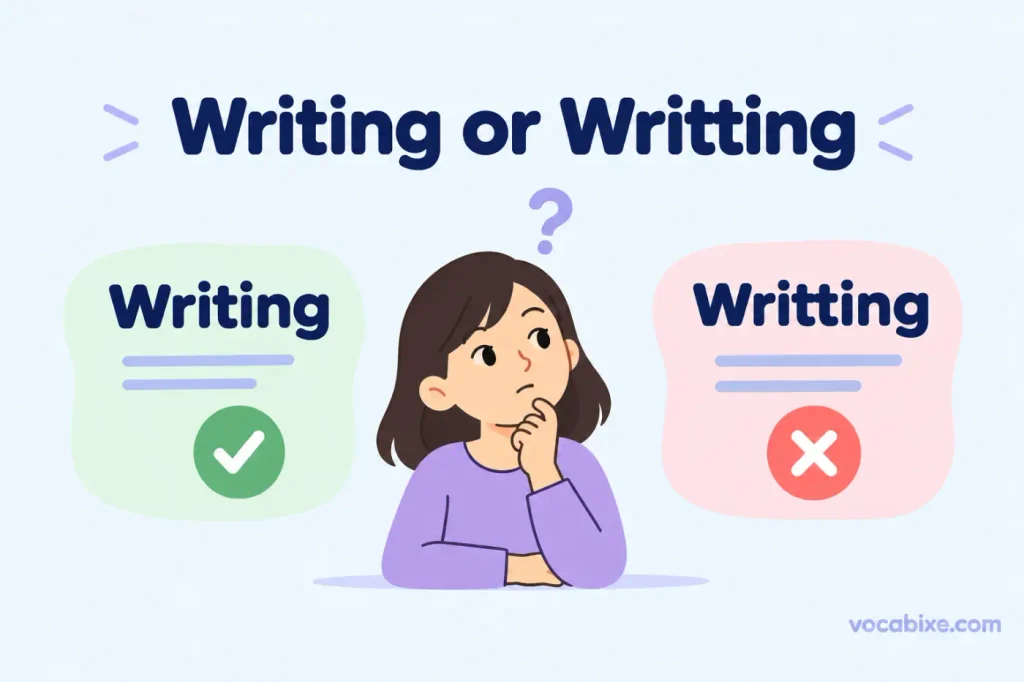
Many English learners wonder if the correct spelling is writing or writting. The correct spelling is writing. Writting is incorrect in standard English.
The word writing comes from the verb write. We use it when someone puts words, letters, or ideas on paper or on a screen. For example, you can say, “I am writing a letter to my friend.”
The confusion happens because many English verbs double their final consonant before adding -ing. However, write does not follow that pattern. The final e is removed, and the word becomes writing, not writting.
Simple Answer in One Look
The correct spelling is writing.
Writing = correct spelling
Writting = incorrect spelling
The spelling changes from write to writing by removing the final e and adding -ing. You do not add another t.
Correct: I am writing an email.
Incorrect: I am writting an email.
What Does Writing Mean?
Writing means putting words, letters, or ideas into a written form.
It can describe the action of creating words. It can also describe the words that someone has already created.
For example:
- She is writing a story.
- I enjoy writing in my notebook.
- His writing is easy to read.
- We are writing an English test.
The word can describe both an activity and the written work itself.
When someone says, “I am writing,” they mean they are creating words at that moment.
When someone says, “Your writing is very clear,” they are talking about the way the person writes or the quality of the written work.
Writing as an Action
Writing is often used to describe something happening now.
For example:
- Tom is writing a message.
- Sara is writing her homework.
- I am writing a short story.
Here, writing is the action of putting words into written form.
Writing as a Skill
Writing can also mean the skill of expressing ideas with words.
For example:
- Writing is an important school skill.
- Her writing has improved.
- Good writing is easy to understand.
In these sentences, writing is not one single action. It is a general skill or activity.
What Is the Correct Spelling?
The correct spelling is writing.
The incorrect form is writting.
The spelling rule is simple:
write → writing
The final e in write is removed before -ing is added.
So:
write + ing → writing
It does not become:
write + ing → writting
The second t is not part of the correct spelling.
Here are some correct examples:
- I am writing a letter.
- She is writing her name.
- He enjoys writing stories.
- We are writing an English essay.
A common mistake is to think that write needs a double t because some other English verbs double their final consonant.
For example:
- run → running
- sit → sitting
- swim → swimming
- stop → stopping
These words double the final consonant. Write does not.
The correct form remains writing. Related post to view endure vs indure.
What Is the Difference Between Writing and Writting?
There is no meaning difference between writing and writting because writting is not the standard English spelling of the word.
Writing
Writing is the correct form.
It means the act of putting words, letters, or ideas into written form.
Example:
I am writing a report for school.
Writting
Writting is an incorrect spelling.
You may see it in:
- Typing mistakes
- Student work
- Online comments
- Social media posts
- Informal messages
However, seeing a spelling mistake online does not make it a correct English word.
Quick Comparison
| Form | Correct? | Example |
|---|---|---|
| writing | Yes | I am writing a story. |
| writting | No | This is a common spelling mistake. |
If you need to use the word in school, work, an email, an essay, or another formal situation, always use writing.
Why Do People Get Confused?
There are several reasons people spell writing incorrectly.
1. People Remember the Word Write
The base verb is write.
When learners add -ing, they may think they should simply keep the letters and add the ending. That can cause confusion.
But English spelling changes in this case:
write → writing
The final e disappears.
2. The T Sound Can Be Confusing
The word writing contains a t sound. Some learners hear the sound and think there should be two t letters.
However, pronunciation does not always tell us exactly how many letters to write.
English has many words where spelling and pronunciation do not match perfectly.
3. Other Verbs Double Their Final Letter
This is probably one of the biggest reasons for the mistake.
Learners see:
- run → running
- sit → sitting
- get → getting
- plan → planning
Then they may assume:
- write → writting
But that is wrong.
Write has a different spelling pattern because the final e is removed.
4. Fast Typing
People often type quickly on phones and computers. A person may know the correct spelling but still type writting by mistake.
That is simply a typo.
5. Learning English Rules by Pattern
English spelling has many patterns, but not every word follows the same pattern.
A learner may correctly understand the rule for one group of verbs and then apply it to the wrong word.
That is why it helps to learn common word forms together.
Which One Should You Use?
Use writing whenever you mean the action or skill of putting words into written form.
A simple rule is:
write → writing
Do not double the t.
You can remember it like this:
Write loses e before -ing.
Examples:
- write → writing
- make → making
- take → taking
- give → giving
- use → using
The final e is removed in these forms.
If you mean the correct English word, choose writing.
Easy Examples in Real Sentences
Here are some natural examples using writing.
School
I am writing my English homework.
A student is putting answers into written form.
Work
Sarah is writing a report for her manager.
Sarah is creating a written report.
Family
My brother is writing a birthday card.
He is putting a message into the card.
Text Messages
I am writing a message to Mom.
The person is typing a message.
Conversations
I love writing about my travels.
The speaker enjoys creating written content about travel.
Shopping
I am writing a shopping list.
The person is making a list of things to buy.
Travel
He spent the evening writing about his trip.
He created a written record of his travel experience.
Social Media
She is writing a post for her followers.
She is preparing words for a social media post.
Common Mistakes to Avoid
Mistake 1: Writing “Writting”
Incorrect:
I am writting an email.
Correct:
I am writing an email.
The word has only one t.
Mistake 2: Keeping the Final E
Incorrect:
I am writeing a letter.
Correct:
I am writing a letter.
The final e is removed before -ing.
Mistake 3: Using the Base Form After “Am”
Incorrect:
I am write a letter.
Correct:
I am writing a letter.
After am in this type of sentence, we use the -ing form.
Mistake 4: Adding Two Ts
Incorrect:
She is writting her name.
Correct:
She is writing her name.
There is no double t.
Mistake 5: Thinking Writting Is a Different Word
Some learners think writing and writting may have different meanings.
They do not.
Writting is simply an incorrect spelling of writing.
Where Does the Word Writing Come From?
The word writing comes from the verb write.
The history of write goes back to Old English and earlier Germanic languages. The modern spelling developed over a long period as English changed.
The word is related to older Germanic words connected with marking, scratching, or making written signs.
English spelling changed over time. The pronunciation of write also changed. The w is silent in modern English.
Today, we pronounce write like “right.”
When we add -ing, the spelling changes:
write → writing
The final e is removed.
This spelling pattern is more useful for modern learners than memorizing the entire history of the word.
A Simple Spelling Rule for Write
You can learn this small group together:
- write → writing
- write → writes
- write → wrote
- write → written
- write → writer
Notice that the word changes in different ways depending on the grammar form.
For the -ing form, remember:
write → writing
This is the form you need when describing an action in progress or the activity of creating written words.
The most important point is that writing has one t.
A Useful Memory Trick
Try this sentence:
“I write, then I am writing.”
Say it a few times.
You can also remember:
WRITE drops E + ING = WRITING
This makes the spelling easier to remember.
Do not think:
WRITE + ING = WRITTTING
Instead, think:
WRIT + ING = WRITING
The final e disappears.
Transition to Section 2
Now that the spelling is clear, it helps to look at how writing works in everyday English. The word appears in school, work, personal messages, books, websites, and many other places. Understanding its different uses can make both your spelling and grammar stronger.
Section 2: Deep Meaning and Practical Use
How Is Writing Used in Real Life?
The word writing is extremely common in everyday English.
You may use it when talking about school work, emails, stories, notes, reports, messages, books, or personal thoughts.
Writing at School
Students write almost every day.
They may write:
- Answers
- Essays
- Stories
- Notes
- Reports
- Homework
- Exams
For example:
I am writing my science homework.
Or:
Good writing can make your ideas easier to understand.
Teachers may also talk about writing skills. These skills include choosing clear words, making sentences, organizing ideas, and checking spelling.
Writing at Work
Adults use writing in many jobs.
People write:
- Emails
- Reports
- Instructions
- Notes
- Plans
- Articles
- Messages
For example:
I am writing an email to my customer.
The word writing is perfectly normal in professional English.
Writing Online
People write on websites and social media every day.
They may write:
- Blog posts
- Comments
- Captions
- Reviews
- Messages
- Forum posts
For example:
She spends an hour writing blog posts every morning.
The same spelling rule still applies online. More related post to this article submission vs submittion.
Writing in Formal English
Writing is completely acceptable in formal English.
You can use it in:
- School essays
- University assignments
- Business emails
- Reports
- Applications
- Articles
- Professional documents
Examples:
Writing clearly is an important communication skill.
He is writing a formal letter to the company.
There is no need to replace writing with another word simply because the situation is formal.
The key is to use the word correctly and build a clear sentence around it.
Writing in Informal English
The word is also common in casual English.
Friends may say:
What are you writing?
Or:
I’m writing a message right now.
People use the word in texts, chats, and conversations without any problem.
The spelling does not change between formal and informal English.
Writing is correct in both.
Writing vs Write
A common grammar question is the difference between write and writing.
Write
Write is the base form of the verb.
Examples:
I write every day.
Please write your name here.
Writing
Writing is the -ing form.
Examples:
I am writing now.
She is writing a letter.
The word changes because the sentence structure changes.
Compare:
I write emails every day.
I am writing an email now.
The first sentence talks about a regular activity.
The second sentence describes an action happening now.
Writing vs Written
Another useful comparison is writing and written.
Writing describes an action or activity.
She is writing a book.
Written usually describes something that has been completed or exists in written form.
She has written a book.
The difference is important.
If someone is creating the words now, you may use writing.
If the words have already been created, written may be the correct form.
How Is Writing Understood in Culture and Stories?
Writing has a major place in human culture.
People use writing to record stories, history, ideas, laws, memories, and personal experiences.
A story can be passed from one person to another through writing. A diary can preserve someone’s thoughts. A letter can carry a message across time and distance.
Books are one of the most familiar forms of writing.
People also use writing to tell fictional stories. A writer may create characters, places, problems, and adventures using words.
In modern life, writing is not limited to paper. Much of our writing happens on screens.
People write:
- Emails
- Websites
- Digital books
- Social media posts
- Online reviews
- Text messages
The basic idea stays the same: writing turns thoughts and language into a written form.
Related Words You Should Know
Learning related words can make the spelling easier to remember.
Write
Write means to put words or letters into written form.
Please write your name.
Writer
A writer is a person who writes.
My favorite writer published a new book.
Written
Written is another form of the verb write.
She has written three stories.
Writes
Writes is used with certain subjects in the present tense.
He writes every morning.
Wrote
Wrote is the past form of write.
She wrote a letter yesterday.
Rewriting
Rewriting means writing something again, often to improve it.
I am rewriting my essay.
Handwriting
Handwriting means the way a person writes by hand.
His handwriting is very neat.
Writer’s
Writer’s can show possession or describe something connected to a writer.
The writer’s notebook was on the desk.
Writing Skills
Writing skills are the abilities needed to create clear and useful written language.
Her writing skills have improved.
How to Use Writing Correctly
There are several simple ways to use writing.
Use Writing for an Action Happening Now
Use writing after forms of be when describing an action in progress.
Examples:
I am writing.
He is writing.
They are writing.
Use Writing for the General Activity
You can also use writing as the name of an activity.
Writing takes practice.
I enjoy writing.
Writing can help you organize your thoughts.
Use Writing Before a Noun
Sometimes writing helps describe something connected with written work.
Examples:
writing skills
writing practice
writing class
writing exercise
Do Not Spell It Writting
This is the main spelling rule to remember.
Correct:
writing
Incorrect:
writting
Correct:
writing a story
Incorrect:
writting a story
Real-Life Usage Examples
Here are more examples that show how native English speakers use writing naturally.
- My teacher asked us to start writing a short story.
- I am writing down the address before I forget it.
- She enjoys writing poems in her free time.
- He is writing a message to his friend.
- Writing every day can help you improve your English.
- The student is writing the answer on the board.
- I finished writing my application last night.
- They are writing notes during the meeting.
- Good writing should make the main idea clear.
- She started writing after dinner.
Notice that the spelling stays the same in every example.
Common Questions People Have
Is “writting” ever correct?
No. Writting is not the standard spelling of the English word. The correct spelling is writing.
Why is writing spelled with one T?
Because the verb write loses its final e before -ing is added.
write → writing
There is no need to double the t.
Is writing a verb?
Writing can be a form of the verb write, as in “She is writing.” It can also function as a noun, as in “Writing is difficult.”
Is writing a present tense word?
It can be part of the present continuous form.
I am writing.
It can also describe writing as a general activity.
Writing is useful.
Is “writeing” correct?
No. Writeing is also incorrect.
The correct spelling is writing.
The final e is removed before -ing is added.
Is writing used in American English?
Yes. Writing is standard in American English.
It is also standard in British English. The spelling writing does not change between these two varieties.
How do you pronounce writing?
Writing is generally pronounced like “RY-ting.”
The w is not pronounced as a separate “w” sound in the way learners may expect from other words.
What is the past tense of writing?
The past tense of write is wrote.
For example:
I wrote a letter yesterday.
The past participle is written.
I have written a letter.
A Quick Test to Check Your Spelling
If you are unsure about writing, start with the base word:
write
Now remove the final e:
writ
Then add -ing:
writing
This gives you the correct spelling.
You can use the same idea with several other verbs:
- make → making
- take → taking
- give → giving
- use → using
- move → moving
This pattern can help you avoid adding an unnecessary letter.
Why “Running” Is Different From “Writing”
This comparison is useful because it explains why learners sometimes make the mistake.
Look at:
run → running
The final consonant is doubled.
Now look at:
write → writing
The final e is removed.
Why?
English spelling rules depend on the form of the base word and its ending. A short verb such as run can double its final consonant before -ing. A verb ending in silent e, such as write, usually drops the e before adding -ing.
So these forms are different:
run → running
sit → sitting
write → writing
make → making
Learning the word family is often easier than trying to apply one rule to every English verb.
Writing in Everyday Communication
Writing is part of daily communication.
- You may write a quick note to a family member.
2. You may write a message to a friend.
3. You may write an email at work.
4. You may write an assignment for school.
5. You may write a review after buying something.
6. You may write a caption for a photo.
The purpose can change, but the spelling does not.
Always use writing.
A Simple Classroom Exercise
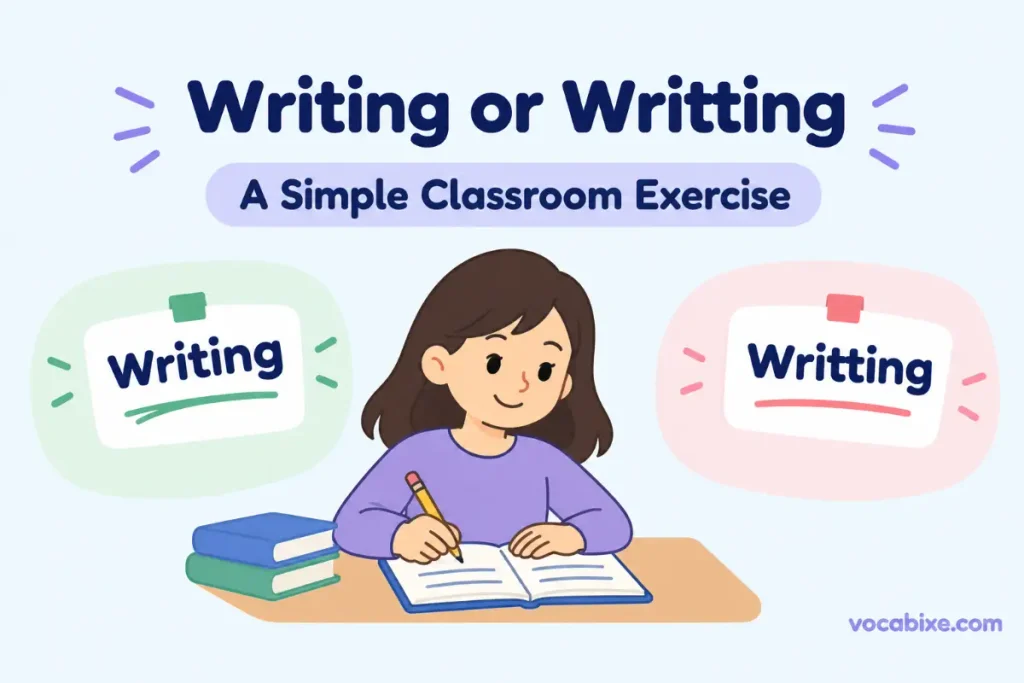
Try completing these sentences:
- I am ________ a letter.
- She is ________ her homework.
- He enjoys ________ stories.
- We are ________ an email.
- ________ helps me express my ideas.
The answer to each blank is writing.
Now try these:
- I am writting a letter.
- She is writeing her homework.
- He is writing a story.
Only the third sentence has the correct spelling.
The correct forms are:
- writing
- writing
- writing
A Simple Way to Remember the Difference
Imagine the word write holding a small letter e.
When -ing arrives, the e leaves.
So:
WRITE + ING
becomes:
WRITING
The t does not double.
You can remember the short rule:
Drop the E. Keep one T.
That gives you:
writing
This is a useful spelling trick for students, writers, and anyone learning English.
Final Teacher Explanation
If you remember only one thing from this lesson, remember this:
Writing is correct. Writting is incorrect.
The word comes from write. When you add -ing, the final e is removed.
So:
write → writing
Do not add a second t.
You may see writting online or in someone’s message. That does not make it a correct spelling. It is usually a simple spelling or typing mistake.
The same rule helps with other verbs such as:
- make → making
- take → taking
- give → giving
- use → using
English spelling has many rules and some exceptions, but this particular word is easy once you remember the pattern.
Final Answer — Quick Recap
The correct spelling is writing. Writting is an incorrect spelling.
Use writing when you mean the action of putting words or ideas into written form. The spelling comes from write + ing, with the final e removed: write → writing.
The easiest memory rule is: Drop the E and keep one T.
Once you learn this pattern, the spelling becomes much easier. If you are writing a school assignment, email, article, message, or professional document, always choose writing.
Good spelling makes your message easier to understand. A small mistake such as writting can be avoided by checking the base word. Start with write, remove the final e, and add -ing.
Conclusion
The spelling question writing or writting has a simple answer: writing is the correct form. Writting is a common spelling mistake, not a different English word.
Remember the basic pattern: write → writing. Remove the final e, add -ing, and keep only one t. This simple rule will help you write the word correctly in school, work, messages, and everyday English.
Frequently Asked Questions
Is writing or writting correct?
Writing is correct. Writting is an incorrect spelling.
What does writing mean in simple English?
Writing means putting words, letters, or ideas into written form.
For example:
I am writing a letter.
How do I use writing in a sentence?
Use writing when talking about the action or activity of putting words into written form.
Example:
She is writing a story.
Why do people spell writing as writting?
People may confuse it with verbs such as run → running or sit → sitting. Fast typing can also cause the mistake.
Is writting accepted in English?
No. Writting is not the standard spelling. The correct form is writing.
Is writing formal or informal English?
Writing is used in both formal and informal English. You can use it in school essays, business emails, books, text messages, and everyday conversations.
Is writing American or British English?
Writing is used in both American English and British English. The spelling is the same in both varieties.
Is writeing correct?
No. Writeing is incorrect. The correct spelling is writing because the final e in write is removed before -ing is added.
Pingback: Preform vs Perform: Clear Difference Explained Simply - Vocabixe
Pingback: Comming vs Coming: Correct Spelling Explained Simply 2026 - Vocabixe