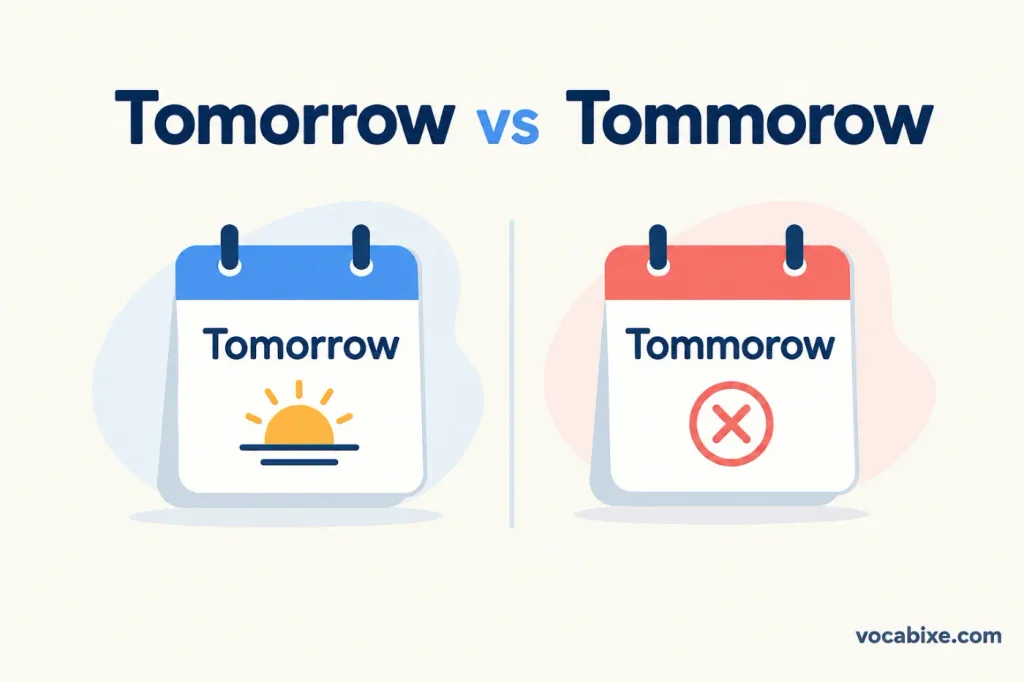
Many people search for tomorrow vs tommorow because the two spellings look almost the same. Only one spelling is correct in standard English.
The correct spelling is tomorrow. The spelling tommorow is incorrect. It is a common spelling mistake caused by putting the letters in the wrong order.
Tomorrow means the day after today. You can use it when talking about plans, events, school, work, travel, or anything that will happen on the next day.
Simple Answer in One Look
The correct spelling is tomorrow.
Tommorow is a common spelling mistake and should not be used in school, work, or formal writing. Remember the correct order: tomorrow has one “m” after the “to” and two “r” letters near the end.
Example:
- Correct: I will call you tomorrow.
- Incorrect: I will call you tommorow.
What Does “Tomorrow” Mean?
Tomorrow means the day after today.
If today is Monday, tomorrow is Tuesday. If today is Friday, tomorrow is Saturday.
Here is a simple example:
Today is March 10. Tomorrow is March 11.
The word describes a future day. It does not describe today or yesterday.
- Today means this day.
- Tomorrow means the next day.
- Yesterday means the day before today.
These three words help us talk about time.
Examples of the Meaning
- I have a test tomorrow.
- We are going to the store tomorrow.
- Tomorrow will be a busy day.
- She will start her new job tomorrow.
- The package should arrive tomorrow.
In each sentence, the event will happen on the day after today.
The word can also refer to the near future in a general way. For example, someone may say, “Tomorrow is a new chance.” This does not always mean only the next calendar day. It can also suggest the future.
What Is the Correct Spelling?
The correct spelling is tomorrow.
It is spelled:
t-o-m-o-r-r-o-w
There are two useful spelling points to remember:
- The word starts with tom.
- The word has two r’s near the end.
The incorrect spelling tommorow changes the order of the letters. It uses two “m” letters close together and only one “r.” That is why it is not accepted as the standard spelling. View other words articles pieces vs peices
.
Correct and Incorrect Forms
- Correct: tomorrow
- Incorrect: tommorow
- Correct: See you tomorrow.
- Incorrect: See you tommorow.
The mistake is easy to make because the word contains several repeated letters. When people type quickly, they may remember that the word has repeated letters but place them in the wrong spots.
Sentence Examples
- I will finish my homework tomorrow.
- Tomorrow is my brother’s birthday.
- We need to leave early tomorrow.
- The doctor can see you tomorrow afternoon.
- I hope the weather is better tomorrow.
How to Remember the Spelling
A helpful memory trick is:
One “m,” two “r’s”: tomorrow.
You can also divide the word into smaller parts:
to-mor-row
This is not a full pronunciation guide, but it can help you remember the letter pattern.
Another memory sentence is:
Tomorrow has one “m” and two “r’s.”
Write the word several times if you often misspell it:
- tomorrow
- tomorrow
- tomorrow
After you see the correct form many times, it will feel more natural.
What Is the Difference Between “Tomorrow” and “Tommorow”?
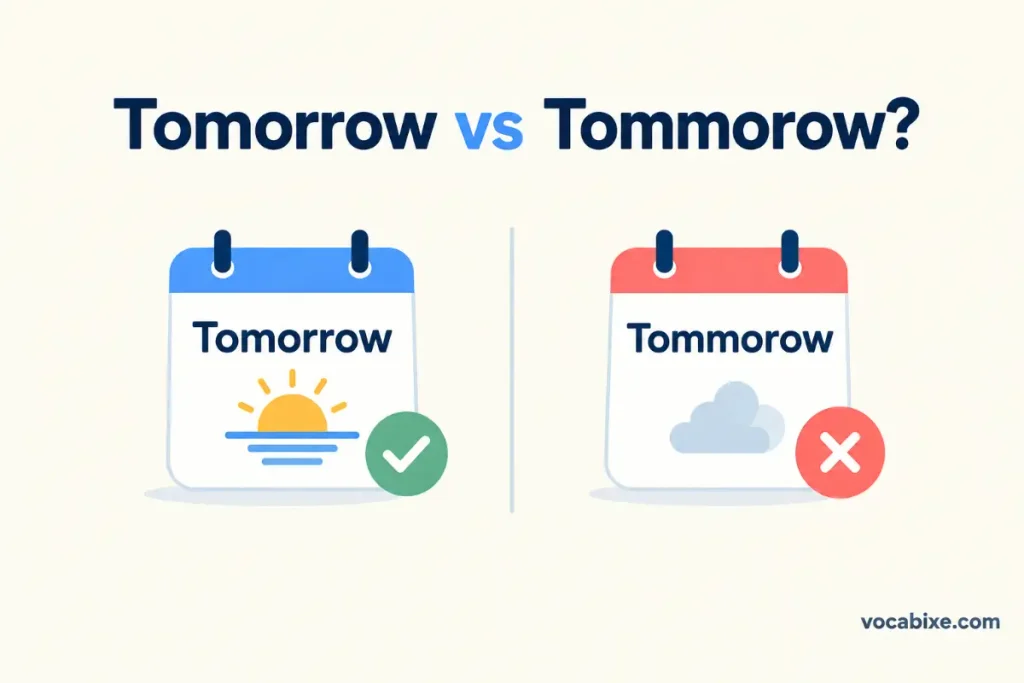
There is no meaning difference between tomorrow and tommorow because tommorow is not a correct English word.
The difference is spelling and correctness.
| Form | Is it correct? | Meaning |
|---|---|---|
| tomorrow | Yes | The day after today |
| tommorow | No | Intended to mean the day after today |
When someone writes tommorow, readers usually understand the intended meaning. However, understanding the word does not make the spelling correct.
Use tomorrow in:
- School assignments
- Emails
- Resumes
- Business writing
- Online articles
- Text messages
- Social media posts
- Notes and lists
Some people may use the incorrect spelling in a casual message, but it is still better to use the correct form.
A Short Comparison
Tomorrow:
- Correct spelling
- Used in standard English
- Means the day after today
- Appropriate in formal and informal writing
Tommorow:
- Incorrect spelling
- Often caused by a typing or memory mistake
- Has no separate meaning
- Should be corrected
Why Do People Get Confused?
People confuse these spellings for several simple reasons.
The Word Has Repeated Letters
The word tomorrow has repeated letters. It contains two “r” letters, and this can make the spelling hard to remember.
Some people remember that there is a repeated letter but use two “m” letters instead:
- Wrong: tommorow
- Right: tomorrow
The Pronunciation Does Not Show Every Letter Clearly
When people say tomorrow, they usually pronounce it quickly. In everyday speech, some sounds may be soft or reduced.
The spoken word may sound like:
tuh-MOR-oh
Because the final letters are not strongly pronounced one by one, listeners cannot always guess the spelling from the sound.
People Type Too Quickly
The incorrect spelling often appears when someone is writing fast. A person may know the correct spelling but accidentally type the letters in the wrong order.
This is especially common in:
- Text messages
- Search boxes
- Chat messages
- Social media comments
- Quick notes
The Letter Pattern Feels Unusual
Many English words with repeated letters follow different patterns. For example:
- summer has two “m” letters
- common has two “m” letters
- tomorrow has one “m” and two “r” letters
People may use a familiar spelling pattern from another word.
Spellcheck May Not Always Help
Most modern writing tools recognize tommorow as a spelling mistake. However, spellcheck may be turned off, or a person may ignore the red underline.
Also, spellcheck does not always catch every error. It is still useful to learn the word yourself.
Which One Should You Use?
Use tomorrow when you mean the day after today.
Do not use tommorow. It is an incorrect spelling.
The easy rule is:
Use “tomorrow” with one “m” and two “r’s.”
If you mean the next day, choose tomorrow:
- I will see you tomorrow.
- The meeting is tomorrow.
- We can talk about it tomorrow.
If you are writing tommorow, stop and change it to tomorrow.
Easy Examples in Real Sentences
Here are simple examples from everyday English.
School
- Our science project is due tomorrow.
- I need to study for the math test tomorrow.
- The teacher will return our papers tomorrow.
Work
- I will send the report tomorrow morning.
- The meeting starts at nine tomorrow.
- Please finish the form by tomorrow.
Family
- Grandma is coming to visit tomorrow.
- We will clean the house tomorrow.
- My sister has a soccer game tomorrow.
Text Messages
- Can we talk tomorrow?
- See you tomorrow!
- I am busy today, but I can help tomorrow.
Shopping
- The store is having a sale tomorrow.
- I will buy the groceries tomorrow.
- The new shoes arrive tomorrow.
Travel
- Our flight leaves tomorrow afternoon.
- We will reach the hotel tomorrow.
- I need to pack my bags tonight because we leave tomorrow.
Social Media
- New video coming tomorrow.
- The results will be posted tomorrow.
- I will share more photos tomorrow.
Common Mistakes to Avoid
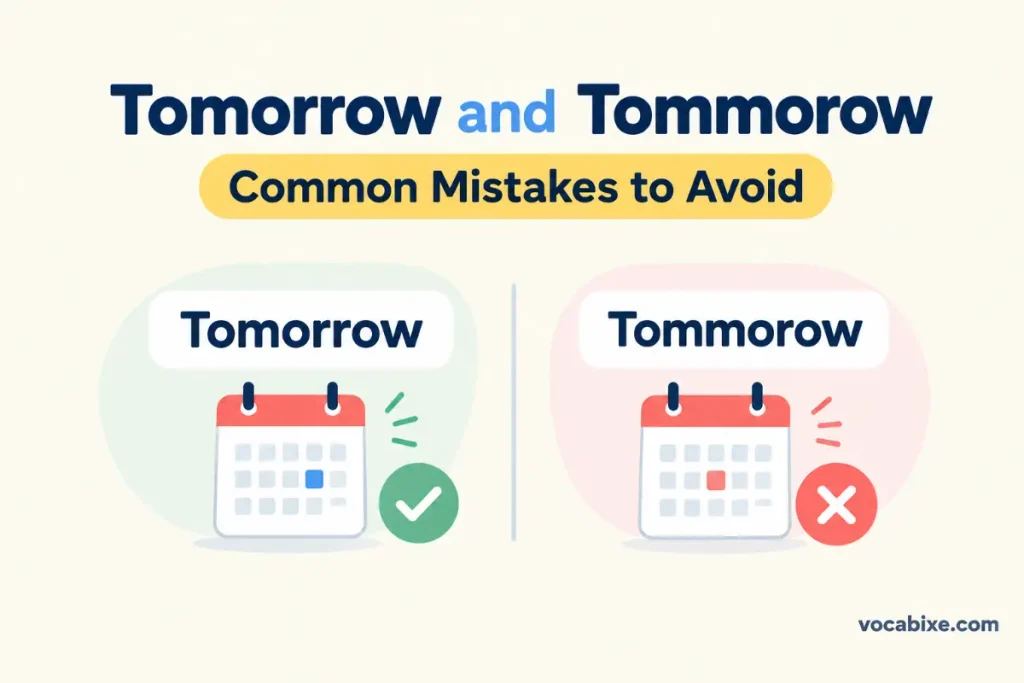
Mistake 1: Writing “tommorow”
Incorrect:
I will visit you tommorow.
Correct:
I will visit you tomorrow.
The correct word has one “m” after “to.”
Mistake 2: Writing “tomorow”
Incorrect:
The game is tomorow.
Correct:
The game is tomorrow.
This form has only one “r.” The correct spelling has two “r’s.”
Mistake 3: Writing “tommorrow”
Incorrect:
We will leave tommorrow.
Correct:
We will leave tomorrow.
This version has two “m” letters and two “r” letters. It contains an extra “m.”
Mistake 4: Using “tomorrow” for yesterday
Incorrect meaning:
Yesterday, I will go to the dentist tomorrow.
The time words do not match. Use the word that fits the time.
Correct:
I went to the dentist yesterday.
Or:
I will go to the dentist tomorrow.
Mistake 5: Forgetting the Capital Letter
At the beginning of a sentence, write Tomorrow with a capital “T.”
- Correct: Tomorrow will be sunny.
- Correct: I will go tomorrow.
- Incorrect: tomorrow will be sunny.
The word does not need a capital letter in the middle of a sentence unless it is part of a title or special name.
Mistake 6: Adding an Unneeded Preposition
People sometimes write:
I will see you on tomorrow.
In standard English, this is usually incorrect. Say:
I will see you tomorrow.
We normally do not use on before tomorrow.
However, on can be used with a specific day:
I will see you on Tuesday.
You can also say:
I will see you tomorrow, on Tuesday.
Where Does the Word Come From?
The word tomorrow comes from an old English expression that meant “on the next morning” or “on the day after today.” Dive into other grammar word frescade meaning
.
Over time, the expression became shorter. The words joined together and developed into the modern word tomorrow.
The word is now used in many English-speaking places, including the United States, Canada, the United Kingdom, Australia, and New Zealand.
Although pronunciation can vary slightly by region, the standard spelling remains tomorrow.
Is “Tomorrow” American or British English?
Tomorrow is used in both American English and British English.
There is no special American spelling and no separate British spelling. Both forms use:
tomorrow
The incorrect spelling tommorow is not a standard regional form. It is simply a spelling mistake.
The same spelling is used in:
- American English
- British English
- Canadian English
- Australian English
- Other major forms of English
Transition to Section 2
Knowing the correct spelling is the first step. The next step is learning how native speakers use tomorrow in different situations. The word is simple, but it can appear in questions, promises, plans, schedules, stories, and common expressions.
How Is “Tomorrow” Used in Real Life?
Native English speakers use tomorrow very often. It is one of the most common time words in everyday English.
You can use it when talking about something planned, expected, promised, or possible.
Talking About Plans
Use tomorrow to talk about plans for the next day.
- I am going to the dentist tomorrow.
- We are meeting at the library tomorrow.
- They plan to move tomorrow.
The verb can change depending on how certain the plan is.
Compare these examples:
- I will call you tomorrow.
- I am calling you tomorrow.
- I might call you tomorrow.
- I want to call you tomorrow.
All four sentences mention the next day, but they show different levels of certainty.
Asking About Plans
You can ask questions with tomorrow.
- What are you doing tomorrow?
- Are you working tomorrow?
- Will you be home tomorrow?
- Can we meet tomorrow?
- Is the store open tomorrow?
These questions are common in conversations and text messages.
Making Promises
People often use tomorrow when making a promise.
- I will clean my room tomorrow.
- I will give you an answer tomorrow.
- I promise I will finish it tomorrow.
A promise about tomorrow may sound certain. If the speaker is not sure, they can use words such as maybe, probably, or might.
- Maybe I can help tomorrow.
- I will probably finish it tomorrow.
- I might visit tomorrow.
Giving Deadlines
At school and work, tomorrow can describe a deadline.
- Please send your homework by tomorrow.
- The application must be finished tomorrow.
- We need the final design tomorrow morning.
The phrase by tomorrow means no later than tomorrow.
For example:
Please call me by tomorrow.
This means you can call today or tomorrow, but you should not wait longer.
Talking About Weather
People often use tomorrow in weather reports.
- It will rain tomorrow.
- Tomorrow will be warmer.
- There may be snow tomorrow morning.
- The weather should improve tomorrow.
The word can appear at the beginning or end of the sentence:
- Tomorrow will be sunny.
- It will be sunny tomorrow.
Both sentences are correct.
Talking About School and Work Schedules
- School starts again tomorrow.
- My work schedule changes tomorrow.
- The office will open late tomorrow.
- The students have a holiday tomorrow.
These sentences show that tomorrow works well with schedules and calendars.
How Is “Tomorrow” Used in Formal and Informal English?
The word tomorrow is correct in both formal and informal English.
Formal Examples
- The committee will meet tomorrow.
- Please submit the document by tomorrow afternoon.
- The office will reopen tomorrow.
- The interview is scheduled for tomorrow.
Informal Examples
- See you tomorrow!
- Want to hang out tomorrow?
- I will text you tomorrow.
- I am too tired today. Maybe tomorrow.
The word itself does not sound too formal or too casual. The surrounding words create the tone.
For formal writing, use a complete sentence and clear details:
The training session will begin tomorrow at 10:00 a.m.
For an informal message, a short phrase is enough:
See you tomorrow!
How Is “Tomorrow” Used in Texting?
In texting, people often shorten their sentences. They may write:
- Tomorrow?
- Can you come tomorrow?
- Not today. Tomorrow works.
- Talk to you tomorrow.
- I will send it tomorrow.
These forms are natural in casual messages.
Some people may misspell the word as tommorow while texting. The fast pace of texting can cause mistakes, but the standard spelling is still tomorrow.
Using the correct spelling helps your messages look clear and careful, especially when writing to:
- A teacher
- A manager
- A customer
- A new client
- A school office
- Someone you do not know well
How Is “Tomorrow” Used in Questions?
Many common English questions include tomorrow.
1. Questions About Time
- What time is the event tomorrow?
- When should I arrive tomorrow?
- What will you do tomorrow?
- Is your appointment tomorrow?
2. Questions About Availability
- Are you free tomorrow?
- Can you work tomorrow?
- Will you be available tomorrow morning?
- Do you have time tomorrow?
3. Questions About Plans
- Are you traveling tomorrow?
- Will you study tomorrow?
- Are you going shopping tomorrow?
- Who is coming tomorrow?
A short answer may be enough:
- Yes, I am free tomorrow.
- No, I am busy tomorrow.
- Tomorrow afternoon works for me.
- I am not sure about tomorrow yet.
Does “Tomorrow” Always Mean the Next Calendar Day?
Usually, tomorrow means the next calendar day after today.
But in some expressions, it can have a wider meaning. It may refer to the future.
For example:
The leaders of tomorrow will solve new problems.
Here, tomorrow does not mean one specific date. It means the future generation.
Another example is:
Tomorrow’s technology may change how we work.
This means future technology, not only technology that appears the next day.
The exact meaning depends on context.
Common Expressions With “Tomorrow”
See You Tomorrow
See you tomorrow is a friendly way to say goodbye when you expect to meet the person the next day.
- I have to go now. See you tomorrow!
- See you tomorrow at school.
Tomorrow Morning
This means the morning of the next day.
- I will call you tomorrow morning.
- We need to leave tomorrow morning.
Tomorrow Afternoon
This means the afternoon of the next day.
- The appointment is tomorrow afternoon.
- I can meet you tomorrow afternoon.
Tomorrow Night
This means the night of the next day.
- We are watching a movie tomorrow night.
- I work tomorrow night.
By Tomorrow
This means no later than tomorrow.
- Please finish the project by tomorrow.
- I need your answer by tomorrow.
Until Tomorrow
This means up to the next day.
- We will wait until tomorrow.
- The shop is closed until tomorrow.
Tomorrow’s
Tomorrow’s is the possessive form. It means something connected with the next day.
- Tomorrow’s meeting starts at nine.
- I need to prepare for tomorrow’s test.
- Tomorrow’s weather may be cold.
The apostrophe is important. Tomorrow’s and tomorrows are not the same.
How Is “Tomorrow” Understood in Culture and Stories?
The idea of tomorrow appears often in books, songs, movies, and daily conversations. Writers use the word because it points toward the future.
In stories, tomorrow may represent:
- A new chance
- A planned event
- A difficult day ahead
- Hope for change
- A promise
- An unknown future
These meanings come from the situation, not from a secret dictionary meaning.
For example, a character who says, “Tomorrow I will try again,” may be showing hope. A character who says, “I am afraid of tomorrow,” may be worried about the future.
In ordinary conversation, people also use the word to talk about fresh starts:
- I made a mistake today, but tomorrow I can do better.
- We can try again tomorrow.
- Tomorrow is another day.
These expressions are easy to understand because people naturally think of a new day as a new opportunity.
Related Words You Should Know
Today
Today means the current day.
- I am busy today.
- Today is Monday.
It is closely connected to tomorrow because tomorrow follows today.
Yesterday
Yesterday means the day before today.
- I saw him yesterday.
- Yesterday was very cold.
Tonight
Tonight means the night of today.
- I am staying home tonight.
- We have dinner tonight.
Morning
Morning is the first part of the day.
- I will call you tomorrow morning.
Afternoon
Afternoon is the part of the day after noon and before evening.
- We have a meeting tomorrow afternoon.
Evening
Evening is the later part of the day before night.
- She is arriving tomorrow evening.
Future
The future is the time that has not happened yet.
Tomorrow is part of the near future.
Soon
Soon means in a short time.
- I will see you soon.
- The bus will arrive soon.
Unlike tomorrow, soon does not name a specific day.
Later
Later means after now or after another time.
- I will do it later.
- We can talk later tomorrow.
Next
Next means the one that follows.
- next week
- next month
- next year
- the next day
The next day may be tomorrow, depending on the sentence. Learn about stich vs stitch difference.
.
How to Use “Tomorrow” Correctly
Use tomorrow when you mean the day after today.
Operate It After the Verb
- I will leave tomorrow.
- She is studying tomorrow.
- They arrive tomorrow.
Use It at the Beginning of a Sentence
- Tomorrow, we will visit the museum.
- Tomorrow will be a busy day.
- Tomorrow, I need to wake up early.
When tomorrow begins a sentence as an opening time phrase, a comma may be used for clarity.
Use It With Time Words
- tomorrow morning
- tomorrow afternoon
- tomorrow evening
- tomorrow night
Examples:
- I have class tomorrow morning.
- We will eat dinner tomorrow night.
Use “By Tomorrow” for a Deadline
- Finish the form by tomorrow.
- Please reply by tomorrow.
Do Not Add “On” Before It
Usually write:
- I will see you tomorrow.
Not:
- I will see you on tomorrow.
Use on with a named day:
- I will see you on Monday.
- I will see you on July 12.
Real-Life Usage Examples
- The bus leaves tomorrow at six in the morning.
- I need to wash my car tomorrow.
- Our new neighbor is moving in tomorrow.
- The library will close early tomorrow.
- Please remind me tomorrow.
- We can discuss the problem tomorrow.
- My cousin is flying home tomorrow.
- Tomorrow’s class will take place online.
- The doctor asked me to return tomorrow.
- I hope I feel better tomorrow.
These examples show that the word can be used with plans, schedules, health, travel, school, and daily chores.
Common Questions People Have
Is “tommorow” a word?
No. Tommorow is not the standard spelling. The correct word is tomorrow.
Why is “tommorow” wrong?
It has the letters in the wrong pattern. It uses two “m” letters instead of one “m” and two “r” letters.
Does “tomorrow” have one or two m’s?
Tomorrow has one “m.”
Correct spelling:
t-o-m-o-r-r-o-w
Does “tomorrow” have one or two r’s?
Tomorrow has two “r” letters.
A useful memory rule is:
One m, two r’s.
Can “tomorrow” be used in formal writing?
Yes. Tomorrow is correct in formal and informal writing.
- The report is due tomorrow.
- The meeting will take place tomorrow.
Is “tomorrow” American or British English?
It is used in both American and British English. The spelling is the same.
What is the difference between “tomorrow” and “the next day”?
Tomorrow usually means the day after today. The next day can mean the day after another day mentioned in a story or conversation.
Example:
Today is Monday. I will leave tomorrow.
In a story:
She arrived on Tuesday. The next day, she visited the museum.
Final Teacher Explanation
The spelling problem is easy to solve once you focus on the letter pattern.
The correct word is tomorrow. It means the day after today. It begins with tom, contains one m, and has two r’s near the end.
The spelling tommorow is incorrect. It does not describe a different kind of tomorrow. It is simply a common mistake.
When you write about the next day, use tomorrow:
I will finish my homework tomorrow.
You can use the word in school writing, work emails, texts, conversations, stories, and formal documents. It works everywhere in English.
Final Answer: Quick Recap
The correct spelling is tomorrow, not tommorow. Tomorrow means the day after today and is used in both American and British English.
Remember the simple rule:
Tomorrow has one “m” and two “r’s.”
If you are writing tommorow, correct it to tomorrow before you finish your sentence.
The word is common in everyday English. You can use it to talk about plans, deadlines, appointments, travel, school, work, and future hopes.
FAQ
What does “tomorrow” mean in simple English?
Tomorrow means the day after today.
If today is Wednesday, tomorrow is Thursday.
Is “tomorrow” or “tommorow” correct?
Tomorrow is correct. Tommorow is an incorrect spelling.
How do I spell tomorrow correctly?
Spell it this way:
t-o-m-o-r-r-o-w
It has one “m” and two “r’s.”
How do I use “tomorrow” in a sentence?
Use tomorrow when talking about the day after today.
Example:
We will go shopping tomorrow.
Why do people spell “tomorrow” incorrectly?
People may confuse the repeated letters, type too quickly, or remember the letter pattern incorrectly. The pronunciation also does not clearly show every letter.
Is “tommorow” accepted in English?
No. It may be understood, but it is not the standard correct spelling.
Can I use “tomorrow” in a school assignment?
Yes. Tomorrow is the correct spelling and is suitable for school assignments.
Is “tomorrow” used in American English?
Yes. American English uses tomorrow. British English uses the same spelling.
Conclusion
The answer to tomorrow vs tommorow is clear: tomorrow is the correct spelling, and tommorow is a spelling mistake.
Use tomorrow when you mean the day after today. Keep the spelling pattern in mind: one “m” and two “r’s.” This small memory rule can help you avoid one of the most common spelling mistakes in everyday English.
Pingback: PAWG Meaning English: Simple Definition, Usage, and Examples - Vocabixe