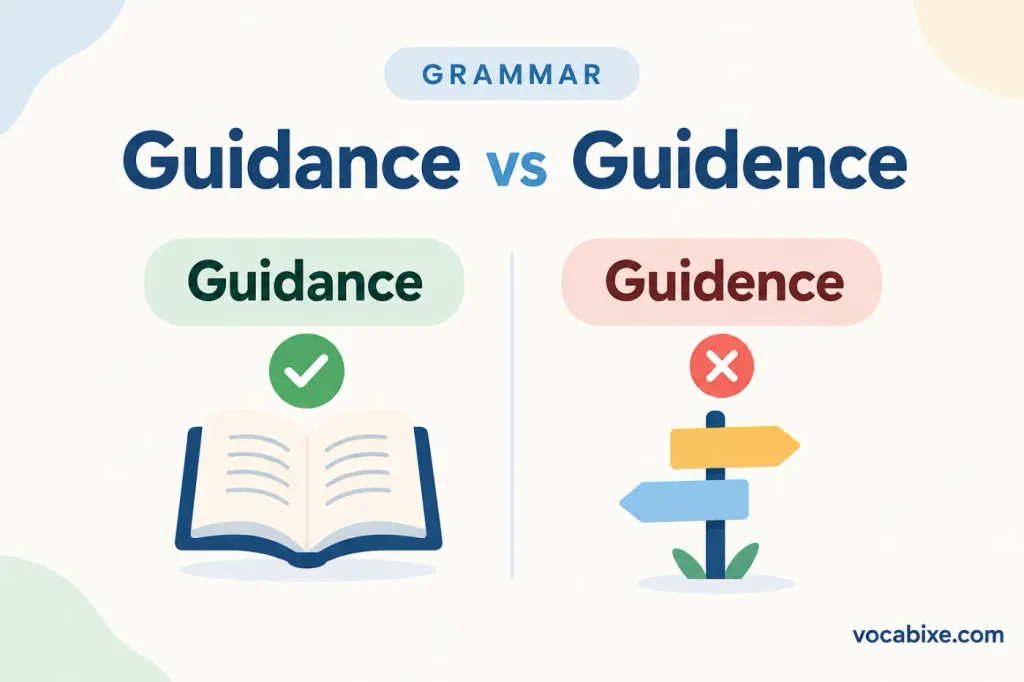
If you have ever paused while typing this word, you are not alone. Many people stop and ask, “Is it guidance or guidence?” This mix-up happens because the word sounds a little different than it looks when you write it out.
The short answer is simple. Guidance is the correct spelling. Guidence is a common spelling mistake that many people make by accident. This mistake usually happens because of the way the word sounds when we say it out loud.
In this article, you will learn the correct spelling, what the word means, why so many people get it wrong, and how to use it the right way in your own writing. By the end, you will never have to second-guess this word again.
Simple Answer in One Look
Guidance is the only correct spelling. Guidence is not a real word in English, even though it looks like it could be. The confusion happens because the “a” in guidance is not pronounced clearly when we speak. People hear a soft “uh” sound and guess it should be an “e” instead of an “a.” Just remember: guidance has an “a,” and that is the version you should always use.
What Does Guidance Mean?
Guidance means help or advice that someone gives you to make a decision or find the right path. It is the noun form of the verb “guide,” which means to lead or direct someone.
Think of guidance like a friendly hand pointing you in the right direction. A teacher gives guidance to a student who is confused about homework. A map gives guidance to a driver who does not know the way. A parent gives guidance to a child who is learning how to behave.
Here is a simple way to remember it. When someone “guides” you, they are giving you “guidance.” The word describes the help, advice, or direction that comes from that guiding.
What Is the Correct Spelling?
The correct spelling is guidance, spelled g-u-i-d-a-n-c-e. The incorrect spelling, guidence, is a common typing mistake, not a real English word.
Here are a few examples that show the correct spelling in action:
- She asked her counselor for guidance about college.
- The pilot needed guidance from air traffic control.
- His father’s guidance helped him choose the right career.
- The new employee received guidance from her manager.
If you ever forget which one is right, look at the ending. Correct English words that come from “guide” almost always keep that “a” sound in their related forms, like guidance and guidable. There is no standard English word spelled with “ence” in this case. Related memento vs momento.
Why Do People Get Confused?
People confuse guidance and guidence for a few clear reasons. Understanding these reasons can help you avoid the mistake in the future.
- Similar pronunciation: When we speak quickly, the “a” in guidance can sound like a soft “e.” Our ears do not always catch the difference.
- Pattern confusion: English has many words that end in “ence,” like patience, difference, and confidence. Because these words are common, people sometimes guess that guidance should follow the same pattern.
- Typing speed: When people type fast on a phone or computer, small letter swaps like “a” and “e” happen without anyone noticing.
- Autocorrect gaps: Some autocorrect tools do not always catch this mistake, especially in casual texting or social media posts.
None of these reasons mean someone is bad at spelling. This is one of the most naturally confusing word pairs in English because the sound and the common “ence” pattern both work against the writer.
Which One Should You Use?
Always use guidance. There is no situation in standard English writing where guidence is considered correct.
Here is an easy rule to remember:
If you are talking about help, advice, or direction, always choose guidance. If you ever see guidence written somewhere, treat it as a spelling mistake, not an alternate form of the word.
Easy Examples in Real Sentences
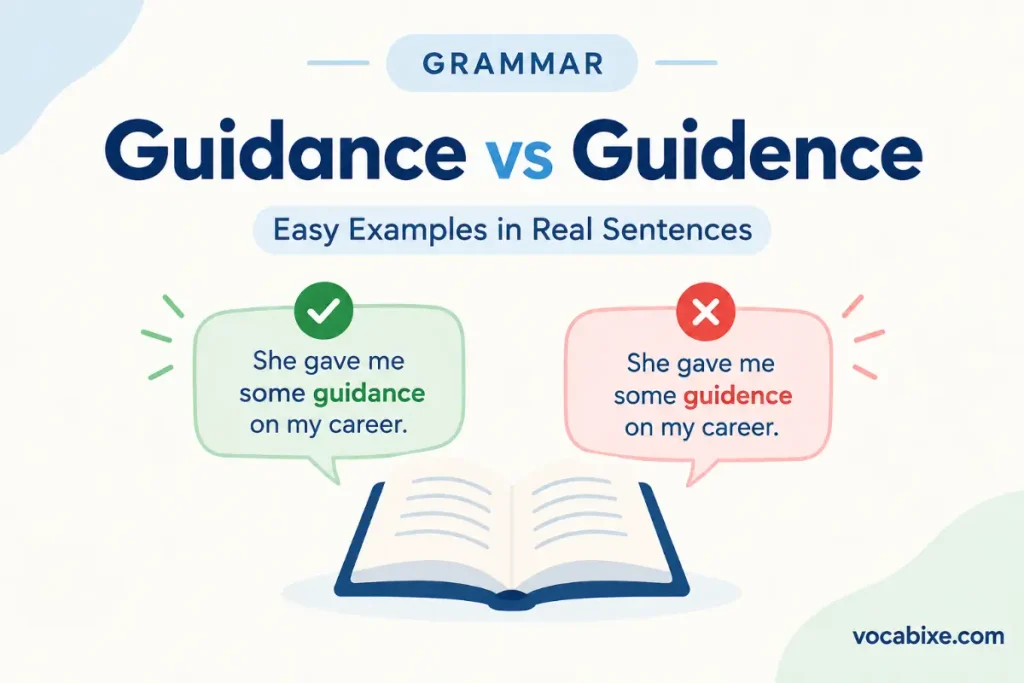
Real examples help the spelling stick in your memory. Here are some everyday situations where guidance fits naturally.
- School: The school counselor gave the students guidance about picking their classes.
- Work: My manager offered helpful guidance during my first week at the job.
- Family: Grandma always gives me good guidance when I feel stuck.
- Text message: Can you send me some guidance on how to fix this form?
- Conversation: I really needed some guidance before making that big decision.
- Shopping: The store clerk gave me guidance on which laptop to buy.
- Travel: The tour guide’s guidance made the trip much easier to plan.
- Social media: She posted a video full of guidance for new college students.
Notice how the word always points to help, direction, or advice. That is the pattern to look for whenever you use it.
Common Mistakes to Avoid
Here are the most common mistakes people make with this word, along with the correct version and a short explanation.
- Incorrect: I need some guidence with this project. Correct: I need some guidance with this project. This is the most common misspelling, caused by how the word sounds.
- Incorrect: She gave us clear guidence during the meeting. Correct: She gave us clear guidance during the meeting. The “ence” pattern from other words creates this mistake.
- Incorrect: He followed his coach’s guidence closely. Correct: He followed his coach’s guidance closely. This happens most often in fast typing or texting.
- Incorrect: The guidence counselor helped me pick a college. Correct: The guidance counselor helped me pick a college. This is a very common error because “guidance counselor” is a frequently used phrase.
Where Does the Word Come From?
Guidance comes from the verb “guide,” which entered English from Old French “guider,” meaning to lead or direct. The ending “-ance” is a common English suffix used to turn a verb into a noun that describes an action or its result. So guidance literally means “the act of guiding” or “the result of being guided.”
This same “-ance” pattern shows up in other familiar words like assistance, appearance, and performance. Once you notice this pattern, it becomes easier to remember why guidance ends the way it does.
Understanding where a word comes from often makes spelling easier to remember. Once you know that guidance is built from “guide” plus “-ance,” the correct spelling starts to feel more natural. This background also helps explain why the word carries such a warm, helpful meaning in everyday English, and why people rely on it so often in conversations about advice, direction, and support.
How Guidance Works in Everyday Life
Now that you know the correct spelling and the basic meaning, let’s look at how people actually use this word in real conversations, writing, and everyday situations. Seeing the word in action will help you use it with confidence.
How Is This Word Used in Real Life?
Guidance shows up in many parts of daily life, both spoken and written. It fits naturally into formal and informal situations.
- Speaking: People use it casually when asking for advice, like “Can you give me some guidance on this?”
- Writing: It appears often in emails, reports, and instructions, especially in professional or academic settings.
- Texting: Friends and coworkers use it in quick messages when asking for help or direction.
- School: Students hear it often, especially in phrases like “guidance counselor” or “academic guidance.”
- Work: Managers and coworkers use it when talking about training, feedback, or advice.
- Social media: Influencers and creators often use it when offering tips or life advice to their followers.
- Formal situations: It appears in official documents, government guidelines, and legal advice.
- Informal conversations: Friends and family use it casually when talking about personal decisions.
Because the word fits so many settings, it is one of those words you will hear and use often once you start paying attention to it.
How Is This Word Understood in Culture and Stories?
Guidance appears often in books, movies, and everyday storytelling, usually connected to mentors, teachers, or wise characters. A student seeking advice from a teacher, a young hero receiving direction from a mentor, or a character following advice from a parent are all common examples of guidance shown through storytelling.
In song lyrics and movies, guidance is often linked to themes of growth, wisdom, and finding your path in life. Think of a mentor character in a story who helps the main character make an important choice. That kind of moment is a perfect real-world picture of what guidance means.
Related Words You Should Know
Learning related words can help you understand guidance even better and expand your vocabulary at the same time.
- Guide: A person or thing that shows the way or gives direction. Guidance is what a guide provides.
- Advice: Suggestions about what someone should do. Guidance often includes advice as part of the help given.
- Direction: Instructions or information that helps someone move forward. Guidance often includes clear direction.
- Mentor: A trusted person who offers guidance, especially in school or work settings.
- Counsel: Formal advice or guidance, often used in serious or official situations.
- Support: General help or encouragement, which can include guidance as one part of it.
- Instruction: Detailed directions on how to do something, closely related to guidance in learning situations.
- Leadership: The act of guiding or directing a group, closely connected to the idea of giving guidance.
Each of these words connects to guidance in a slightly different way, but they all share the same core idea of helping someone move in the right direction. Must view putting vs puting.
.
How to Use Guidance Correctly
Using guidance correctly is simple once you understand a few basic rules.
- Use it as a noun, not a verb. You would say “I need guidance,” not “I will guidance you.”
- Use it in both formal and informal writing. It works well in emails, essays, casual texts, and conversations.
- Pair it naturally with words like “give,” “need,” “offer,” “seek,” and “provide.” For example, “seek guidance” or “offer guidance.”
- Avoid using “guidence” in any situation, since it is always incorrect.
- In written communication, double-check the spelling if you are typing quickly, since this is when most mistakes happen.
Keeping these simple rules in mind will help you use the word naturally and correctly every time.
Real-Life Usage Examples
Here are more natural examples that show guidance being used in different everyday situations.
- The new student asked for guidance on finding her classroom.
- I always seek guidance from my older sister before big decisions.
- The company offers guidance to new employees during training week.
- His guidance helped the team finish the project early.
- The app gives step-by-step guidance for beginners.
- She thanked her professor for his guidance throughout the semester.
- The coach’s guidance improved the whole team’s performance.
- I found some helpful guidance online about budgeting.
- The nurse gave clear guidance on how to take the medicine.
- Their guidance made the moving process much less stressful.
Each example shows guidance being used the same simple way, as help or direction given from one person to another.
Common Questions People Have
Many readers want quick answers about this word, so here are some direct explanations based on common searches.
Guidance is always spelled with an “a,” never an “e” in that spot. It means help, advice, or direction given to someone. People often search for this word when they are unsure about spelling it correctly in school papers, emails, or job applications. The confusion almost always comes from how the word sounds when spoken quickly.
Final Teacher Explanation
Here is the one thing to remember from this whole lesson. Guidance is the only correct spelling, and it means help or advice that leads someone in the right direction. The mistake “guidence” happens because of how the word sounds, not because it is a real alternative spelling.
Every time you write this word, picture the verb “guide” first. If someone “guides” you, they are giving you “guidance.” That simple connection will help you spell it correctly every single time, without needing to think twice.
Final Answer — Quick Recap
Guidance is correct. Guidence is incorrect and should never be used in writing. The word means help, advice, or direction given to someone, and it comes from the verb “guide.”
This word shows up everywhere in daily life, from school and work to casual conversations and social media. Once you remember that it comes from “guide,” the spelling becomes much easier to recall.
Now that you know the correct spelling and how to use it naturally, you can write with confidence anytime this word comes up in your school papers, emails, or everyday conversations.
Conclusion
Spelling mistakes like guidance vs guidence happen to almost everyone at some point, especially because of how the word sounds when spoken. The good news is that once you connect guidance to its root word “guide,” the correct spelling becomes much easier to remember.
Whether you are writing a school essay, a work email, or a quick text message, using the correct spelling helps your writing look polished and clear. Guidance is a word you will use often, so it is worth locking in the right spelling for good.
Keep this simple rule in your memory: guide plus ance equals guidance. With that connection in mind, you will never have to second-guess this word again. Others experience vs experiance.
.
FAQs
What does guidance mean in simple English?
Guidance means help, advice, or direction given to someone to help them make a choice or find the right path.
Is guidance or guidence correct?
Guidance is correct. Guidence is a common spelling mistake and is not a real English word.
How do I use guidance in a sentence?
You can say, “My teacher gave me helpful guidance before the test.” It works as a noun that describes help or advice.
Why do people confuse guidance and guidence?
People confuse them because the “a” sound in guidance is soft when spoken, and it can sound like an “e.” Common word endings like “ence” also add to the confusion.
Is guidence ever an accepted spelling?
No. Guidence is not accepted in any form of standard English writing, formal or informal.
Can I use guidance in formal writing?
Yes. Guidance is appropriate for formal writing, including school papers, business emails, and official documents.
Is guidance American or British English?
Guidance is used the same way in both American and British English, with no spelling difference between the two.
What is a guidance counselor?
A guidance counselor is a school professional who helps students with academic planning, career advice, and personal support.
Pingback: Lieing or Lying: Which Spelling Is Correct? - Vocabixe
Pingback: Divet or Divot: Which Spelling Is Correct? - Vocabixe