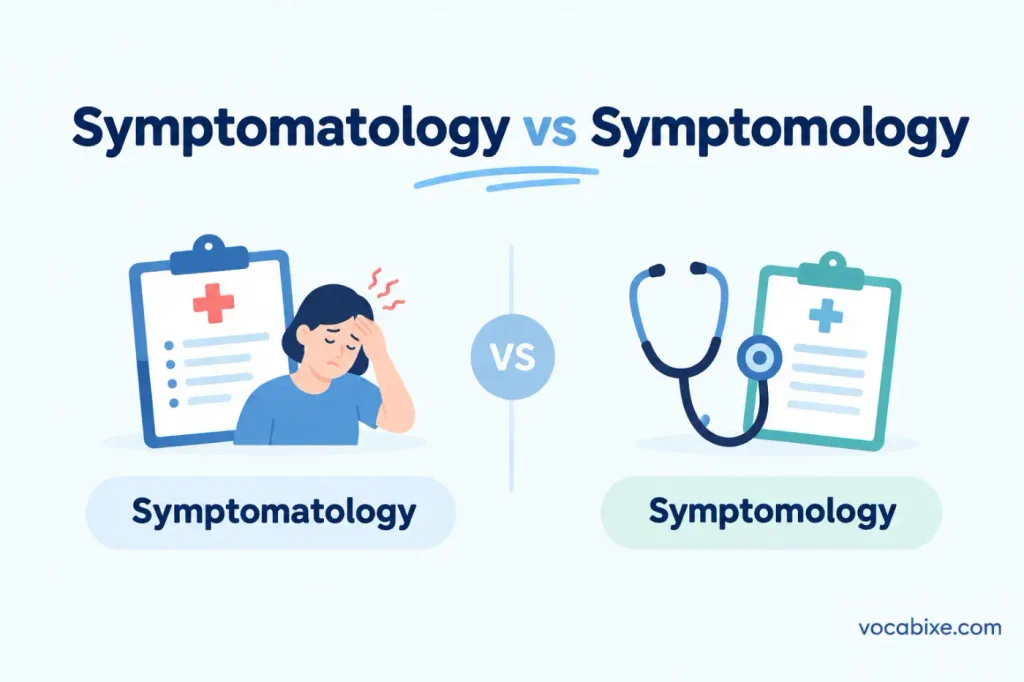
Section 1: Understanding Symptomatology vs Symptomology
If you are unsure whether to write symptomatology or symptomology, the preferred spelling in standard medical English is symptomatology. It refers to the study or description of symptoms linked to a disease, medical condition, or other health problem. Symptomology is also used, especially in informal medical writing and everyday speech, but it is less established as the standard term. Both words relate to symptoms, yet symptomatology is the safer choice for academic papers, professional medical documents, and formal writing.
The difference can be confusing because both forms look reasonable. The word symptomology appears to follow a common pattern in English, where the ending “-ology” refers to a field of study. However, symptomatology is the established medical term, and it has a long history in medical language. Understanding the difference helps you choose the right word for your audience and avoid spelling mistakes in professional writing.
Quick Answer: Is It Symptomatology or Symptomology?
Symptomatology is the preferred spelling in standard medical English. It refers to the study, description, or collection of symptoms associated with a disease or condition. Symptomology is a less-established alternative that is also used in some contexts.
For example:
- Correct in formal medical writing: “The doctor studied the symptomatology of the disease.”
- Less preferred in formal writing: “The doctor studied the symptomology of the disease.”
When writing a research paper, medical report, clinical summary, or educational article, choose symptomatology unless your field or publication follows a different established usage.
What Does Symptomatology Mean?
Symptomatology is a medical term that describes the study or pattern of symptoms associated with a particular disease, illness, or health condition. It can refer to the symptoms a person experiences, how those symptoms appear, and how they relate to a medical problem.
A symptom is something a person experiences or reports, such as pain, nausea, dizziness, or tiredness. Doctors consider these experiences alongside other findings when assessing a patient’s health.
For example, a patient with a respiratory infection might report coughing, a sore throat, and fatigue. A medical professional may describe this group of symptoms as part of the condition’s symptomatology.
The word can also refer to the study of symptoms more generally. In research, professionals may examine how symptoms develop, how they differ between patients, and how they change over time.
Here are some examples of symptomatology in sentences:
- “The researchers examined the symptomatology of the neurological disorder.”
- “Early symptomatology may include fatigue, fever, and muscle aches.”
- “The patient’s symptomatology changed over several weeks.”
- “Understanding the symptomatology helped the medical team compare different cases.”
In each example, the word refers to symptoms as a group, their characteristics, or their study.
What Does Symptomology Mean?
Symptomology is a variant of symptomatology. It is formed from the word symptom and the ending “-ology,” which commonly appears in words related to a subject or field of study.
People sometimes use symptomology to mean the study of symptoms or the collection of symptoms associated with a disease. Its intended meaning is often clear from the surrounding sentence.
For instance, someone might write, “The doctor reviewed the symptomology of the patient.” Most readers would understand that the writer means the patient’s symptoms or their pattern.
However, symptomology is not the preferred form in standard medical terminology. If accuracy and consistency matter, symptomatology is generally the better choice.
The existence of symptomology does not mean every dictionary, medical institution, or style guide treats the two words as equally standard. Usage can vary, so formal writers should follow the terminology preferred by their profession or publication.
What Is the Main Difference Between Symptomatology and Symptomology?
The main difference is their status in standard medical English rather than a clear difference in meaning.
| Feature | Symptomatology | Symptomology |
|---|---|---|
| Preferred spelling | Yes | Less preferred |
| Main meaning | Study or pattern of symptoms | Usually the same intended meaning |
| Medical research | Suitable | Less conventional |
| Formal reports | Recommended | Best avoided when standard terminology is expected |
| Everyday speech | Understandable | Also encountered |
| General recommendation | Use this form | Recognize it as a variant |
Both words are associated with symptoms. The distinction is mainly about established usage and professional preference.
If you are editing an article, preparing a medical presentation, or writing a university assignment, symptomatology is the more reliable option. It communicates the intended idea while following established medical terminology.
Why Is Symptomatology the Preferred Spelling?
Symptomatology is the established form used in medical language. Its structure reflects the term’s development from symptom-related terminology and the suffix “-atology.”
English contains many technical words that do not follow the simplest spelling patterns. A word may have an established form because of its history, its development from other languages, or long-standing use within a profession.
The word symptomatology is one example. Although symptomology may look more straightforward, the more familiar-looking construction does not automatically make it the preferred spelling.
Compare these examples:
- Symptomatology: “The report describes the symptomatology of the condition.”
- Symptomology: “The report describes the symptomology of the condition.”
The intended message is similar, but the first sentence uses the more established medical term.
A useful rule is to learn technical vocabulary in the form commonly used by professionals in that field. This helps you avoid mistakes when writing about medicine, science, law, or other specialized subjects.
How Do You Pronounce Symptomatology and Symptomology?
Both words are long, but you can make them easier to say by breaking them into smaller sound groups.
Symptomatology is commonly pronounced with the main stress on the syllable containing “tol.” In American English, a practical guide is:
- Symptomatology: simp-tuh-muh-TOL-uh-jee
- Symptomology: simp-tuh-MOL-uh-jee
Pronunciation can vary slightly among speakers and dictionaries. The two forms also differ in their number of syllables and sound pattern.
If you have trouble pronouncing symptomatology, begin with the familiar word symptom. Then add the remaining parts slowly until you can say the complete word comfortably.
For example, practice this sentence aloud: “The researcher studied the symptomatology of the illness.”
You do not need to use the longer word in every conversation. In everyday English, phrases such as “the patient’s symptoms” or “the symptoms of the disease” are often easier to understand.
What Is the Origin of Symptomatology?
Symptomatology developed from symptom-related medical vocabulary. The word symptom ultimately comes from Greek through Latin, while the ending “-logy” is associated with the idea of study, account, or discourse.
In modern English, “-logy” appears in many words that name fields of knowledge or systematic study. Examples include biology, geology, and psychology.
Symptomatology contains an additional “-at-” element, which is part of its established word form. This helps explain why the word does not follow the simplified pattern some writers might expect.
Symptomology appears to be a more direct formation from symptom and “-ology.” That construction may seem logical, but technical words are not always standardized according to the pattern that looks easiest.
The important point is that word structure can help you understand a term, but established usage determines which form is most appropriate in formal writing.
Is Symptomatology a Medical Term?
Yes. Symptomatology is a recognized term in medical and health-related writing. It is used when discussing the symptoms associated with diseases, disorders, or other health conditions.
Medical professionals need clear language to describe what patients experience and how those experiences relate to a possible diagnosis. Symptomatology can help summarize that information.
For example, a report might describe the symptomatology of a condition as including persistent pain, reduced movement, and fatigue. The word brings these related symptoms together under one concept.
The term can also appear in psychology and psychiatry. In these fields, professionals may discuss patterns of emotional, behavioral, or physical symptoms associated with a condition.
However, symptomatology does not automatically identify the cause of a person’s symptoms. A description of symptoms is only one part of understanding a medical problem.
A person may experience similar symptoms for different reasons. Medical professionals consider the patient’s history, examination, and any relevant tests before reaching conclusions.
What Is the Difference Between Symptoms and Symptomatology?
Symptoms are individual experiences or signs reported by a patient, while symptomatology refers to the study, description, or overall pattern of symptoms.
For example, a headache is a symptom. Nausea is another symptom. When a clinician examines how several symptoms appear together and how they relate to a condition, the discussion may involve symptomatology.
Consider this simple comparison:
- Symptom: “The patient reports a headache.”
- Symptoms: “The patient reports a headache, nausea, and dizziness.”
- Symptomatology: “The report describes the pattern of symptoms observed in the patient.”
This distinction is useful because the terms are related but not interchangeable in every sentence.
The word symptom is usually the best choice when discussing one experience. The plural symptoms works well when naming several experiences. Symptomatology is more suitable when discussing a broader pattern or the study of those symptoms.
In everyday writing, the shorter words are often clearer. Use symptomatology when its more specialized meaning adds value.
How Is Symptomatology Used in Medical Writing?
Symptomatology is useful when writers need to discuss the features of a disease or condition in a concise, professional way.
Medical researchers may use it to compare patients, describe patterns in clinical observations, or explain how a condition presents. Health professionals may also use the term in case reports, reviews, and educational materials.
Here are several examples of its use.
In a medical research paper
“The study compared the symptomatology of patients in the early and later stages of the condition.”
This sentence indicates that researchers examined symptoms and how they differed between groups.
In a clinical report
“The patient’s symptomatology included persistent coughing and shortness of breath.”
The sentence summarizes the symptoms documented in the report.
In a psychology discussion
“The therapist assessed the patient’s symptomatology before developing a treatment plan.”
Here, the word refers to the overall pattern of symptoms considered during an assessment.
In a medical textbook
“The chapter reviews the symptomatology commonly associated with the disorder.”
This example shows how the term can introduce a discussion of symptoms linked to a particular condition.
These examples illustrate why symptomatology is valuable in professional contexts. It can express a broad idea without listing every symptom in the same sentence.
Still, clarity should come first. If a sentence becomes difficult to understand, replacing symptomatology with “symptoms” or “pattern of symptoms” may improve it.
Can Symptomatology and Symptomology Be Used Interchangeably?
They can sometimes be used to express the same general idea, but that does not make them equally suitable in every setting.
A reader will often understand symptomology as a reference to symptoms or their study. However, formal medical writing usually favors symptomatology.
Imagine that you are writing a university assignment about a disease. Using the preferred term helps maintain consistency with standard medical vocabulary. Choosing a less-established variant may distract readers or prompt an editor to change it.
In casual conversation, the distinction may matter less. Someone discussing the symptoms of a cold is unlikely to need either technical term.
The best approach depends on your purpose:
- For medical research, use symptomatology.
- For formal health-related writing, use symptomatology unless a specific style guide says otherwise.
- For everyday conversation, consider using “symptoms” or “pattern of symptoms.”
- When reading symptomology in another text, use context to understand its intended meaning.
This approach recognizes the variant without suggesting that both forms have identical standing in professional writing.
What Are Common Mistakes When Using These Words?
Writers can make several mistakes when choosing between symptomatology and symptomology. Most are easy to avoid once the preferred spelling and meaning are clear.
Mistake 1: Assuming symptomology is always the correct form
The word may look natural because it follows a familiar word-building pattern. However, symptomatology is the more established medical term.
Better: “The paper examines the symptomatology of the condition.”
Mistake 2: Treating symptomatology as the name of a disease
Symptomatology refers to symptoms and their study or pattern. It does not name a specific disease.
Better: “The patient’s symptomatology was consistent with several possible conditions.”
Mistake 3: Using symptomatology when symptoms would be clearer
Technical language is useful when it adds precision, but it can make ordinary sentences harder to read.
Wordy: “The symptomatology of the patient included a headache.”
Clearer: “The patient had a headache.”
Mistake 4: Assuming symptomatology proves a diagnosis
A symptom pattern may help guide a medical assessment, but it does not always establish the cause.
Better: “The symptomatology helped the doctor decide which tests might be needed.”
Mistake 5: Changing spellings within one document
Switching between symptomatology and symptomology without a clear reason can make a report appear inconsistent.
Better: Choose the preferred term and use it consistently.
Mistake 6: Confusing symptoms with objective findings
A symptom is generally something a person experiences or reports, such as pain or nausea. A sign is an observable or measurable finding, such as a rash or elevated temperature.
Although symptomatology focuses on symptoms, medical discussions may consider symptoms alongside signs and other evidence. Keeping these concepts separate improves accuracy.
Is Symptomatology Used in American and British English?
Symptomatology is used in both American and British English. There is no major regional spelling difference comparable to pairs such as color and colour or organize and organise.
The preferred spelling remains symptomatology in formal writing on both sides of the Atlantic.
Symptomology may also appear in writing from different regions, but its presence does not establish it as the preferred standard in either variety of English.
For example, an American medical paper might say, “The study examined the symptomatology of the disorder.” A British medical report could use the same spelling and structure.
If you are writing for an American audience, use symptomatology. The same recommendation applies to British audiences unless a publication’s style guide specifies otherwise.
The choice is therefore mainly about standard terminology, not geography.
What Words Are Related to Symptomatology?
Several related terms can help you explain symptoms more clearly. Each has a slightly different meaning, so choosing the right one depends on your sentence.
- Symptom: An experience reported by a person, such as pain or nausea.
- Symptoms: Two or more experiences associated with a health problem.
- Sign: A finding that can be observed or measured by another person.
- Diagnosis: The identification of a disease or condition based on available evidence.
- Clinical presentation: The way a patient appears or presents with a health problem.
- Manifestation: A way a disease or condition shows itself.
- Symptomatic: Showing symptoms or relating to symptoms.
- Asymptomatic: Having a condition without noticeable symptoms.
- Syndrome: A group of features or symptoms that occur together and are associated with a particular condition.
- Pathology: The study of disease or the changes caused by disease.
These terms overlap in some situations, but they are not synonyms in every context.
For example, symptomatology focuses on symptoms, while pathology concerns disease processes and changes. Diagnosis refers to identifying a condition, not simply describing the symptoms.
Using the right term helps you explain medical information without making claims that go beyond the available evidence. Related article Homey-or Homie.
How Can You Remember the Correct Spelling?
The simplest way to remember the preferred spelling is to learn symptomatology as one complete medical term rather than trying to build it from symptom and “-ology.”
You can also connect the word with its common use in medical research and clinical writing. When you see a sentence about studying or describing the pattern of symptoms, symptomatology is usually the appropriate choice.
Try this memory rule:
Formal medical writing = symptomatology.
Practice with these sentences:
- “The researcher studied the symptomatology of the disease.”
- “The patient’s symptomatology changed over time.”
- “The article describes the symptomatology associated with the condition.”
Notice how the word refers to symptoms as a group or the study of their patterns.
Another helpful strategy is to use a simpler expression when the technical term is unnecessary. Instead of writing, “The symptomatology included a fever,” you could write, “The symptoms included a fever.”
This keeps your writing accurate and easy to understand.
Section 2: Practical Examples and Further Clarification
Which Word Should You Use in Different Situations?
The right choice depends on how formal your writing is and what you want to communicate.
| Situation | Recommended wording | Reason |
|---|---|---|
| Medical research paper | Symptomatology | Uses established terminology |
| Clinical case report | Symptomatology | Suitable for describing a symptom pattern |
| University assignment | Symptomatology | Preferred in formal academic writing |
| General health article | Symptoms or symptomatology | Choose the clearest wording |
| Casual conversation | Symptoms | Easier for most people to understand |
| Editing a text that uses symptomology | Usually change it to symptomatology | Improves consistency with standard usage |
These recommendations are practical guidelines rather than absolute rules for every publication. A journal or institution may have its own style requirements.
If you are quoting a source that uses symptomology, preserve the original spelling within the quotation. Outside the quotation, use symptomatology when following standard medical terminology.
What Are Examples of Symptomatology in Everyday Contexts?
Although symptomatology is a technical word, its meaning becomes easier to understand through familiar situations.
Example 1: A respiratory illness
A patient reports a sore throat, coughing, and tiredness. A medical report may discuss the symptomatology of the illness to describe how these symptoms appear together.
Example 2: A digestive problem
Someone experiences stomach pain, nausea, and a reduced appetite. A doctor considers the overall symptom pattern alongside the person’s history and examination.
Example 3: A mental health assessment
A mental health professional asks about changes in mood, sleep, concentration, and daily activities. The pattern of symptoms may be part of the person’s symptomatology.
Example 4: A research project
Researchers compare two groups of patients to learn whether they experience different symptoms. Their report may describe differences in symptomatology.
Example 5: A change over time
A patient initially reports mild discomfort but later develops additional symptoms. A clinician may document how the symptomatology has changed during follow-up.
These examples show that symptomatology is about the description or study of symptoms, not simply the presence of one symptom.
They also show why context matters. The term can be useful in research and clinical discussions, but plain language may be more effective when speaking directly to patients.
Does Symptomatology Mean the Same Thing as Clinical Presentation?
The terms are related, but they are not always interchangeable.
Symptomatology focuses on symptoms and their characteristics or patterns. Clinical presentation is broader because it can include symptoms, observable signs, medical history, and other features that help describe how a patient presents with a condition.
For example, a person may report chest discomfort and tiredness. These are symptoms. A clinician may also observe an abnormal heart rate or measure a high temperature. Such findings can form part of the broader clinical presentation.
A medical report might discuss both the patient’s symptomatology and clinical presentation because each term highlights a different aspect of the assessment.
If your sentence concerns symptoms specifically, symptomatology may be appropriate. If it concerns the full picture of how a patient presents, clinical presentation may be more accurate.
Does Symptomatology Mean the Same Thing as Diagnosis?
No. Symptomatology describes or studies symptoms, while diagnosis is the process of identifying a disease or condition.
A person can have a clear pattern of symptoms without having a confirmed diagnosis. Different medical conditions can produce similar symptoms, so a professional may need more information before determining the cause.
For example, fatigue and headaches can occur for many reasons. Describing these experiences is not the same as identifying the condition responsible for them.
Symptomatology can contribute to the diagnostic process because it helps organize information about what a patient experiences. However, it does not replace a full medical assessment.
This distinction is especially important in health writing. Avoid suggesting that a particular group of symptoms proves that someone has a specific illness.
Is Symptomatology Singular or Plural?
Symptomatology is generally treated as a singular, uncountable noun when it refers to the study or overall pattern of symptoms.
For example:
- “The symptomatology is complex.”
- “The symptomatology of the disorder varies.”
- “This study examines symptomatology in older adults.”
In these sentences, the word takes a singular verb.
Writers should avoid treating the word as a simple plural form of symptom. The ordinary plural of symptom is symptoms, not symptomatologies.
Although specialized contexts may use a countable form when discussing distinct systems or descriptions, most readers will find the singular, uncountable use more natural.
When in doubt, use symptomatology with a singular verb or replace it with the simpler phrase “the patient’s symptoms.”
Can You Use Symptomatology Without Mentioning a Disease?
Yes. The word does not always need to appear beside the name of a specific disease.
Writers may discuss symptomatology in a general study of health, in a comparison of patient groups, or in an explanation of how symptoms are assessed.
For example:
- “The research focuses on symptomatology in young adults.”
- “Further study is needed to understand the symptomatology observed in this group.”
- “The report provides an overview of the patient’s symptomatology.”
The surrounding context should make it clear which symptoms or group of patients the writer means.
If the reference is unclear, add a short explanation. For example, “The report describes the patient’s symptomatology, including pain, fatigue, and dizziness.”
This gives readers the information they need without relying on technical vocabulary alone.
Conclusion
When choosing between symptomatology and symptomology, symptomatology is the safer and more established choice for standard medical English. It refers to the study, description, or pattern of symptoms associated with a disease or health condition. Symptomology is also used, but it is less conventional in formal medical and academic writing.
Remember that symptoms are the experiences a person reports, while symptomatology describes or studies those symptoms as a group or pattern. The word does not identify a disease by itself, nor does it replace a medical diagnosis.
For research papers, clinical reports, university assignments, and professional health articles, use symptomatology unless your publication specifies another form. When writing for a general audience, simpler expressions such as “the patient’s symptoms” or “the pattern of symptoms” may communicate your meaning more clearly.
The key rule is simple: choose symptomatology for formal medical writing, use it consistently, and prioritize clear language whenever a technical term is not needed.
FAQs
Is symptomatology the correct spelling?
Yes. Symptomatology is the preferred spelling in standard medical and academic English. Symptomology is a less-established variant.
Is symptomology a real word?
Yes. Symptomology appears in actual usage and is generally understood to refer to the study or pattern of symptoms. However, symptomatology is the preferred form in formal medical writing.
What is the difference between symptomatology and symptomology?
Both words usually communicate the same general idea. The main difference is that symptomatology is the more established medical term, while symptomology is a less-preferred variant.
What does symptomatology mean in simple words?
Symptomatology means the study or description of symptoms linked to a health condition. It can also refer to the overall pattern of symptoms a person experiences.
How do you use symptomatology in a sentence?
You can write, “The doctor studied the symptomatology of the condition.” This means the doctor examined the symptoms associated with the condition.
Is symptomatology used in American English?
Yes. Symptomatology is used in American English and British English. It is the preferred spelling in formal medical writing in both varieties.
Is symptomatology the same as symptoms?
Not exactly. Symptoms are individual experiences, such as pain or nausea. Symptomatology refers to the study, description, or overall pattern of symptoms.
Is symptomatology a singular or plural noun?
Symptomatology is usually treated as a singular, uncountable noun. For example, you would write, “The symptomatology is unusual,” rather than “The symptomatology are unusual.”
Pingback: Neice or Niece: Correct Spelling Guide - Vocabixe