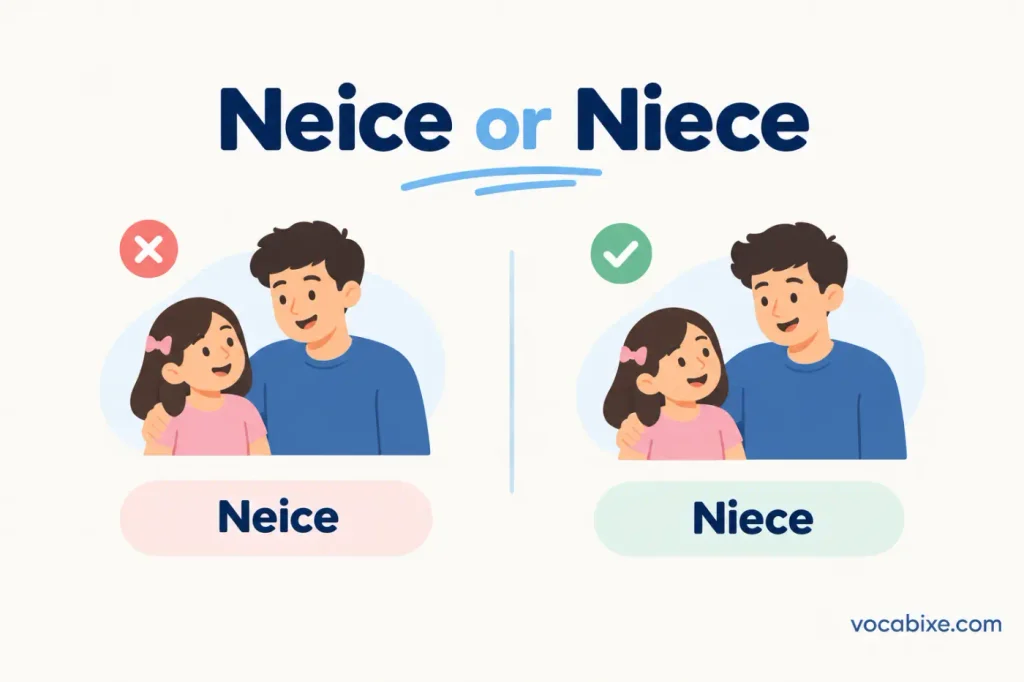
If you are wondering whether to write neice or niece, the correct spelling is niece. The word “neice” is a common spelling mistake and is not accepted as the standard spelling in English. A niece is the daughter of your brother or sister, or the daughter of your spouse’s brother or sister. For example, you can say, “My niece is visiting us this weekend.” Remember the simple spelling rule: in niece, the I comes before the E. Learning this word will help you write family messages, school assignments, emails, and everyday conversations correctly.
Section 1: Neice or Niece: The Quick Answer
The correct spelling is niece, not neice. Although both spellings may look similar, only “niece” is the standard English word for a female relative who is the daughter of your sibling or your spouse’s sibling.
Here is a quick comparison:
| Word | Correct or incorrect? | Explanation |
|---|---|---|
| Niece | Correct | The daughter of your brother or sister |
| Neice | Incorrect | A common misspelling of niece |
For example:
- Correct: My niece loves reading storybooks.
- Incorrect: My neice loves reading storybooks.
The difference is only one letter. However, that small change makes the second spelling incorrect.
If you are writing a birthday card, a social media post, a school essay, or a family invitation, always use “niece.” Spell-checking tools may catch the mistake, but remembering the correct spelling is more useful because you can avoid the error before it happens.
Why Is Niece the Correct Spelling?
The spelling “niece” follows the traditional spelling of the English word. Its letters appear in this order: N-I-E-C-E.
The spelling “neice” changes the order of the I and E. This is a common mistake because English has many words with different vowel patterns, and the familiar spelling rule does not work for every word.
Consider these examples:
- Niece: My niece starts school next week.
- Piece: She ate a piece of cake.
- Field: The children played in the field.
- Believe: I believe you are telling the truth.
These words contain the letters I and E in different arrangements. That can make English spelling confusing, especially for younger learners.
The easiest solution is to memorize the spelling of “niece” as one complete word rather than trying to guess which vowel comes first.
What Does Niece Mean?
A niece is the daughter of your brother or sister. The word can also describe the daughter of your spouse’s brother or sister.
For example, if your sister has a daughter named Emma, Emma is your niece. If your brother has a daughter named Olivia, Olivia is also your niece.
The word describes a family relationship. It does not depend on the person’s age, whether she is a child or an adult, or whether she lives nearby.
Here are a few examples:
- My niece is five years old.
- I bought a present for my niece.
- Her niece works as a teacher.
- We invited our nieces to the family dinner.
In each sentence, “niece” identifies a female family member through a sibling or a spouse’s sibling.
The male equivalent is “nephew.” A nephew is the son of your brother or sister, or the son of your spouse’s brother or sister.
Understanding the meaning makes it easier to remember the correct word and use it naturally.
How Do You Pronounce Niece?
The word “niece” is pronounced like “neess.” It has one syllable and rhymes with words such as “piece,” “peace,” and “fleece.”
The final sound is an S sound, not a Z sound. You do not pronounce the final E as a separate syllable.
Try saying these words aloud:
- Niece
- Piece
- Peace
- Fleece
Each word has a similar ending sound, which can help you remember how to pronounce “niece.”
The pronunciation also explains why some people find the spelling confusing. The word sounds like it starts with an N followed by a long E sound, but the correct spelling uses the letter sequence “nie.”
When writing the word, remember that pronunciation alone does not tell you which letters come first. Memorizing the written form is the most reliable way to avoid the mistake.
What Is the Difference Between Neice and Niece?
The difference between neice and niece is spelling.
“Niece” is the correct English spelling. “Neice” is a misspelling that often occurs when writers reverse the I and E.
Both forms may be pronounced the same way when someone intends to write the family word. However, only “niece” should be used in standard writing.
For example:
Correct: My niece sent me a beautiful birthday card.
Incorrect: My neice sent me a beautiful birthday card.
The meaning a writer intends may be clear, but the spelling still needs to be corrected.
This distinction matters in professional emails, schoolwork, formal letters, and online articles. Correct spelling makes your writing easier to read and helps you communicate clearly.
If you see “neice” in a message, you can usually understand that the writer means “niece.” Still, when you write the word yourself, use the standard form. Related article Symptomatology vs Symptomology.
Why Do People Commonly Spell Niece as Neice?
Many people write “neice” because they are unsure whether I or E should come first. English spelling can be difficult because similar sounds do not always follow the same letter patterns.
The phrase “I before E except after C” is often taught as a spelling rule. According to this familiar phrase, I usually comes before E in certain words, except when the letters follow C.
The word “niece” fits the first part of this rule because the I comes before the E, and the sequence is not immediately after C.
However, the rule has many exceptions in English, so it should not be treated as a perfect guide for every word.
People may also make this mistake because they have heard the word many times but have not written it often. Recognizing a word while speaking is different from remembering its exact spelling.
Here are some common reasons for the error:
- Vowel confusion: The writer is unsure which letter comes first.
- Typing quickly: The letters are entered in the wrong order.
- Limited writing practice: The correct spelling has not become familiar.
- Overreliance on sound: The writer tries to spell the word based only on how it sounds.
- Autocorrect errors: A typing tool may fail to catch the mistake in some situations.
The good news is that “niece” is easy to learn once you connect its spelling with a simple memory trick.
How to Remember the Correct Spelling of Niece
A useful way to remember “niece” is to focus on its first three letters: N-I-E.
Say the letters slowly as you write the word. Then finish with C-E.
N + I + E + C + E = NIECE.
You can also use the following memory tips.
1. Remember “I before E.”
In “niece,” the I comes before the E. Think of this familiar spelling pattern whenever you need to write the word.
2. Connect niece with piece.
The words “niece” and “piece” share the same ending pattern: I-E-C-E. If you can spell “piece,” you can use that spelling pattern to help remember “niece.”
For example, you might remember this sentence: “My niece gave me a piece of cake.”
3. Write the word three times.
Repeated writing can help you remember the letter order.
- My niece is kind.
- My niece likes music.
- I love spending time with my niece.
4. Learn the word as part of a family pair.
Remember “niece and nephew” together. A niece is a female relative, while a nephew is a male relative. Learning the words as a pair can make both meanings easier to recall.
5. Check the word before submitting your writing.
If you are unsure, look carefully at the letters. The correct sequence is N-I-E-C-E, not N-E-I-C-E.
A few moments of practice can help you avoid repeating this common spelling error.
Section 2: Niece Usage, Examples, and Related Words
Knowing the correct spelling is only the first step. You should also understand how to use “niece” in everyday sentences, how it differs from similar family terms, and how its plural form works.
How to Use Niece in a Sentence
“Niece” is a noun. It names a person and usually appears after words such as “my,” “your,” “his,” “her,” “our,” or “their.”
You can use it when talking about family relationships, special occasions, school activities, or everyday events.
Here are 15 example sentences:
- My niece is learning how to ride a bicycle.
- We bought a birthday cake for our niece.
- Her niece lives in New York.
- My brother’s niece enjoys drawing pictures.
- I helped my niece with her homework.
- Their niece is visiting them during the summer.
- My niece gave me a handmade greeting card.
- We took our niece to the zoo.
- His niece wants to become a doctor.
- My niece and nephew play together every weekend.
- I am proud of my niece’s hard work.
- The little girl is my niece.
- Her niece won first place in the school competition.
- We invited our niece to dinner.
- My niece loves spending time with her grandparents.
Each example uses the word to describe a family relationship. Notice that “niece” can appear at the beginning, middle, or end of a sentence, depending on the sentence structure.
It can also be followed by a possessive form, as in “my niece’s book.” In this example, the apostrophe and S show that the book belongs to the niece.
Is Niece Singular or Plural?
“Niece” is singular. It refers to one female relative.
The plural form is “nieces,” which refers to two or more female relatives.
Here is the difference:
| Singular | Plural |
|---|---|
| Niece | Nieces |
| My niece is visiting. | My nieces are visiting. |
| I bought a gift for my niece. | I bought gifts for my nieces. |
To form the plural, add S to the end of “niece.”
For example, if your brother has one daughter and your sister has two daughters, you have three nieces. You would say, “My nieces are coming over this weekend.”
Remember to use a singular verb with one niece and a plural verb with multiple nieces.
- My niece is happy.
- My nieces are happy.
The same pattern applies to many regular English nouns, making this plural form easy to learn.
Niece vs. Nephew: What Is the Difference?
“Niece” and “nephew” describe related family relationships, but they refer to different genders.
A niece is the daughter of your sibling or your spouse’s sibling. A nephew is the son of your sibling or your spouse’s sibling.
For example:
- Your brother’s daughter is your niece.
- Your brother’s son is your nephew.
- Your sister’s daughter is your niece.
- Your sister’s son is your nephew.
If you have one niece and one nephew, you can say, “My niece and nephew are visiting today.”
Both words are common in American English and British English. Their basic meanings are the same in both varieties.
One useful memory tip is to associate “niece” with a girl and “nephew” with a boy. This makes it easier to choose the right word when describing family members.
Is Niece Used in American and British English?
Yes. “Niece” is the standard spelling in both American English and British English.
Unlike some English words that change spelling between the United States and the United Kingdom, this word does not have a standard American and British spelling difference.
For example, American writers use “niece,” and British writers also use “niece.”
The same is true in countries such as Canada, Australia, and New Zealand, where English is widely used.
Examples include:
- American English: My niece is starting school in September.
- British English: My niece is starting school in September.
- Australian English: My niece lives near Sydney.
The wording may vary slightly with local speech, but the spelling remains the same.
Therefore, you do not need to choose between an American version and a British version. Use “niece” regardless of which variety of English you are writing.
What Is the Origin of the Word Niece?
The word “niece” comes from older forms of French and Latin. It developed from the Old French word “niece,” which came from the Latin word “neptis.”
The Latin term referred to a granddaughter or female descendant. Over time, the word developed into the modern English term used for the daughter of a brother or sister.
Its history helps explain why the modern spelling is not always easy to guess from pronunciation alone. English has borrowed many words from other languages, and their spellings often reflect older language patterns.
Today, “niece” has a clear and familiar meaning in everyday English. You do not need to know its history to use it correctly, but understanding its origin can make the word more interesting to learn.
The spelling has become established through centuries of use, so “neice” is not an accepted alternative in standard modern English.
What Is the Possessive Form of Niece?
The possessive form is “niece’s” when you are talking about something that belongs to one niece.
For example:
- My niece’s bicycle is blue.
- I attended my niece’s graduation.
- My niece’s favorite book is on the table.
In each example, the apostrophe followed by S shows possession.
When referring to several nieces, the plural possessive form is “nieces’.”
For example:
- My nieces’ school is nearby.
- We attended our nieces’ performances.
The difference is simple:
- Niece’s = something belongs to one niece.
- Nieces’ = something belongs to multiple nieces.
Do not confuse “niece’s” with “nieces.” The first is possessive, while the second is simply the plural form.
Correct apostrophe use helps readers understand exactly who owns something or whom you are describing.
What Are the Most Common Mistakes With Niece?
The most common mistake is reversing the I and E, producing “neice.” However, writers can also make errors when using the plural form, possessive form, or related family terms.
Here are several mistakes to avoid.
Mistake 1: Writing neice instead of niece
Incorrect: My neice is coming to dinner.
Correct: My niece is coming to dinner.
The I must come before the E.
Mistake 2: Using niece when you mean nephew
Incorrect: My sister’s son is my niece.
Correct: My sister’s son is my nephew.
A niece is female, while a nephew is male.
Mistake 3: Using niece for more than one person
Incorrect: My niece are playing outside.
Correct: My nieces are playing outside.
Use “nieces” when you mean two or more female relatives.
Mistake 4: Forgetting the possessive apostrophe
Incorrect: My nieces birthday is tomorrow.
Correct: My niece’s birthday is tomorrow.
When referring to one niece’s birthday, use the singular possessive form.
Mistake 5: Adding an unnecessary apostrophe to the plural
Incorrect: I have three niece’s.
Correct: I have three nieces.
The plural form does not need an apostrophe.
By learning these examples, you can improve both spelling and grammar. Whenever you write about family relationships, check whether you need the singular, plural, or possessive form.
Is Neice Ever an Acceptable Word?
In standard English, “neice” is considered a misspelling of “niece.” It is not the accepted spelling in formal writing, school assignments, or edited publications.
You may see “neice” in social media posts, text messages, online comments, or informal notes. Its appearance in those places does not make it a correct spelling.
There may also be unusual cases where a person uses “Neice” as a name, username, or deliberately chosen label. A proper name can have a nonstandard spelling because people can choose how to spell their names.
However, when you want to describe a family relationship, use “niece.”
For example:
- Correct family usage: My niece is visiting this afternoon.
- Incorrect standard spelling: My neice is visiting this afternoon.
If a spelling checker highlights “neice,” replace it with “niece” unless you are referring to a specific name that is intentionally spelled that way.
How Can You Improve Your Spelling of Niece?
The best way to improve your spelling is to combine reading, writing, and quick self-checks.
Start by learning the word’s letter sequence. Write N-I-E-C-E on paper and read it aloud. Then use it in a few sentences about family members.
You can also practice with short exercises.
Choose the correct spelling:
- My (niece / neice) is learning to swim.
- I sent a gift to my (neice / niece).
- Her (niece / neice) loves playing the piano.
- We visited our (neices / nieces) last weekend.
Answers:
- Niece
- Niece
- Niece
- Nieces
After completing the exercise, try writing your own sentence using the word. For example, “My niece enjoys reading books before bedtime.”
You can make this practice part of your daily writing routine. The more often you see and use the correct spelling, the easier it becomes to remember.
Conclusion
When choosing between neice or niece, always use niece. It is the correct spelling in American English, British English, and standard English worldwide. The word refers to the daughter of your brother or sister, or your spouse’s brother or sister. “Neice” is a common spelling mistake caused by reversing the I and E.
To remember the correct form, focus on the letter sequence N-I-E-C-E and connect it with the word “piece.” Use “nieces” for the plural and “niece’s” when showing possession by one niece. With a little practice, you can spell the word correctly in schoolwork, emails, family messages, and everyday writing.
FAQs
Is it neice or niece?
“Niece” is correct. “Neice” is a common misspelling. Always use “niece” when referring to the daughter of your brother or sister.
How do you spell niece correctly?
The correct spelling is N-I-E-C-E. Remember that the I comes before the E.
What does niece mean?
A niece is the daughter of your brother or sister, or the daughter of your spouse’s brother or sister.
Is niece spelled the same in American and British English?
Yes. Both American and British English use “niece.” There is no standard regional spelling difference.
What is the plural of niece?
The plural is “nieces.” For example, “My nieces are coming to visit.”
What is the male version of niece?
The male equivalent is “nephew.” A niece is a female relative, while a nephew is a male relative.
Why do people spell niece as neice?
People often reverse the I and E because English vowel patterns can be confusing. Remembering the sequence N-I-E-C-E helps prevent this error.
How do you use niece in a sentence?
You can write, “My niece is celebrating her birthday today.” The word identifies a female family member who is the daughter of your sibling or your spouse’s sibling.