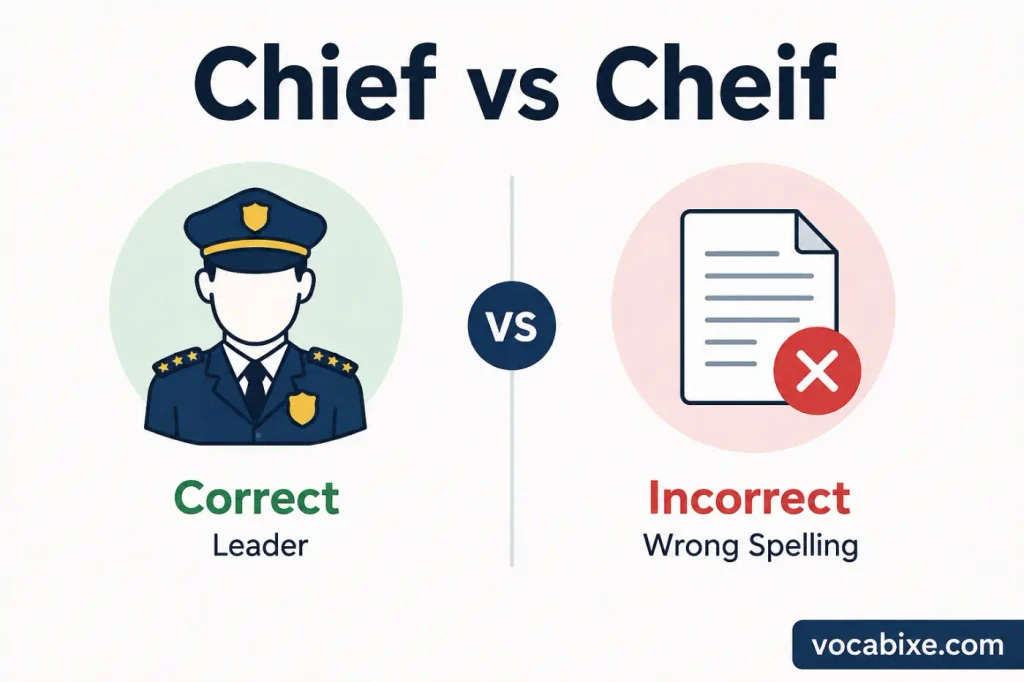
Have you ever paused while writing a word because you were unsure about its spelling? You may have seen cheif and wondered whether it is an accepted form. This mix-up is common because the letters i and e appear together, making it easy to place them in the wrong order. A small spelling difference can change whether a word is considered correct in standard English.
The correct form is chief, while cheif is not a standard English spelling. The word can describe a leader or person in charge, such as a police chief, or refer to something that is most important, such as a chief concern. It is also used in many common expressions and professional titles, so knowing the correct form is useful in both everyday and formal writing.
In this guide, you’ll learn how to spell and pronounce the word correctly, understand its meanings, and see how it is used in sentences. You’ll also learn the difference between chief and chef, review common examples, and discover a simple memory trick that can help you avoid this spelling mistake in the future.
Simple Answer in One Look
Chief is correct.
Cheif is incorrect.
Use chief when you mean a leader, a person in a high position, or something that is most important.
A quick way to remember it is:
Chief = correct
Cheif = misspelled
So, if you are asking “chief vs cheif, which is correct?”, the answer is always chief in standard English.
What Does Chief Mean in Simple English?
The word chief has a few common meanings, but they are all easy to understand. View article on REPORE OR RAPPORT.
First, chief can mean a leader. A chief is someone who has a high position and may lead a group, department, organization, or community.
For example:
- The police chief spoke to reporters.
- The fire chief arrived at the station.
- The chief called a meeting.
In these examples, chief means a person who leads or has a high rank.
Second, chief can mean most important or main.
For example:
- My chief concern is safety.
- Her chief goal is to finish school.
- The chief reason was lack of time.
Here, chief does not mean a person. It means the main or most important thing.
This is why the word can be used in different situations. The basic idea stays the same: chief points to something or someone at the top.
Oxford defines chief as a person with a high or highest rank in an organization. It also uses chief for a leader of a people or community. As an adjective, chief can mean most important or highest in rank.
Merriam-Webster gives the same basic idea. As a noun, chief can mean the head of a group or organization. As an adjective, it can mean highest in rank or most important.
So, when you see chief, think of one simple idea:
Chief = leader or most important.
Why Do People Mix Up Chief and Cheif?
People mix up chief and cheif mainly because of the spelling pattern.
Many students learn a simple spelling rule that says “i before e.” Because of this, they may write cheif instead of chief.
But English has many spelling patterns that do not work every time. Chief is one of the words that students often need to remember.
Look at the letters:
Correct:
c-h-i-e-f
Wrong:
c-h-e-i-f
Only two letters change places, but that makes one spelling incorrect.
Another reason people make this mistake is that the word sounds like “cheef.” When people hear a word, they may try to spell it based on its sound. English spelling does not always work that way.
For example, the sound in chief does not clearly tell you whether the word should contain ie or ei.
This is why spelling practice helps.
The mistake is especially common when someone is typing quickly. A person may know the word and its meaning but still type cheif by accident.
For example, someone might write:
“The cheif of police gave a speech.”
The meaning is easy to understand, but the spelling is wrong.
The correct sentence is:
“The chief of police gave a speech.”
Chief vs Cheif: Clear Difference Explained Simply
The difference between chief and cheif is very simple.
| Spelling | Correct? | Meaning |
|---|---|---|
| chief | Yes | Leader, highest rank, or most important |
| cheif | No | Common spelling mistake |
There is no separate English word called cheif in standard English.
That means you should not treat chief and cheif as two words with different meanings.
Instead, think of cheif as a misspelling of chief.
Here is another easy comparison:
1st
Chief → correct spelling
Cheif → incorrect spelling
2nd
Chief → can be used in formal writing
Cheif → should be corrected
3rd
Chief → appears in dictionaries
Cheif → does not work as the standard spelling
This makes the chief vs cheif question easy to solve.
Which Form Should You Use?
Always use chief when you mean leader, highest rank, main, or most important.
Use chief in sentences such as:
- He is the chief of police.
- She became the chief engineer.
- Safety is our chief concern.
- The chief reason was the weather.
- The village chief welcomed the visitors.
Do not write:
- He is the cheif of police.
- She became the cheif engineer.
- Safety is our cheif concern.
The spelling cheif should be corrected to chief.
If you are writing an essay, school assignment, resume, business email, website, or report, use chief.
Easy Real-Life Sentences You Can Use
Here are some simple examples that show how chief works in everyday English.
- The police chief gave a short speech.
- She is the chief doctor at the hospital.
- His chief goal is to help his family.
- The chief reason for the change was cost.
- We met the fire chief yesterday.
- The chief engineer checked the machine.
- Safety is our chief concern.
- The chief asked everyone to stay calm.
Notice how chief can describe a person or something important.
In “the fire chief,” it means a leader.
In “the chief reason,” it means the main reason.
That is a useful trick. Ask yourself whether you mean “leader” or “main.” If either meaning fits, chief may be the word you need.
How Do You Spell Chief Correctly?
The correct spelling is:
C-H-I-E-F
The easiest way to practice it is to break the word into its letters:
CH + IEF
The middle letters are I-E, not E-I.
So remember:
chief = I-E
cheif = E-I
When you type the word, pause for one second and check the middle letters.
This is especially useful if you often make spelling mistakes while typing.
You can also connect chief with another familiar word: thief.
Chief and thief both contain I-E.
Chief
Thief
This can give you a simple spelling memory trick.
You can think:
“The chief is not a cheif. Chief rhymes with thief.”
The words do not mean the same thing, of course. The trick is only about spelling.
What Is the Difference Between Chief and Cheif?
There is no meaning difference between chief and cheif because cheif is not the standard spelling of a separate English word.
Chief is the real word.
It can mean:
- a leader
- a person with the highest rank
- the main person in a group
- the most important thing
- the main reason or concern
Cheif is simply a spelling error.
This is one of those cases where the “difference” is really a question of correct spelling.
If someone asks, “Should I write chief or cheif?” write chief.
If someone asks, “Is cheif a word?” the safe answer is no in standard English. It is normally an incorrect spelling of chief.
Where Does the Word Chief Come From?
The history of chief helps explain why its spelling may look unusual.
Chief came into English from Old French. The Old French form was chief or chef. The word goes back further to the Latin word caput, which means “head.”
The idea of “head” connects naturally with the modern meaning of leader. A person who is the head of a group is its leader.
Over time, chief developed meanings connected with leadership, high rank, and importance.
The word has been used in English since the Middle English period. Merriam-Webster lists its first known use as an adjective in the 14th century and as a noun in the 15th century.
There is also an interesting connection between chief and the French word chef. The two forms come from the same older source. In English, chef later became strongly connected with cooking, while chief developed its modern meanings of leader and importance.
So, the spelling is not random. It comes from a long history of the word moving through different languages.
Why Does Chief Have “ie” Instead of “ei”?
This is a common spelling question.
English has many words that use ie and many that use ei. Learners often try to use a spelling rule to decide which one is correct.
But the best choice for chief is simply to remember its spelling.
Chief uses:
ie
Not:
ei
You can make a small memory group:
chief
thief
brief
grief
belief
These words can help you remember the I-E pattern.
This does not mean every English word follows the same pattern. English spelling has many exceptions and borrowed words. When one spelling is difficult, learning the word as a whole is often easier than trying to force every word into one rule.
Chief vs Cheif in School Writing
If you are writing for school, always choose chief.
For example:
Incorrect:
“The cheif of the group gave us instructions.”
Correct:
“The chief of the group gave us instructions.”
Incorrect:
“The chief reason for his absence was illness.”
This second sentence is already correct because chief is spelled properly.
Teachers may mark cheif as a spelling error even if the meaning is clear.
A good writing habit is to check words that you often misspell. If chief is one of those words, add it to your personal spelling list.
Write it several times:
chief
chief
chief
chief
Then use it in a sentence:
“The police chief spoke to the students.”
This gives your brain both the spelling and the meaning.
Biblical and Mythological Meaning of Chief
Chief can appear in Bible translations and older religious writing, usually with the basic meanings of leader, highest, first, or most important.
For example, older English Bible language can use chief when describing a person with high rank or something considered important. Historical dictionary material also shows chief being used in older religious English.
In mythology and traditional stories, chief can describe a leader of a people, tribe, clan, or community.
The important point is that chief itself is not a special religious word.
It is a normal English word that can be used in religious, historical, or mythological stories.
The meaning depends on the sentence.
If a story says “the chief spoke,” chief probably means leader.
If it says “the chief reason,” chief means main or most important.
Symbolism Explained in Simple Words
Chief can carry a simple idea of leadership.
When people hear the word chief, they may think of someone who is at the head of a group.
That can create ideas such as:
- leadership
- responsibility
- authority
- importance
- decision-making
- guidance
But remember that these are ideas connected with the role. They are not extra dictionary meanings that must apply to every use.
What One Version Represents
The correct form, chief, represents the real English word.
When used for a person, it can represent leadership or high rank.
For example:
“The police chief arrived.”
The person has a leadership position.
When used for something, it can represent importance.
For example:
“Her chief concern is her child’s safety.”
Here, chief means her main or most important concern.
What the Other Version Represents
Cheif does not represent a different idea or role.
It represents a common spelling mistake.
If you see cheif in a message, the writer most likely intended chief.
So the comparison is very easy:
Chief = real English word
Cheif = spelling mistake
There is no special hidden meaning behind cheif.
Related Words You Should Know
Learning related words can make chief easier to understand.
Chief
A leader or something that is most important.
Example: “The chief spoke to the team.”
Chiefly
Chiefly means mainly or mostly.
Example: “The town is chiefly known for farming.”
Chieftain
A chieftain is a leader, especially a leader of a group, tribe, or clan.
Example: “The chieftain led his people.”
Leadership
Leadership means the act or skill of leading people.
Example: “Her leadership helped the team.”
Leader
A leader is someone who guides or directs other people.
Example: “He is a strong leader.”
Principal
Principal can mean most important or a person who has a leading position. It is also commonly used for the head of a school.
Example: “The principal spoke to the students.”
Main
Main means most important or central.
Example: “The main problem is the cost.”
Primary
Primary means first or most important.
Example: “Our primary goal is safety.”
These words are not all perfect replacements for chief in every sentence. However, they can help you understand its basic meaning.
How Do People Actually Use Chief in Daily English?

Chief appears in many normal conversations.
Here are some real-life examples.
1. Police work
“The police chief held a press conference.”
Here, chief means the person who leads the police department.
2. Fire departments
“The fire chief arrived at the scene.”
The fire chief is a high-ranking leader in the department.
3. Business
“She is the company’s chief financial officer.”
Chief is part of a job title showing a very high position.
4. Engineering
“The chief engineer checked the design.”
Chief tells us that the engineer has a leading position.
5. Daily explanation
“The chief reason I left was the late hour.”
Here, chief means main or most important.
6. Personal concerns
“My chief concern is keeping everyone safe.”
Again, chief means most important.
7. News
“The army chief spoke to reporters.”
Here, chief refers to a high-ranking leader.
8. Community stories
“The village chief welcomed the visitors.”
Chief means community leader.
9. Formal writing
“The chief purpose of the meeting was to discuss safety.”
Here, chief means main purpose.
10. Friendly conversation
“My chief problem is that I never have enough time.”
This sounds a little more formal than “my main problem,” but it is still understandable and correct.
These examples show that chief can work in both professional and general English.
Common Mistakes People Make
The biggest mistake is simple:
Wrong: cheif
Right: chief
But there are a few other mistakes worth watching.
Mistake 1: Writing Cheif
Wrong:
“The cheif called the team.”
Correct:
“The chief called the team.”
Remember the I-E order.
Mistake 2: Thinking Cheif Is a Different Word
Some people see the two spellings and think they have different meanings.
They do not.
Cheif is normally just a misspelling of chief.
Mistake 3: Using Chief When You Mean Chef
Chief and chef look similar, but they are different words.
A chef is a professional cook.
A chief can be a leader or something most important.
For example:
“The chef prepared dinner.”
“The chief gave a speech.”
Do not confuse these two words.
Interestingly, the two words are historically related. Merriam-Webster explains that chef and chief came from the same French source, but chef later developed its English meaning connected with a skilled cook.
Mistake 4: Using Chief When Main Is Better
Chief is correct in many sentences, but it can sound more formal than main.
For example:
“The main reason I left was the rain.”
This sounds very natural in everyday conversation.
“The chief reason I left was the rain.”
This is also correct, but it sounds a little more formal.
So the issue is not always correctness. Sometimes it is style.
Mistake 5: Forgetting That Chief Can Describe Importance
Some learners only know chief as “leader.”
But chief can also mean main or most important.
For example:
“Money was the chief concern.”
There is no leader in this sentence.
Chief means the main concern.
Chief vs Cheif: How Can You Remember the Correct Spelling?
A good spelling trick is to connect chief with thief.
Both have the I-E pattern:
chief
thief
You can also remember:
The chief has IE.
Another useful trick is to say the letters slowly when you are unsure:
C-H-I-E-F.
If you are writing an important document, do not depend only on memory. Use a dictionary or spelling checker.
The goal is not to feel bad about spelling mistakes. Everyone makes them.
The goal is to notice your common mistakes and learn them.
Is Chief Used in American English?
Yes. Chief is a normal word in American English.
It is used in government, business, police and fire departments, the military, news writing, schools, history, and everyday conversation.
American English also uses chief in many job titles.
For example:
- police chief
- fire chief
- chief executive
- chief engineer
- chief of staff
The Oxford Advanced American Dictionary lists chief as a noun for a person with a high or highest rank in a company or organization and also as a leader or ruler of a people or community.
Can Chief Be Used for a Woman?
Yes.
Chief is not limited to men.
For example:
“She became the new police chief.”
“The company appointed her chief engineer.”
“The chief spoke to the group.”
The word describes the person’s position or role. It does not require the person to be male.
Can Chief Be Used as a Name or Title?
Yes.
Chief can appear as part of a person’s title.
For example:
- Chief Justice
- Chief Executive Officer
- Chief Medical Officer
- Commander-in-Chief
It can also be used before a person’s name in certain cultural or traditional settings.
The exact capitalization depends on the style and the specific title.
For ordinary writing, focus first on the spelling:
chief
If it is part of an official title, capitalization may be needed depending on how the title is being used.
What Does Chief Mean in a Sentence?
The meaning depends on how it is used.
If chief describes a person:
“The chief entered the room.”
It means a leader or high-ranking person.
If chief describes a reason:
“The chief reason was cost.”
It means the main reason.
If chief appears in a job title:
“She is the chief engineer.”
It shows a high position.
This simple test can help:
Chief + person or role = leader/high rank
Chief + reason, concern, goal, cause, purpose = main/most important
Final Teacher Explanation
Here is the classroom version.
If I were writing this word on the board for students, I would write:
CHIEF
Then I would write:
CHEIF
I would put a check next to chief and a cross next to cheif.
Why?
Because chief is the correct spelling.
The word chief can mean a leader. A police chief leads a police department. A fire chief has a high position in a fire department.
Chief can also mean main or most important. If I say “the chief reason,” I mean “the main reason.”
The spelling is the part students often get wrong.
Do not write C-H-E-I-F.
Write C-H-I-E-F.
The middle letters are I-E.
A simple memory trick is to connect chief with thief:
chief
thief
Both use I-E.
And remember that chef is a different word. A chef is a cook. A chief is a leader or something most important.
So if you remember only three things, remember these:
Chief is correct.
Cheif is a spelling mistake.
Chief can mean leader or most important.
That is all you need to answer the chief vs cheif question correctly.
How Is Chief Understood in Culture and Stories?
The word chief often appears in stories because stories need leaders.
A chief may be the leader of a village, group, family, community, or organization. In older stories, the chief may make important decisions for the people around them.
You may also see the word in adventure stories, history books, movies, and traditional tales.
For example:
“The village chief called everyone together.”
In this sentence, the chief is a community leader.
Stories may show a chief as wise, brave, kind, strict, proud, or powerful. But the word itself does not mean that the person is good or bad. It only tells us about the person’s position.
This is useful to remember.
Chief means leader or someone with a high position. The story tells you what kind of leader that person is.
In modern American English, chief is also common in job titles. You may hear phrases such as police chief, fire chief, chief executive officer, chief engineer, and chief of staff. Oxford lists several of these kinds of uses.
So chief is not only an old story word. It is still used in everyday professional English.
Frequently Asked Questions (FAQs)
What is the correct spelling, chief or cheif?
Chief is the correct spelling. Cheif is a common misspelling.
What does chief mean in simple words?
Chief can mean a leader or someone with a high rank. It can also mean main or most important.
Why do people spell chief as cheif?
People often mix up the letters because English spelling rules can be confusing. They may remember the wrong order of I and E.
Is cheif a real English word?
No, cheif is normally an incorrect spelling of chief in standard English.
How do you spell chief correctly?
Spell it C-H-I-E-F. The middle letters are I-E.
What is the difference between chief and chef?
A chief is a leader or something most important. A chef is a professional cook.
Can chief mean main?
Yes. Chief can mean main or most important, as in “the chief reason.”
Is chief used in American English?
Yes. Chief is common in American English, especially in job titles and words such as police chief and fire chief.
Hi, this is a comment.
To get started with moderating, editing, and deleting comments, please visit the Comments screen in the dashboard.
Commenter avatars come from Gravatar.
Pingback: Repore or Rapport: Which Spelling Is Correct? - Vocabixe
Pingback: Buoy vs Bouy: Correct Spelling Guide 2026 - Vocabixe
Pingback: High School or Highschool: Ultimate 2026 Usage Guide - Vocabixe