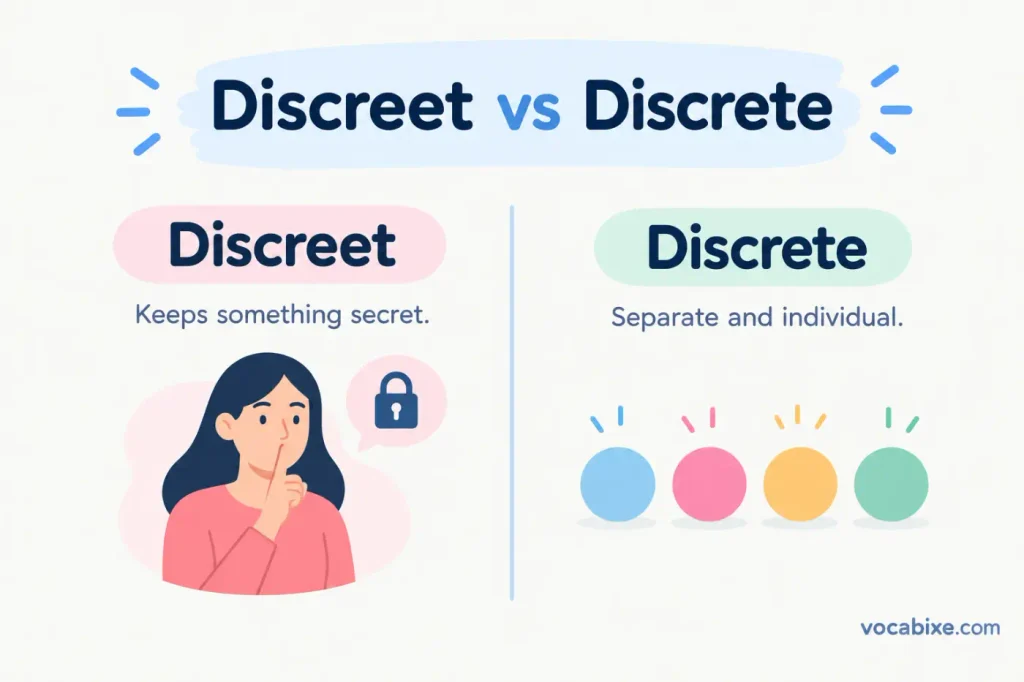
If you are confused by discreet vs discrete, you are not alone. These two words look almost the same and are pronounced the same in standard English. However, they have different meanings and are used in different situations.
Discreet usually describes someone who is careful, private, or tactful. Discrete means separate, distinct, or clearly different from other things. The spelling changes by only one letter, but the meaning changes a lot.
A simple way to remember the difference is this: discreet is about being careful with information or behavior, while discrete is about things being separate or distinct.
Simple Answer in One Look
The correct spellings are discreet and discrete. Both are real English words, but they do not mean the same thing.
- Discreet = careful, private, or tactful
- Discrete = separate, distinct, or individual
For example:
- Please be discreet about the surprise party.
- The report contains three discrete sections.
The two words are also pronounced the same, which is one major reason people confuse them.
What Does Discreet vs Discrete Mean?
The difference becomes easy once you look at each word separately.
What Does Discreet Mean?
Discreet means careful about what you say, do, or reveal.
A discreet person knows how to handle private information. They do not attract unnecessary attention. They may also know when to stay quiet.
For example:
Sarah was discreet about her friend’s personal problem.
This means Sarah did not tell everyone about the problem.
You can also use discreet for actions.
He gave me a discreet signal to leave the room.
He gave the signal quietly and without making other people notice.
The word can describe good judgment, privacy, or quiet behavior.
What Does Discrete Mean?
Discrete means separate, distinct, or individual.
If several things are discrete, they are treated as separate things rather than as one continuous group.
For example:
The machine has five discrete parts.
This means the machine has five separate parts.
Another example is:
The survey has four discrete categories.
The categories are separate from one another.
The word discrete is common in science, mathematics, technology, statistics, and technical writing. It can also appear in everyday English when someone wants to describe clearly separate things.
What Is the Correct Spelling?
Both discreet and discrete are correct spellings.
The important question is not which spelling is correct in general. The real question is which word matches your meaning.
Use discreet when you mean:
- Careful
- Tactful
- Private
- Quiet about sensitive information
- Not drawing attention
Use discrete when you mean:
- Separate
- Distinct
- Individual
- Clearly divided
- Not continuous
Here are some quick examples:
She was discreet about the family matter.
The study divided the subjects into three discrete groups.
Please be discreet when discussing the gift.
The program uses discrete steps.
A common mistake is choosing the spelling only because the words sound alike. Since both words have the same pronunciation, you must think about the meaning.
What Is the Difference Between Discreet and Discrete?
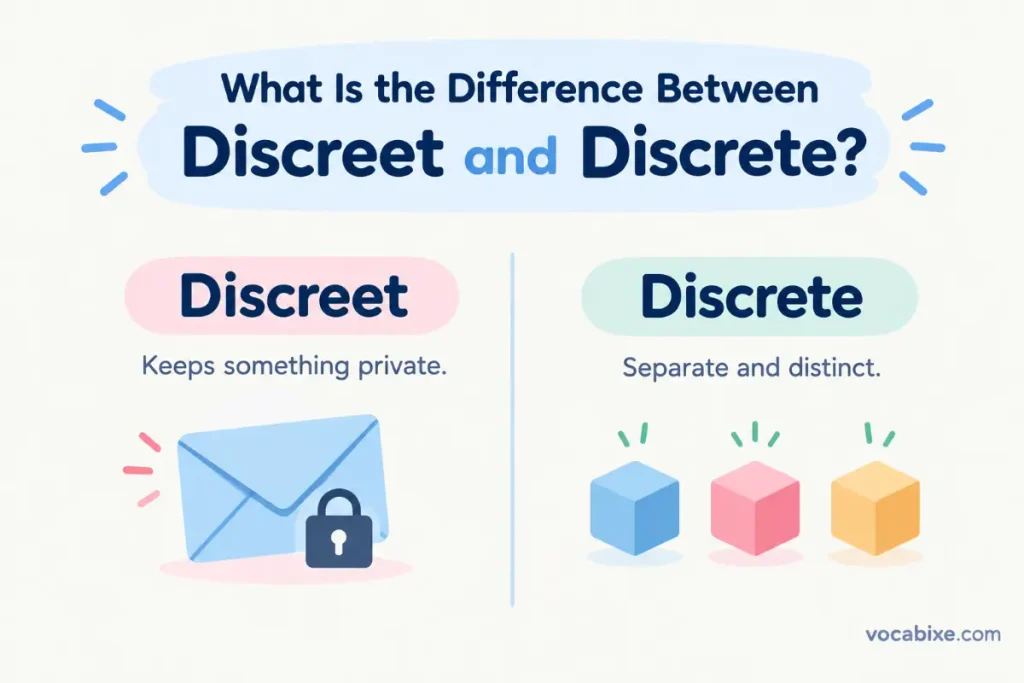
The main difference is simple:
Discreet describes careful behavior or handling of information. Discrete describes things that are separate or distinct.
| Word | Meaning | Example |
|---|---|---|
| Discreet | Careful, private, tactful | She was discreet about the news. |
| Discrete | Separate, distinct, individual | The experiment has three discrete stages. |
Another easy way to see it:
Discreet → people, actions, information, behavior
Discrete → parts, groups, categories, objects, values, stages
These are not strict rules for every sentence, but they are useful clues.
Discreet Is About Conduct
If someone is discreet, they handle a situation carefully.
The receptionist was discreet when discussing the patient’s appointment.
The receptionist did not share private information openly.
Discrete Is About Separation
If something is discrete, it is separate from something else.
The teacher divided the lesson into four discrete activities.
The activities are separate parts of the lesson.
Why Do People Get Confused?
There are several reasons for the confusion.
They Sound the Same
In standard English, discreet and discrete are homophones. This means they have the same pronunciation but different meanings and spellings.
You hear:
discreet
and
discrete
but you cannot hear the spelling difference.
This creates a problem when people learn the word through conversation first.
They Look Almost Identical
The words contain nearly the same letters.
discreet
discrete
The main difference is the position of the second “e” and the “t” pattern.
When typing quickly, it is easy to choose the wrong spelling.
Their Meanings Can Feel Related
Both words have a connection to the idea of making distinctions or keeping things apart. Their histories are related, too. Over time, English developed different meanings for the two forms.
That shared history can make the words feel connected even though modern English uses them differently.
Spell-Checking Does Not Always Help
A spell checker may accept both words because both are valid English words.
For example:
Please be discrete about the secret.
The sentence may pass a basic spelling check, even though discreet is the better word if you mean “careful and private.”
This is a meaning problem, not simply a spelling problem.
Which One Should You Use?
Use this simple rule:
Yeah Use discreet when you mean careful or private.
Be discreet about the surprise.
Use discrete when you mean separate or distinct.
The program has five discrete sections.
Another memory trick is:
Discreet has “ee” together like a person keeping something quietly between people.
This is not a formal spelling rule, but it can help you remember the word.
For discrete, think about separate things.
Three discrete boxes = three separate boxes.
If you mean “keep something private,” choose discreet.
If you mean “keep things separate,” choose discrete.
Easy Examples in Real Sentences
Here are some everyday examples that show the difference.
- Please be discreet about my new job.This means please do not openly share the information.
- The manager was discreet when talking about the employee.The manager handled private information carefully.
- The box contains four discrete compartments.The compartments are separate from each other.
- She gave him a discreet smile.The smile was subtle and did not attract attention.
- The class was divided into three discrete groups.The groups were separate.
- He tried to be discreet during the meeting.He tried not to attract attention.
- The computer program has several discrete functions.The functions are separate or distinct.
- The doctor was discreet about the patient’s condition.The doctor handled private information carefully.
Notice how the meaning changes depending on the word.
Common Mistakes to Avoid
Mistake 1: Using Discrete for Privacy
Incorrect:
Please be discrete about my personal information.
Correct:
Please be discreet about my personal information.
Here, the meaning is “be careful and private,” so discreet is correct.
Mistake 2: Using Discreet for Separate Parts
Incorrect:
The machine has five discreet parts.
Correct:
The machine has five discrete parts.
Here, the meaning is “separate parts,” so discrete is correct.
Mistake 3: Thinking One Word Is British
Some people think discreet and discrete are British and American versions of the same word.
That is not correct.
Both words are used in American English and British English. They have different meanings in both varieties.
Mistake 4: Choosing by Sound
Because the words sound the same, pronunciation cannot tell you which spelling to use.
Think about the meaning first.
Ask yourself:
Am I talking about careful behavior?
If yes, use discreet.
Ask:
Am I talking about separate things?
If yes, use discrete.
Mistake 5: Assuming a Spell Checker Is Enough
A spell checker can tell you that discreet is spelled correctly. It cannot always tell you that discreet is the wrong word for your sentence.
Both spellings are valid words.
The writer has to choose the correct word based on meaning.
Where Do the Words Come From?
The histories of discreet and discrete are closely connected.
Both words ultimately trace back to Latin roots connected with distinguishing, separating, or discerning. They passed through older forms of French before becoming established in English.
Over time, the English forms developed different meanings.
Discrete kept a strong connection with the idea of being separate or distinct.
Discreet developed its modern sense of showing careful judgment, especially in speech and behavior.
This is why the two words look and sound so similar today. Their shared history helps explain the similarity, but their modern meanings are different.
You do not need to remember the Latin history to use the words correctly. The practical rule is much easier:
Discreet = careful and private.
Discrete = separate and distinct.
That simple distinction will solve most everyday spelling and usage questions.
A Quick Memory Test
Try these sentences:
Please be ______ about the surprise.
The answer is discreet because the person needs to keep information private.
Now try:
The teacher created four ______ groups.
The answer is discrete because the groups are separate.
One more:
The nurse was ______ when discussing the patient’s condition.
The answer is discreet.
And:
The data contains several ______ values.
The answer is discrete.
If you can identify the meaning, the spelling becomes much easier.
Transition to Section 2
Once you know the basic difference, the next step is learning how native English speakers use these words in real situations. Discreet often appears when privacy, manners, or careful behavior matter. Discrete appears more often when people describe separate objects, groups, stages, values, or categories.
Understanding those settings helps you choose the right word without stopping to think about the spelling every time.
Section 2: Deep Meaning + Culture + Practical Use
How Is This Word Used in Real Life?
The two words appear in different types of writing and conversation.
Discreet in Everyday Conversation
People often use discreet when talking about private matters.
For example:
Can you be discreet about this?
This means:
Can you keep this private?
A person might say this after sharing personal news with a friend.
You can also use it when someone does something quietly.
He made a discreet exit.
This means he left without attracting much attention.
The word can describe polite behavior too.
She was discreet when asking about his family problem.
She did not ask loudly or embarrass him.
Discreet at Work
Discreet is useful in professional situations because workplaces often involve private information.
For example:
Please be discreet with customer information.
This asks someone to handle private information carefully.
You might also see:
The company needs a discreet way to discuss the issue.
This suggests that the matter should be handled privately or carefully.
The word sounds fairly formal, so it can work well in professional writing.
Discreet in Social Situations
Imagine that your friend is planning a surprise birthday party.
You’ll might say:
We need to be discreet so she does not find out.
You are not talking about separate objects. You are talking about keeping information hidden or avoiding attention.
Another example:
He discreetly checked the time.
He checked the time without making it obvious.
The adverb discreetly comes from discreet.
Discrete in Everyday English
Discrete is less common in casual conversation than discreet, but it appears often in technical and educational writing.
For example:
The course is divided into six discrete units.
Each unit is treated as a separate part.
You might also say:
These are two discrete problems.
This means the problems are separate rather than being one single problem.
Discrete in School
Students may see discrete in mathematics, computer science, science, and statistics.
For example:
The chart shows discrete values.
A teacher might explain that these values are separate rather than part of a smooth continuous range.
The phrase discrete mathematics is also common. It is an area of mathematics that studies objects and structures that can be treated as separate or countable.
Discrete in Technology
Technology uses the word frequently.
For example:
The system has several discrete components.
The components are separate parts.
A technical document might also say:
The software performs the task in discrete steps.
Each step is separate and identifiable.
How Is This Word Understood in Culture and Stories?
Discreet can appear in books, movies, television shows, and everyday stories because privacy is a common part of human relationships.
A character may be asked to be discreet about a secret. A person may behave discreetly to avoid embarrassing someone. A detective may need to work discreetly so other people do not notice what is happening.
In these situations, discreet keeps its normal meaning. It does not automatically mean mysterious or dishonest.
For example, a story might describe someone as discreet because that person does not reveal another person’s private information.
The word discrete appears more naturally in stories that involve science, mathematics, technology, systems, or careful descriptions of separate objects.
A science-fiction story might describe discrete systems. A math book might discuss discrete values. A technical novel might mention discrete components.
There is no special secret cultural meaning attached to either word. Their meanings usually remain close to their standard dictionary meanings.
Related Words You Should Know
Learning related words can make the difference easier to remember.
Private
Private means not meant for everyone to know or see.
This is a private conversation.
It connects closely with discreet because discreet behavior often protects privacy.
Tactful
Tactful means careful about other people’s feelings.
She gave a tactful answer.
A discreet person may also be tactful.
Careful
Careful means paying attention and avoiding mistakes or problems.
Be careful with that information.
This is another useful clue for discreet.
Separate
Separate means apart from something else.
Put the two bags in separate rooms.
This connects strongly with discrete.
Distinct
Distinct means clearly different or easy to tell apart.
The two colors are distinct.
This is one of the closest everyday words to discrete.
Word Individual
Individual means one particular person or thing.
Each student received an individual task.
Individual things can be described as discrete when they are treated as separate units.
Confidential
Confidential means private information that should not be shared freely.
The document contains confidential information.
This word often appears in the same situations as discreet.
Continuous
Continuous means happening or existing without breaks.
This is useful when learning discrete because discrete things are often contrasted with continuous things.
For example:
Discrete values are separate values, while continuous values can change across a range.
How to Use Discreet Correctly
Use discreet when someone is careful about information, behavior, or attention.
Common situations include:
- Keeping a secret
- Protecting private information
- Avoiding embarrassment
- Acting quietly
- Avoiding unnecessary attention
- Handling sensitive topics
- Speaking tactfully
Examples:
Please be discreet with this information.
She was discreet about the family issue.
He discreetly left the room.
The assistant gave me a discreet warning.
Do not use discreet when you simply mean separate.
For separate things, use discrete.
How to Use Discrete Correctly
Use discrete when things are separate, distinct, or individually identifiable.
Common situations include:
- Separate parts
- Separate groups
- Separate categories
- Separate stages
- Separate values
- Mathematics
- Statistics
- Computer science
- Science and technical writing
Examples:
The study has three discrete groups.
The process has five discrete stages.
The program uses discrete commands.
The data contains discrete values.
The word is especially common in technical writing.
Formal vs Informal Use
Both words are acceptable in formal and informal English, but they appear in different settings.
Discreet is common in everyday conversation and professional communication.
Please be discreet about the meeting.
It can sound polite and professional.
Discrete is common in technical, academic, and professional writing.
The researchers analyzed three discrete populations.
You can also use it in ordinary English.
The project has four discrete parts.
Neither word is slang.
Neither is limited to one country.
Both are standard English words.
Pronunciation of Discreet and Discrete
One reason this pair is difficult is pronunciation.
Both words are normally pronounced the same way:
discreet — /dɪˈskriːt/
discrete — /dɪˈskriːt/
The final sound is like the word treat with a different beginning.
Because the pronunciation is the same, listening alone cannot tell you which spelling is being used.
Context gives you the answer.
If someone says:
Be discreet.
You need to understand that the speaker means “be careful or private.”
If someone says:
These are discrete units.
The speaker means “these are separate units.”
Real-Life Usage Examples
Here are more examples showing how the words work in different settings.
- The teacher was discreet when speaking to the student’s parents.The teacher handled the private matter carefully.
- Please be discreet because the party is a surprise.The person should not reveal the secret.
- The hospital needs discreet staff members who respect patient privacy.The staff should handle private information carefully.
- The research team studied four discrete populations.The populations were treated as separate groups.
- The machine is made of several discrete components.The components are separate parts.
- She discreetly put the gift behind the sofa.She did it without drawing attention.
- The application divides the process into discrete steps.Each step is separate and identifiable.
- He gave me a discreet look across the room.The look was subtle and not obvious.
- The survey uses five discrete categories.The categories are separate.
- The manager asked everyone to be discreet about the complaint.
The manager wanted the information handled privately.
These examples show why replacing one word with the other can change the meaning of a sentence.
A Useful Comparison With Secret
Some learners think discreet simply means “secret.”
That is close in some situations, but the words are not identical.
Secret means something that is hidden or not known to others.
Discreet describes careful behavior that avoids revealing information or attracting attention.
For example:
The plan is secret.
This means people do not know about it.
She was discreet about the plan.
This means she behaved carefully and did not reveal it.
The difference is small but useful.
A Useful Comparison With Separate
Likewise, discrete is similar to separate, but they are not always interchangeable.
Separate is a very common everyday word.
Discrete often emphasizes that things are clearly distinct or treated as individual units.
For example:
The children sat at separate tables.
This is natural everyday English.
The study examined three discrete groups.
This sounds more technical because the groups are being treated as distinct units.
Is Discrete Related to Discretion?
This is an interesting point.
Discreet and discretion are closely related in meaning.
If someone uses discretion, they show good judgment about what to say or do.
For example:
The employee handled the matter with discretion.
This means the employee used careful judgment and protected private information.
This can help you remember discreet:
discreet → discretion → careful judgment
The word discrete does not have this same meaning.
Can Discreet Mean Quiet?
Sometimes discreet can describe something that is subtle or does not attract attention.
For example:
She wore a discreet necklace.
This can mean the necklace was simple and not very noticeable.
However, discreet does not simply mean “quiet” in every situation.
A loud person could still be discreet about private information. A quiet person could still reveal a secret.
The key idea is careful handling, privacy, or avoiding unwanted attention.
Can Discrete Mean Different?
Yes, discrete can mean clearly different or distinct.
For example:
The experiment contains two discrete groups.
The groups are different and separate.
But remember that discrete often has a stronger sense of separation than the everyday word different.
If you only mean that two things are not the same, different may be more natural.
If you mean they are separate units or categories, discrete may be a better choice.
Common Questions People Have
Is discreet the same as discrete?
No. Discreet means careful, private, or tactful. Discrete means separate, distinct, or individual.
Are discreet and discrete pronounced the same?
Yes. They are normally pronounced the same in standard English.
Is discreet the correct spelling for private behavior?
Yes. Use discreet when you mean careful or private behavior.
Is discrete the correct spelling for separate things?
Yes. Use discrete when you mean separate, distinct, or individual things.
Can discreet describe a person?
Yes. You can describe someone as discreet when they handle private information or sensitive situations carefully.
Can discrete describe a person?
Usually, no, not with the meaning of “private” or “tactful.” Discrete normally describes things, groups, categories, values, parts, or concepts that are separate.
Is discrete used in mathematics?
Yes. Discrete is common in mathematics, especially in the phrase discrete mathematics. It can also describe separate or countable values and structures.
Is discreet formal or informal?
Discreet works in both everyday and formal English. It is especially useful when discussing privacy, sensitive information, or tactful behavior.
Final Teacher Explanation
Here is the easiest classroom rule to remember.
Imagine two situations.
In the first situation, your friend tells you a personal secret. You do not tell anyone else And You act carefully. You are being discreet.
In the second situation, a box has three separate sections. Each section is its own part. The sections are discrete.
So think:
Discreet = careful with people or information.
Discrete = separate things.
The words sound exactly alike, so do not try to solve the spelling problem by pronunciation. Look at the meaning of the sentence.
If the sentence is about privacy, tact, secrecy, or avoiding attention, choose discreet.
If the sentence is about separate parts, groups, categories, values, or stages, choose discrete.
That is the main difference.
RELATD POST ON OTHER SAME WORDS: comming vs coming , preform vs perform , writing or writting.
Final Answer — Quick Recap
Discreet and discrete are both correct English words, but they have different meanings. Discreet means careful, private, or tactful, while discrete means separate, distinct, or individual.
The best memory rule is simple: discreet is about careful behavior or private information, while discrete is about separate things. Both words are pronounced the same, so meaning must guide your spelling.
When you write about a private conversation, choose discreet. When you describe separate groups, parts, stages, or values, choose discrete.
Once you connect each spelling with its meaning, this commonly confused pair becomes much easier. You do not need to memorize a complicated grammar rule. Just ask what you mean before choosing the word.
FAQs
Frequently Asked Questions
What does discreet mean in simple English?
Discreet means careful about what you say or do, especially when dealing with private information.
Example: Please be discreet about the surprise.
What does discrete mean in simple English?
Discrete means separate, distinct, or treated as an individual unit.
Example: The project has four discrete parts.
Is discreet or discrete correct?
Both are correct. Discreet means private or careful. Discrete means separate or distinct.
Why do people confuse discreet and discrete?
They look very similar and are pronounced the same. Both words also have related histories, which makes the spelling difference harder to remember.
How do I remember the difference between discreet and discrete?
Remember:
Discreet = careful and private.
Discrete = separate and distinct.
Is discreet used in formal writing?
Yes. Discreet is appropriate in formal, professional, and everyday English.
Is discrete used in mathematics?
Yes. Discrete is widely used in mathematics, statistics, computer science, and other technical fields.
Are discreet and discrete American or British English?
Both words are used in both American English and British English. They are not different regional spellings.
Pingback: Paid vs Payed: Clear Difference Explained Simply - Vocabixe
Pingback: Full Time or Fulltime: Clear Guide to Correct Usage - Vocabixe
Pingback: Dysregulated vs Disregulated: Correct Spelling Explained Clearly - Vocabixe