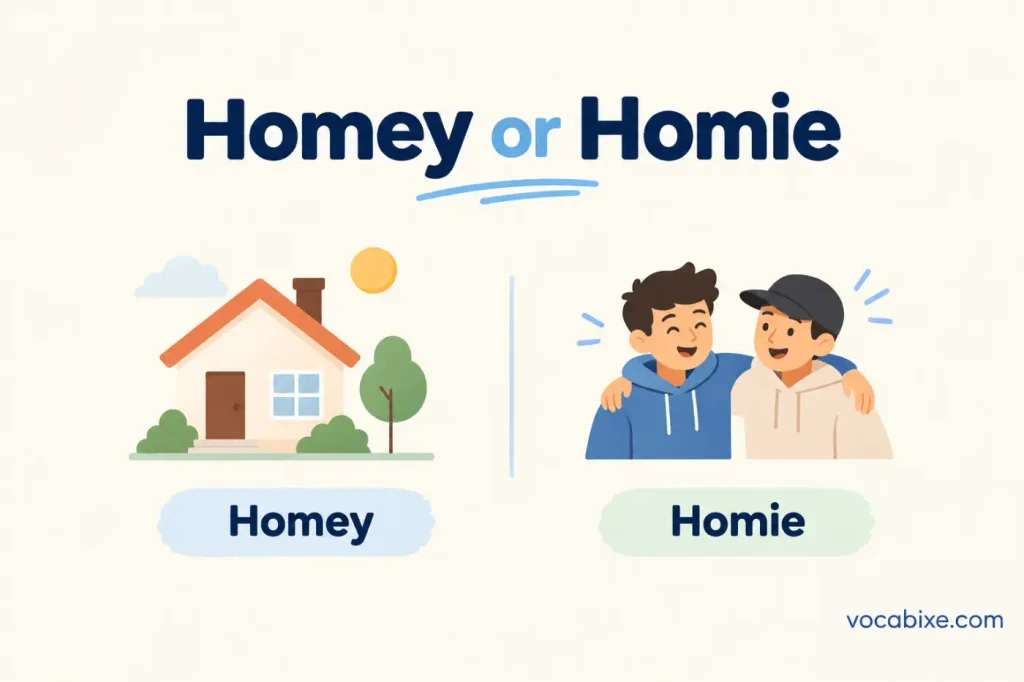
If you are wondering whether to write “homey” or “homie,” both spellings are correct, but they have different meanings and uses. Homey usually describes a place that feels comfortable, warm, and welcoming. Homie is informal slang for a friend, buddy, or someone you feel close to. The right word depends on what you want to say. For example, “This room feels homey” describes a cozy room, while “He is my homie” means he is your friend. Understanding this difference will help you choose the correct spelling in everyday writing and conversation.
Homey or Homie: Quick Answer
Homey is the correct spelling when describing something that feels like home. Homie is the usual spelling when referring to a friend or close companion in informal language.
Here is the simple rule:
- Use homey for a comfortable, cozy, or welcoming place.
- Use homie for a friend, buddy, or close associate.
- Use homey when describing the feeling of a room, house, or environment.
- Use homie when talking casually to or about a friend.
Examples:
- The little café has a homey atmosphere.
- My homie helped me move into my new apartment.
- We made the living room feel more homey.
- I have known that homie since childhood.
Although the words look and sound similar, they are not interchangeable in most situations. One describes a feeling or atmosphere, while the other usually refers to a person.
What Does Homey Mean?
Homey is an adjective that describes something comfortable, familiar, and welcoming. It often refers to a place that makes people feel relaxed, as if they were at home.
A homey space does not have to be large, expensive, or beautifully decorated. It simply needs to create a sense of comfort and warmth. Soft lighting, familiar furniture, family photographs, and friendly surroundings can all make a place feel homey.
For example, imagine visiting a small restaurant with wooden tables, warm lights, and friendly staff. The restaurant may not look fancy, but it feels pleasant and welcoming. You could describe it as homey.
The word can also describe the atmosphere of a home, a bedroom, a hotel room, or even a small shop. In each case, it suggests comfort rather than luxury.
Examples of Homey in Everyday Sentences
These examples show how to use homey naturally.
- Our new apartment feels homey after we decorated it.
- The bed-and-breakfast has a homey atmosphere.
- I love the homey feeling of my grandmother’s kitchen.
- Warm colors can make a bedroom look more homey.
- The small bookstore has a quiet, homey charm.
- We chose a homey restaurant instead of an expensive one.
- Her living room is simple but very homey.
- The cabin felt homey despite being far from the city.
Notice that homey describes the quality or feeling of a place. It does not usually mean that the place literally belongs to a person or family.
Can Homey Describe a Person?
Homey most commonly describes places, rooms, and atmospheres. However, it can sometimes describe a person or an environment associated with a warm, familiar feeling.
For instance, someone might describe a host as having a homey manner if that person makes guests feel comfortable and welcome. This use is less common than describing a room or house as homey.
When you want to describe a person who is friendly, kind, or easy to talk to, words such as welcoming, warm, friendly, and approachable are often clearer choices.
Consider these examples:
- Correct and natural: The guest room feels homey.
- Possible in context: Her homey manner made everyone comfortable.
- More direct: She is a warm and welcoming host.
If your main goal is to describe a friend, however, homey is usually not the word you want. Homie is the more suitable informal term.
What Does Homie Mean?
Homie is an informal slang word for a friend, buddy, or close companion. It is often used for someone you know well and feel comfortable around.
The word is associated with the idea of a person from your home area or community. Over time, it became a familiar way to refer to friends and trusted companions in casual speech.
Today, people may use homie when talking to a close friend, describing a member of their social circle, or expressing friendship and loyalty. The term is common in informal conversation, popular culture, music, and online communication.
For example, you might say, “What’s up, homie?” when greeting a friend. This is a casual expression, not a formal greeting for a business meeting or an unfamiliar person.
Examples of Homie in Everyday Sentences
Here are several natural examples of homie used to refer to a person.
- My homie came over to watch the game.
- I have known that homie for ten years.
- Thanks for helping me out, homie.
- She introduced me to her homie from college.
- My homies and I went to the movies.
- He is more than a friend; he is my homie.
- I can always count on my homie.
- What’s up, homie? How have you been?
In these sentences, homie refers to a friend or companion. It does not describe a room, building, or atmosphere.
Is Homie Only Used for Male Friends?
No. Homie is not limited to male friends. Although it has often been associated with male friendships in popular culture, people can use it for friends of different genders.
The word’s meaning depends on the speaker, the relationship, and the social setting. Some people use homie for their closest friends, while others use it more casually for members of their wider social group.
For example:
- My homie Sarah helped me prepare for the exam.
- She is one of my closest homies.
- All my homies came to celebrate my birthday.
The term remains informal, so it may not suit every relationship or situation. If you are unsure whether someone likes being addressed that way, simply use their name or a neutral greeting.
What Is the Difference Between Homey and Homie?
The main difference is their meaning and grammatical role. Homey is an adjective that describes a comfortable, welcoming feeling. Homie is a noun that refers to a friend or companion.
| Feature | Homey | Homie |
|---|---|---|
| Main meaning | Comfortable and welcoming | Friend or buddy |
| Part of speech | Adjective | Noun |
| Typical use | Describing a place or atmosphere | Referring to a person |
| Tone | Descriptive and conversational | Informal and slang |
| Example | The kitchen feels homey. | My homie is visiting. |
| Formal writing | Sometimes suitable | Usually avoided |
| Common context | Homes, rooms, restaurants | Friends, greetings, casual speech |
The easiest way to remember the difference is to ask yourself what you are describing.
If you are describing a place, homey is usually correct. If you are referring to a friend, homie is usually correct.
Homey vs. Homie: Compare These Sentences
Looking at similar sentences can make the difference easier to understand.
Example 1: Describing a room
- Correct: The room looks homey.
- Incorrect for the intended meaning: The room looks homie.
The first sentence means the room looks comfortable and welcoming. The second does not communicate that meaning naturally.
Example 2: Talking about a friend
- Correct: My homie lives nearby.
- Incorrect for the intended meaning: My homey lives nearby.
If you mean that your friend lives nearby, homie is the usual spelling. Homey would be confusing because it normally describes a feeling or atmosphere.
Example 3: Talking about a café
- Correct: We found a homey little café.
- Incorrect for the intended meaning: We found a homie little café.
The first sentence describes a cozy café. The second incorrectly uses a noun referring to a person as an adjective.
Example 4: Greeting someone
- Correct: Hey, homie! How are you?
- Unnatural for this meaning: Hey, homey! How are you?
Homie is the familiar slang spelling for a friend. In casual conversation, it can work like buddy or pal.
These examples show why choosing the correct spelling matters. The words are similar, but their meanings are different.
Why Do People Confuse Homey and Homie?
People often confuse homey and homie because the words look almost identical and are pronounced similarly in many varieties of English.
Both contain the letters h, o, m, and the same general sound pattern. The main spelling difference appears in the final part of each word: homey ends in “ey,” while homie ends in “ie.”
However, spelling alone is not the only source of confusion. Both words have a connection to the idea of home or familiarity, which can make their meanings seem related.
Homey describes the feeling of being at home. Homie refers to a friend or companion, especially someone associated with your community or social circle.
Another reason for the confusion is informal communication. People often use slang in text messages, social media posts, comments, and online conversations. In these settings, spelling mistakes may go unnoticed or become repeated by other users.
To avoid confusion, focus on the meaning rather than the sound. Ask whether you mean a comfortable atmosphere or a person you consider a friend.
Is Homey or Homie More Common in American English?
Both words are used in American English, but they appear in different contexts.
Homey is an established descriptive adjective. American speakers use it to describe places that feel comfortable, familiar, or welcoming.
For example:
- The house has a homey feel.
- We prefer homey restaurants to crowded, noisy places.
- Her apartment looks homey and inviting.
Homie is informal American English slang used to refer to a friend or companion. It is especially familiar in casual speech and popular culture.
For example:
- I am meeting my homie after work.
- What’s going on, homie?
- My homies have supported me for years.
Neither word is automatically better than the other. The correct choice depends on the intended meaning.
Is Homey or Homie British English?
Homey is understood in British English, although British speakers also commonly use the spelling “homely” to describe a comfortable, simple, or welcoming home.
This creates an important regional difference. In American English, homey is a common adjective for a cozy or welcoming atmosphere. In British English, homely often serves the same purpose.
The word homie is also understood in Britain, especially through music, television, social media, and other forms of popular culture. Its use depends on the speaker and setting.
For example:
- American English: The cottage feels homey.
- British English: The cottage feels homely.
- Informal English: My homie is coming over.
Remember that homely can have a different meaning in American English. When used to describe a person, it can mean unattractive. In British English, the word is more commonly positive when describing a comfortable home.
Therefore, when writing for an American audience, homey is a useful choice for a welcoming atmosphere. When addressing a British audience, homely may sound more natural.
What Is the Difference Between Homey, Homie, and Homely?
These three words are related in appearance, but they do not have exactly the same use.
Homey means comfortable, familiar, and welcoming. It usually describes a place or atmosphere.
Example: The little cottage has a homey feel.
Homie means a friend, buddy, or close companion. It is informal slang.
Example: My homie saved me a seat.
Homely often means simple, comfortable, or pleasant in a way associated with home, especially in British English. In American English, it can also mean unattractive when describing a person.
Examples:
- British English: We stayed in a homely guesthouse.
- American English: The guesthouse felt homey.
- Informal slang: My homie booked the guesthouse.
How Do You Use Homey Correctly in a Sentence?
Use homey when an adjective is needed to describe the feeling, look, or atmosphere of a place.
It often appears after linking verbs such as feels, looks, seems, and is. It can also appear before a noun.
Common patterns include:
- A homey room
- A homey atmosphere
- A homey kitchen
- The house feels homey.
- The café looks homey.
For example, “We made the guest room homey with soft blankets and warm lighting” explains how the room became more comfortable and welcoming.
Homey can also appear in comparisons. You might say, “This café feels more homey than the hotel restaurant.” Here, more homey compares the atmosphere of two places.
Although homey is not limited to houses, it usually suggests a personal, familiar, relaxed feeling. It does not necessarily mean modern, expensive, fashionable, or luxurious. Related article Habit vs Habbit.
Common Mistakes With Homey
Avoid these common errors when using homey.
Mistake 1: Using homey to mean friend
Incorrect: My homey called me yesterday.
Better: My homie called me yesterday.
If you mean a friend, homie is the usual spelling.
Mistake 2: Using homey as a noun for a building
Unnatural: We bought a homey near the park.
Better: We bought a home near the park.
Homey describes a quality; it is not the ordinary word for a house or building.
Mistake 3: Assuming homey always means old-fashioned
Incorrect assumption: A homey room must have old furniture.
Better understanding: A room can be modern and still feel homey.
Comfort comes from the overall atmosphere, not a specific decorating style.
How Do You Use Homie Correctly in a Sentence?
Use homie as an informal noun when talking about a friend, companion, or someone in your social circle.
It can appear as the subject or object of a sentence. It can also be used directly when speaking to a friend.
Examples:
- My homie lives across the street.
- I invited my homie to dinner.
- That homie always makes me laugh.
- Thanks, homie!
- I am going to meet up with my homies.
The word can communicate closeness, familiarity, and loyalty. However, it does not always mean a person’s closest or oldest friend. Some speakers use it broadly, while others reserve it for people they trust.
Common Mistakes With Homie
Mistake 1: Using homie in formal writing
Informal: My homie helped me finish the project.
More formal: My friend helped me finish the project.
Homie may be fine in a personal message, but friend is usually better for a school essay, business email, or formal report.
Mistake 2: Using homie to describe a place
Incorrect: The restaurant is very homie.
Better: The restaurant is very homey.
The adjective homey describes a welcoming atmosphere.
Mistake 3: Assuming everyone likes the term
Although homie can be friendly, not everyone uses or enjoys slang. Some people may find it too familiar, especially when used by someone they do not know well.
When speaking to a new acquaintance, a simple hello or the person’s name is usually a safer choice.
What Are Some Synonyms for Homey and Homie?
The best synonym depends on which word you mean. Homey describes a quality, while homie refers to a person.
Synonyms for Homey
Useful alternatives include:
- Cozy: Comfortable, warm, and relaxing.
- Welcoming: Making people feel accepted and comfortable.
- Comfortable: Giving a feeling of ease and relaxation.
- Inviting: Making people want to enter or stay.
- Warm: Friendly or pleasant in feeling.
- Familiar: Having the comfortable quality of something well known.
- Homelike: Resembling the comfort and atmosphere of a home.
Examples:
- The living room feels cozy.
- The hotel has a welcoming atmosphere.
- Her kitchen is warm and inviting.
- The guesthouse feels homelike.
These words overlap with homey, but each has a slightly different focus. Cozy emphasizes comfort, welcoming emphasizes friendliness, and familiar emphasizes something known or recognizable.
Synonyms for Homie
Common alternatives include:
- Friend: A person you know and like.
- Buddy: An informal word for a friend.
- Pal: A casual term for a friend.
- Mate: A common informal term for a friend in several English-speaking regions.
- Companion: Someone who spends time with another person.
- Close friend: Someone with whom you have a strong personal relationship.
- Best friend: A particularly close or trusted friend.
Examples:
- My buddy is coming over tonight.
- I met a friend after work.
- My mate helped me carry the boxes.
- A close friend gave me some useful advice.
Friend is the safest general alternative because it works in both formal and informal situations. Buddy, pal, and mate are also informal, while companion can sound more neutral or formal.
Is Homey a Formal Word and Is Homie Slang?
Homey is a standard English adjective. It can be used in everyday conversation, reviews, travel descriptions, and many forms of general writing.
For example, a hotel review might say, “The rooms are simple but homey.” A restaurant review could describe a small dining area as having a homey atmosphere.
Homie, on the other hand, is informal slang. It is most suitable for friendly conversation, casual messages, and dialogue that reflects the way people speak.
For example, “Thanks for the ride, homie” sounds natural in a casual exchange between friends. In a professional email, “Thank you for giving me a ride” would usually be more appropriate.
The difference is not that homey is always formal and homie is always incorrect. Rather, homey is a standard descriptive word, while homie belongs mainly to informal language.
Choose words based on your audience. If you are writing a school assignment about interior design, homey may be appropriate. If you are writing a formal report about a group of colleagues, friend or colleague is usually better than homie.
FAQs
Is homey or homie the correct spelling?
Both spellings are correct, but they have different meanings. Homey describes a comfortable atmosphere, while homie is slang for a friend or companion.
Is homie a real English word?
Yes. Homie is an established informal English word used to refer to a friend, buddy, or close companion. It is common in casual conversation and popular culture.
Does homey mean cozy?
Yes. Homey often means cozy, comfortable, familiar, or welcoming. For example, “The bedroom feels homey” means the room has a pleasant, home-like atmosphere.
Does homie mean best friend?
Not always. Homie can refer to a close friend, but it can also mean a friend or companion more generally. The exact meaning depends on the speaker and context.
Is homey the same as homely?
Not exactly. In American English, homey commonly describes a comfortable atmosphere, while homely can describe a simple home-like setting or, when referring to a person, someone considered unattractive. In British English, homely often has a positive meaning related to comfort.
Can I call a girl my homie?
Yes. Homie can refer to a friend of any gender. For example, “My homie helped me study for the test” is a natural informal sentence.
How do you spell homie in the plural?
The usual plural spelling is homies. For example, “I am meeting my homies after school.” The word homey can also become homeys when referring to multiple things described as homey, though this use is much less common.
Is homie appropriate for formal writing?
Usually not. Homie is informal slang, so friend, colleague, or companion is generally more suitable in academic, business, and professional writing.
Conclusion
The choice between homey and homie depends on what you want to express. Homey is the correct word for a place that feels comfortable, warm, and welcoming. Homie is the informal word for a friend, buddy, or close companion.
Remember this simple rule: a room can feel homey, but a friend can be your homie. Both spellings are valid, so you do not need to treat either one as a spelling mistake. Just match the word to its meaning and the situation in which you are using it.
Pingback: Symptomatology vs Symptomology: Find Correct Spelling - Vocabixe