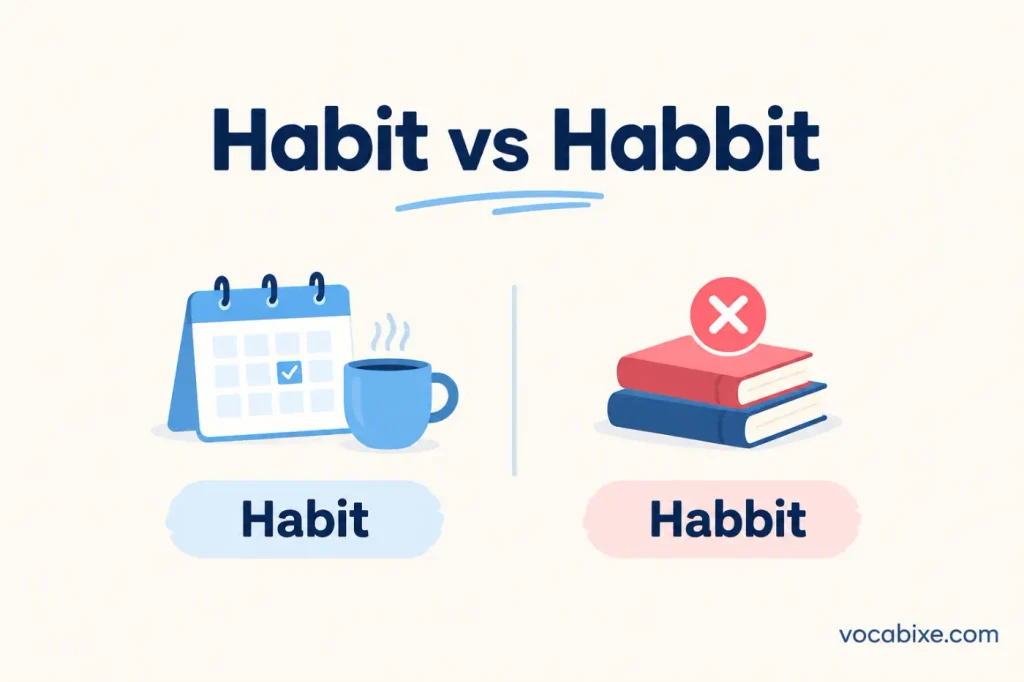
The correct spelling is habit, with one “b.” The spelling “habbit,” with two “b” letters, is incorrect in standard English. A habit is something a person does regularly, often without thinking much about it. For example, brushing your teeth every morning, reading before bed, or drinking water after waking up can be habits. If you are writing an essay, a school assignment, an email, or a social media post, always use “habit.” Although “habbit” may appear in online searches or informal messages, it is not the standard spelling of this word.
What Does Habit Mean?
A habit is an action or behavior that someone repeats regularly. It can become part of a person’s daily routine. Some habits are helpful, while others can cause problems if they are repeated too often.
For example, a student who reviews class notes every evening has developed a study habit. Someone who bites their nails when nervous may have a habit they want to change. In both cases, the word “habit” describes a repeated behavior.
Habits can develop over days, months, or years. They often begin with a choice, but repeating the same action can make it feel automatic. This is why people sometimes perform familiar actions without giving them much thought.
Here are some common examples of habits:
- Healthy habits: Eating balanced meals, exercising regularly, and getting enough sleep.
- Study habits: Reading daily, completing homework on time, and reviewing lessons.
- Work habits: Planning tasks, arriving on time, and keeping a workspace organized.
- Bad habits: Procrastinating, interrupting others, or spending too much time scrolling through a phone.
- Personal habits: Making the bed, washing hands before eating, or drinking tea in the morning.
The meaning stays the same across these examples. A habit is something repeated often enough to become a regular part of a person’s behavior.
Is Habit or Habbit the Correct Spelling?
“Habit” is the correct spelling in standard American English and British English. The word contains five letters: H, A, B, I, and T. It has only one “b.”
“Habbit” is a common spelling mistake. People may write it with two “b” letters because they are unsure how to spell the word or because they confuse it with other English words that contain double consonants.
Compare these examples:
- Correct: Reading every night is a good habit.
- Incorrect: Reading every night is a good habbit.
- Correct: She has a habit of waking up early.
- Incorrect: She has a habbit of waking up early.
The incorrect spelling does not create a different standard English word with another meaning. In ordinary writing, replace “habbit” with “habit.”
This rule applies to schoolwork, business communication, blog posts, applications, and everyday writing. Choosing the correct spelling helps readers understand your message and makes your writing look polished.
Why Do People Spell Habit as Habbit?
There are several reasons why this spelling mistake happens.
First, English spelling can be confusing. Some words use double consonants, while others use a single consonant. For example, “rabbit” has two “b” letters, but “habit” has only one. Someone who remembers the sound of a word more clearly than its written form may accidentally add another letter.
Second, people sometimes rely on how a word looks rather than remembering its correct spelling. Because “rabbit” and “habit” share several letters and have a similar rhythm, a learner might mistakenly write “habbit.”
Typing quickly can also cause errors. When writing a text message or social media comment, people may not check every word. A simple mistake can remain unnoticed, especially when the reader understands the intended meaning.
Finally, seeing an incorrect spelling online can make it seem familiar. If someone repeatedly encounters “habbit,” they may begin to think it is correct. However, frequent online use does not make a misspelling standard English.
The easiest solution is to remember that “habit” has one “b.” Reading the word correctly and using it in your own sentences can help you remember its spelling.
What Is the Difference Between Habit and Habbit?
The main difference is spelling. “Habit” is a standard English word, while “habbit” is a misspelling when the intended word is habit.
| Feature | Habit | Habbit |
|---|---|---|
| Spelling | Correct | Incorrect |
| Number of “b” letters | One | Two |
| Standard English word | Yes | No, not as the intended word |
| Meaning | A repeated action or behavior | No standard meaning in this context |
| Suitable for formal writing | Yes | No |
| Example | Walking daily is a healthy habit. | Walking daily is a healthy habbit. |
There is no meaningful difference in definition to learn between these two spellings. You do not need to choose one based on the situation, the audience, or the type of writing.
Use “habit” whenever you mean a repeated action or behavior. If you see “habbit” in a sentence with that meaning, treat it as a spelling error.
How Do You Pronounce Habit?
The word “habit” is commonly pronounced with two syllables: “HAB-it.” The first syllable receives the stronger stress.
Its pronunciation is the same in the usual American and British forms, although individual accents may affect the exact vowel sound.
To practice saying it, break the word into two parts:
- HAB: Say the first part with clear emphasis.
- it: Say the second part more lightly.
Then say the complete word naturally: “habit.”
The spelling “habbit” does not have a separate standard pronunciation in this context. Adding a second “b” does not change the intended word or create a new meaning.
You can practice with a short sentence such as, “Reading is a good habit.” Saying the word aloud while looking at its correct spelling may help you remember both its sound and its written form.
How Do You Use Habit in a Sentence?
The word “habit” can appear in many kinds of sentences. It often follows words such as “a,” “good,” “bad,” “daily,” and “healthy.” It can also appear in phrases such as “break a habit,” “form a habit,” and “get into the habit of.”
Here are practical examples.
1. Everyday routines
- Drinking water in the morning is a healthy habit.
- My habit of making the bed keeps my room tidy.
- She has a habit of checking the weather before leaving home.
These sentences describe actions that happen regularly.
2. School and learning
- Reading for twenty minutes a day is a useful study habit.
- He developed a habit of reviewing his notes after class.
- Good study habits can help students prepare for exams.
In these examples, the word refers to repeated actions that support learning.
3. Work and responsibility
- Arriving on time is a professional habit.
- My colleague has a habit of writing down important tasks.
- Planning each morning helps me build better work habits.
The word can describe behaviors that make work easier and more organized.
4. Habits someone wants to change
- She wants to break her habit of biting her nails.
- Checking my phone too often has become a bad habit.
- He is trying to stop the habit of delaying important tasks.
These examples show that a habit does not always have to be positive.
5. Family and social life
- My grandfather has a habit of telling stories after dinner.
- They have a family habit of eating together on Sundays.
- He has a habit of helping his neighbors.
A repeated behavior can be part of family life, friendship, or a person’s way of interacting with others.
In every sentence above, “habit” has one “b.” You can use it in many settings without changing its spelling.
What Are Common Phrases With Habit?
Learning common expressions can help you use the word naturally. These phrases appear in everyday conversations, books, school assignments, and professional writing.
Break a habit
This means to stop doing something regularly, especially a behavior you consider unhelpful.
Example: I want to break the habit of staying up too late.
Form a habit
This means to develop a repeated behavior.
Example: She is trying to form a habit of reading every evening.
Develop a habit
This has a similar meaning to “form a habit.” It often suggests that a behavior grows through repeated practice.
Example: Children can develop a habit of washing their hands before meals.
Get into the habit of
This means to begin doing something regularly.
Example: Get into the habit of checking your work before submitting it.
Out of habit
This describes an action performed automatically because it is familiar.
Example: He opened the refrigerator out of habit, even though he was not hungry.
Old habits die hard
This expression means that familiar behaviors can be difficult to change.
Example: She still checks her phone first thing in the morning. Old habits die hard.
Creature of habit
A creature of habit is someone who prefers familiar routines and often does things the same way.
Example: My father always takes the same route to work because he is a creature of habit.
Each expression uses the correct spelling, “habit.” Learning these phrases also makes it easier to recognize the word in different contexts. Related article Wiener vs Weiner.
What Is the Difference Between a Habit and a Routine?
The words “habit” and “routine” are related, but they are not exactly the same.
A habit is a repeated behavior that can become automatic. A routine is a series of actions performed regularly, often in a particular order.
For example, brushing your teeth before bed may be a habit. Your entire bedtime routine might include brushing your teeth, changing clothes, preparing your bag for the next day, and reading a book.
A routine can contain several habits. However, a routine may also involve actions that require conscious planning rather than happening automatically.
Consider these examples:
- Habit: She automatically drinks a glass of water after waking up.
- Routine: She wakes up, makes breakfast, exercises, and gets ready for work.
- Habit: He checks his calendar every morning.
- Routine: He reviews his calendar, answers emails, and plans his tasks before starting work.
Both words are correct, but they describe slightly different ideas. Use “habit” when focusing on a repeated behavior. Use “routine” when describing a regular process or sequence of activities.
What Is the Difference Between a Habit and a Behavior?
“Habit” and “behavior” are also connected, but their meanings are different.
A behavior is an action or way of acting. It can happen once or many times. A habit is a behavior that a person repeats regularly and may perform with little thought.
For example, helping someone carry a bag is a behavior. If a person regularly looks for opportunities to help others, that repeated action may become a habit.
Here are two more examples:
- Behavior: He stayed up late last night.
- Habit: He regularly stays up late, even when he needs to wake up early.
The first sentence describes one event. The second describes a repeated pattern.
Understanding this distinction helps you choose the right word. Not every action is a habit, but a habit is a type of repeated behavior.
Is Habit a Noun or a Verb?
“Habit” is a noun. It names a repeated action, practice, or behavior rather than describing an action directly.
For example:
- Reading is a good habit.
- She has a habit of arriving early.
- Exercise has become part of his daily habits.
In these sentences, “habit” and “habits” name things. The singular form is “habit,” and the plural form is “habits.”
The word itself is not normally used as a verb in standard everyday English. Instead, you can use related verbs such as “develop,” “form,” “build,” or “break.”
For example, say “I want to develop a healthy habit,” rather than using “habit” as the action word.
Several related words can help you express similar ideas:
- Habitual: Done regularly or repeatedly.
- Habitually: In a way that happens regularly.
- Habituate: To become accustomed to something or help someone become accustomed to it.
- Habituation: The process of becoming accustomed to something through repeated exposure.
For example, “He is a habitual reader” means that he reads regularly. The related adjective “habitual” contains the same basic spelling pattern as “habit.”
What Is the Plural of Habit?
The plural of “habit” is “habits.” To make the word plural, add “s” at the end.
Examples:
- One habit, several habits.
- A good habit, good habits.
- One unhealthy habit, several unhealthy habits.
Use the singular form when referring to one behavior. Use the plural form when referring to two or more behaviors.
For instance, “Walking daily is a healthy habit” refers to one behavior. The sentence “Walking daily and eating balanced meals are healthy habits” refers to more than one.
Do not write “habbits” as the plural form. The extra “b” is still incorrect. The spelling changes only by adding an “s” to the correctly spelled word.
What Are the Past Tense and Related Forms of Habit?
Because “habit” is a noun, it does not have a regular past-tense form like a verb. Instead, use a verb to explain how a habit began, continued, or ended.
Examples include:
- She developed a habit of reading before bed.
- He formed a habit of exercising every morning.
- They broke a habit of eating late at night.
- I have built a habit of planning my day.
The verb changes according to the tense, but the spelling of the noun “habit” remains the same.
The adjective “habitual” can describe a repeated action, while “habitually” is an adverb that explains how an action is performed.
For example, “He habitually arrives early” means that arriving early is something he does regularly.
Remember that “habit,” “habits,” “habitual,” and “habitually” are related forms. None requires the double “b” found in the incorrect spelling “habbit.”
Is Habit Spelled Differently in American and British English?
No. The spelling “habit” is the same in standard American and British English.
Some English words have regional spelling differences. For example, American English often uses “color,” while British English commonly uses “colour.” The word “habit” does not follow that pattern.
Correct examples in both varieties include:
- Reading every day is a good habit.
- He has a habit of arriving early.
- They are working to develop healthier habits.
Whether you are writing for an American school, a British reader, an international audience, or an English-learning website, use “habit.”
The same rule applies to the word’s common forms, including “habits,” “habitual,” and “habitually.” There is no standard American or British version that uses two “b” letters.
How Can You Remember the Correct Spelling of Habit?
A simple memory trick can help you avoid the mistake.
Remember: Habit has one “b,” just like the word “behavior” begins with one “b.”
Although the words are not spelled the same way, connecting the correct spelling with a familiar idea may make it easier to recall.
You can also use these methods:
1. Write the word several times.
Write “habit” in a short list and read it aloud as you write. Repeated practice can help you remember the letter pattern.
2. Use it in a sentence.
Write a sentence such as, “Reading is a good habit.” A meaningful sentence is often easier to remember than a word on its own.
3. Compare it with rabbit.
The word “rabbit” has two “b” letters, but “habit” has one. Keeping these spellings side by side can help you notice the difference.
4. Check your writing.
When proofreading, search for “habbit” and correct it to “habit” wherever you intended to use the standard word.
5. Read regularly.
Seeing correctly spelled words in books and other reliable reading material helps build spelling awareness over time.
These methods are useful for students, English learners, bloggers, and anyone who wants to improve their writing. The aim is to remember the correct spelling naturally rather than relying on guesswork.
What Are Some Common Mistakes With Habit?
Writers sometimes make mistakes beyond adding an extra “b.” Understanding the correct spelling and grammar together can help you avoid them.
Mistake 1: Writing habbit instead of habit
Incorrect: Drinking water is a healthy habbit.
Correct: Drinking water is a healthy habit.
The corrected sentence uses the standard spelling.
Mistake 2: Using the singular form when referring to several habits
Incorrect: Reading and exercise are a good habit.
Correct: Reading and exercise are good habits.
The second sentence refers to two repeated behaviors, so the plural form is appropriate.
Mistake 3: Confusing a habit with a single action
Sentence: I ate breakfast late today.
This sentence describes one event, not necessarily a habit. If the person eats breakfast late regularly, the word “habit” may be suitable.
Better example: Eating breakfast late has become a habit for me.
Mistake 4: Using an unclear phrase
Less clear: She has habit waking up early.
Correct: She has a habit of waking up early.
The phrase “a habit of” is a common and natural way to describe a repeated action.
Mistake 5: Assuming a familiar spelling must be correct
Seeing “habbit” in a comment or message does not make it standard. Always check the spelling when accuracy matters.
Avoiding these errors can make your sentences clearer and more natural. In most cases, a quick spelling check and a clear understanding of the word’s meaning are enough.
Why Does Correct Spelling Matter in Everyday Writing?
Correct spelling helps people understand your message without distraction. A reader will often understand “habbit” from the surrounding sentence, but that does not make it the right choice.
For students, spelling accuracy can improve the quality of homework, essays, and examinations. In professional writing, correct spelling helps messages, reports, and applications appear careful and trustworthy.
Website owners and content writers also benefit from accurate spelling. A spelling error in a heading or article can make the content look less polished. Proofreading helps readers focus on the information instead of noticing avoidable mistakes.
However, one typo does not automatically make an entire piece of writing poor. The goal is to communicate clearly and correct errors when they appear.
For this particular word, the rule is simple: write “habit” with one “b.” You can then focus on choosing the right meaning, building a clear sentence, and giving readers useful information.
FAQs
Is habit or habbit correct?
Habit is correct. “Habbit” is a misspelling when you mean a repeated action or behavior.
How do you spell habit correctly?
Spell it H-A-B-I-T. The word has five letters and only one “b.”
What does habit mean?
A habit is an action or behavior that someone repeats regularly, sometimes without thinking about it. Brushing your teeth every morning is one example.
Why do people write habbit?
People may add an extra “b” because they confuse the word with double-consonant words such as “rabbit” or simply make a typing mistake.
Is habit spelled the same in British and American English?
Yes. Both American and British English use “habit.” There is no standard regional spelling difference.
What is the plural of habit?
The plural is “habits.” For example, “Reading and exercise are healthy habits.”
Is habit a noun or a verb?
Habit is a noun. Related verbs such as “develop,” “form,” “build,” and “break” describe what people do with habits.
How can I remember habit vs habbit?
Remember that “habit” has one “b.” Practice writing the word in a sentence, such as “Reading is a good habit,” to reinforce the correct spelling.
Conclusion
When choosing between habit vs habbit, always use habit. It is the correct spelling in standard American and British English, and it refers to an action or behavior that someone repeats regularly. The spelling “habbit” is incorrect when used with this meaning.
You can use “habit” to discuss daily routines, study practices, work behaviors, and actions someone wants to change. Remember that the plural is “habits,” while related forms include “habitual” and “habitually.” If you are ever unsure, check the word before submitting your writing.
The easiest rule to remember is simple: habit has one “b.” Use this spelling in school assignments, professional documents, website articles, and everyday messages.
Pingback: Homey or Homie: Which Spelling Is Correct? - Vocabixe