Many English learners wonder about paid vs payed because both forms look like they belong to the same verb. The confusion becomes stronger because paid and payed are both real English words. However, they are not used in the same way.
For normal uses of the verb pay, the correct past tense and past participle is paid. For example, you say, “I paid the bill,” not “I payed the bill.” The word payed has a much narrower use and mainly appears in special nautical contexts.
Simple Answer in One Look
Paid is the normal past tense and past participle of pay. Use it when talking about giving money, receiving money, or settling a bill.
Payed is a rare word used mainly in nautical language. It can describe paying out or letting out a rope, cable, or chain on a ship.
So, for everyday English, remember:
- Paid = the normal form of pay
- Payed = a rare nautical form
- “I paid for lunch.” is correct.
- “I payed for lunch.” is incorrect.
What Does Paid vs Payed Mean?
The easiest way to understand paid vs payed is to start with the verb pay.
The verb pay usually means to give money for something. You can pay for food, clothes, a service, a ticket, or a bill. You can also pay someone for work.
The past tense of pay is normally paid.
For example:
I pay the bill every month.
This sentence talks about a regular action.
Now change it to the past:
I paid the bill yesterday.
The word paid tells us that the payment happened in the past.
The same form is used as a past participle:
I have paid the bill.
This is why paid is the word you will see most often.
The word payed is different. It is not the normal past form of pay when money is involved. It has a special meaning connected with ships, ropes, cables, and similar equipment.
For example:
The sailors payed out the rope.
Here, payed means that the rope was let out or released gradually.
This special meaning is why both words exist. The difference is not simply a spelling choice.
What Is the Correct Spelling?
If you are talking about money, the correct spelling is paid.
Examples:
- I paid for my new shoes.
- She paid the electricity bill.
- We paid the restaurant before leaving.
- He has paid his school fee.
- They paid me for the work.
In each sentence, paid is correct.
Writing payed in these situations is a common spelling and grammar mistake.
For example:
Incorrect: I payed the bill.
Correct: I paid the bill.
Another example:
Incorrect: She payed $20 for the book.
Correct: She paid $20 for the book.
The unusual word payed is not simply a second spelling of paid. It has a special use.
What Is the Difference Between Paid and Payed?
The main difference is meaning and context.
Paid
- Used in everyday English.
- Usually relates to money.
- Means money was given or a payment was made.
- It is the normal past tense of pay.
- It is also used as the past participle.
Payed
- Very uncommon in everyday English.
- Mainly used in nautical language.
- Can refer to letting out a rope, cable, chain, or similar line.
- It is a specialized form rather than the normal past tense for financial payments.
Think of the difference this way:
Money → paid
A ship’s rope or cable being let out → payed
This simple rule will solve almost every everyday question about these two words.
Why Do People Get Confused?
People often expect English verbs to follow a simple pattern.
For example:
- play → played
- stay → stayed
- pray → prayed
- pay → payed
That pattern seems logical. If pay ends in y, why should its past form be paid instead of payed?
The answer is that English has many irregular verbs. An irregular verb does not always form its past tense by simply adding -ed.
Consider these examples:
- go → went
- buy → bought
- take → took
- see → saw
- have → had
- say → said
- pay → paid
The form paid developed as the regular historical form of the verb in ordinary use. English spelling does not always follow the pattern that learners expect.
There is another reason for confusion. The word payed really does exist. A dictionary search can show it, so a learner may reasonably think, “Then why can’t I say ‘I payed the bill’?”
The answer is context. Payed has a specialized meaning and is not normally used for financial payments.
Which One Should You Use?
Use paid when you mean that someone gave money or received money.
Use payed only when you are using the special nautical meaning of the word.
A quick memory rule is:
If money is involved, use PAID.
For example:
- paid the bill
- paid for dinner
- paid the rent
- paid the fee
- paid a worker
- paid the price
Do not write:
- payed the bill
- payed for dinner
- payed the rent
- payed the fee
There is one more useful point. Paid can also be used in expressions that do not involve a direct payment of money.
For example:
He paid attention in class.
Here, paid is still correct.
You can also say:
She paid a visit to her grandmother.
Again, paid is correct.
So the rule is slightly broader than simply “money means paid.” Paid is the normal past form of pay in ordinary expressions too.
Easy Examples in Real Sentences
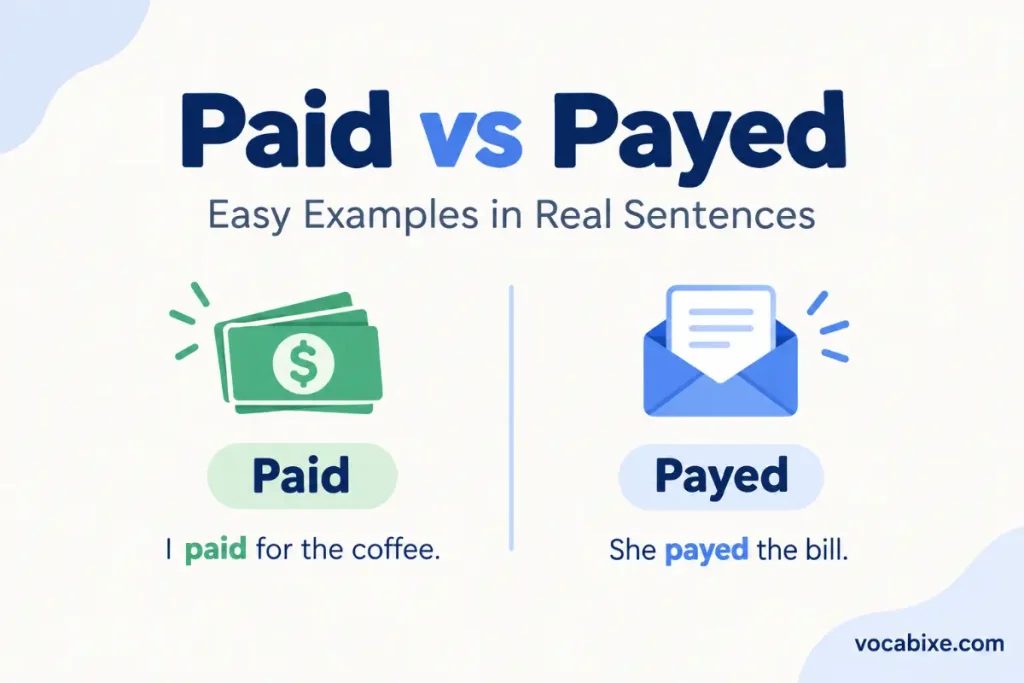
Here are some everyday examples that show how paid works.
- I paid for my lunch at the counter.
The person gave money for food.
- Sarah paid the phone bill yesterday.
The bill was settled in the past.
- My father paid the school fee this morning.
The payment happened earlier today.
- We paid $50 for the tickets.
The sentence tells us how much the tickets cost.
- He paid me for helping him move.
Money was given in return for work.
- I have already paid the rent.
The payment is complete.
- She paid attention to the teacher.
Here, “paid attention” is a common expression. It does not mean that she gave money.
- They paid a visit to their old friend.
“Paid a visit” is another common expression.
Notice that paid works naturally in all of these sentences.
Common Mistakes to Avoid
Mistake 1: Using “payed” for a bill
Incorrect: I payed my water bill.
Correct: I paid my water bill.
Use paid because this is a normal financial payment.
Mistake 2: Using “payed” after “have”
Incorrect: She has payed the fee.
Correct: She has paid the fee.
The past participle is paid.
Mistake 3: Assuming every verb ending in “y” takes “-ed”
Incorrect: I payed for the meal.
Correct: I paid for the meal.
English has irregular verbs. Pay is one of them.
Mistake 4: Thinking “payed” is always wrong
This is also not quite correct.
Payed can be correct in specialized nautical writing.
For example:
The crew payed out the cable.
In this context, the word has a special meaning.
Mistake 5: Changing “paid” to “payed” because it sounds regular
The pronunciation can also cause confusion. People may hear the verb pay and naturally expect a past form ending in -ed.
The safest habit is to memorize this pair:
pay → paid
Where Does the Word Come From?
The history of paid helps explain why it does not look like the past form many learners expect.
The English verb pay has a long history. It came into English through Old French and is connected to Latin words related to payment and settling a debt.
Over time, the ordinary past form developed as paid.
The special form payed has a different history of use. It became associated with nautical expressions involving ropes, chains, cables, and similar lines.
English has many words that developed different forms for different meanings. This is one reason spelling can sometimes look surprising.
You do not need to remember the full history to use the words correctly. The practical rule is much easier:
Ordinary pay → paid.
Special nautical use → payed.
A Simple Pronunciation Note
Paid is pronounced like the word “made” with a different first sound. It rhymes with words such as made, shade, and trade.
Payed, when it appears in specialized writing, is normally pronounced like the past form you would expect from pay. It is not the pronunciation that makes the main difference, though. Context does.
This is useful because a person may hear a spoken sentence and not know which spelling is intended. In that case, look at the meaning.
If someone says:
“I ___ the bill.”
The correct written form is paid.
If a nautical text says:
“The sailors ___ out the line.”
The specialized form may be payed.
Paid as an Adjective
Paid can also work as an adjective.
For example:
She is a paid employee.
This means she receives money for her work.
You can also see expressions such as:
- paid worker
- paid position
- paid vacation
- paid leave
- paid service
- paid subscription
- paid membership
These uses are very common in modern English.
For example:
The company offers paid vacation.
Here, paid describes the vacation. It means the employee receives their normal pay during that time.
Paid in Common Expressions
The word paid appears in many everyday expressions.
Paid attention means to focus carefully.
Please pay attention to the instructions.
In the past:
Please note that I paid attention to the instructions.
Paid a visit means visited someone.
We paid a visit to our uncle.
Paid the price can mean suffered a result or consequence.
He ignored the warning and paid the price.
This expression does not always mean money. It can have a figurative meaning.
Paid in full means that all money owed has been paid.
The loan is now paid in full.
These expressions show why it is useful to learn paid as a normal English word rather than thinking of it only as a money word.
Transition to Section 2
Once the basic difference is clear, the next step is understanding how native English speakers actually use these forms. The key is context. Paid belongs to normal everyday English, while payed usually appears in specialized nautical writing. Knowing that difference helps you read older texts, technical material, and everyday messages without confusion.
Section 2: Deep Meaning and Practical Use
How Is Paid Used in Real Life?
Paid is extremely common in everyday English. You will see it at school, at work, in stores, on websites, in bank messages, and in normal conversations.
- At a store, someone might say:
I already paid.
2. At work, an employee might say:
I got paid on Friday.
At school, a student might say:
My parents paid the fee.
On a website, you might see:
Your order has been paid for.
In a conversation, someone might ask:
Have you paid the bill?
All of these uses are normal.
The word also appears in business English.
The invoice has been paid.
The customer paid the full amount.
The worker was paid on time.
These sentences are simple but common.
In formal writing, paid is also the standard choice.
For example:
The required fee must be paid before registration.
You would not normally replace paid with payed.
How Is Payed Used in Real Life?
Payed is much less common.
Its main use is in nautical language. Nautical language is the special vocabulary used when talking about ships, boats, sailing, and related activities.
You may see phrases such as:
- payed out the rope
- payed out the cable
- payed out the line
- payed out the chain
In these expressions, payed out means that something such as a rope, cable, or chain was allowed to move outward or become longer.
For example:
The crew payed out more rope.
The sentence does not mean that the crew gave money for the rope. It means they let more rope out.
This is why context matters so much.
Compare these two sentences:
The sailor paid for the rope.
Here, money is involved.
The sailor payed out the rope.
Here, the sailor released or let out the rope.
The spelling changes because the meaning changes.
Is Payed Used in American English?
The normal American English form for the past tense of pay is paid.
American English speakers use paid for financial payments and common expressions.
For example:
I paid the bill.
She paid for the car.
We paid attention.
The specialized word payed can still appear in American English when nautical terminology is needed. However, it is rare in ordinary conversation and everyday writing.
If you are writing a school essay, email, text message, application, or normal business message, paid is almost certainly the form you need.
Is Payed British English?
Payed is not simply a British spelling of paid.
This is a common misunderstanding.
British English and American English both normally use paid as the past form of pay.
For example, both varieties use:
I paid the bill.
The special nautical use of payed can occur in English regardless of whether the writer uses American or British English.
So this is not mainly an American-versus-British spelling difference. It is a difference in meaning and specialized usage.
Paid in School English
Students often encounter this word when writing about fees, books, trips, or services.
Correct examples include:
I paid my school fee.
We paid for the field trip.
My mother paid the registration fee.
The students have paid already.
A common mistake is writing payed because the student knows the base verb is pay.
Remember that irregular verbs must be learned as individual forms.
A useful mini-list is:
- pay → paid
- say → said
- buy → bought
- bring → brought
- teach → taught
These words do not simply add -ed to make their past forms.
Paid in Work and Business
You will often see paid in workplace English.
For example:
The company paid its employees on Friday.
I have been paid for the project.
The invoice was paid yesterday.
This is a paid position.
Employees receive paid leave.
The word can describe both the action of giving money and something connected with receiving money.
For example, paid employee means an employee who receives money for their work.
Paid leave means approved time away from work for which the employee continues to receive pay.
Paid in Online Shopping
Modern shopping also uses paid very often.
You might see:
Payment received.
Your order has been paid.
Paid in full.
The customer paid by credit card.
I paid online.
These are all normal uses.
If you are writing a customer service message, use paid, not payed.
For example:
I paid for my order, but I have not received a confirmation email.
That is the correct form.
Paid in Text Messages and Informal English
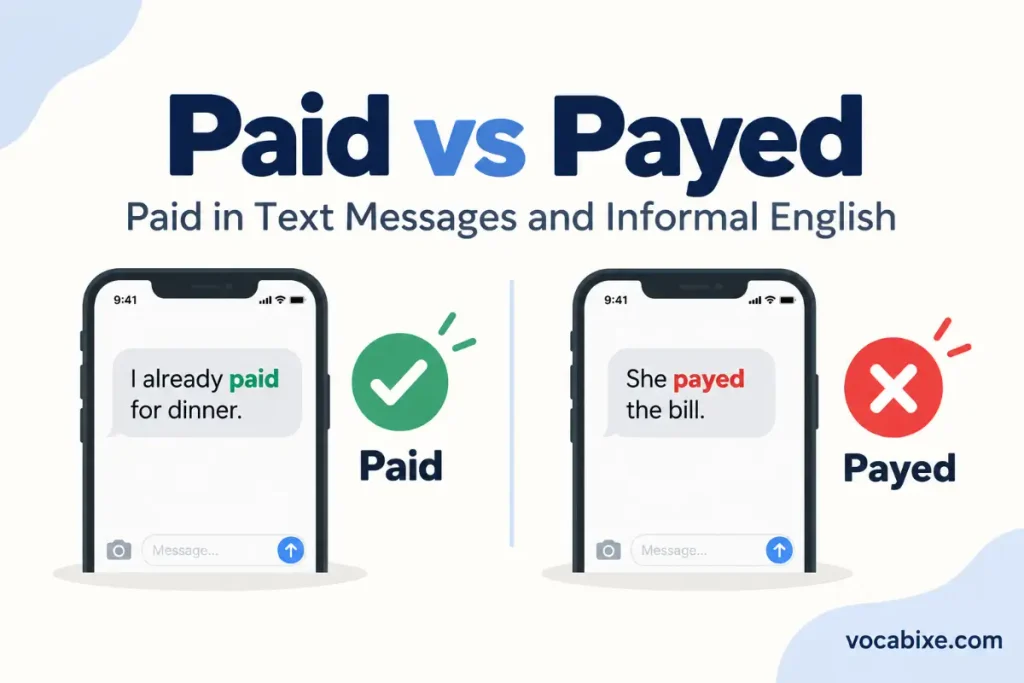
The word paid is also common in informal messages.
Someone might text:
Paid!
This can mean “I have made the payment.”
A friend might write:
I paid for the tickets.
Another person might say:
Don’t worry. I already paid.
The form does not become payed just because the message is informal.
This is an important point. Informal English can have shortened words and casual expressions, but that does not mean ordinary spelling rules disappear.
Does Payed Have a Special Meaning?
Yes.
In specialized nautical use, payed can describe letting out a rope, cable, chain, or similar line.
For example:
The crew payed out the anchor cable.
The idea is that the cable was allowed to run out.
The phrase pay out is especially useful here. It has a meaning different from ordinary pay.
Compare:
The company paid the worker.
Money was given.
The crew payed out the cable.
The cable was released or allowed to extend.
The two meanings are easy to separate once you see the context.
Related Words You Should Know
Learning a few related forms can make paid vs payed much easier.
Pay
Pay is the base verb.
I pay my bill every month.
It can mean giving money or using one of several established expressions.
Paid
Paid is the normal past tense and past participle of pay.
I paid yesterday.
I have paid already.
Payment
Payment is the money given to settle something.
Your payment has been received.
Payer
A payer is a person or organization that makes a payment.
The payer must provide the correct information.
Payable
Payable means that money is owed or must be paid.
The bill is payable by Friday.
Payee
A payee is the person or organization that receives a payment.
For example, when you write a check, the person named on it is the payee.
Payroll
Payroll refers to the system or list used to pay workers.
The company processes payroll every Friday.
Paycheck
A paycheck is money paid to an employee, often through a check or direct deposit.
My paycheck arrived this morning.
These words all connect to the normal financial meaning of pay.
How to Use Paid Correctly
There are several simple patterns worth remembering.
Use paid when you talk about giving money:
I paid $10.
utilize paid for when you talk about buying something:
I paid for the meal.
Use paid someone when you give someone money:
She paid the driver.
Use paid attention for the common expression meaning focused carefully:
He paid attention in class.
Utilize paid a visit for the common expression meaning visited:
We paid a visit to our neighbors.
Use paid the price for the common expression meaning experienced a consequence:
He paid the price for his mistake.
In all these normal uses, paid is the correct form.
How Not to Use Payed
Do not use payed as a replacement for paid in normal financial sentences.
Avoid:
I payed the rent.
Write:
I paid the rent.
Avoid:
She payed for dinner.
Write:
She paid for dinner.
Avoid:
We have payed the fee.
Write:
We have paid the fee.
Avoid:
He payed me yesterday.
Write:
He paid me yesterday.
Unless you are deliberately writing about a nautical action involving letting out a rope, cable, or chain, paid is the safe and correct choice.
Real-Life Usage Examples
Here are some additional examples from situations you may see in normal English.
- The customer paid by card.
This means the customer completed the payment using a card.
- I have paid the electricity bill.
The bill has already been settled.
- She was paid for her work.
She received money for the work she completed.
- We paid extra for faster delivery.
The speakers spent additional money for a service.
- The hotel has been paid in full.
No money remains due.
- He paid close attention during the lesson.
He listened and watched carefully.
- They paid a visit to their old teacher.
They visited their teacher.
- The crew payed out the line slowly.
This is a specialized nautical use. The line was allowed to move out slowly.
- The sailor paid for the supplies.
The sailor gave money for the supplies.
- The sailors payed out more cable.
The sailors let more cable out.
The last two examples show why context is useful. The first involves money. The second involves a cable.
Common Questions People Have
Is “payed” ever correct?
Yes. Payed is a real word, but it is rare. It is mainly used in nautical contexts for letting out a rope, cable, chain, or similar line.
Is “I payed the bill” correct?
No. The correct sentence is:
I paid the bill.
Is “I have payed” correct?
Usually no, if you mean a financial payment. Say:
I have paid.
Why isn’t the past tense “payed”?
Because pay is an irregular verb in its ordinary use. Its standard past tense is paid.
Can “paid” mean something other than giving money?
Yes. It appears in expressions such as paid attention, paid a visit, and paid the price.
Is “payed” a British spelling?
No. It is not simply the British version of paid. Both American and British English normally use paid for ordinary payments.
RELATED POSTS: discreet vs discrete , comming vs coming , preform vs perform.
Final Teacher Explanation
If you remember only one thing from this lesson, remember this:
Pay becomes paid in normal English.
You pay for something today.
&
You paid for it yesterday.
&
You have paid for it already.
That rule works for bills, shopping, salaries, fees, tickets, services, and many common expressions.
Payed is different. It is a specialized word that you may find in nautical writing. It can describe letting out a rope, cable, chain, or line. You are unlikely to need it in everyday writing.
So if you are writing a school assignment and you want to say that someone gave money, choose paid.
If you are writing a technical description about a ship and a cable being let out, payed may be correct.
The context tells you which form belongs there.
Final Answer — Quick Recap
Paid is the correct everyday past tense and past participle of pay. Use it for money, bills, fees, purchases, wages, and common expressions such as paid attention.
Payed is a rare specialized form mainly used in nautical language. It can describe letting out a rope, cable, chain, or line. For normal English, remember: pay → paid.
When you are unsure, ask yourself what the sentence means. If you are talking about a normal payment, paid is the answer. You do not need to use payed simply because it looks like a regular past-tense spelling.
This small distinction can prevent a common spelling mistake. Once you connect paid with ordinary uses of pay, the correct form becomes easy to remember.
FAQs
Frequently Asked Questions
What is the correct spelling: paid or payed?
Paid is correct for normal uses of the verb pay. For example, “I paid the bill” is correct.
Is “payed” an incorrect word?
Not always. Payed is a real but uncommon word. It is mainly used in nautical contexts, such as when a crew lets out a rope or cable.
Is “I payed for it” correct?
No. The correct sentence is “I paid for it.”
Why do people write “payed” instead of “paid”?
People may expect pay to follow the regular pattern of adding -ed, as in “played.” However, the normal past form of pay is paid.
Can I use “paid” in formal writing?
Yes. Paid is completely standard in formal, academic, business, and everyday English.
Is “payed” an American or British spelling?
Neither. Payed is not a regional replacement for paid. American and British English both normally use paid for ordinary payments.
What does “payed out” mean?
In nautical language, payed out means that a rope, cable, chain, or line was allowed to run out or extend.
How do I remember paid vs payed?
Use this simple rule: normal payment = paid. Think about money, bills, shopping, or wages, and choose paid. Save payed for its specialized nautical use.
Conclusion
The difference between paid vs payed is easier than it first appears. Paid is the standard form used in everyday English, while payed has a much narrower nautical use.
For school, work, shopping, emails, messages, and normal conversations, use paid. Once you remember pay → paid, you will avoid one of the most common mistakes involving this verb.
Pingback: Full Time or Fulltime: Clear Guide to Correct Usage - Vocabixe
Pingback: Dysregulated vs Disregulated: Correct Spelling Explained Clearly - Vocabixe
Pingback: Vender or Vendor: Which Spelling Is Correct? - Vocabixe