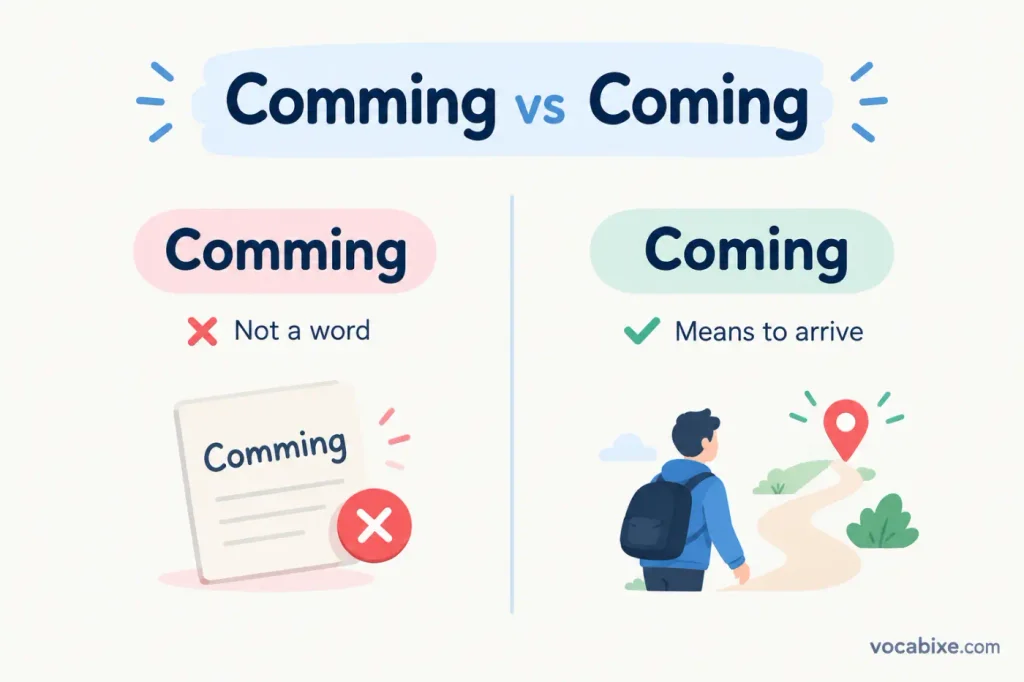
If you are searching for comming vs coming, you probably want to know which spelling is correct. The correct spelling is coming. Comming is a common spelling mistake.
The word coming is the present participle of the verb come. It can mean moving toward a person or place, arriving, or happening soon. You may see it in sentences such as, “She is coming home” or “The coming exam is important.”
The main spelling rule is simple: come + ing = coming. The final e in come is dropped before adding -ing. You do not double the final m.
Simple Answer in One Look
The correct spelling is coming.
Coming is the standard English spelling. Comming is incorrect in standard English and is usually caused by doubling the final m by mistake.
- Correct: coming
- Incorrect: comming
- Meaning: moving toward, arriving, or happening soon
What Does “Comming vs Coming” Mean?
The search phrase comming vs coming compares two spellings that look very similar. Only one is correct in standard English.
Coming comes from the verb come.
For example:
“My brother is coming home.”
Here, coming means that the brother is moving toward home or will arrive at home.
The spelling comming does not have a separate meaning. It is simply a misspelling of coming.
What Is the Correct Spelling?
The correct spelling is coming, with one m in the middle.
Coming is spelled:
C-O-M-I-N-G
Not:
C-O-M-M-I-N-G
The mistake often happens because English has many words that double their final consonant before -ing. For example:
- run → running
- sit → sitting
- swim → swimming
- stop → stopping
A learner may see these words and think:
come → comming
But come does not follow that pattern.
The correct form is:
come → coming
The final e disappears, and the m stays single.
Here are some simple examples:
- “Are you coming with us?”
- “He is coming home soon.”
- “The bus is coming.”
- “A new season is coming.”
What Is the Difference Between Comming and Coming?
There is no meaning difference between the two forms because comming is not a standard English word.
| Form | Correct? | Meaning |
|---|---|---|
| coming | Yes | Moving toward, arriving, or happening soon |
| comming | No | Common misspelling of coming |
So if you are writing an email, school assignment, website article, message, or formal document, use coming.
Why Do People Get Confused?
The biggest reason is the spelling pattern of English verbs.
Some short verbs double their final consonant when -ing is added. This can make learners think that every similar-looking verb should do the same thing.
For example:
- run → running
- get → getting
- sit → sitting
- swim → swimming
But come works differently:
- come → coming
Why?
Because the final e is removed before -ing is added. The final m is not doubled.
Another reason is pronunciation. When people say coming, the word can sound quick in normal conversation. Learners may remember the sound rather than the letters.
Typing can also cause the mistake. Someone may type comming quickly because the double m feels natural.
Which One Should You Use?
Use coming when you mean that someone or something is moving toward a place, arriving, or happening soon.
A simple rule is:
Come + ing = coming
Do not add another m.
Remember:
come → coming
not:
come → comming
If you are unsure, think about the base word. The base verb is come, not comm.
Easy Examples in Real Sentences
Here are some natural examples of coming in everyday English.
- Are you coming to school today?Here, coming means going or arriving at the school.
- My father is coming home.The person is moving toward home.
- The bus is coming now.The bus is approaching.
- Are you coming with us?The speaker is asking if someone will join the group.
- Christmas is coming soon.Here, coming means that the event will happen soon.
- The weekend is coming.The weekend will arrive soon.
- A storm is coming.The storm is approaching or is expected soon.
- She is coming to my birthday party.She plans to attend the party.
Common Mistakes to Avoid
Mistake 1: Writing “comming”
Incorrect:
“I am comming home.”
Correct:
“I am coming home.”
The word has only one m.
Mistake 2: Keeping the final “e”
Some learners write:
“I am comeing home.”
This is also incorrect.
The e in come is removed before -ing.
Correct:
come → coming
Not:
come → comeing
Mistake 3: Thinking “coming” needs two consonants
Words such as running and swimming can create confusion.
Correct:
run → running
But:
come → coming
The spelling rule depends on the word. You cannot simply double the final consonant in every verb.
Mistake 4: Using “comming” in formal writing
A spelling mistake in a quick text may be harmless, but comming should not be used in schoolwork, applications, business emails, or professional writing.
Use coming in all standard English writing.
Why Is “Coming” Spelled With One M?
The spelling becomes easier when you look at the base verb.
The base verb is:
come
When -ing is added, the final e is removed:
come + ing → coming
There is no spelling step that adds a second m.
This is similar to other verbs ending in silent e:
- make → making
- take → taking
- write → writing
- give → giving
- move → moving
The same basic idea applies to come:
- come → coming
This is one reason it helps to learn the base form of a verb instead of memorizing only one form.
Is “Comming” Ever Correct?
No. Comming is not the standard spelling of the English word coming.
If you see comming online, in a message, or in a social media post, it is normally a spelling error.
It does not become correct because many people make the same mistake.
For standard English, use:
coming
Is “Coming” a Verb?
Yes. Coming is an -ing form of the verb come.
For example:
“She is coming home.”
The word coming is part of the verb phrase is coming.
The word can also work like an adjective in some sentences:
“The coming year may be busy.”
Here, coming describes the year and means the year that is approaching.
So the word has more than one common use.
What Does “Coming” Mean?
The meaning of coming depends on the sentence.
It can mean moving toward a place:
“The dog is coming toward me.”
It can mean arriving:
“The train is coming.”
It can mean planning to attend:
“Are you coming to the party?”
It can mean happening soon:
“The exam is coming.”
It can also describe something that is approaching in time:
“The coming months will be busy.”
The central idea is often moving closer in place or time.
Pronunciation of “Coming”
In standard English, coming is pronounced roughly like:
KUM-ing
The first part sounds like come without the final sound of the silent e.
The spelling is:
coming
The pronunciation does not contain a strong second m sound. This is another reason that adding a second m does not make sense.
Can “Coming” Be Used in Formal English?
Yes.
Coming is completely normal in formal, informal, spoken, and written English.
For example:
“The coming financial year may bring new changes.”
“Please let us know if you are coming to the meeting.”
“The coming weeks will be important.”
You do not need a more formal replacement simply because the word appears in professional writing.
The spelling comming, however, should be corrected.
What Is the Simple Spelling Rule?
The easiest rule is:
When you add -ing to come, drop the final e and do not double the m.
So:
come → coming
You can remember it as:
One M, no E: coming.
That short memory trick can help you avoid both common mistakes: comming and comeing.
Is “Coming” American or British English?
Coming is used in both American English and British English.
There is no American-versus-British spelling difference here.
American English:
“She is coming home.”
British English:
“She is coming home.”
Both use coming.
Can “Coming” Describe the Future?
Yes.
Coming can describe something that will happen soon.
For example:
“The coming holiday will be exciting.”
“We need to prepare for the coming winter.”
“The coming year may bring new opportunities.”
In these sentences, coming means approaching or about to happen.
A Quick Memory Trick
If you often write comming, use this trick:
Think:
COME loses E, but keeps one M.
So:
COME → COMING
Do not think:
COM → COMMING
The correct word has one m.
This small rule can prevent a very common spelling error.
The basic spelling is now clear. But coming is more than a simple spelling exercise. It has several useful meanings in everyday English, and understanding those uses makes the word much easier to recognize and use correctly.
How Is “Coming” Used in Real Life?
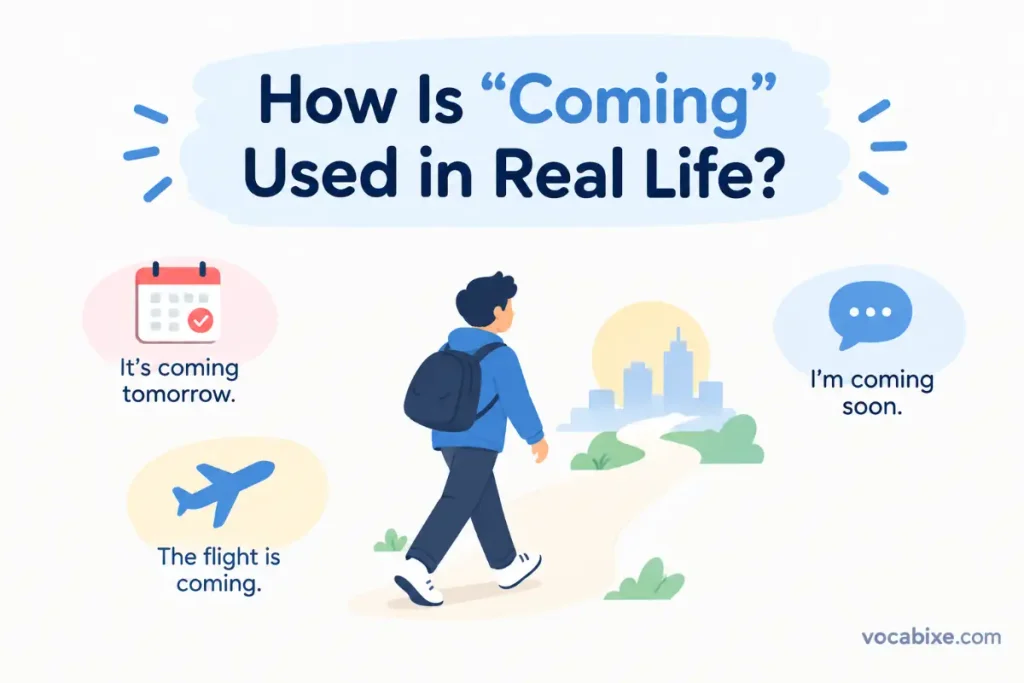
Native English speakers use coming very often. It is a basic everyday word.
You can hear it at home, at school, at work, on the phone, and in casual conversations.
A parent might say:
“Dinner is ready. Are you coming?”
A friend might text:
“I’m coming in five minutes.”
A teacher might say:
“The final exam is coming next week.”
A worker might say:
“I’m coming to the office after lunch.”
In these examples, the word has slightly different uses. Sometimes it means movement. Sometimes it means arrival. Sometimes it means an event is getting closer.
“Coming” in Conversations
In everyday speech, coming is often used when people talk about joining someone.
For example:
“Are you coming?”
This short question can mean:
“Are you coming with us?”
or:
“Are you going to join us?”
The exact meaning depends on the situation.
Imagine three friends are leaving a classroom. One friend stays behind.
Another friend asks:
“Are you coming?”
The meaning is clear. The friend wants to know if the other person will join them.
“Coming” in Text Messages
The word is also common in texting.
Someone might send:
“Coming!”
This usually means:
“I am on my way.”
For example, a friend may be waiting outside your house. You are putting on your shoes. You send:
“Coming!”
This is informal but completely natural.
You might also see:
“I’m coming now.”
or:
“I’ll be there soon. Coming!”
The exact wording depends on the conversation.
“Coming” at School
Students use coming in many simple sentences.
For example:
“The exam is coming.”
“Are you coming to class?”
“The school trip is coming soon.”
“Our teacher is coming.”
A student may also say:
“The holidays are coming.”
Here, coming does not mean that the holidays are physically moving. It means the time for the holidays is getting closer.
“Coming” at Work
The word is also common in professional English.
For example:
“The coming meeting will cover the new plan.”
“We need to prepare for the coming deadline.”
“Are you coming to the office tomorrow?”
The word is not too casual for professional writing.
However, the best choice always depends on the sentence. In formal writing, upcoming can sometimes be used instead of coming.
For example:
“The upcoming meeting will begin at 10 a.m.”
Both coming meeting and upcoming meeting can be correct, although upcoming may sound more natural in some formal contexts.
“Coming” and “Upcoming”
These two words are related, but they are not always interchangeable.
Coming can describe movement:
“He is coming toward us.”
You cannot normally replace it with upcoming.
Upcoming is usually used for an event or time that will happen soon:
“The upcoming exam is difficult.”
So:
- coming = moving toward, arriving, or approaching
- upcoming = scheduled or expected to happen soon
This difference is useful when choosing the right word.
“Coming” in Stories and Books
The word coming appears frequently in stories.
A writer may describe someone approaching:
“He heard footsteps coming down the stairs.”
Here, coming helps show movement.
A story may also describe an approaching event:
“They knew a difficult winter was coming.”
Here, the word creates a sense that something is getting closer in time.
This use is common because coming can make the reader feel that something is approaching.
“Coming” in Movies and Shows
You may hear phrases such as:
“I’m coming!”
“Coming right up!”
“Something big is coming.”
“Are you coming with me?”
These phrases are common because they sound natural in conversation.
In a movie, a character might shout:
“I’m coming!”
This can mean the person is on the way or is responding to someone calling them.
“Coming” in Popular Culture
The word coming is so common that it appears in many kinds of titles, announcements, advertisements, and entertainment messages.
You may see:
“Coming Soon”
This means that something will be available or released soon.
For example:
“New movie coming soon.”
The phrase coming soon is especially common on movie posters, websites, product pages, and event announcements.
The important point is that this is a normal English use of coming. It is not a special spelling or a different word.
Biblical and Mythological Meaning
There is no special biblical or mythological meaning attached to the spelling coming itself.
The word is an ordinary English form of come.
However, religious writing can use phrases involving coming. For example, English translations of religious texts may use coming when describing someone or something that approaches or arrives.
That does not create a separate spelling. The word remains:
coming
The exact meaning depends on the passage and its context.
Symbolism Explained in Simple Words
There is no fixed symbolic meaning for coming.
However, writers can use the idea of something coming to create a feeling of expectation.
For example:
“A new beginning is coming.”
Here, coming can suggest that change is near.
This is a contextual use rather than a dictionary definition. The word itself simply means that something is approaching or arriving.
What the Word Can Represent
In stories, coming may suggest:
- Arrival
- Change
- Expectation
- Movement
- A future event
But these ideas come from the sentence and story. They are not permanent meanings of the word.
How the Meaning Changes by Context
Consider these sentences:
“My friend is coming.”
This describes movement or arrival.
“Winter is coming.”
This describes an approaching time of year.
“A new opportunity is coming.”
This describes something expected in the future.
The word stays the same, but the context changes the exact idea.
Related Words You Should Know
Understanding related words can make coming easier to use.
Come
Come is the base verb.
“Please come here.”
It means to move toward the speaker or a place being discussed.
Came
Came is the past form of come.
“She came home early.”
It describes something that happened in the past.
Coming
Coming is the -ing form.
“She is coming home.”
It can describe an action happening now or an approaching event.
Comes
Comes is used with certain present-tense subjects.
“He comes here every Friday.”
Come
Come can also be used with subjects such as I, you, we, and they.
“They come here every week.”
Arriving
Arriving is closely related to coming when someone reaches a place.
“The train is arriving.”
It focuses more directly on reaching the destination.
Approaching
Approaching means getting closer.
“The storm is approaching.”
It is similar to coming in some contexts.
Upcoming
Upcoming describes something that will happen soon.
“The upcoming test is on Monday.”
Soon
Soon means after a short amount of time.
“She will come soon.”
These related words help you understand the different shades of meaning around coming.
How to Use “Coming” Correctly
Use coming when the base verb is come and you need the -ing form.
For example:
“I am coming.”
“She is coming.”
“They are coming.”
“We were coming home.”
You can also use coming before a noun when it means approaching:
“the coming year”
“the coming months”
“the coming winter”
Do not spell it comming.
Do not spell it comeing.
The standard spelling is always:
coming
When Should You Not Use “Coming”?
Do not use coming when you need a different form of come.
For example, if you are talking about the past, you may need came:
“He came yesterday.”
Not:
“He coming yesterday.”
If you are giving a simple command, use come:
“Come here.”
Not:
“Coming here.”
If you are talking about a regular action with he, she, or it, you may need comes:
“She comes here every day.”
The correct form depends on the sentence.
Real-Life Usage Examples
Here are more examples that show different uses of coming.
- I am coming to your house after work.The speaker plans to go to the listener’s house.
- The teacher is coming into the classroom.The teacher is moving toward the classroom.
- The train is coming from the north.The train is approaching from a particular direction.
- The new school year is coming soon.The new school year will begin soon.
- We are coming back tomorrow.The speakers plan to return tomorrow.
- Are your friends coming to dinner?The question asks if the friends will attend.
- A cold night is coming.A cold night is expected soon.
- The coming weeks will be busy.The weeks ahead are expected to be busy.
- I heard someone coming upstairs.Someone is moving upstairs toward the speaker or another location.
- The bus is coming, so get ready.
The bus is approaching.
Common Questions People Have
Is “comming” a word?
No. Comming is not the standard spelling of the English word coming. It is normally a spelling mistake.
Why is “coming” not spelled “comming”?
Because come becomes coming when -ing is added. The final e is removed, but the m is not doubled.
Why is “running” correct but “comming” wrong?
Different spelling rules apply to these verbs.
Run becomes running, while come becomes coming.
The correct forms must be learned individually.
Is “comeing” correct?
No. The correct spelling is coming.
The final e in come is removed before -ing is added.
Does “coming” have one m or two?
Coming has one m.
Correct:
coming
Incorrect:
comming
Is “coming” used in American English?
Yes. Coming is standard in American English.
It is also standard in British English.
Can I use “coming” in formal writing?
Yes. Coming is a normal English word and can be used in formal writing when the meaning fits the sentence.
Final Teacher Explanation
If you remember only one thing from this lesson, remember this:
come + ing = coming
The correct word is coming.
The spelling comming is a common mistake. It happens because some English verbs double their final consonant before -ing. However, come does not do that.
The final e is removed, and the m stays single.
So:
come → coming
Not:
come → comming
And not:
come → comeing
You can use coming when someone is moving toward a place, arriving, joining someone, or when an event is getting closer in time.
For example:
“I am coming home.”
“Are you coming with us?”
“The exam is coming soon.”
“The coming year may be busy.”
These are all normal uses.
Final Answer — Quick Recap
The correct spelling in comming vs coming is coming. Comming is an incorrect spelling.
The word coming is the -ing form of come. The final e is dropped, but the m is not doubled: come → coming.
If you are writing in school, at work, online, or in everyday English, always choose coming.
The easiest memory trick is simple: one M, no E — coming. Once you remember that rule, this spelling mistake becomes much easier to avoid.
Frequently Asked Questions
What does “coming” mean in simple English?
Coming usually means moving toward a person or place, arriving, or getting closer in time.
Example: “My brother is coming home.”
Is “comming” or “coming” correct?
Coming is correct. Comming is an incorrect spelling.
How do I use “coming” in a sentence?
Use coming as the -ing form of come.
Example:
“She is coming to school.”
Why do people spell “coming” as “comming”?
People may confuse it with verbs such as run → running or sit → sitting, where the final consonant is doubled.
Is “comming” accepted in English?
No. Comming is not the standard spelling of coming.
Is “comeing” correct?
No. The correct form is coming. The final e in come is removed before -ing is added.
Is “coming” American or British English?
Coming is used in both American English and British English. There is no spelling difference between the two varieties.
Can “coming” be used in formal writing?
Yes. Coming is a standard English word and is appropriate in formal writing when it fits the meaning.
Conclusion
The answer to comming vs coming is straightforward: coming is the correct spelling. Comming is a common spelling mistake, not a separate English word.
Related article: preform vs perform , writing or writting , endure vs indure.
Remember the simple spelling pattern: come → coming. Drop the final e, keep one m, and add -ing. This rule will help you spell the word correctly in sentences, messages, schoolwork, and professional writing.
Pingback: Discreet vs Discrete: Clear Difference Explained - Vocabixe
Pingback: Full Time or Fulltime: Clear Guide to Correct Usage - Vocabixe
Pingback: Paid vs Payed: Clear Difference Explained Simply 2026 - Vocabixe