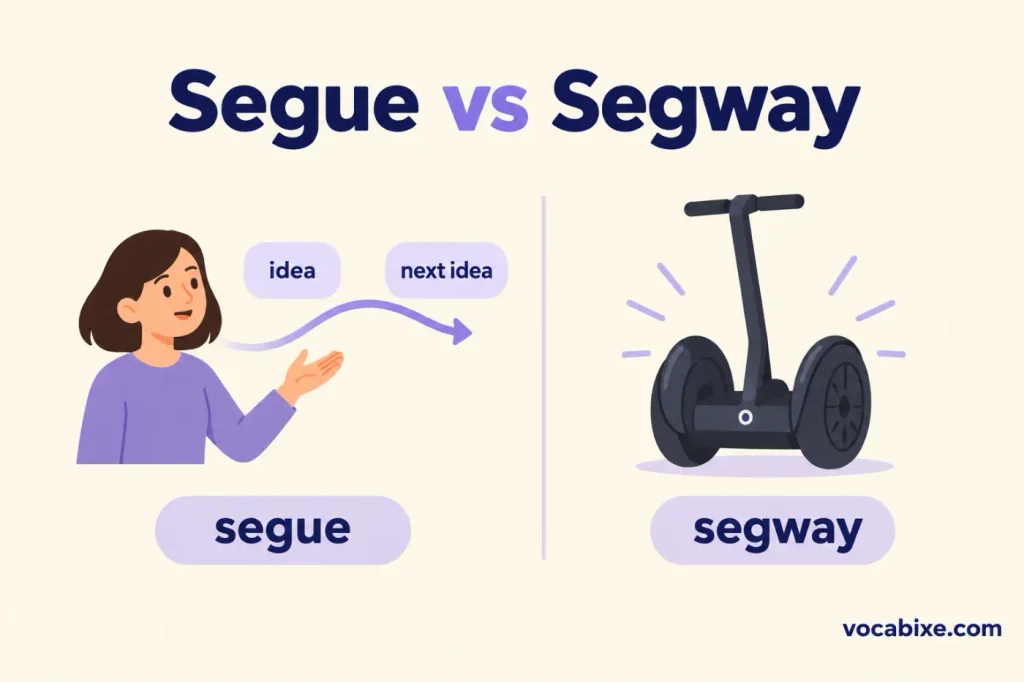
If you are confused about “segue vs segway,” you are not alone. These two words sound almost the same, but they have very different meanings. Segue is the correct word when you mean a smooth transition from one topic, scene, song, or activity to another. Segway is a brand name associated with a self-balancing, two-wheeled personal transporter. The key difference is simple: use “segue” when talking about a transition and “Segway” when referring to the vehicle brand. Understanding this distinction will help you choose the right spelling in writing, conversations, presentations, and everyday situations.
Section 1: Segue vs Segway — The Quick Answer
The main difference between segue and Segway is their meaning and use. Although they sound alike in English, they are not interchangeable.
- Segue: A smooth change or transition from one subject, activity, musical section, or scene to another.
- Segway: A brand name associated with a self-balancing personal transporter that a person rides while standing.
Here is a quick comparison:
| Word | Meaning | Example |
|---|---|---|
| Segue | A smooth transition | She used a joke to segue into the next topic. |
| Segway | A personal transporter brand | We rode a Segway during our city tour. |
Easy rule to remember: If you are moving from one idea to another, use “segue.” If you are talking about riding a two-wheeled personal transporter made by the Segway brand, use “Segway.”
For example, a teacher might segue from a spelling lesson to a grammar lesson. A tourist might ride a Segway around a historic city.
The words have different spellings because they serve different purposes. “Segue” is a regular English word used in writing and speech. “Segway” is a brand name, so it is usually capitalized when referring to the brand or its products.
Section 2: What Does Segue Mean?
A segue is a smooth and natural transition from one thing to another. It can describe a change in conversation, writing, music, film, or another activity.
When someone makes a segue, they connect one subject to the next without making the change feel sudden or awkward. The connection may be based on a shared idea, a related event, or a natural next step.
For example, imagine two friends talking about their favorite movies. One friend then begins discussing an upcoming film festival. That change can be called a segue because the second subject follows naturally from the first.
The word is often used in professional settings, too. A speaker may use a segue to move from an introduction to the main points of a presentation. A writer may use one paragraph to connect two related ideas.
What Is the Definition of Segue?
As a noun, “segue” means a smooth transition from one subject, activity, or section to another.
As a verb, “to segue” means to move smoothly from one thing to another.
Here are the two uses:
- Noun: “The segue between the two topics was natural.”
- Verb: “The presenter will segue into the next section.”
Both sentences describe a transition. The first names the transition, while the second describes the action of making it.
In everyday English, the verb form is especially common when people discuss speeches, meetings, conversations, podcasts, and written content.
How Do You Use Segue in a Sentence?
You can use “segue” whenever one topic or activity leads naturally into another.
Consider these examples:
- “After discussing the weather, Maya used a segue to talk about the weekend trip.”
- “The teacher will segue from fractions to decimals.”
- “His funny story provided a perfect segue into the main subject.”
- “The podcast host used a short question to segue into the interview.”
- “The movie segues from a quiet scene into an exciting chase.”
- “Our meeting segued from budget planning to next month’s schedule.”
- “The author creates a smooth segue between the two chapters.”
- “She segued from a discussion of schoolwork to a conversation about sports.”
Each sentence describes a connection or change. None of them refers to a vehicle.
You can also use “segue” when describing a change that happens without an obvious break. For example, a song may segue into another song, or a live performance may move from one musical section into the next.
What Does Segue Mean in Conversation?
In conversation, a segue is a way to change subjects smoothly. It helps people move from one idea to another without making the discussion feel forced.
Suppose you are talking to a friend about your classes. You might say, “Speaking of school, have you started preparing for the final exam?”
The phrase “speaking of school” creates a connection between the current discussion and the new question. It acts as a conversational segue.
Other expressions that can help create a segue include:
- “That reminds me…”
- “Speaking of that…”
- “On a related note…”
- “Before we move on…”
- “That brings us to…”
For example, a manager might say, “We have covered the sales figures. On a related note, let’s discuss our plans for next month.”
The change feels natural because the speaker signals how the next subject connects to the current one.
A good segue does not need to be long. Sometimes a single sentence is enough to help listeners understand why the conversation is changing direction.
What Does Segue Mean in Writing?
In writing, a segue connects one idea, paragraph, section, or topic to another. It helps readers follow the writer’s thoughts.
For example, an article about healthy eating might begin by explaining the benefits of fruits and vegetables. The next paragraph could discuss easy ways to include them in daily meals.
A sentence such as “Knowing which foods are healthy is only the first step; learning how to prepare them makes healthy eating easier” can serve as a segue.
This connection works because it links the information readers have just learned with the next part of the article.
Writers often create effective segues by using:
- A related question.
- A shared idea.
- A short summary of the previous point.
- A sentence that introduces the next topic.
- A clear connection between cause and effect.
However, a segue should not add unnecessary words. If two ideas already connect clearly, a simple transition may work better than a long explanation. Related article Organizing vs Organising.
What Does Segue Mean in Music and Film?
In music, a segue describes a smooth transition from one musical section or piece to another. The music may continue without a pause, creating a connected listening experience.
For example, a DJ might segue from one dance track into another by blending their endings and beginnings. An album may also use a segue to connect two tracks.
In film and television, a segue can describe a transition between scenes or parts of a story. A scene showing a character looking at a clock might lead into the next scene, where the character arrives late for a meeting.
The transition helps the audience move from one moment to another. Depending on the context, it may be created through sound, images, dialogue, or the flow of the story.
The central meaning remains the same: one part leads smoothly into the next.
How Do You Pronounce Segue?
The word “segue” is pronounced like “SEG-way.” It has two syllables, with the stress on the first syllable.
Its pronunciation is the main reason people confuse it with “Segway.” Although the spellings look different, their usual pronunciations are alike.
For example, someone might say, “I need a segue into the next topic,” and a listener unfamiliar with the spelling might think the speaker means the vehicle brand.
The pronunciation does not tell you which word to write. You must use the meaning and context to choose the correct spelling.
Remember that “segue” ends with the letters “gue,” even though the ending sounds like “way.”
What Is the Origin of Segue?
“Segue” comes from Italian, where the word means “follows” or “continues,” depending on the context. Its connection to the idea of following naturally into something else explains its modern English meaning.
The word became established in English through musical usage, where it indicated that one passage should continue into another without a break. Over time, its meaning expanded beyond music.
Today, people use “segue” when talking about conversations, speeches, writing, films, meetings, and many other situations involving smooth transitions.
Its Italian origin also helps explain why its spelling may seem unusual to English learners. The final letters do not follow the pronunciation pattern that many readers might expect from English spelling alone.
What Are Common Mistakes When Using Segue?
The most common mistake is writing “Segway” when you mean a transition.
For example:
- Incorrect: “That is a great Segway into my next point.”
- Correct: “That is a great segue into my next point.”
The second sentence uses the right word because it refers to moving from one point to another.
Another mistake is assuming that “segue” and “Segway” are alternative spellings of the same word. They are not. One is a general English word, while the other is a brand name.
Writers sometimes make a related mistake by using “segue” when a transition does not exist. A sentence may introduce a completely unrelated topic without connecting it to the previous discussion. In that situation, the change may feel abrupt rather than smooth.
To avoid these errors, ask yourself two questions:
- Am I describing a transition between ideas or activities?
- Am I referring to the Segway brand or one of its products?
If the answer to the first question is yes, write “segue.” If the second is yes, write “Segway.”
What Does Segway Mean?
Segway is a brand name associated with personal transportation devices, including self-balancing two-wheeled vehicles. A rider stands on a platform and uses the device to travel while maintaining balance through its control system.
These vehicles have been used in guided tours, certain workplaces, and other settings where personal transportation devices are suitable.
For example, a visitor might rent a Segway to explore a large outdoor area or join a guided city tour. A security worker might use one to move around a large property.
Unlike “segue,” the word “Segway” does not generally mean a smooth change from one subject to another. It identifies a brand and, in everyday speech, may be used to refer to the brand’s personal transporters.
The capital S is appropriate when referring to the brand name. Because it is a proper name, “Segway” should not normally be substituted for the lowercase common noun “segue.”
How Do You Use Segway in a Sentence?
Use “Segway” when the context involves the personal transporter or the brand.
Here are several examples:
- “We rented a Segway for our guided city tour.”
- “The tourist learned how to balance on a Segway.”
- “The guide explained the safety rules before the group rode their Segways.”
- “He saw a Segway parked outside the visitor center.”
- “The company offered a Segway tour of the waterfront.”
- “She watched a demonstration of a self-balancing Segway.”
- “The riders practiced turning before starting their tour.”
- “Our guide used a Segway to travel around the large site.”
In each example, the word refers to a vehicle or its use. It does not describe a transition between topics.
If you are writing about personal transportation in a general sense rather than a specific brand, “self-balancing transporter” or “personal transporter” may be more suitable. Those expressions can describe the type of device without naming a particular brand.
Why Do People Confuse Segue and Segway?
People often confuse these words because they sound the same. When someone hears either word without seeing it written, the intended spelling may not be clear.
The confusion becomes especially common in professional conversations. Someone might hear a speaker say that a question provides a useful “segue” into another subject. If the listener knows the vehicle brand but has never seen “segue” in writing, they may assume the speaker is talking about a Segway.
Autocorrect and spell-checking tools can add to the confusion. A writer who types the wrong word may not notice the error if the software accepts it as a correctly spelled word.
Both words can be spelled correctly while still being used incorrectly in a sentence. That is why checking the meaning is more useful than relying on a spelling checker alone.
For example:
- “The host made a smooth segue into the interview.” Correct.
- “The host made a smooth Segway into the interview.” Incorrect.
- “The visitors rode a Segway around the park.” Correct.
- “The visitors rode a segue around the park.” Incorrect.
The sentence’s meaning determines the right spelling.
Is Segue or Segway Correct in American English?
Both spellings are correct in American English, but they have different meanings.
“Segue” is the standard spelling for a smooth transition. It can be used in conversations, academic writing, news articles, business presentations, and everyday communication.
“Segway” is the spelling of the personal transporter brand. It is a proper name and should be capitalized when used as the brand name.
Neither word is an American-versus-British spelling variation of the other. The distinction is based on meaning, not regional spelling preferences.
For example, an American teacher would write, “Let’s segue into our next lesson.” A traveler in the United States might write, “We took a Segway tour.”
The same basic distinction applies in British English and other varieties of English.
What Is the Difference Between a Segue and a Transition?
A segue is a type of transition, but the two words do not always have exactly the same feel.
A transition is a broad term for a change from one state, subject, place, or activity to another. It may be smooth or sudden.
A segue usually emphasizes a smooth or connected movement between two things.
For example, changing from one job to another is a transition. A speaker moving naturally from an introduction to the main topic is making a segue.
Here is a simple comparison:
| Word | Main idea | Example |
|---|---|---|
| Transition | A change from one thing to another | The transition to online classes took time. |
| Segue | A smooth connection between two things | Her question provided a segue into the next topic. |
A segue can be a useful transition, but not every transition is a segue. The word “transition” is more general and works in many situations where “segue” would sound unusual.
What Are Synonyms for Segue?
The best synonym for “segue” depends on how the word is used. When describing a change between topics, several alternatives may work.
Common synonyms include:
- Transition: A change from one topic, stage, or activity to another.
- Shift: A change in focus or direction.
- Bridge: Something that connects two ideas or sections.
- Link: A connection between two things.
- Lead-in: An introduction that prepares someone for what follows.
- Move: A change from one subject or activity to another.
- Connection: A relationship between two ideas or parts.
For example, “The speaker used a segue into the next topic” could become “The speaker used a transition into the next topic.”
However, these words are not perfect replacements in every sentence. “Bridge” may suggest a strong connection between ideas, while “shift” may emphasize a change in focus. Choose the word that best expresses the meaning you intend.
There is no need to replace “segue” simply because it is less familiar. When it accurately describes a smooth transition, it is a useful and natural choice.
How Can You Remember the Difference Between Segue and Segway?
A simple memory trick can help you avoid this spelling mistake.
Think of “segue” as the word for moving from one idea to another. Its unusual spelling belongs to the transition word.
Think of “Segway” as the name of a vehicle brand. The ending “way” may remind you of a way to travel from one place to another.
You can also remember these two examples:
- “I will segue into the next subject.”
- “I will ride a Segway through the tour.”
The first describes a change in a discussion. The second describes transportation.
Another helpful method is to replace the word with a simpler expression. If “transition” fits the sentence, use “segue.” If “personal transporter” fits, use “Segway” when you mean the brand.
This quick substitution test works well when proofreading essays, articles, presentations, emails, and social media posts.
FAQs
What is the difference between segue and Segway?
Segue means a smooth transition between ideas, activities, or sections. Segway is a brand name associated with self-balancing personal transporters.
Is segue pronounced the same as Segway?
Yes. In standard English, “segue” and “Segway” are pronounced the same way. Their meanings and spellings are different.
Is Segway a misspelling of segue?
No. Segway is a correct brand name, but it is incorrect when used to mean a transition. In that context, the correct word is “segue.”
How do you spell segue correctly?
The correct spelling is “segue.” It has six letters and ends in “gue.” Use it when describing a smooth change from one topic, scene, or activity to another.
Can segue be used as a verb?
Yes. “Segue” can be a verb meaning to move smoothly from one thing to another. For example, “The teacher will segue into the next lesson.”
What is an example of segue in a sentence?
“After discussing the exam, the teacher used a segue to introduce the next lesson.” Here, “segue” describes the smooth change from one subject to another.
Is segue a British or American word?
“Segue” is used in both American and British English. Its spelling and basic meaning are the same in both varieties.
Should Segway always be capitalized?
Capitalize “Segway” when referring to the brand name. The common word “segue” is normally written in lowercase unless it begins a sentence or appears in a title that uses title capitalization.
Conclusion
The difference between segue vs Segway comes down to meaning, not pronunciation. “Segue” means a smooth transition between ideas, topics, scenes, or activities. “Segway” refers to a personal transporter brand. Since both words sound alike, it is easy to mix them up when writing, especially if you have only heard them spoken.
Remember this simple rule: use “segue” when you move from one idea to another, and use “Segway” when you mean the vehicle brand. With this distinction in mind, you can use both words correctly in conversations, articles, presentations, and everyday writing.
Pingback: Wiener vs Weiner: Meaning, Correct Spelling, and Examples - Vocabixe