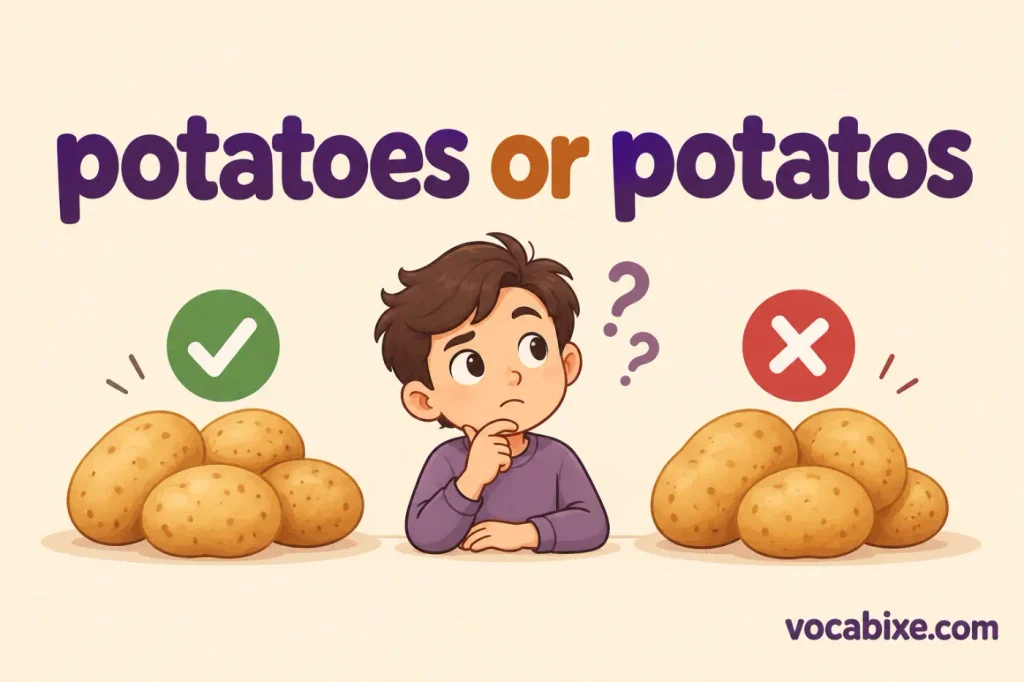
If you are unsure whether to write potatoes or potatos, the correct spelling is potatoes. The word “potatoes” is the plural form of “potato,” which means more than one potato. “Potatos” is a common spelling mistake and is not the standard plural form in English. The confusion happens because many English nouns ending in “o” simply add “s” to become plural, while others add “es.” Learning this simple spelling rule can help you avoid mistakes in schoolwork, recipes, emails, and everyday writing.
Quick Answer: Potatoes or Potatos?
Potatoes is the correct spelling. Potatos is incorrect in standard English.
- Singular: One potato
- Plural: Two potatoes
- Incorrect spelling: Two potatos
Example: I bought five potatoes to make dinner.
The main rule is simple: when making the plural of “potato,” add “es” to the end of the word. Do not remove the final “o” or add only “s.”
Section 1: Understanding the Correct Spelling
Why Is Potatoes Correct?
The correct plural spelling is “potatoes” because the singular noun “potato” takes “es” when it becomes plural.
A potato is a common food that grows underground. People cook potatoes in many ways, including boiling, baking, frying, and roasting. When you have more than one, you use the plural word “potatoes.”
Here are some examples:
- I ate one potato with my lunch.
- She bought three potatoes from the market.
- We need ten potatoes for the family dinner.
- The farmer grows potatoes on his land.
- These potatoes are ready to cook.
In each sentence, “potatoes” refers to more than one potato. The spelling stays the same whether you have two, five, or a hundred potatoes.
The word does not become “potatos” simply because that form might seem easier to write. Standard English uses “potatoes” for the plural.
Why Is Potatos Incorrect?
“Potatos” is incorrect because it does not follow the standard plural spelling used for the word “potato.”
Many learners make this mistake because they know that English often forms plurals by adding “s.” For example, one book becomes two books, and one apple becomes three apples. Applying the same pattern to every word ending in “o,” however, can lead to spelling errors.
Consider these examples:
- Incorrect: We bought four potatos.
- Correct: We bought four potatoes.
- Incorrect: The potatos are in the kitchen.
- Correct: The potatoes are in the kitchen.
- Incorrect: I planted six potatos in the garden.
- Correct: I planted six potatoes in the garden.
The incorrect form may still be understood by readers, but it should not be used in formal writing, school assignments, professional documents, or published content.
A useful way to remember the difference is to connect the plural spelling to the familiar food itself. When you talk about several potatoes, the word needs “es” at the end.
What Is the Singular and Plural Form of Potato?
The singular form is “potato,” and the plural form is “potatoes.”
A singular noun refers to one person, place, thing, or idea. A plural noun refers to more than one. The form you choose depends on the number you are describing.
| Number | Correct word | Example |
|---|---|---|
| One | Potato | I baked one potato. |
| Two | Potatoes | I baked two potatoes. |
| Three | Potatoes | She peeled three potatoes. |
| Several | Potatoes | We need several potatoes. |
| Many | Potatoes | The store sells many potatoes. |
Notice that the singular word does not change when you are talking about one potato. The spelling changes only when you make it plural.
For example, “This potato is fresh” refers to one potato. In contrast, “These potatoes are fresh” refers to two or more.
Remember that “potatoes” is the usual plural form in standard English, regardless of whether the potatoes are small, large, red, white, or sweet varieties commonly called potatoes.
What Spelling Rule Does Potato Follow?
The word “potato” follows a common English plural rule for certain nouns ending in “o.”
Many nouns that end in a consonant followed by “o” form their plurals by adding “es.” Examples include:
- Potato → Potatoes
- Tomato → Tomatoes
- Hero → Heroes
- Echo → Echoes
The added “es” creates the standard plural spelling for these words.
However, English has exceptions. Some nouns ending in “o” form their plurals by adding only “s.”
Examples include:
- Photo → Photos
- Piano → Pianos
- Video → Videos
- Radio → Radios
This difference is one reason learners sometimes struggle with words ending in “o.” There is no single rule that works for every noun.
The safest approach is to learn the common plural forms of individual words. For “potato,” remember that the correct spelling is “potatoes.”
Why Do Some Words Ending in O Add ES While Others Add S?
English spelling has developed over many centuries. Different words entered the language from different sources, and their plural forms did not all develop in exactly the same way.
As a result, some nouns ending in “o” add “es,” while others add only “s.” The spelling can depend on the individual word, its history, and established usage.
For example, “potato” becomes “potatoes,” but “photo” becomes “photos.” Both words end in the same letter, yet their plural forms are different.
Here is another comparison:
- One tomato, two tomatoes
- One piano, two pianos
- One hero, two heroes
- One video, two videos
These examples show why it is helpful to memorize common forms rather than guess based only on the final letter.
When writing about potatoes, there is no need to wonder which version is preferred in American or British English. Both use “potatoes” as the standard plural spelling. Latest article Sly Synonym.
Is Potatoes Correct in American and British English?
Yes. “Potatoes” is correct in both American English and British English.
Unlike some English words that have different spellings across regions, the plural form of “potato” remains the same in both varieties.
For example, an American writer might say:
“We bought potatoes for Thanksgiving dinner.”
A British writer might say:
“We bought potatoes for Sunday lunch.”
The spelling does not change because of the country, the meal, or the type of cooking involved.
Both varieties also use “potato” for one and “potatoes” for more than one. Writing “potatos” is not the standard plural spelling in either variety.
This makes the rule easy to apply when communicating with people from different English-speaking countries. You can use “potatoes” confidently in schoolwork, business writing, recipes, and online articles.
Section 2: How to Use Potatoes Correctly in Everyday Writing
How Do You Use Potatoes in a Sentence?
Use “potatoes” whenever you are referring to two or more potatoes.
The word appears in many everyday situations, especially when discussing food, cooking, shopping, farming, or gardening. The following examples show how to use it naturally.
In everyday conversation
- We need potatoes for dinner.
- These potatoes look fresh.
- My brother loves mashed potatoes.
- There are potatoes in the kitchen.
In cooking instructions
- Peel the potatoes before boiling them.
- Cut the potatoes into small pieces.
- Bake the potatoes until they become soft.
- Add the potatoes to the soup.
In shopping and food planning
- I bought a bag of potatoes.
- The market sells fresh potatoes.
- We need more potatoes for the party.
- Potatoes are on my shopping list.
In schoolwork and informative writing
- Potatoes are grown in many countries.
- Farmers harvest potatoes when they are ready.
- Some potatoes have red skin, while others have brown skin.
- People prepare potatoes in many different ways.
All these examples use the plural correctly. The word remains “potatoes” even when the sentence contains a large quantity.
What Is the Difference Between Potato and Potatoes?
The difference is number. “Potato” is singular, while “potatoes” is plural.
Use “potato” when you mean one item. Use “potatoes” when you mean two or more items.
Compare these sentences:
- I want a potato with my meal.
- I want two potatoes with my meal.
The first sentence describes one potato. The second describes two.
The same difference applies to other situations:
- A potato is growing in the garden.
- Several potatoes are growing in the garden.
- This potato needs more time to cook.
- These potatoes need more time to cook.
You should also make sure that the rest of the sentence agrees with the noun.
For example, “The potato is ready” is correct because the subject is singular. “The potatoes are ready” is correct because the subject is plural.
Writing “The potatoes is ready” is incorrect because the plural subject needs the plural verb “are.”
Is It a Potato or an Potato?
The correct phrase is “a potato,” not “an potato.”
The choice between “a” and “an” depends on the sound that begins the next word. Since “potato” begins with the consonant sound /p/, it takes “a.”
Examples include:
- I ate a potato for lunch.
- She planted a potato in the garden.
- He peeled a potato before cooking it.
When referring to more than one, you can use phrases such as “two potatoes,” “some potatoes,” or “many potatoes.”
You would not normally say “a potatoes” because the article “a” refers to one item, while “potatoes” is plural.
Correct article use and correct plural spelling work together to make your sentences clear.
Should You Write Potato’s, Potatoes, or Potatoes’?
These three forms look similar, but they have different uses.
Potato is the singular noun.
Example: The potato is on the plate.
Potatoes is the plural noun.
Example: The potatoes are on the plate.
Potato’s is the singular possessive form. It shows that something belongs to or is associated with one potato, although this construction is less common in everyday writing.
Example: The potato’s skin was covered in soil.
Potatoes’ is the plural possessive form. It shows that something belongs to or is associated with multiple potatoes.
Example: The potatoes’ skins were removed before cooking.
The apostrophe does not make a noun plural. Instead, it often shows possession or marks certain contractions.
A common mistake is to write “potato’s” when the writer simply means more than one potato. If you are talking about several potatoes without showing possession, write “potatoes” without an apostrophe.
How Do You Remember the Spelling of Potatoes?
A simple memory trick can help you avoid the mistake.
Think of this pattern:
One potato → Two potatoes
The ending changes from “o” to “oes” when the plural form is written. You can also remember the related word “tomatoes,” which follows the same spelling pattern.
Try repeating these pairs:
- Potato, potatoes
- Tomato, tomatoes
- Hero, heroes
Next, compare them with words that add only “s”:
- Photo, photos
- Piano, pianos
- Video, videos
Practicing both groups helps you understand that plural spelling depends on the word.
Another useful method is to write a short sentence whenever you learn a new plural form. For example, write “I bought potatoes” several times while paying attention to the final letters.
Reading and writing the correct form regularly can make the spelling easier to remember.
What Are the Most Common Mistakes With Potatoes?
Several mistakes can happen when people write about potatoes. Most are easy to correct once you know the basic rule.
Mistake 1: Adding only s
Incorrect: We bought three potatos.
Correct: We bought three potatoes.
Why: The standard plural of “potato” ends in “oes,” not just “os.”
Mistake 2: Using a singular verb with the plural noun
Incorrect: The potatoes is ready.
Correct: The potatoes are ready.
Why: “Potatoes” is plural, so it normally takes “are” in this sentence.
Mistake 3: Using a plural noun for one item
Incorrect: I ate one potatoes.
Correct: I ate one potato.
Why: The word “one” requires the singular noun in this context.
Mistake 4: Adding an unnecessary apostrophe
Incorrect: We need five potato’s.
Correct: We need five potatoes.
Why: A regular plural does not need an apostrophe.
Mistake 5: Confusing potato with tomato
Incorrect: The plural of potato is potatos because tomato becomes tomatos.
Correct: The plural forms are “potatoes” and “tomatoes.”
Why: Both words take “es” in their standard plural forms.
Checking these common errors before submitting an assignment or publishing an article can improve spelling and grammar.
Are Potatoes and Sweet Potatoes the Same Thing?
Regular potatoes and sweet potatoes are different vegetables, although both have the word “potato” in their names.
A regular potato belongs to the nightshade family. A sweet potato belongs to the morning glory family. They also differ in taste, texture, and nutritional makeup.
The plural forms follow the same spelling pattern:
- One potato, two potatoes
- One sweet potato, two sweet potatoes
Notice that “sweet” does not change. Only the noun “potato” becomes plural.
Here are two examples:
- I bought three regular potatoes.
- She prepared two sweet potatoes for dinner.
The distinction is useful when reading recipes or making a shopping list. If a recipe calls for sweet potatoes, regular potatoes may not give the same flavor or texture.
Regardless of which vegetable you mean, the plural spelling of the word “potato” remains “potatoes.”
Is Potatoes a Countable or Uncountable Noun?
“Potato” is a countable noun. This means you can count individual potatoes.
You can have one potato, two potatoes, six potatoes, or a hundred potatoes. The noun changes to its plural form when you mean more than one.
Examples:
- One potato is enough for this dish.
- Three potatoes are enough for the soup.
- We bought several potatoes yesterday.
When talking about food in general, people may use “potato” as a general category or ingredient name, depending on the sentence. However, when counting individual items, “potato” is countable.
For example, “I like potato in this dish” may occur when a speaker is talking about the ingredient in a general or informal way. In ordinary counting situations, the plural remains “potatoes.”
You can also use quantity words such as “some,” “many,” “few,” and “several” with the plural noun.
Examples include “some potatoes,” “many potatoes,” and “a few potatoes.” Other article Experienced Synonym.
How Is Potatoes Used in Recipes and Instructions?
Recipes often use the plural form because they call for more than one potato.
For example, a recipe might say, “Wash four potatoes and cut them into cubes.” The plural noun tells the reader how many potatoes are needed.
Other instructions might include:
- Peel the potatoes carefully.
- Boil the potatoes for 15 minutes, or until tender.
- Mash the potatoes with butter.
- Spread the potatoes on a baking tray.
- Store the cooked potatoes in the refrigerator.
These examples show how the plural noun works with action words. The spelling remains the same whether the potatoes are raw, cooked, peeled, sliced, or mashed.
When writing a recipe, check the quantity carefully. If the instructions call for one potato, use “potato.” If they call for two or more, use “potatoes.”
This small detail helps readers follow the recipe without confusion.
Can You Use Potatoes in Formal and Informal Writing?
Yes. “Potatoes” is correct in both formal and informal English.
In informal messages, you might write, “Can you buy some potatoes on your way home?” This sounds natural in an everyday conversation.
In formal writing, you might write, “The farm produces potatoes for local markets.” This is also correct and appropriate.
The word itself does not need to change depending on the situation. Only the rest of the sentence may need to become more formal or more conversational.
For example:
Informal: We need more potatoes for dinner.
Formal: Additional potatoes are required for the evening meal.
Both sentences use the plural noun correctly, even though their styles differ.
You should avoid “potatos” in both settings if you want to follow standard English spelling. Informal writing may contain intentional shortcuts, but there is no need to use an incorrect spelling when the correct one is easy to remember.
FAQs
Is it potatoes or potatos?
“Potatoes” is correct. “Potatos” is a common spelling error. For example, write “I bought four potatoes,” not “I bought four potatos.”
Why does potato become potatoes?
The noun “potato” forms its plural by adding “es.” This is a common pattern for certain English nouns ending in “o,” such as “tomato” and “hero.”
Is potatoes correct in American English?
Yes. “Potatoes” is the standard plural spelling in American English. It is also correct in British English.
What is the singular of potatoes?
The singular form is “potato.” For example, “one potato” is singular, while “three potatoes” is plural.
Do you use an apostrophe in potatoes?
No. The regular plural “potatoes” does not need an apostrophe. Use “potato’s” or “potatoes’” only when the sentence requires a possessive form.
Is it two potato or two potatoes?
The correct phrase is “two potatoes.” Since the number is greater than one, the noun must be plural.
Is the spelling of tomatoes similar to potatoes?
Yes. Both words add “es” to form their standard plurals: “tomato” becomes “tomatoes,” and “potato” becomes “potatoes.”
How can I remember the correct spelling of potatoes?
Remember the pair “one potato, two potatoes.” You can also practice the similar pair “one tomato, two tomatoes” to reinforce the pattern.
Conclusion
The correct spelling is “potatoes,” not “potatos.” Use “potato” when talking about one item and “potatoes” when talking about two or more. The word follows a common English spelling pattern in which certain nouns ending in “o” add “es” to form their plurals.
Remember that “potatoes” is correct in both American and British English. It also works in formal writing, casual conversations, recipes, school assignments, and online articles. Avoid adding an unnecessary apostrophe or using only “s” at the end. With a little practice, you can confidently choose the correct spelling whenever you write about potatoes.
Pingback: Bougie or Boujee: Which Spelling Is Correct? - Vocabixe