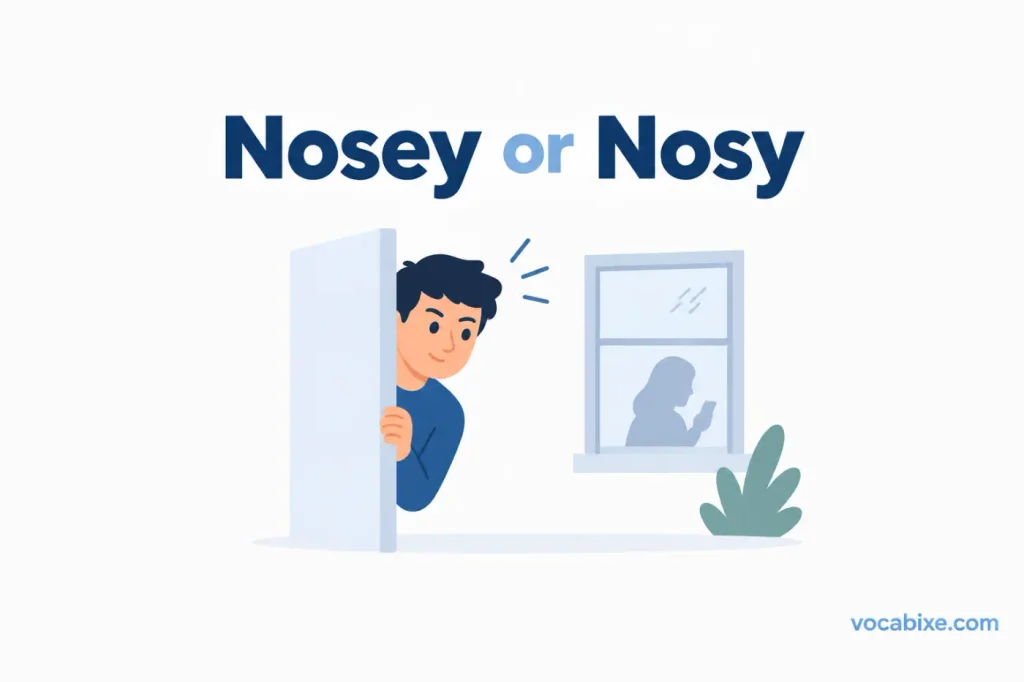
If you are wondering whether to write “nosey” or “nosy,” both spellings are correct. They have the same meaning and pronunciation. The word describes someone who is too curious about other people’s private lives or personal business. However, “nosy” is the more common spelling in American English, while “nosey” is also widely understood and accepted. For most American readers, “nosy” is the safest choice. You can use either spelling without changing the meaning of your sentence.
Section 1: Nosey or Nosy: The Quick Answer
The correct spelling is both “nosy” and “nosey.” Neither spelling is wrong, but “nosy” is generally preferred in American English.
Here is the simple rule:
- Nosy: The more common spelling in American English.
- Nosey: An accepted alternative with the same meaning.
- Meaning: Too interested in other people’s private affairs.
- Pronunciation: Both words are pronounced the same way.
- Best choice: Use “nosy” for most American English writing.
For example:
- My neighbor is very nosy and always asks personal questions.
- The nosey reporter wanted to know every detail of the story.
Both sentences are correct. The spelling changes, but the meaning stays the same.
If you are writing a school assignment, blog post, email, or professional document for an American audience, choose “nosy.” It is the more familiar form and is less likely to distract your readers.
Section 2: What Does Nosy Mean?
“Nosy” is an adjective that describes a person who shows too much interest in other people’s private matters. A nosy person may ask questions that are too personal, listen to conversations that do not concern them, or try to discover information that someone wants to keep private.
For example, imagine that two coworkers are talking quietly about a family problem. Another coworker keeps moving closer to hear what they are saying. That person is being nosy because they are trying to learn something that does not concern them.
The word usually has a negative meaning. It suggests that someone is crossing a boundary or interfering in another person’s life.
Consider these examples:
- My nosy aunt keeps asking when I plan to get married.
- The children became nosy when they saw a wrapped gift.
- Stop being nosy and let your sister handle her own problem.
- Our nosy neighbor always wants to know who visits our house.
In each example, the word describes curiosity that may be unwanted or inappropriate.
However, the meaning can sometimes be playful rather than harsh. Friends and family members may call someone nosy when that person asks too many questions out of curiosity. The exact tone depends on the situation and the relationship between the people involved.
What Does Nosey Mean?
“Nosey” means exactly the same thing as “nosy.” It describes someone who is overly curious about other people’s personal affairs.
For example:
- My nosey cousin asked how much money I earn.
- The nosey children tried to discover what their parents had bought.
- A nosey stranger asked why I was waiting outside the building.
These sentences are correct. The spelling “nosey” does not create a different meaning or a different level of curiosity.
The main difference is spelling preference. American writers generally favor “nosy,” but “nosey” remains a recognized alternative. If you encounter either form while reading, you can understand it in the same way.
Is Nosy a Negative Word?
Yes, “nosy” is usually a negative word because it suggests that someone is asking questions or seeking information without respecting other people’s privacy.
For example, asking a friend how their day went is normally friendly. Asking that friend to reveal private medical information after they have refused to discuss it may be nosy.
The difference is not simply the question itself. It also depends on the situation, the relationship, and whether the person wants to share the information.
Compare these examples:
- Friendly curiosity: “How was your holiday?”
- Potentially nosy question: “Why did you argue with your partner?”
- Clearly intrusive behavior: Reading someone’s private messages without permission.
The adjective can also describe behavior rather than a person. Saying “That was a nosy question” focuses on the question, while “He is nosy” describes the person. Latest article Journies or Journeys.
How Do You Pronounce Nosy and Nosey?
Both spellings have the same pronunciation. In American English, “nosy” is pronounced with two syllables, with the first syllable sounding like “no” and the second sounding like “zee.”
The final letter “y” has the sound of a long “e.” In “nosey,” the additional letter “e” does not change the pronunciation.
Here are some useful points:
- Both words have two syllables.
- Both have the same vowel sounds.
- Both sound identical in ordinary conversation.
- Neither spelling requires a different pronunciation.
For example, if someone says, “My neighbor is nosy,” you cannot tell from the sound alone which spelling the speaker would use when writing the sentence.
This is why the choice between “nosy” and “nosey” is a spelling question rather than a pronunciation question.
Why Are There Two Spellings?
English has many words with accepted spelling variations. Sometimes, different spellings develop through changes in word formation, historical usage, or the way writers represent sounds.
“Nosy” is formed from “nose” with the adjective-forming suffix “-y.” The suffix often means having a particular quality or being characterized by something.
For example:
- Hairy means having a lot of hair.
- Messy means untidy.
- Dusty means covered with dust.
- Nosy describes someone who shows too much curiosity about other people.
The spelling “nosey” keeps the letter “e” from the word “nose” before adding the “y.” The shorter spelling “nosy” drops that “e.”
Both forms have become established in use. You do not need to treat one as a misspelling simply because it contains an extra letter.
Is Nosy or Nosey Correct in American English?
Both forms are acceptable in American English, but “nosy” is generally the preferred spelling.
American English often favors shorter spellings when a word has an established short form. “Nosy” is the standard choice in many American dictionaries and everyday writing contexts.
For example, an American writer might write:
“My nosy coworker keeps asking about my weekend plans.”
This is a natural and correct sentence. Writing “nosey coworker” would also communicate the same meaning, but the shorter version is more conventional.
If you are preparing content for an American website, a school assignment, or a business document, use “nosy” consistently. There is no need to alternate between the two forms within the same article.
Is Nosey or Nosy Correct in British English?
Both spellings are understood in British English, too. “Nosy” is a recognized spelling, and “nosey” is also used as a variant.
The important point is that the spelling difference does not create a British meaning and an American meaning. Both words describe excessive curiosity about other people’s business.
British and American writers may differ in their spelling preferences, but this is not a strict regional division in which one form belongs exclusively to one country.
For example:
- American English: “Our nosy neighbor asked about the new car.”
- British English: “Our nosey neighbour asked about the new car.”
Both examples are understandable. Notice that “neighbor” and “neighbour” show a separate American–British spelling difference. The choice between “nosy” and “nosey” does not depend on that distinction.
When writing for a particular audience, follow the spelling style used throughout your document and choose one form consistently.
What Is the Difference Between Nosy and Nosey?
There is no difference in meaning, pronunciation, or grammatical function between “nosy” and “nosey.” Both are adjectives.
The difference is simply the spelling.
| Feature | Nosy | Nosey |
|---|---|---|
| Correct spelling | Yes | Yes |
| Meaning | Overly curious | Overly curious |
| Pronunciation | Same | Same |
| Part of speech | Adjective | Adjective |
| Common American preference | Preferred | Accepted alternative |
| Example | A nosy neighbor | A nosey neighbor |
You can replace one spelling with the other without changing the message.
For instance, “She is a nosy person” and “She is a nosey person” mean the same thing. Both describe a person who takes too much interest in matters that may be private.
The shorter spelling is generally the better choice when you are unsure which form to use.
How Do You Use Nosy in a Sentence?
“Nosy” usually appears before a noun or after a linking verb such as “is,” “seems,” or “becomes.” It describes a person, question, action, or behavior that shows excessive curiosity.
Here are several common sentence patterns.
1. Before a noun
Use “nosy” to describe a person or thing.
- A nosy neighbor watched everyone entering the house.
- My nosy friend asked about my private conversation.
- The nosy reporter kept asking personal questions.
2. After a linking verb
Use “nosy” after verbs such as “be,” “seem,” or “become.”
- He is nosy.
- She seems nosy when she asks so many questions.
- The children became nosy about the surprise.
3. With a noun describing a question or action
The word can also describe the nature of an action.
- That was a nosy question.
- I do not like nosy behavior.
- His nosy comments made everyone uncomfortable.
4. In a playful conversation
The word does not always express serious anger.
- “You are so nosy! It is a surprise.”
- “Stop being nosy. You will find out tomorrow.”
These expressions can sound lighthearted when people are joking with one another. Tone and context help determine whether the word is playful or critical.
What Are Common Mistakes With Nosy and Nosey?
The most common mistake is assuming that “nosey” is always wrong because “nosy” is shorter. In reality, both spellings are accepted.
Another mistake is thinking that the two forms have different meanings. They do not. Neither spelling refers to a different personality trait, level of curiosity, or type of behavior.
Watch out for these errors:
Mistake 1: Calling “nosey” completely incorrect
Incorrect claim: “You must never write nosey.”
Better explanation: “Nosy” is the more common American spelling, while “nosey” is an accepted variant.
Mistake 2: Giving the words different definitions
Incorrect claim: “Nosy means curious, but nosey means rude.”
Correct explanation: Both forms carry the same meaning. Whether the behavior seems rude depends on the situation.
Mistake 3: Confusing the adjective with the noun “nose”
The word “nose” refers to the part of the face used for smelling and breathing. The adjective “nosy” is a separate word meaning overly curious about other people’s affairs.
For example, “My nose is cold” refers to a body part. “My neighbor is nosy” describes behavior.
Mistake 4: Changing spelling within the same piece of writing
Although both forms are correct, switching between them without a reason can make your writing look inconsistent. Pick one spelling and use it throughout your article, essay, or report.
Mistake 5: Assuming every curious person is nosy
Curiosity is not always negative. Asking respectful questions or showing interest in a friend’s life can be kind and natural. The word “nosy” usually suggests that the curiosity is excessive, unwanted, or intrusive.
What Are Synonyms for Nosy?
Several words have meanings close to “nosy,” but they are not always interchangeable. The best choice depends on how strongly you want to describe someone’s behavior.
- Inquisitive: Eager to learn or ask questions. This word can be positive or neutral.
- Curious: Interested in learning something. It is usually more neutral than “nosy.”
- Intrusive: Entering someone’s private life or space without welcome.
- Meddlesome: Trying to interfere in other people’s affairs.
- Pr nosy: A less common expression is not needed; simply use “nosy” when you mean excessive curiosity.
- Prying: Trying to discover private information that someone does not want to share.
- Impertinent: Showing a lack of respect, especially by asking inappropriate questions.
For example, a curious student may ask a teacher how a machine works. That is usually positive. A nosy person may repeatedly ask a stranger about their salary. That can feel intrusive.
“Meddlesome” is especially useful when someone does more than ask questions and actually interferes in other people’s decisions. “Prying” focuses on attempts to uncover information, while “inquisitive” can describe healthy curiosity.
Choosing the right synonym helps you express the exact meaning without making every kind of curiosity sound negative. Other article Signer or Signor.
What Is the Opposite of Nosy?
The opposite of “nosy” describes someone who respects privacy and does not interfere in other people’s personal matters.
Useful opposites include:
- Respectful: Shows consideration for other people’s feelings and boundaries.
- Discreet: Understands when to avoid asking questions or sharing private information.
- Unintrusive: Does not interfere or impose on others.
- Reserved: Does not ask many personal questions or reveal much about private matters.
- Indifferent: Shows little interest, although this may sound less positive than the other options.
For example, “My neighbor is respectful and never asks personal questions” gives a positive description.
However, “indifferent” is not always a good replacement. A person can respect privacy while still caring about other people. Someone who is indifferent may simply show little interest in them.
The best opposite in most everyday situations is “respectful” because it focuses on treating other people’s boundaries properly.
Is Nosy the Same as Curious?
No. “Nosy” and “curious” are related, but they do not mean exactly the same thing.
“Curious” usually means wanting to learn or understand something. It can describe a healthy interest in people, places, ideas, or events. “Nosy” usually describes curiosity that goes too far into someone else’s private affairs.
Compare these examples:
- Curious: “I am curious about how airplanes fly.”
- Friendly curiosity: “I am curious about your new job. Do you enjoy it?”
- Nosy: “I want to know exactly how much money you earn, and I will keep asking until you tell me.”
The first example involves learning about a subject. The second shows ordinary interest in a friend’s life. The third crosses a possible privacy boundary.
A curious person does not automatically behave in a nosy way. The distinction depends on what the person wants to know, why they want to know it, and whether they respect another person’s choice not to answer.
Is Nosy an Insult?
“Nosy” can be an insult, but it is not always used that way. The word is critical because it suggests that someone’s curiosity is unwanted or excessive.
If you say, “You are nosy,” in an angry voice, the other person may understand it as criticism. If you say, “You are so nosy! Wait until your birthday,” while smiling, it may sound like friendly teasing.
The setting also matters. Calling a stranger nosy can sound rude, while using the word jokingly with a close friend may be perfectly normal.
If you want a softer way to express the same concern, you can say:
- “That is a little personal.”
- “I would rather not discuss that.”
- “I prefer to keep that private.”
- “I do not think that is something you need to know.”
These phrases help you set a boundary without directly labeling the other person.
FAQs
Is nosey spelled with an e?
Yes. “Nosey” is an accepted spelling. However, “nosy” is generally the more common choice in American English.
Which is correct: nosy or nosey?
Both are correct. They have the same meaning and pronunciation, but “nosy” is the preferred spelling for most American English writing.
Does nosy mean rude?
Not exactly. “Nosy” means overly curious about other people’s private affairs. This behavior can seem rude when it ignores someone’s privacy or personal boundaries.
Are nosy and nosey pronounced the same?
Yes. Both spellings have the same pronunciation in ordinary English speech. The extra “e” in “nosey” does not change the sound.
Is nosy American or British English?
“Nosy” is used in both American and British English. “Nosey” is also understood in both varieties, so neither spelling belongs exclusively to one country.
What is the plural of nosy?
“Nosy” is an adjective, so it does not have a plural form. You can say “a nosy neighbor” or “nosy neighbors.” The adjective remains unchanged.
What is the past tense of nosy?
“Nosy” is an adjective, not a verb, so it has no past tense. You can say, “He was nosy yesterday,” or “She became nosy during the conversation.”
What is a good synonym for nosy?
“Prying” is a useful synonym when someone tries to discover private information. “Intrusive” works when someone crosses personal boundaries, while “inquisitive” is better for neutral or positive curiosity.
Conclusion
Both “nosey” and “nosy” are correct spellings of the same adjective. Each describes someone who shows too much interest in other people’s private lives or personal business. The words have the same pronunciation, meaning, and grammatical use.
For American English writing, “nosy” is usually the best choice because it is the more common spelling. You may still encounter “nosey” in books, messages, and everyday conversations, and you do not need to treat it as an error.
Remember the simple rule: use “nosy” as your default spelling, understand “nosey” as an accepted alternative, and pay attention to the context to decide whether the word describes playful curiosity or unwanted interference.