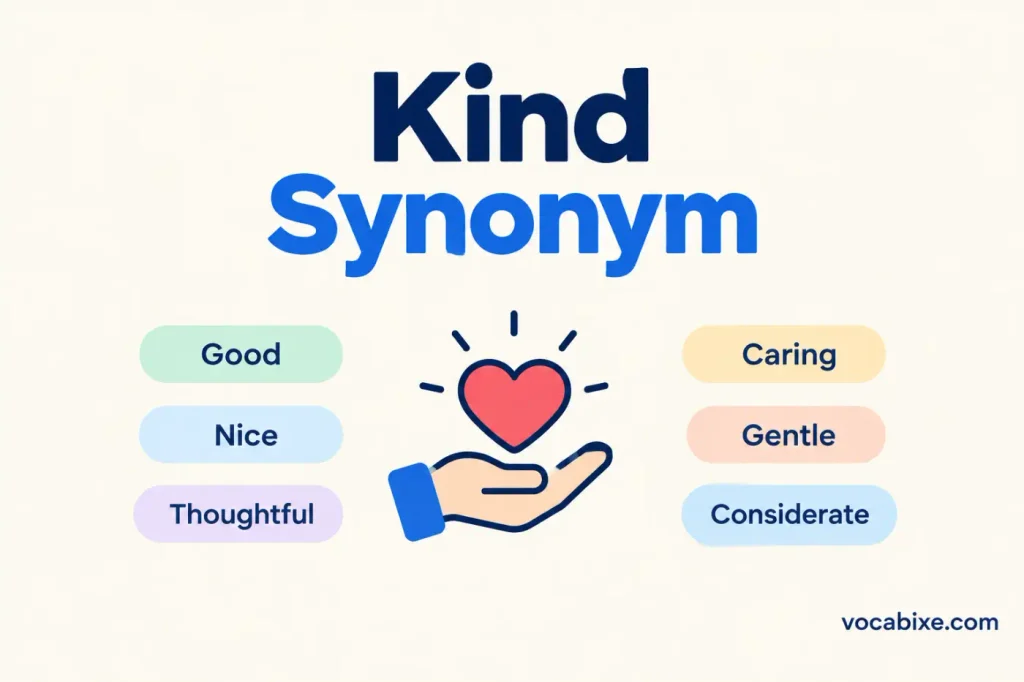
If you need a kind synonym, the best choice depends on what you mean by kind. You might want to describe someone who cares about others, someone who gives freely, someone who is gentle, or someone who thinks carefully about other people’s feelings. Words such as compassionate, considerate, thoughtful, caring, generous, gentle, friendly, kindhearted, and benevolent can all relate to kind, but they are not interchangeable in every sentence. Cambridge defines kind as being generous, helpful, and attentive to other people’s feelings.
The easiest way to choose the right synonym is to identify the specific quality of kindness you want to express.
Quick Answer: What Is a Good Synonym for Kind?
Some of the most useful synonyms for kind are:
| Synonym | Best meaning | Tone | Best context |
|---|---|---|---|
| Caring | Showing concern | Warm | People and relationships |
| Compassionate | Showing sympathy for suffering | Deep | Emotional or serious situations |
| Considerate | Thinking about others’ feelings or needs | Respectful | Professional and everyday |
| Thoughtful | Showing care through attention or actions | Warm | Gifts, gestures, behavior |
| Generous | Giving freely | Positive | Money, time, help |
| Gentle | Mild and non-harsh | Soft | Behavior, speech, treatment |
| Friendly | Pleasant and welcoming | Casual | Social situations |
| Kindhearted | Having a naturally caring nature | Warm | Describing personality |
| Benevolent | Wanting to do good | Formal | Formal or professional writing |
| Gracious | Kind, polite, and pleasant | Polished | Formal and social situations |
There is no single perfect replacement for kind. The most natural synonym changes with the intended meaning.
The Kind Synonym Hierarchy
A useful way to understand these words is to divide kindness into different qualities.
Care → compassion → consideration → generosity → gentleness → friendliness → goodwill
Each area answers a slightly different question:
- Caring: Does this person show concern?
- Compassionate: Does this person understand or respond to suffering?
- Considerate: Does this person think about other people’s needs?
- Thoughtful: Does this person show care through attention or actions?
- Generous: Does this person give freely?
- Gentle: Does this person avoid harshness?
- Friendly: Does this person create a welcoming social atmosphere?
- Benevolent: Does this person actively wish others well?
This semantic approach is more useful than treating every thesaurus entry as an exact substitute.
Best Synonyms for Kind and Their Differences
Caring
Caring means showing concern for another person’s well-being.
It is especially natural when talking about relationships, family, teachers, nurses, friends, or people who regularly help others.
Example:
She is a caring teacher who always listens to her students.
Common collocations: caring person, caring parent, caring attitude, caring nature.
Use caring when the central idea is emotional concern.
Compassionate
Compassionate suggests sympathy and concern for someone who is suffering or experiencing difficulty.
Example:
The doctor was compassionate toward the frightened patient.
Compared with kind, compassionate is more specific. A person can be kind in many situations, while compassion usually involves recognizing another person’s pain or hardship.
Common collocations: compassionate care, compassionate person, compassionate response, compassionate approach.
This word works particularly well in healthcare, social work, leadership, and serious writing.
Considerate
Considerate means thinking about other people’s wishes, feelings, comfort, or needs. Oxford describes a considerate person as someone who thinks about others and tries not to hurt or upset them.
Example:
It was considerate of him to lower the music while the baby was sleeping.
The difference is subtle:
- Kind = generally good and caring.
- Considerate = careful about how your actions affect others.
A considerate action often involves awareness.
Thoughtful
Thoughtful can mean kind and considerate, especially when someone’s action shows that they have paid attention to another person’s needs. Oxford specifically gives considerate and kind as related meanings.
Example:
It was thoughtful of Maya to remember my birthday.
You can also use thoughtful for careful thinking:
She gave a thoughtful answer.
That second meaning makes thoughtful different from many simple synonyms for kind.
Generous
Generous focuses on giving more than is expected.
The gift might be money, time, attention, help, or forgiveness.
Example:
My neighbor was generous enough to help me move.
A useful distinction is:
Kind describes goodness toward others; generous emphasizes giving.
Someone can be generous with money without being especially gentle or emotionally compassionate.
Gentle
Gentle describes behavior that is mild, careful, calm, or non-harsh.
Example:
The nurse was gentle while treating the injured child.
It can describe touch, speech, behavior, people, animals, and even criticism.
Gentle is therefore a good synonym when the opposite idea is harsh rather than cruel.
Friendly
Friendly means pleasant, welcoming, and easy to interact with.
Example:
The receptionist was friendly and helpful.
The distinction is useful:
- Friendly → social warmth.
- Kind → goodness or helpfulness.
- Caring → concern for someone’s well-being.
A friendly person may make you feel welcome without necessarily doing something especially helpful.
Kindhearted
Kindhearted describes someone with a naturally sympathetic and caring personality.
Example:
She is a kindhearted woman who always helps stray animals.
It is especially useful when you are describing someone’s character rather than one isolated action.
Benevolent
Benevolent means wishing good things for others or showing goodwill.
It has a more formal tone than kind.
Example:
The organization received support from a benevolent donor.
Use benevolent in formal writing, historical descriptions, institutional contexts, and serious prose.
It can sound unnatural in a casual sentence such as:
Thanks for being benevolent and helping me carry these boxes.
In everyday conversation, kind or helpful would usually sound more natural.
Gracious
Gracious can describe someone who is kind, polite, generous, or courteous, especially in social or formal situations.
Example:
She was gracious enough to thank everyone personally.
Unlike kind, gracious often carries an additional sense of polished manners.
Kind Synonyms by Context
Choosing a synonym becomes easier when you start with the situation.
| Context | Natural choices |
|---|---|
| Everyday conversation | nice, friendly, caring, helpful |
| Describing personality | kindhearted, caring, warm, good-natured |
| Showing sympathy | compassionate, sympathetic, understanding |
| Giving help | helpful, generous, supportive |
| Respecting feelings | considerate, thoughtful, courteous |
| Soft behavior | gentle, tender, mild |
| Formal writing | benevolent, humane, charitable |
| Professional communication | considerate, thoughtful, courteous, gracious |
| Academic writing | compassionate, benevolent, humanitarian |
| Customer service | courteous, helpful, friendly, accommodating |
| Creative writing | tender, warmhearted, gentle, compassionate |
| Leadership | considerate, compassionate, supportive, fair |
The best word is the one that communicates the specific quality, not simply one that appears in a thesaurus.
Kind vs Nice: What Is the Difference?
Kind and nice overlap, but they are not always equal.
Nice is broad. It can mean pleasant, agreeable, friendly, or enjoyable.
Kind more strongly suggests goodness, helpfulness, generosity, or concern for another person’s feelings. Cambridge lists nice as a related synonym but also provides more specific alternatives such as good-hearted, helpful, caring, and thoughtful.
Compare:
She is nice to everyone.
This tells us that she behaves pleasantly.
She is kind to everyone.
This more strongly suggests that she treats people with care and consideration.
Use nice for general pleasantness. Use kind when you want to emphasize positive treatment of others.
Kind vs Thoughtful
These words overlap when an action shows consideration.
Kind:
It was kind of him to help me.
Thoughtful:
It was thoughtful of him to remember that I needed help.
The second sentence emphasizes that he noticed a need and acted with attention.
A useful shortcut is:
Kind = good action
Thoughtful = attentive action
Kind vs Compassionate
The word Kind is broader.
Compassionate is more closely connected to suffering, hardship, or emotional pain.
Compare:
She was kind to the new student.
She was compassionate toward the student after learning about his difficult situation.
The first sentence describes good treatment. The second emphasizes sympathy and understanding.
Kind vs Considerate
Considerate focuses on awareness of other people’s feelings and needs.
Kind can be broader and can include generosity, compassion, friendliness, or helpfulness.
For example:
He was kind enough to give me a ride.
He was considerate enough to ask whether the timing worked for me.
The first emphasizes help. The second emphasizes awareness.
Kind Synonyms for Professional Writing
Professional writing usually benefits from precision rather than simply replacing kind with a more complicated word.
Instead of:
She was kind to the customer.
You might write:
She was courteous to the customer.
If she solved a problem:
She was helpful and resolved the customer’s issue quickly.
If she showed emotional understanding:
She was compassionate toward the customer’s concerns.
If she carefully respected the customer’s needs:
She was considerate of the customer’s situation.
This approach makes business writing clearer and more specific.
Kind Synonyms for Academic Writing
Academic writing generally benefits from precise vocabulary.
Consider these choices:
- benevolent — focused on goodwill.
- compassionate — focused on sympathy and suffering.
- humanitarian — focused on improving human welfare.
- altruistic — focused on helping others without expecting personal benefit.
- considerate — focused on awareness of others.
- charitable — focused on giving help, money, or resources.
For example:
The organization adopted a compassionate approach toward vulnerable communities.
That sentence communicates more information than simply saying:
The organization adopted a kind approach.
A Simple Decision Tree for Choosing a Kind Synonym
Ask yourself one question:
What kind of kindness am I describing?
If the answer is…
- Concern for someone → caring
- Suffering or hardship → compassionate
- Awareness of feelings → considerate
- A carefully chosen gesture → thoughtful
- Giving time, money, or help → generous
- Soft or non-harsh behavior → gentle
- Social warmth → friendly
- A naturally good personality → kindhearted
- Formal goodwill → benevolent
- Polite and socially polished behavior → gracious
- General pleasantness → nice
This is often more reliable than choosing the first synonym in a thesaurus.
Common Mistakes When Using Kind Synonyms
One common mistake is assuming that every synonym can replace kind without changing the meaning.
For example, generous does not always mean compassionate. A generous person may give money freely, while a compassionate person may comfort someone in distress.
Another mistake is using overly formal vocabulary in casual conversation.
The waiter was benevolent.
This is grammatically possible, but it sounds unusual. Friendly, helpful, or courteous would normally fit better.
A third mistake is using thoughtful only as a synonym for kind. Thoughtful also means showing careful consideration or deep thought, so context determines its meaning.
Finally, avoid replacing a simple word merely to sound sophisticated. If kind communicates the meaning perfectly, keeping kind may be the strongest writing choice.
Grammar Tips for Using Kind
The most common structures include:
kind + to + person
She is kind to her younger brother.
kind + of + person + to + verb
It was kind of you to call.
kind enough + to + verb
He was kind enough to explain the problem.
a kind + noun
She gave me a kind response.
The word also has comparative and superlative forms:
- kind
- kinder
- kindest
For example:
She is kinder than her sister.
He is the kindest person I know.
Cambridge and Dictionary.com both document these ordinary grammatical uses and forms.
Antonyms of Kind
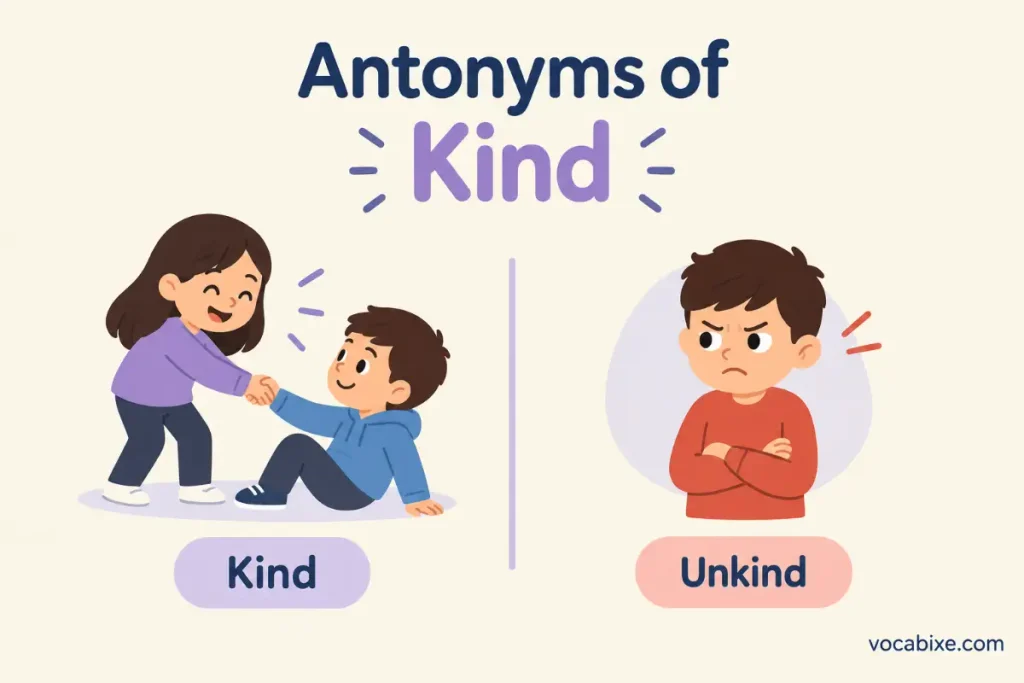
Common opposites include:
- unkind
- cruel
- harsh
- insensitive
- inconsiderate
- unfriendly
- selfish
- unsympathetic
- hurtful
- unforgiving
The correct antonym depends on what kind of kindness is being contrasted.
For example:
considerate ↔ inconsiderate
friendly ↔ unfriendly
compassionate ↔ unsympathetic
gentle ↔ harsh
This shows why antonyms can also help clarify the precise meaning of a synonym.
Kind Expressions and Phrases
Several common expressions communicate kindness without using the adjective kind directly.
- have a heart of gold — be extremely kind and caring
- go out of your way — make extra effort to help someone
- lend a hand — offer help
- do someone a favor — help someone with a task
- show compassion — respond with sympathy and care
- show consideration — think about another person’s needs
- treat someone well — behave positively toward them
- do a good deed — perform a helpful or morally positive action
These expressions can make everyday and creative writing sound more natural than repeatedly using kind.
How to Avoid Repeating the Word Kind
Replacing every occurrence of kind with a synonym can make writing feel forced.
Instead, first identify the exact idea.
Original:
She was kind and kind to everyone.
Better:
She was caring, considerate, and always willing to help.
Another option is to rewrite the sentence entirely:
She always noticed when someone needed help.
The second approach adds information rather than simply swapping words.
Good vocabulary improvement is not about using the largest possible number of synonyms. It is about selecting the most precise word for the intended meaning.
Related Article
FAQ About Kind Synonyms
What is the best synonym for kind?
There is no single best synonym for every situation. Caring, compassionate, considerate, thoughtful, generous, gentle, friendly, and kindhearted are useful alternatives, but each emphasizes a different aspect of kindness.
What is a strong word for kind?
Compassionate, benevolent, humanitarian, and kindhearted can express stronger or more specific forms of kindness depending on context.
What is a synonym for kind in professional writing?
Considerate, courteous, thoughtful, gracious, helpful, and compassionate can work well in professional writing. The best choice depends on the behavior being described.
What is a synonym for kind in an essay?
Useful choices include compassionate, considerate, benevolent, generous, humanitarian, and altruistic. Choose the word that expresses the exact idea rather than using a more complex word simply for variety.
Is nice a synonym for kind?
Nice can be a synonym for kind in some contexts, but it is broader and often less specific. Kind more strongly suggests helpfulness, generosity, or concern for other people’s feelings.
What is the difference between kind and thoughtful?
Kind describes positive and caring behavior generally. Thoughtful often describes an action that shows someone noticed another person’s needs or feelings.
What is the difference between kind and considerate?
Kind is broader. Considerate specifically emphasizes thinking about other people’s feelings, wishes, comfort, or needs.
What is the difference between kind and compassionate?
Kind can describe many forms of positive behavior. Compassionate more specifically suggests sympathy and concern for someone who is suffering or experiencing difficulty.
What is a formal synonym for kind?
Benevolent is one of the clearest formal alternatives. Depending on context, humane, charitable, gracious, or beneficent may also work.
What is a synonym for a kind person?
Depending on the intended meaning, you can say caring person, compassionate person, considerate person, generous person, kindhearted person, good-hearted person, or warmhearted person.
Final Guide: Choose the Meaning, Not Just the Synonym
The word kind is useful because it covers a wide range of positive human behavior. That broad meaning is also why replacing it requires some care.
Choose caring for concern, compassionate for sympathy, considerate for awareness of others, thoughtful for attentive actions, generous for giving, gentle for mild behavior, friendly for social warmth, kindhearted for personality, and benevolent for formal expressions of goodwill.
Modern thesaurus resources list many additional alternatives, but the most useful vocabulary comes from understanding the distinctions between related words rather than memorizing a long list.
Pingback: Guidance Synonym: 30+ Best Synonyms & Examples - Vocabixe
Pingback: Powerful Synonym: 30+ Strong Alternatives & Examples- Vocabixe