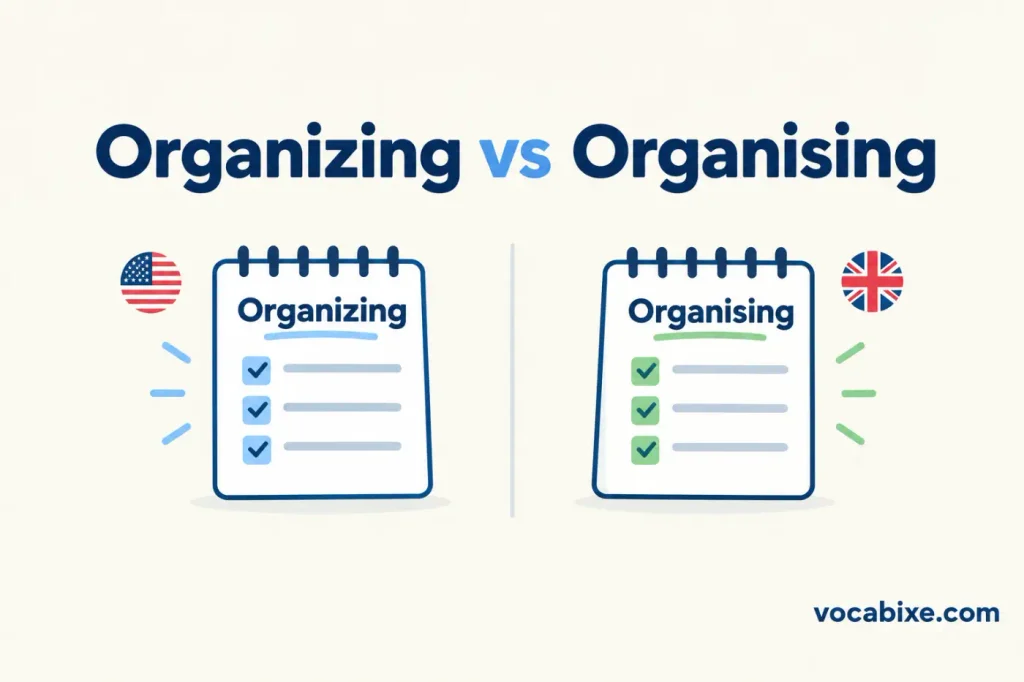
The difference between organizing and organising is regional spelling. Both words are correct and mean the same thing: arranging things in an orderly way, planning an event, or managing tasks. Organizing is the preferred spelling in American English, while organising is the standard spelling in British English and many other varieties of English. Neither spelling is wrong. The best choice depends on your audience, location, and writing style.
Organizing vs Organising: Quick Answer
- Organizing: The standard American English spelling.
- Organising: The standard British English spelling.
- Meaning: Both words mean arranging, planning, or managing something.
- Pronunciation: Both spellings are pronounced the same way in ordinary speech.
- Past tense: Organized in American English and organised in British English.
- Present participle: Organizing in American English and organising in British English.
Example: “I am organizing my desk” is standard American English, while “I am organising my desk” is standard British English.
The main difference is the letter used before the ending “-ing.” American English generally uses “z” in this word, while British English usually uses “s.”
What Does Organizing Mean?
Organizing means putting things in order, making a plan, or arranging people and activities so that something can happen smoothly.
People use the word in everyday conversations, schoolwork, offices, businesses, and personal tasks. It can describe something as simple as arranging books on a shelf or something as large as planning a public event.
Here are some examples:
- I am organizing my bedroom before the guests arrive.
- She is organizing a meeting for her team.
- We are organizing our notes for the exam.
- The teacher is organizing a school trip.
- He spends Sunday organizing his weekly schedule.
In each sentence, the word describes an action that involves planning, arranging, or managing something.
The spelling depends on the variety of English being used. An American writer would usually write “organizing,” while a British writer would generally choose “organising.”
Is Organizing a Verb?
Yes, organizing is the present participle and gerund form of the verb “organize” in American English. The corresponding British English form is “organising,” from “organise.”
As a present participle, it can describe an action that is happening now or help form a continuous verb tense.
Examples:
- She is organizing the files.
- They are organizing a charity event.
- We were organizing the classroom when the bell rang.
As a gerund, the word functions as a noun. It names an activity rather than simply describing what someone is doing.
Examples:
- Organizing takes time.
- I enjoy organizing my workspace.
- Organizing a large event requires careful planning.
Both forms are grammatically correct. The spelling choice does not change the role of the word in the sentence.
What Is the Difference Between Organizing and Organising?
The difference between organizing and organising is the spelling convention used in different varieties of English. Their meaning, pronunciation, and grammatical function are the same.
American English usually favors “organize,” “organizing,” and “organized.” British English commonly uses “organise,” “organising,” and “organised.”
| Feature | Organizing | Organising |
|---|---|---|
| Main variety | American English | British English |
| Base verb | Organize | Organise |
| Present participle | Organizing | Organising |
| Past tense | Organized | Organised |
| Past participle | Organized | Organised |
| Meaning | Arranging or planning | Arranging or planning |
| Pronunciation | The same | The same |
For example, an American student might write, “I am organizing a study group.” A British student could write, “I am organising a study group.”
Both sentences are correct. They communicate the same idea and use the same grammatical structure.
The important point is consistency. If you are writing an essay in American English, use “organizing.” If your school, workplace, or publication follows British English, use “organising.”
Why Does American English Use a Z?
American English often uses “z” in words that have “s” in their British English forms. This difference appears in several common verbs.
Examples include:
- Organize and organise
- Realize and realise
- Recognize and recognise
- Apologize and apologise
- Analyze and analyse
American dictionaries generally prefer the “z” forms in these words. Many British dictionaries favor the “s” forms, although some British publications and dictionaries also accept “z” spellings.
The difference reflects spelling traditions rather than a difference in meaning. Both forms have a long history in English, and neither is automatically incorrect. Related article Totaling vs Totalling.
One useful rule is to follow the spelling system used by the organization, school, or publication you are writing for.
Is Organising British English?
Yes, organising is a standard spelling in British English. It is also widely used in countries and communities that follow British spelling conventions, including Australia and New Zealand.
Examples:
- She is organising a family dinner.
- The school is organising a sports competition.
- We are organising the documents for the meeting.
In these examples, the spelling follows the British-style “organise” pattern.
However, British English is not completely uniform. Some British writers use “organize” because certain dictionaries and style guides accept it. Therefore, the letter “s” is a useful general guide, not an absolute rule for every British writer.
Is Organizing American English?
Yes, organizing is the standard spelling in American English. American writers generally use “organize” as the base verb and “organized” as its past tense.
Examples:
- I am organizing my notes.
- They are organizing a community event.
- She organized the office yesterday.
American English also uses “organization” and “organizer.” These noun forms normally contain “z” in American spelling.
If you are writing for an American audience, using “organizing” is the safest and most familiar choice.
When Should You Use Organizing or Organising?
Choose the spelling that matches your audience and the spelling rules of your document. The meaning stays the same, so you do not need to choose one form based on the type of activity.
Use “organizing” when writing in American English. It is suitable for American school assignments, business emails, reports, website articles, and everyday messages.
Use “organising” when writing in British English or following a British-style spelling guide. It is suitable for schoolwork, business documents, articles, and personal writing that uses British spelling.
Consider these situations:
Writing for an American school: Use “organizing” in your assignment if your teacher expects American English.
Writing for a British company: Use “organising” if the company follows British spelling conventions.
Publishing a website: Choose the spelling style that fits your main audience, then use it consistently across related articles.
Writing an international report: Follow the requested style guide. If no guide is provided, choose one variety of English and apply it throughout the document.
There is no need to change every instance of one spelling in a quotation or official name if the original wording must be preserved. Consistency matters, but so does accuracy when reproducing someone else’s words.
Can You Use Both Spellings in the Same Article?
You can use both spellings, but doing so without a clear reason may make your writing look inconsistent.
For example:
“I am organizing the files before organising the office.”
This sentence is understandable, but it switches between American and British spelling conventions. If the writer intends to use American English, “organizing” should normally appear in both places. A British-style document would generally use “organising” throughout.
There are exceptions. A language article comparing the two spellings may need both forms because each one is part of the topic. Direct quotations may also preserve the original spelling.
For most ordinary writing, select one style and stay with it.
Organizing vs Organising in Different Sentence Types
Both spellings work in the same sentence structures. Only the spelling changes, not the grammar.
Present Continuous Tense
The present continuous describes an action happening now or around the current period.
American English: “I am organizing my study materials.”
British English: “I am organising my study materials.”
Both sentences describe the same ongoing action. The verb “am” is followed by the present participle.
Past Continuous Tense
The past continuous describes an action that was happening at a particular time in the past.
American English: “She was organizing the event when I arrived.”
British English: “She was organising the event when I arrived.”
The spelling difference does not affect the tense. In both sentences, “was” combines with the verb ending in “-ing.”
Future Plans
The word can also describe an activity that someone plans to do.
American English: “We will be organizing the conference next month.”
British English: “We will be organising the conference next month.”
The future meaning comes from the verb phrase “will be.” The spelling of the main verb remains a regional choice.
After Certain Verbs
Organizing or organising can follow verbs such as “enjoy,” “consider,” and “finish.”
Examples:
- I enjoy organizing my bookshelf.
- She finished organizing the documents.
- They considered organizing a fundraiser.
In British spelling, the corresponding forms are “organising,” “organising,” and “organising” in these sentences.
The grammar remains the same because both forms are the “-ing” form of the verb.
Organize, Organizing, Organized, and Organization
Understanding the related forms helps you spell the word correctly in different situations.
| Word | Function | Example |
|---|---|---|
| Organize | Base verb in American English | I organize my notes every Friday. |
| Organizing | Present participle or gerund | Organizing helps me stay focused. |
| Organized | Past tense or past participle | She organized the meeting yesterday. |
| Organization | Noun | Good organization saves time. |
| Organizer | Person or tool that arranges things | The event organizer welcomed everyone. |
British English commonly uses “organise,” “organising,” “organised,” “organisation,” and “organiser.”
Notice that the difference extends beyond the “-ing” form. If you choose British spelling, you will usually need to use the related British forms as well.
For example, a British-style sentence might read, “The organiser is organising the event for the organisation.” An American-style version would generally use “organizer,” “organizing,” and “organization.”
Both sentences are correct within their respective spelling systems.
What Is the Difference Between Organizing and Organized?
“Organizing” usually refers to an action that is happening, continuing, or being discussed as an activity. “Organized” often describes an action that has been completed or a state of being orderly.
Examples:
- I am organizing my desk. The action is happening now.
- I organized my desk yesterday. The action happened in the past.
- My desk is organized. The desk is in an orderly state.
In British English, the corresponding forms are “organising” and “organised.”
This is a grammatical difference between the “-ing” and “-ed” forms, not a difference between American and British meanings.
What Is the Difference Between Organizing and Organisation?
“Organizing” is a verb form that describes arranging, planning, or managing something. “Organization” is a noun that can refer to the process of arranging things or to a group such as a company, charity, or institution.
Examples:
- Organizing the shelves took an hour.
- Good organization makes the work easier.
- She is organizing a meeting for the organization.
British English generally spells the noun “organisation,” while American English usually spells it “organization.”
The meaning depends on the sentence. The verb describes an action, while the noun names an activity, quality, structure, or group.
Common Mistakes With Organizing and Organising
These spellings are easy to confuse because they look almost identical. Most mistakes happen when writers mix spelling styles or use the wrong related form.
Mistake 1: Assuming Organising Is Always Wrong
Some American writers believe that “organising” is a misspelling. That is not correct.
“Organising” is standard in British English and other varieties that use British-style spelling. It is only unsuitable when the chosen style requires the American form.
Correct examples:
- American English: I am organizing the files.
- British English: I am organising the files.
Mistake 2: Assuming Organizing Is Always Wrong in Britain
The “z” spelling is not automatically incorrect in British English. Some British dictionaries and style guides accept “organize” and its related forms.
However, if a British school, employer, or publication specifically requires “organise,” follow that rule.
Mistake 3: Mixing Related Spellings
Using “organizing” alongside “organised” in ordinary prose can create an inconsistent style.
For example, “She is organizing the event that he organised” mixes the common American “z” form with the common British “s” form.
A consistent American version is “She is organizing the event that he organized.”
A consistent British version is “She is organising the event that he organised.”
Mistake 4: Confusing Spelling With Pronunciation
The two words have the same standard pronunciation in ordinary English. The letter “s” in the British spelling does not mean that the word must be pronounced differently from the American form.
Both spellings are pronounced with the same basic sounds and stress pattern. You can use either spelling without changing how you say the word.
Mistake 5: Using Organizing When You Mean Organized
The “-ing” form and the “-ed” form do not always serve the same grammatical purpose.
Incorrect for a completed past action: “Yesterday, I am organizing the files.”
Correct: “Yesterday, I organized the files.”
The correct choice depends on the time and structure of the sentence. The same rule applies to the British forms “organising” and “organised.”
Why Do British and American English Spell Words Differently?
British and American English developed different spelling preferences over time. Dictionaries, publishers, schools, and other institutions helped establish and maintain these conventions.
Some differences involve “s” and “z,” as seen in “organise” and “organize.” Other differences involve letter combinations, endings, or the use of certain vowels.
Examples include:
- Colour and color
- Favour and favor
- Centre and center
- Travelling and traveling
- Organising and organizing
These pairs do not all follow exactly the same historical rule. Some differences arose through efforts to simplify spelling, while others reflect older spelling traditions and changes in common usage.
For “organize,” the “z” spelling has historical roots and is not an American invention. American usage favors it, while British usage commonly favors “s” in the related word “organise.”
The most useful lesson is that English has more than one accepted spelling system. A regional spelling difference does not automatically make one form better or more correct than another.
Is Organizing or Organising More Common Online?
The answer depends on the audience, location, and type of website.
American websites commonly use “organizing” because it matches American spelling conventions. British, Australian, and New Zealand websites often use “organising” because it matches their usual spelling preferences.
Search engines can understand that these forms are closely related and have the same basic meaning. However, people may search for one spelling more often in a particular country.
For website writers, the best approach is to understand the target audience. If your readers are mainly in the United States, “organizing” is usually the natural choice. If your readers are mainly in the United Kingdom, “organising” may be more suitable.
Avoid changing spellings simply to repeat a keyword more often. Use the form that fits the sentence and the site’s chosen language style. Clear writing and consistent spelling make an article easier for readers to follow.
Which Spelling Should You Learn?
If you are learning English, it is helpful to recognize both spellings but practice one variety consistently.
Choose American English if your studies, workplace, or main audience use American conventions. Learn “organize,” “organizing,” “organized,” and “organization” as a related set.
Choose British English if your school, employer, or preferred learning materials follow British conventions. Practice “organise,” “organising,” “organised,” and “organisation” together.
If you are unsure which style to use, check the instructions for your assignment or document. A teacher may expect one form, while an employer may follow a particular editorial guide.
You do not need to memorize separate meanings for these two words. They mean the same thing. Focus instead on the spelling pattern and use the appropriate form consistently.
Conclusion
The difference between organizing and organising comes down to regional spelling preferences. Organizing is the standard choice in American English, while organising is widely used in British English and other varieties that follow British spelling conventions. Both words have the same meaning, pronunciation, and grammatical function.
To choose the right spelling, consider your audience and follow the style guide for your school, workplace, or website. Keep related words consistent, including organized or organised and organization or organisation. Once you understand this simple spelling difference, you can use either form confidently and avoid unnecessary confusion.
FAQs
Is organizing or organising correct?
Both are correct. “Organizing” is the standard American English spelling, while “organising” is the usual British English spelling.
Is organizing American or British?
Organizing is the standard American English form. British English commonly uses organising, although some British style guides accept the “z” spelling.
Is organising a spelling mistake?
No. Organising is a correct spelling in British English and other varieties that follow British spelling conventions.
Do organizing and organising mean the same thing?
Yes. Both mean arranging, planning, or managing something. The difference is spelling, not meaning.
Are organizing and organising pronounced the same way?
Yes. Both forms have the same standard pronunciation in ordinary English. The spelling difference does not change how the word is said.
Should I use organizing or organising in an essay?
Follow the spelling system required by your teacher or institution. Use “organizing” for American English and “organising” for British English.
What is the past tense of organizing?
The American English past tense is “organized.” The usual British English form is “organised.”
Example: “I organized my room yesterday” and “I organised my room yesterday” are both correct in their respective spelling systems.
Is it organization or organisation?
“Organization” is the standard American English spelling. “Organisation” is the usual British English spelling, although both forms are accepted in some British contexts.
Pingback: Segue vs Segway: Meaning, Difference, Spelling, and Examples - Vocabixe