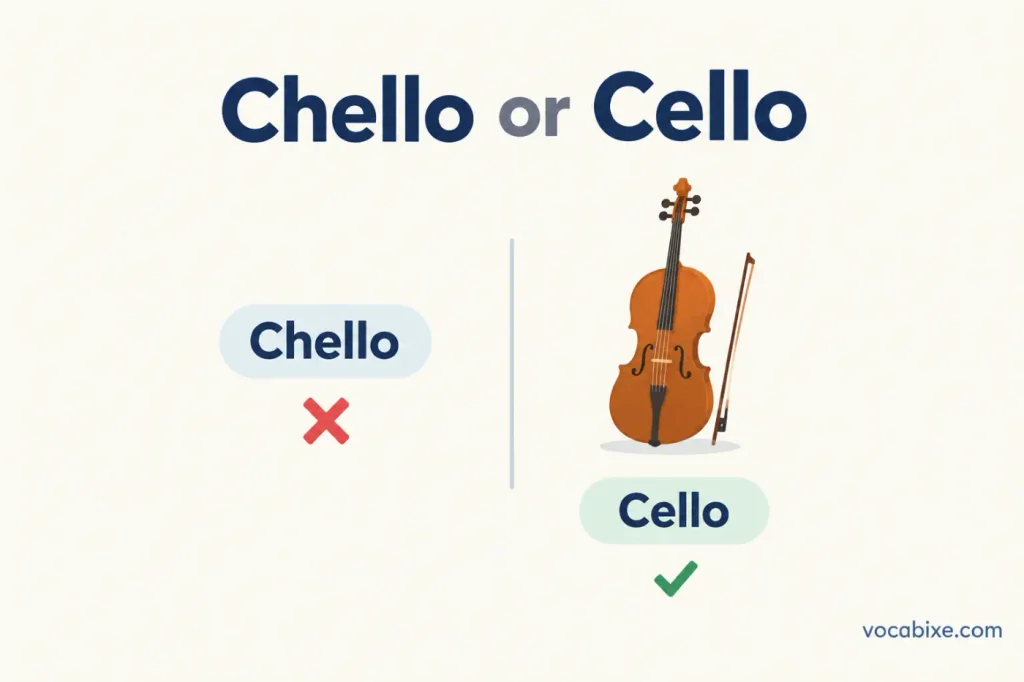
If you are wondering about chello or cello, the correct spelling is cello when you mean the musical instrument. Chello is a common spelling mistake caused by the way the word sounds. A cello is a large wooden string instrument played with a bow while the player sits and holds it between the knees. The standard spelling is cello, not chello.
Section 1: Chello or Cello — Which One Is Correct?
The correct spelling is cello.
Chello is not the standard English spelling of the musical instrument. If you are writing a school assignment, article, email, music lesson note, or any other formal text, use cello.
Here is the simple difference:
| Spelling | Correct? | Meaning |
|---|---|---|
| cello | Yes | A large bowed string instrument |
| chello | No | Common misspelling of cello |
| violoncello | Yes | The full formal name of the instrument |
| ‘cello | Older form | Historical shortened form of violoncello |
For example:
Correct: She plays the cello.
Incorrect: She plays the chello.
Correct: My brother is learning to play the cello.
Incorrect: My brother is learning to play the chello.
The key thing to remember is that the word begins with cell-, even though its first sound can make it seem as if it begins with chell-.
Why Do People Write Chello Instead of Cello?
The main reason is pronunciation.
In English, cello is pronounced with a beginning sound like the “ch” in cheese or chair. That can create a spelling trap.
When someone hears the word for the first time, they may think:
chello
The spelling feels logical because many English words use ch for this sound:
- chair
- cheese
- child
- cherry
- chocolate
However, cello does not follow that spelling pattern. It keeps the c from its Italian origin.
So the correct memory rule is:
You hear “ch,” but you write “c.”
Think of the word as:
C-E-L-L-O
not:
C-H-E-L-L-O
This small spelling difference is the main reason behind many searches for chello or cello.
What Does Cello Mean?
A cello is a musical instrument from the violin family. It has four strings and is played with a bow. The instrument is held vertically between the player’s knees, with its lower end resting on the floor.
The cello is larger than a violin and viola but smaller than a double bass.
Its size gives it a deep, warm sound. You can hear cellos in orchestras, chamber music, school music groups, film scores, and many modern recordings.
A person who plays the instrument is called a cellist.
For example:
- Maria is a talented cellist.
- The cellist played a beautiful solo.
- Our school orchestra has two cellists.
- He started learning the cello when he was eight.
The word cellist is therefore related to cello, while chello is simply the wrong spelling when you mean the instrument.
How Do You Spell Cello?
The correct spelling is:
C-E-L-L-O
There are two l’s and no h.
A useful way to remember it is to connect it with the word cell:
cell + o = cello
This is not a complete explanation of the word’s historical formation, but it can work as a simple spelling trick.
If you are unsure while writing, remember:
cello = correct
chello = incorrect
Is Chello a Different Word From Cello?
When someone writes chello while talking about the musical instrument, they normally mean cello.
It is not the standard British spelling and it is not an alternative American spelling of the instrument.
This means you should not treat the two spellings as two different names for the same instrument.
The practical rule is simple:
Use cello. Avoid chello. Article which relates to this is Fix Synonym.
Cello vs. Violoncello
You may sometimes see the longer word violoncello.
Both words refer to the same instrument.
Cello is the shorter and much more common form. Violoncello is the full formal name.
Examples:
- She plays the cello.
- She plays the violoncello.
- The cello has four strings.
- The violoncello has four strings.
The first version is more natural in everyday English.
A music book or formal musical context may use violoncello, especially in titles or traditional terminology.
What Is the Plural of Cello?
The normal plural is cellos.
For example:
- The orchestra has three cellos.
- Several cellos played together.
- The teacher asked the cellos to play more softly.
Some musical contexts also use celli, which comes from Italian.
For everyday English, cellos is the easiest and safest choice.
What Is a Cellist?
A cellist is someone who plays the cello.
Do not confuse the names:
- cello = the instrument
- cellist = the person who plays it
- cellos = more than one cello
- violoncello = formal name for the instrument
Examples:
The cellist practiced for two hours.
Here, cellist means the musician.
The cellist carried her cello into the hall.
Here, both words are used correctly. The person is the cellist, and the instrument is the cello.
Section 2: Cello Spelling, Pronunciation, Usage, and Common Mistakes
How Is Cello Pronounced?
In standard English, cello starts with the “ch” sound.
The US pronunciation is approximately CHEL-oh, while the UK pronunciation has a slightly different final vowel sound.
The pronunciation explains why the spelling can be confusing.
You hear a sound similar to:
ch + ello
but you write:
c + ello
This is a good example of how English spelling does not always match pronunciation in an obvious way.
The word has two main syllables:
cel-lo
The first syllable receives the main stress.
Why Does Cello Start With C Instead of CH?
The answer comes from the word’s history.
Cello is a shortened form of the Italian violoncello.
The Italian form helps explain why the spelling contains c rather than ch.
In Italian, c before e or i can represent the “ch” sound familiar to English speakers. The spelling was carried into the English name of the instrument.
That means the unusual-looking spelling is not random.
The word has a history behind it.
English has many borrowed words whose spelling reflects another language. Sometimes the pronunciation changes after a word enters English. Sometimes the original spelling remains. Cello is an example where the spelling can look surprising to an English learner because the pronunciation does not immediately reveal the written form.
Where Did the Word Cello Come From?
The English word cello comes from Italian violoncello. The shortened English form became established in the 19th century.
The longer Italian word is connected with violone, an older name for a large bass string instrument. The ending -cello has a diminutive sense in Italian.
You do not need to know all of this to spell the word correctly, but its history explains why cello looks different from how it sounds.
The modern English form became much shorter:
violoncello → cello
An older English form, ‘cello, also appeared. The apostrophe showed that part of the longer word had been removed. Today, cello without the apostrophe is the normal form. Visit other confusion word article Chief Vs Cheif.
Is ‘Cello Correct?
You may see ‘cello in older books or historical writing.
It is an older shortened form of violoncello. The apostrophe indicates that part of the original word has been removed.
Modern everyday English normally uses:
cello
rather than:
‘cello
So if you are writing a new article, school paper, message, or general piece of content, cello is the natural choice.
The older form can still appear in historical quotations or older musical writing.
Is Cello the Same in American and British English?
Yes. Cello is the standard spelling in both American and British English.
The pronunciation has a small regional difference, but the spelling does not change.
So you should not write:
chello in American English
and:
cello in British English.
That is not how the difference works.
Both varieties use cello.
For example:
American English: She plays the cello.
British English: She plays the cello.
The spelling stays the same.
Common Chello or Cello Mistakes
The most common mistake is adding h after the first letter.
Incorrect:
chello
Correct:
cello
Another mistake is using chello as though it were an accepted regional spelling.
It is not the standard spelling of the instrument in either American or British English.
A third mistake is confusing cello with cellist.
Incorrect:
He is a cello.
Correct:
He is a cellist.
The instrument is a cello. The person who plays it is a cellist.
Another mistake is assuming that violoncello is a different instrument.
It is the full formal name for the cello.
Correct and Incorrect Examples
Seeing the word in real sentences makes the rule easier to remember.
Correct: My sister plays the cello.
Incorrect: My sister plays the chello.
Correct: The cello has a deep sound.
Incorrect: The chello has a deep sound.
Correct: He bought a new cello.
Incorrect: He bought a new chello.
Correct: She is an excellent cellist.
Incorrect: She is an excellent cello.
Correct: The orchestra has four cellos.
Incorrect: The orchestra has four celloes.
Correct: The formal name is violoncello.
Incorrect: The formal name is chelloncello.
The most important correction is the first one: cello, not chello.
Can You Use Cello Without an Article?
Yes. English can use cello with or without an article depending on the sentence.
When talking about the instrument as a general activity, you may hear:
She plays cello.
You can also say:
She plays the cello.
The second form is very common in everyday English.
For learners, play the cello is a very natural pattern:
- I play the cello.
- She plays the cello.
- They are learning the cello.
- He wants to buy a cello.
When talking about the physical instrument as an object, an article is usually needed:
He bought a cello.
The cello is in the room.
What Kind of Instrument Is a Cello?
A cello is a string instrument in the violin family.
It has four strings and is played with a bow. The player sits while holding the instrument between the knees. The bottom of the cello rests on the floor with a support called an endpin.
The cello is larger than a violin and viola. It is smaller than a double bass.
Its sound is lower than that of the violin and viola, which helps give it its rich and deep musical character.
Cellos can be used in:
- orchestras
- chamber music
- school bands and orchestras
- solo performances
- film music
- popular music
- modern experimental music
So the word cello is not limited to classical music.
Cello, Violin, Viola, and Double Bass
These instruments belong to the same broad family, but they are different sizes and have different ranges.
A simple comparison is:
| Instrument | General size | Common playing position |
|---|---|---|
| Violin | Small | Held under the chin |
| Viola | Medium | Held under the chin |
| Cello | Large | Held between the knees |
| Double bass | Very large | Played while standing or sitting on a tall stool |
The cello sits between the viola and double bass in size.
This comparison can also help you understand why a person might search for the meaning of cello rather than simply its spelling.
How Do You Remember Cello Correctly?
Use this short memory trick:
The cello starts with C, not CH.
You can also connect the spelling with cell:
cell + o = cello
Another helpful idea is to remember that the word comes from violoncello. The longer word contains cello, not chello.
So:
violoncello → cello
not:
violonchello → chello
If you often make this mistake, write the correct form three times:
cello 3x
Then use it in a sentence:
I want to learn the cello.
This connects the spelling with its meaning.
Why Is the Spelling So Easy to Get Wrong?
English spelling often depends on word history rather than only on sound.
A learner may know that ch commonly represents the sound at the start of cello. That makes chello feel reasonable.
The problem is that English has many words borrowed from other languages. Their spelling may not follow the pattern a learner expects.
The same basic issue appears when people hear an unfamiliar word and try to spell it from sound alone.
For cello, listening carefully is not enough. You also need to remember the written form.
The simplest rule remains:
If you mean the musical instrument, spell it cello.
Cello in Everyday Sentences
Here are some natural examples:
- My daughter wants to learn the cello.
- The cello sounded beautiful during the concert.
- He practices cello every evening.
- Our school has two cellists.
- She carried her cello into the classroom.
- The teacher showed us how to hold the cello.
- I heard a cello solo in the movie.
- His cello was carefully stored after the performance.
- The cellos played together during the final section.
- The cellist practiced before the concert.
Notice that cello is used for the instrument, while cellist is used for the musician.
Quick Reference: Chello or Cello
If you need the answer quickly, remember these points:
Correct spelling: cello
Incorrect spelling: chello
Meaning: a large bowed string instrument
Full name: violoncello
Person who plays it: cellist
Plural: cellos
Common pronunciation: CHEL-oh
American spelling: cello
British spelling: cello
Common reason for the mistake: the word begins with a “ch” sound even though it is written with c.
Conclusion
When choosing between chello or cello, use cello. It is the standard English spelling for the large bowed string instrument in the violin family. Chello usually appears because the word’s pronunciation begins with a “ch” sound, which can make the spelling confusing.
Remember the simple rule: you hear the “ch” sound, but you write the word with C.
The related forms are easy once you know the pattern. The instrument is a cello, the musician is a cellist, and more than one instrument is cellos. The formal name violoncello is also correct.
Whether you are writing a school assignment, searching for music lessons, describing an orchestra, or simply checking a spelling mistake, choose cello, not chello.
FAQs
Is chello or cello correct?
Cello is correct when you mean the musical instrument. Chello is a common misspelling.
How do you spell cello?
Spell it C-E-L-L-O. The word has two l’s and no h.
Is chello a word?
Chello is not the standard spelling of the musical instrument. In ordinary English writing, use cello instead.
Why is cello spelled with c?
The word comes from Italian violoncello, and the spelling was retained when the shortened form entered English.
Is cello spelled differently in British English?
No. British and American English both use cello. The pronunciation has a small regional difference, but the spelling remains the same.
What is the plural of cello?
The usual plural is cellos. Celli is also used, especially in musical contexts.
What is a person who plays the cello called?
A person who plays the cello is called a cellist.
Is violoncello the same as cello?
Yes. Violoncello is the full formal name, while cello is the common shortened form.
Pingback: Spelling Words by Grade Level (1st–12th Grade) 2026 - Vocabixe