If you are wondering whether dealt or delt is correct, the answer is simple: dealt is the standard modern English spelling. It is the past tense and past participle of the verb deal. The spelling delt is not the standard past form of deal, even though it sounds almost exactly the same. Cambridge and Oxford both list dealt as the past tense and past participle of deal, with the pronunciation /delt/.
The confusion is easy to understand. When people hear the word, it sounds like “delt,” so some writers naturally leave out the a. However, English spelling does not always match pronunciation. In standard writing, use dealt when you mean the past form of deal.
Section 1: Dealt or Delt — The Correct Spelling
The correct spelling is dealt.
Dealt is the past tense and past participle of deal. You use it when talking about something that happened in the past, such as handling a problem, distributing cards, doing business with someone, or giving someone a particular result.
Delt is not the standard modern spelling of the past tense of deal. If you are writing a school assignment, email, article, report, application, or other formal or everyday text, write dealt.
Here is the basic verb pattern:
| Verb form | Correct word |
|---|---|
| Base form | deal |
| Simple past | dealt |
| Past participle | dealt |
| Incorrect past form | delt |
For example:
- I deal with customer questions every day.
- I dealt with the customer yesterday.
- She has dealt with similar problems before.
Do not write:
- I delt with the customer yesterday.
- She has delt with similar problems before.
The important point is that deal is an irregular verb. It does not form its past tense by simply adding -ed, and it does not drop the a to become delt.
Why Is Dealt Correct?
The easiest way to understand the spelling is to remember that dealt is the established past form of deal.
Many English verbs have irregular past forms. Their past tense cannot always be predicted by a simple spelling rule.
Consider these examples:
- feel → felt
- keep → kept
- mean → meant
- leave → left
- deal → dealt
Because felt, kept, and meant have shorter spellings, it can feel natural to write delt instead of dealt. However, the standard form of the verb remains dealt.
The extra a is part of the established spelling. It should not be removed just because the word is pronounced without a separate “a” sound.
Why Do People Write Delt?
The main reason is pronunciation.
Dealt is pronounced /delt/ in both American and British English. Cambridge gives the same pronunciation for US and UK English.
That creates a spelling trap.
When someone hears:
“I dealt with the problem.”
the spoken word can sound like:
“I delt with the problem.”
A person who is writing the sentence from memory may spell the word exactly as it sounds.
This is common with English because many English words contain letters that are not obvious from their pronunciation. The same general problem can happen with words such as said, enough, though, and write.
So the pronunciation can explain the mistake, but it does not make delt the standard spelling.
What Does Dealt Mean?
The meaning of dealt depends on how deal is being used in the sentence.
One common meaning is to handle or manage something.
For example:
- She dealt with the complaint calmly.
- We dealt with the problem yesterday.
- He dealt with the situation quickly.
- The teacher dealt with the issue fairly.
In these sentences, dealt with means handled, managed, or addressed something.
Another meaning is to distribute something, especially cards in a game.
For example:
- He dealt five cards to each player.
- She dealt the cards before the game began.
- The dealer dealt everyone a new hand.
The word can also describe doing business or having a relationship with someone.
For example:
- The company has dealt with that supplier for years.
- We dealt with several customers today.
The exact meaning comes from the context.
Dealt as the Past Tense of Deal
The simplest grammar rule is this:
Deal → dealt
Use deal for the present or base form.
Use dealt for a completed action in the past.
Examples:
Present:
I deal with customer complaints.
Past:
I dealt with a customer complaint yesterday.
Present perfect:
I have dealt with many customer complaints.
Notice that the word does not become dealed or delt.
The correct form stays dealt.
Dealt as a Past Participle
Dealt is not only the simple past form. It is also the past participle of deal. Cambridge and Collins both identify dealt as both the past tense and past participle of deal.
This matters when you use helping verbs such as has, have, or had.
Examples:
- I have dealt with this before.
- She has dealt with many difficult situations.
- They had dealt with the problem before we arrived.
The pattern is:
have/has/had + dealt
Not:
have/has/had + delt
For example:
Correct:
She has dealt with the problem.
Incorrect:
She has delt with the problem.
Common Meanings of Dealt
The word dealt can appear in several everyday situations.
1. Handled a problem
The manager dealt with the complaint.
Here, dealt with means handled or managed.
2. Distributed cards
Sam dealt the cards to the players.
Here, dealt means gave or distributed cards.
3. Did business
The store dealt with local suppliers.
Here, the word refers to doing business or working with someone.
4. Gave or caused something
The word can also appear in expressions such as dealt a blow.
The team was dealt a serious blow by the loss.
Here, dealt means caused or delivered an impact.
Understanding these meanings helps you recognize the word in different types of writing.
Dealt With vs Dealt
One of the most common patterns is dealt with.
When you see dealt with, it usually means that someone handled, managed, addressed, or responded to something.
Examples:
- I dealt with the problem.
- She dealt with the customer.
- They dealt with the complaint.
- We dealt with the situation.
The word with is important in these examples.
Compare:
The dealer dealt the cards.
Here, dealt means distributed.
Now compare:
The dealer dealt with the complaint.
Here, dealt with means handled.
The two sentences use the same verb but have different meanings because the sentence structure changes.
Dealt With a Problem
The phrase dealt with a problem is extremely common in English.
It means that someone handled or addressed the problem.
Examples:
- She dealt with the issue immediately.
- We dealt with the problem before lunch.
- The manager dealt with the complaint professionally.
- He dealt with the mistake and fixed it.
A useful replacement for dealt with can sometimes be handled.
For example:
She dealt with the issue.
can become:
She handled the issue.
Both sentences can communicate a similar idea.
Dealt the Cards
Another common use appears in card games.
The person who gives cards to players is often called the dealer.
The dealer deals the cards.
After the action happens, the sentence uses dealt.
Examples:
- The dealer dealt the cards.
- She dealt three cards to each player.
- He dealt the final hand.
- The cards were dealt face down.
Here, dealt means distributed.
This meaning is especially useful because it clearly shows why the word is not simply a form of give. It is a specific verb associated with distributing something, especially cards.
Is Delt Ever a Word?
There is an important detail here.
Delt can appear in English in other contexts, but that does not make it the correct past tense of deal.
Wiktionary records delt as an informal noun referring to a deltoid muscle, especially in bodybuilding or fitness language. It also records delt as an archaic spelling of dealt.
This is different from the spelling mistake people usually mean when they search for dealt or delt.
For example:
He worked on his delts at the gym.
Here, delts refers to the deltoid muscles.
But:
I delt with the problem yesterday.
is not the standard modern spelling when the intended verb is dealt.
So context matters.
If you are writing about handling a problem, distributing cards, or another past action from deal, use dealt.
Dealt vs Delt: Quick Comparison
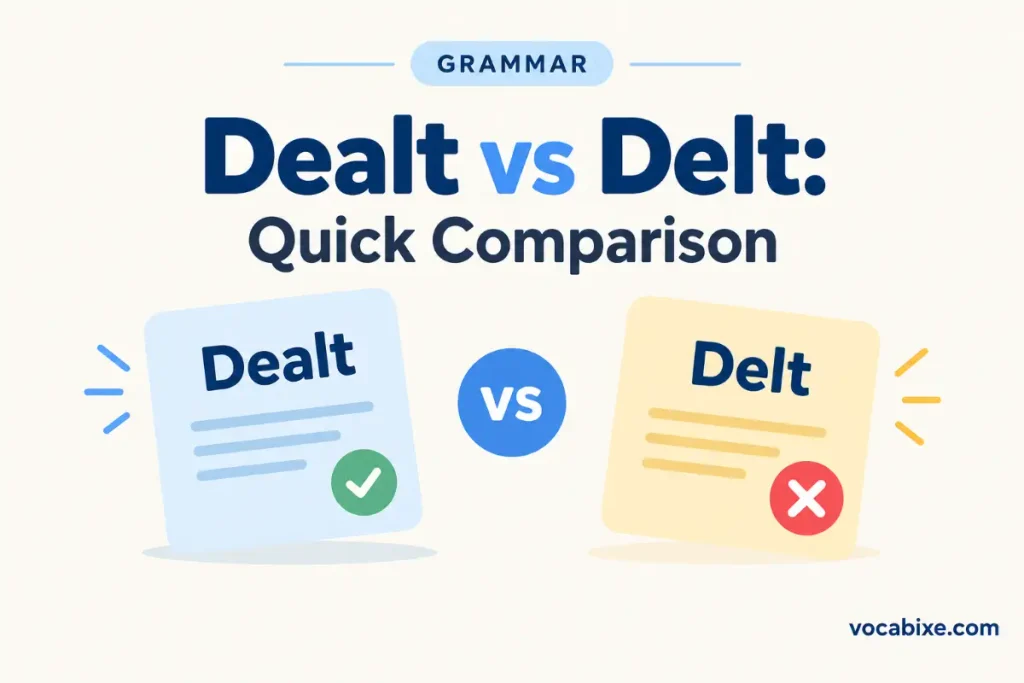
| Feature | Dealt | Delt |
|---|---|---|
| Standard past tense of deal | Yes | No |
| Standard past participle of deal | Yes | No |
| Used in formal writing | Yes | Not for the past form of deal |
| Pronunciation | /delt/ | Can be pronounced /delt/ in other uses |
| Meaning | Past form of deal | Usually a misspelling in this context |
| Example | She dealt with it. | She delt with it. |
| Correct choice for deal | Yes | No |
The comparison becomes simple when you focus on the verb.
deal → dealt
That is the form to remember.
Section 2: How to Use Dealt Correctly
How Do You Use Dealt in a Sentence?
Use dealt when you need the past tense or past participle of deal.
Here are examples from everyday situations.
- At school:
The teacher dealt with the student’s question.
2. At work:
The manager dealt with the complaint.
3. At home:
We dealt with the broken pipe yesterday.
4. In a card game:
Jake dealt the cards to everyone.
5. In business:
The company dealt with several suppliers last year.
With a difficult situation:
She dealt with the situation calmly.
Each sentence uses dealt because the action is connected to the past form of deal.
Correct and Incorrect Examples
Seeing the two forms side by side makes the difference easier to remember.
Correct:
I dealt with the problem.
Incorrect:
I delt with the problem.
Correct:
She dealt the cards.
Incorrect:
She delt the cards.
Correct:
They have dealt with this issue before.
Incorrect:
They have delt with this issue before.
Correct:
He dealt with the customer politely.
Incorrect:
He delt with the customer politely.
The incorrect form often looks believable because it follows the pronunciation. Still, standard English spelling uses dealt.
Why Dealt Sounds Like Delt
The pronunciation is one of the biggest reasons for this spelling confusion.
Cambridge lists the US and UK pronunciation of dealt as /delt/.
That means the ea in the spelling does not sound like the long vowel in words such as eat or team.
Compare:
- deal
- dealt
The base form deal has a different vowel sound from the past form dealt.
This is another reason English learners may find the word confusing. The spelling contains ea, but the pronunciation does not make that spelling obvious.
The safest approach is not to spell the word from its sound. Remember the written verb pattern:
deal → dealt
Dealt in American English
American English uses dealt as the standard past tense and past participle of deal.
Examples include:
- I dealt with the issue.
- She dealt the cards.
- They have dealt with similar problems.
- The company dealt with the complaint.
There is no standard American spelling change from dealt to delt.
Dictionary.com also lists dealt as the American simple past and past participle of deal and gives the pronunciation as /delt/.
Dealt in British English
British English also uses dealt.
Examples:
- We dealt with the problem.
- She dealt the cards.
- He has dealt with this before.
The spelling does not change between standard American and British English.
This makes the word easier than some other British-American spelling pairs.
For example:
- color / colour
- center / centre
have spelling differences between common American and British usage.
But:
- dealt / dealt
does not.
Both varieties use dealt.
Is Dealt a British or American Word?
Dealt is used in both American and British English.
It is not a spelling that belongs only to one region. Major dictionaries give the same standard form for both varieties.
So whether your audience is in the United States, United Kingdom, Canada, Australia, or another English-speaking region, dealt is the standard spelling for the past form of deal.
Dealt vs Dealed
Another mistake worth learning is dealed.
Some English learners may think that because many verbs form their past tense by adding -ed, the past tense of deal should be dealed.
It is not.
The correct form is:
deal → dealt
Not:
deal → dealed
For example:
Correct:
We dealt with the issue yesterday.
Incorrect:
We dealed with the issue yesterday.
This happens because deal is an irregular verb.
You cannot always create the correct past tense of an irregular verb by adding -ed.
Compare:
- go → went
- take → took
- see → saw
- deal → dealt
Learning the complete verb form is often easier than trying to create it from a general spelling rule.
A Simple Memory Trick
If you often confuse dealt and delt, use this short memory rule:
Deal has an A. Dealt keeps the A.
Think:
deal → dealt
The a stays in the spelling.
You can also connect it with another common irregular verb:
feel → felt
deal → dealt
Both verbs change their form in the past, but dealt keeps the a.
Another useful trick is to remember the phrase:
“I dealt with it.”
If you can remember that phrase, you can often recall the spelling of the word automatically.
Common Mistakes With Dealt
Here are some mistakes to watch for.
Mistake 1: Writing delt
I delt with the problem.
Correct:
I dealt with the problem.
Mistake 2: Writing dealed
She dealed with the customer.
Correct:
She dealt with the customer.
Mistake 3: Using deal in a past sentence
Yesterday, I deal with the issue.
Correct:
Yesterday, I dealt with the issue.
Mistake 4: Using delt after has
He has delt with this before.
Correct:
He has dealt with this before.
Mistake 5: Confusing pronunciation with spelling
A writer hears /delt/ and assumes the spelling must be delt.
Correct spelling:
dealt
The pronunciation does not change the standard spelling.
Dealt in Everyday Expressions
You will often see dealt in common phrases.
Dealt with a problem
She dealt with the problem quickly.
With a complaint
The manager dealt with the complaint.
Dealt with stress
He dealt with stress by taking a walk.
The cards
She dealt the cards to the players.
Dealt a blow
The loss dealt a serious blow to the team.
These expressions show how flexible the verb can be.
Dealt a Blow: What Does It Mean?
The expression dealt a blow means that someone or something caused a strong setback, disappointment, or harmful effect.
For example:
The unexpected loss dealt a blow to the team.
This does not mean that someone physically handed over a blow like a package. It is an established expression.
Another example is:
The news dealt a major blow to their plans.
The phrase is common in news writing and everyday English.
Dealt With Emotions
You may also hear people say that they dealt with emotions, stress, fear, or disappointment.
For example:
She dealt with her fear by talking to a friend.
Here, dealt with means managed or handled.
The same pattern works with many nouns:
- dealt with stress
- dealt with anger
- dealt with fear
- dealt with pressure
- dealt with disappointment
- dealt with a difficult situation
The phrase does not mean that the person necessarily solved the problem perfectly. It simply says that the person handled or responded to it.
Dealt With vs Handled
In many situations, dealt with and handled can have similar meanings.
For example:
The manager dealt with the complaint.
and:
The manager handled the complaint.
Both can mean that the manager took care of the issue.
However, the exact meaning depends on context. Dealt with is a broad phrase. It can mean addressed, managed, responded to, or took action regarding something.
Dealt vs Handed
The words can sometimes appear in similar contexts, but they are not always interchangeable.
Handed usually focuses on physically giving something to another person.
She handed me the book.
Dealt can mean distributing something according to a system or process.
She dealt the cards.
You would not normally replace dealt the cards with handed the cards if you are specifically describing the action of a dealer in a card game.
Understanding the context helps you choose the right verb.
Dealt vs Distributed
Distributed and dealt can overlap when something is being given to several people.
For example:
The teacher distributed the worksheets.
But:
The dealer dealt the cards.
Dealt is especially natural with cards and certain fixed expressions.
The words are related in meaning but are not always interchangeable.
Is “Delt” Ever Correct in a Sentence?
If you mean the past tense of deal, no. Use dealt.
However, delt can appear as a different noun in informal fitness language, where it is a shortened form related to deltoid. Wiktionary records this use.
For example:
He worked on his delts at the gym.
That is a completely different use from:
He dealt with the problem.
Therefore, do not assume every appearance of delt is automatically a spelling error. Context determines what word the writer means.
For normal writing about the past tense of deal, however, the correct spelling is dealt.
How to Remember Dealt Forever
Use this three-step method.
Step 1: Find the base verb.
Ask yourself:
Is the word connected to deal?
If yes, continue.
Step 2: Check the tense.
If the action happened in the past, use:
dealt
Step 3: Keep the A.
Remember:
deal → dealt
Do not remove the a just because you hear the word as /delt/.
A quick mental check can save you from the mistake:
“I dealt with it.”
If that sounds like the sentence you want, spell the word with ea.
Quick Rules to Remember
Keep these rules handy:
- Deal is the present or base form.
- Dealt is the simple past form.
- Dealt is also the past participle.
- Delt is not the standard modern past form of deal.
- Dealt with commonly means handled or managed.
- Dealt can also mean distributed, especially cards.
- American and British English both use dealt.
- The pronunciation of dealt is /delt/.
- Do not write dealed as the standard past tense.
- Do not spell the word only by listening to its sound.
Examples You Can Copy
Here are several natural examples:
- I dealt with the problem yesterday.
- She dealt with the customer politely.
- We dealt with the issue before the meeting.
- He has dealt with similar problems before.
- The dealer dealt five cards to each player.
- She dealt the cards face down.
- They dealt fairly with their customers.
- The company dealt with the complaint quickly.
- He dealt with the pressure calmly.
- The unexpected news dealt a blow to their plans.
- I had already dealt with the problem.
- The teacher dealt with the question during class.
In every example where the word comes from the verb deal, the correct past form is dealt.
FAQs
Is dealt or delt correct?
Dealt is correct when you mean the past tense or past participle of deal. Delt is not the standard modern spelling for this verb form.
What is the past tense of deal?
The past tense of deal is dealt.
Example: “She dealt with the problem yesterday.”
What is the past participle of deal?
The past participle is also dealt.
Example: “They have dealt with this issue before.”
Why is dealt pronounced like delt?
The standard pronunciation of dealt is /delt/ in both American and British English. The spelling contains ea, but those letters do not produce a separate “a” sound in this word.
Is delt a real English word?
It can appear as a different word. In informal fitness language, delt can refer to a deltoid muscle. It has also appeared historically as a spelling of dealt. However, delt is not the standard modern past tense of deal.
Is dealed correct?
No. The standard past tense and past participle of deal are dealt, not dealed.
Is dealt used in American English?
Yes. Dealt is standard in American English. British English also uses dealt, so there is no spelling difference between these varieties for this verb form.
What does dealt with mean?
Dealt with usually means handled, managed, addressed, or responded to something.
Example: “The manager dealt with the complaint quickly.”
Other Related Articles
Conclusion
When choosing between dealt or delt, use dealt when you mean the past tense or past participle of deal. The correct verb pattern is simple:
deal → dealt → dealt
The word can mean handled something, distributed something, did business with someone, or caused a particular effect, depending on the sentence.
The spelling delt is easy to understand as a mistake because dealt is pronounced /delt/ in standard American and British English. Still, pronunciation does not change the standard spelling.
Remember one simple rule: deal keeps its “a” when it becomes dealt.
So write:
I dealt with the problem.
Not:
I delt with the problem.
Once you remember deal → dealt, this common spelling question becomes much easier.
Pingback: Problem Synonym: 30+ Synonyms With Examples - Vocabixe
Pingback: Humorous vs Humerous: 2026 Guide - Vocabixe