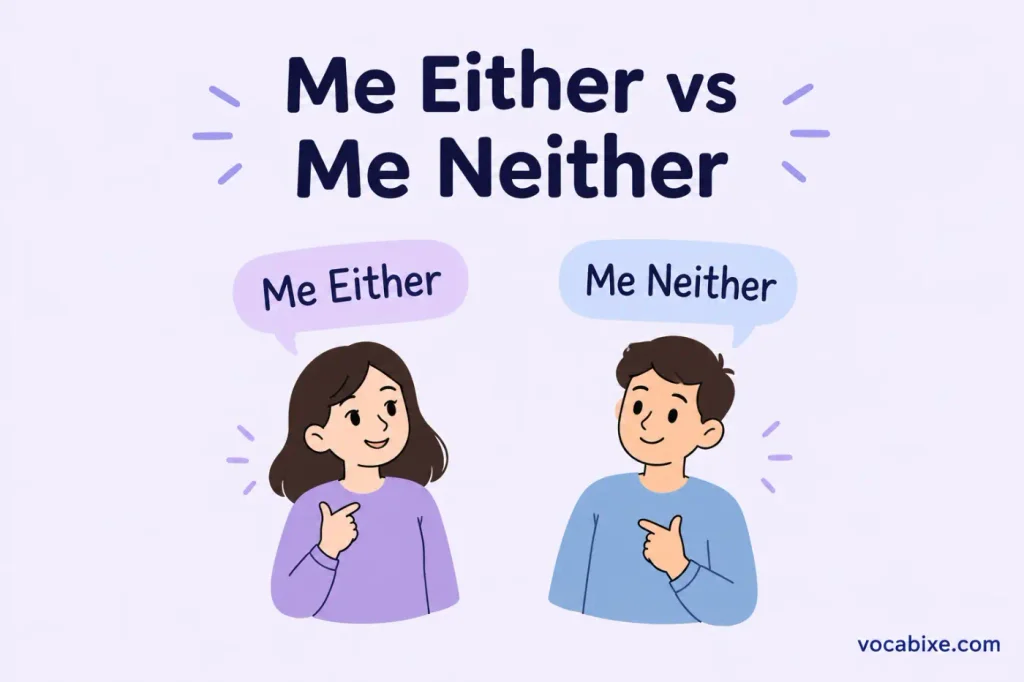
“Me either” and “me neither” are both used in everyday English, but they do not work in exactly the same way in every sentence. Me neither is the more widely accepted choice when you want to agree with a negative statement. For example, if someone says, “I don’t like cold coffee,” you can reply, “Me neither.” The phrase means that you also do not like cold coffee.
“Me either” is also used by some English speakers, especially in casual American conversation, but it is less widely accepted as a stand-alone response. In standard English, “me either” most often appears in negative sentences such as “I don’t like it either.” Understanding this small difference will help you sound more natural in conversations, texts, and everyday writing.
Section 1: Understanding Me Either and Me Neither
What Is the Quick Answer: Me Either or Me Neither?
Use “me neither” to agree with a negative statement. For example, if someone says, “I can’t swim,” you can reply, “Me neither.” This means that you cannot swim either.
The phrase “me either” also appears in casual speech, especially in some American English conversations. However, “me neither” is generally the safer and more widely accepted choice when it stands alone as a response to a negative statement.
Here is the simple rule:
- Positive statement: “I love pizza.” You can reply, “Me too.”
- Negative statement: “I don’t like pizza.” You can reply, “Me neither.”
- Negative sentence with either: “I don’t like pizza either.”
- More formal response: “Neither do I.”
Examples:
- “I haven’t seen that movie.” “Me neither.”
- “I don’t understand this question.” “Me neither.”
- “I can’t come tomorrow.” “Neither can I.”
- “I don’t enjoy horror films either.”
Remember that the best response depends on the sentence you are answering. The main goal is to agree with the other person’s negative meaning.
What Does Me Neither Mean?
“Me neither” is a common conversational expression used to agree with a negative statement. It tells another person that the same situation, feeling, or experience applies to you.
For example:
Person A: “I don’t like getting up early.”
Person B: “Me neither.”
Person B means, “I don’t like getting up early either.”
The phrase can be used in many everyday situations. You might use it when discussing food, school, work, hobbies, feelings, or plans.
More examples include:
- “I haven’t finished my homework.” “Me neither.”
- “I don’t want to go outside.” “Me neither.”
- “I can’t remember his name.” “Me neither.”
- “I have never visited London.” “Me neither.”
- “I wasn’t ready for the test.” “Me neither.”
In each example, the second speaker agrees with the negative meaning of the first statement.
Although “me neither” is common in informal conversation, it is a shortened response. In more formal writing, you may prefer a complete sentence such as “Neither have I,” “Neither can I,” or “I haven’t either,” depending on the original statement.
What Does Me Either Mean?
“Me either” is an expression used by some speakers to agree with a negative statement. It is particularly heard in casual American English conversation.
For example:
Person A: “I don’t want any more food.”
Person B: “Me either.”
The intended meaning is clear: Person B also does not want more food. However, many speakers prefer “Me neither” in this situation, and some consider the stand-alone expression “me either” nonstandard.
The word “either” is fully correct in negative sentences. For example:
- I don’t want any more food either.
- I can’t find my phone either.
- I haven’t finished the book either.
- She doesn’t know the answer, and I don’t either.
These sentences are standard English. The concern is not the word either itself. It is the use of “me either” as a short, stand-alone response.
If you want to avoid confusion, use “me neither” for a short response to a negative statement and use “either” in a complete negative sentence. Last article Dreamed or Dreamt.
What Is the Difference Between Me Either and Me Neither?
The main difference is how widely accepted the expressions are as short responses to negative statements.
“Me neither” is a common, natural response in both American and British English. “Me either” is also used in some casual conversations, particularly in American English, but it is less widely accepted in this role.
Compare these examples:
| Situation | Example | Explanation |
|---|---|---|
| Agreeing with a negative statement | “I don’t like coffee.” “Me neither.” | The second person also dislikes coffee. |
| Using either in a full negative sentence | “I don’t like coffee either.” | The speaker also dislikes coffee. |
| Using a formal response | “Neither do I.” | The speaker agrees with the negative statement. |
| Using a casual regional expression | “I don’t like coffee.” “Me either.” | Some speakers use it, but others prefer “me neither.” |
The expressions are often intended to communicate the same message, but they do not have the same level of acceptance in all contexts.
If you are learning English, preparing an exam answer, or writing for a broad audience, “me neither” is usually the better stand-alone choice.
Is Me Neither Grammatically Correct?
Yes. “Me neither” is a widely accepted conversational expression.
It is not a complete sentence in the traditional sense because it leaves out words that can be understood from the previous statement. In everyday conversation, however, short responses like this are normal.
Consider this example:
Person A: “I don’t watch television very often.”
Person B: “Me neither.”
The full meaning of Person B’s response is “I don’t watch television very often either.”
You do not need to repeat the entire sentence because the other person has already provided the context.
Other common short responses include:
- “Me too.”
- “Me neither.”
- “Not me.”
- “Same here.”
- “Neither do I.”
Some of these expressions are more suitable for formal writing than others. “Neither do I” follows a standard grammatical pattern and is useful when you want a complete, clearly structured response.
For everyday conversation, “me neither” is natural and easy to understand.
Is Me Either Grammatically Correct?
The answer depends on how you use it.
In a full negative sentence, either is correct:
- I don’t like the movie either.
- I haven’t eaten lunch either.
- I can’t hear the music either.
These are standard English sentences.
As a stand-alone response, “me either” is used by some speakers, particularly in informal American English. However, it is not as widely accepted as “me neither,” and some teachers, editors, and speakers may regard it as nonstandard.
For example:
Person A: “I haven’t seen that show.”
Person B: “Me neither.”
This is a broadly accepted response. Replacing it with “Me either” may sound natural to some speakers but unusual to others.
When writing an essay, business email, school assignment, or formal message, choose a complete response such as “Neither have I” or “I haven’t either.”
Why Do People Say Me Either Instead of Me Neither?
People sometimes use “me either” because it follows a pattern they hear in everyday speech. Informal English varies from person to person and from region to region, so an expression may be common in conversation even when other speakers prefer a different form.
Another reason is that both either and neither are linked to negative meaning. For example, “I don’t like it either” and “I don’t like it, neither” may both be heard in casual speech, although the second form is not standard in many varieties of English.
People may also shorten a full sentence when responding quickly. Instead of saying “I don’t like it either,” a speaker may simply say “Me either.”
This does not mean that every speaker considers the short form correct. Language habits differ, and people do not always follow the same rules in conversation that they follow in formal writing.
For learners, the most useful approach is to understand what people mean while choosing widely accepted forms in your own speech and writing.
Is Me Either or Me Neither More Common in American English?
“Me neither” is a widely understood response in American English, while “me either” is also heard in informal American speech.
The choice can vary by speaker, region, and personal habit. It is therefore too simple to say that all Americans use one form and never use the other.
For example, an American speaker might say:
“I don’t want to watch that movie.”
“Me neither.”
Another speaker may respond:
“I don’t want to watch that movie either.”
Both responses communicate the same basic meaning.
You may also hear “Me either” in casual conversations or text messages. However, if you are unsure which form to choose, “me neither” is the safer option when responding to a negative statement.
For formal American English, complete constructions such as “Neither do I” or “I don’t either” are often better choices.
Is Me Neither or Me Either More Common in British English?
“Me neither” is a familiar response in British English. It is also widely understood in other varieties of English.
“Me either” may be understood by British speakers, but it is less likely to be the preferred stand-alone form in standard usage. Many British English speakers would naturally say “Me neither” or use a complete response such as “Neither have I.”
For example:
Person A: “I haven’t been to Scotland.”
Person B: “Me neither.”
This sounds natural in everyday British English.
You could also say:
“Neither have I.”
Both responses agree with the negative statement.
The word either remains correct in British English when used in a suitable sentence, such as “I haven’t been to Scotland either.” The regional difference mainly concerns the short expression “me either,” not the general use of either.
Section 2: Grammar Rules, Examples, and Common Mistakes
When Should You Use Me Neither?
Use “me neither” when someone makes a negative statement and you want to say that the same thing is true for you.
It works in everyday conversations and is especially useful when you want to agree quickly without repeating the full sentence.
Use me neither when:
- You agree with a statement containing “not.”
- Someone says they cannot do something that you also cannot do.
- Someone describes an experience you have not had.
- Someone shares a dislike that you also have.
- You want a short, natural response in casual conversation.
Examples:
Talking about food
Person A: “I don’t like mushrooms.”
Person B: “Me neither.”
Talking about school
Person A: “I haven’t finished my assignment.”
Person B: “Me neither.”
Talking about abilities
Person A: “I can’t drive.”
Person B: “Me neither.”
Talking about experiences
Person A: “I’ve never been on a plane.”
Person B: “Me neither.”
The phrase is flexible because it can agree with many different negative statements. The meaning of the original sentence tells the listener what you also do not like, have not done, or cannot do.
When Should You Use Either in a Negative Sentence?
Use either at the end of a negative sentence when you want to say that something is also true for you or another person.
This is one of the clearest and most useful rules for English learners.
Examples:
- I don’t like spicy food either.
- She hasn’t called me either.
- We can’t attend the meeting either.
- He doesn’t understand the question either.
- They haven’t arrived yet either.
In these sentences, either means that the negative situation applies to another person or situation as well.
Compare the following examples:
Person A: “I don’t like spicy food.”
Person B: “Me neither.”
Person B: “I don’t like spicy food either.”
All three responses communicate agreement with the negative statement. The first is a short conversational response, while the third is a complete sentence.
You should not think of either as a word that is wrong whenever a sentence is negative. It is correct in negative sentences and is a useful part of standard English grammar.
What Is the Difference Between Me Neither and Neither Do I?
Both expressions agree with a negative statement, but they have different sentence structures.
“Me neither” is a short conversational response. “Neither do I” is a complete response that uses an auxiliary verb.
For example:
Person A: “I don’t play tennis.”
Person B: “Me neither.”
Person B could also say, “Neither do I.”
Both mean that Person B does not play tennis.
The helping verb in the second response depends on the first statement.
| Original statement | Short response | Complete response |
|---|---|---|
| I don’t like tea. | Me neither. | Neither do I. |
| I can’t swim. | Me neither. | Neither can I. |
| I haven’t eaten. | Me neither. | Neither have I. |
| I wasn’t ready. | Me neither. | Neither was I. |
| I won’t attend. | Me neither. | Neither will I. |
Notice how the complete response changes according to the original verb. You should not use “Neither do I” for every negative sentence.
For example, if someone says, “I haven’t finished,” the matching response is “Neither have I,” not “Neither do I.”
This is a useful rule for exams and formal writing because it shows that you understand how auxiliary verbs work.
What Is the Difference Between Me Too and Me Neither?
“Me too” agrees with a positive statement, while “me neither” agrees with a negative statement.
For example:
Person A: “I love reading.”
Person B: “Me too.”
Both people enjoy reading.
Now consider a negative statement:
Person A: “I don’t like reading on my phone.”
Person B: “Me neither.”
Both people dislike reading on their phones.
Here is another comparison:
- “I am excited.” → “Me too.”
- “I am not excited.” → “Me neither.”
- “I have finished.” → “Me too” may fit when agreeing with the positive experience.
- “I haven’t finished.” → “Me neither.”
The response must match the meaning of the original statement.
A common mistake is to use “me too” after a negative statement without considering what it means. If someone says, “I don’t want to leave,” replying “Me too” can sound unclear or may suggest agreement with the wrong idea.
When the original statement is negative, “me neither” is usually the clearer choice.
Can You Say I Don’t Either Instead of Me Neither?
Yes. “I don’t either” is a correct way to agree with a negative statement when the original sentence uses “don’t.”
For example:
Person A: “I don’t watch football.”
Person B: “I don’t either.”
The response means that Person B also does not watch football.
However, the helping verb must fit the original sentence.
Examples:
- “I don’t eat meat.” → “I don’t either.”
- “I can’t swim.” → “I can’t either.”
- “I haven’t finished.” → “I haven’t either.”
- “I won’t go.” → “I won’t either.”
- “I wasn’t invited.” → “I wasn’t either.”
These responses are complete sentences or shortened clauses with the subject understood from context.
You can also use “me neither” in each situation. It is shorter and works naturally as a conversational reply.
Remember that “I don’t either” is not a universal replacement for every negative statement. Match the verb to the sentence you are answering.
Can You Say Me Neither After Every Negative Sentence?
In many everyday conversations, yes. “Me neither” can respond to a wide range of negative statements when you want to say that the same situation applies to you.
Examples:
- “I don’t eat fish.” “Me neither.”
- “I haven’t seen the new film.” “Me neither.”
- “I can’t solve this puzzle.” “Me neither.”
- “I wasn’t at school yesterday.” “Me neither.”
However, you should check that you genuinely agree with the meaning of the statement.
For example, if someone says, “I don’t think this plan will work,” responding with “Me neither” means you also do not think the plan will work.
If you actually believe the plan will succeed, you should not use “me neither.” You could instead say, “I think it will work.”
Also, if a negative statement describes a fact that does not apply to you, choose a different response. The phrase is for agreement, not simply for answering any sentence that contains a negative word.
Is It Correct to Say Me Neither, Too?
“Me neither, too” is generally unnecessary and sounds unnatural in standard English.
The reason is simple: “me neither” already communicates that you also share the negative situation. Adding “too” repeats the idea of agreement.
For example:
Less natural: “I don’t like this song.” “Me neither, too.”
Natural: “I don’t like this song.” “Me neither.”
You could also say:
“I don’t like this song either.”
Or:
“Neither do I.”
All three natural options express agreement with the negative statement.
A similar rule applies to “me too, also.” In most ordinary contexts, “me too” already expresses the idea of “also,” so adding both can be unnecessary.
Keeping your response short makes your English sound clearer and more natural. Related article Combatting or Combating.
What Are the Most Common Mistakes With Me Either and Me Neither?
Learners often confuse the two phrases because both can appear in conversations about negative situations. The following mistakes are worth avoiding.
Mistake 1: Using me either in formal writing
Some speakers use “me either” in casual conversation, but it may be marked as nonstandard by teachers or editors.
Better choice: “Me neither.”
Mistake 2: Thinking either is always incorrect in a negative sentence
Incorrect belief: “You can never use either with not.”
Correct rule: “I don’t like it either” is standard English.
Mistake 3: Using me too to agree with a negative statement
Person A: “I can’t swim.”
Unclear response: “Me too.”
Better response: “Me neither.”
Mistake 4: Using the wrong helping verb
Person A: “I haven’t eaten.”
Incorrect: “Neither do I.”
Correct: “Neither have I.”
The auxiliary verb should match the grammar of the original statement.
Mistake 5: Adding unnecessary words
Less natural: “Me neither, too.”
Better: “Me neither.”
Mistake 6: Assuming regional usage is identical
Some speakers use “me either” naturally, while others prefer “me neither.” Knowing this difference helps you understand real conversations without assuming that every speaker follows the same habits.
The safest approach is to use “me neither” as a short response to negative statements and use either in complete negative sentences.
How Do You Use Me Either and Me Neither in Text Messages?
Text messages are usually informal, so people often use short expressions instead of full sentences.
“Me neither” is a natural choice when agreeing with a negative message.
For example:
Friend: “I don’t feel like going out tonight.”
You: “Me neither.”
Friend: “I haven’t started the homework.”
You: “Me neither.”
Friend: “I can’t stop thinking about that song.”
You: “Me neither” would mean you also cannot stop thinking about it only if the intended statement is negative in meaning. In this case, however, the sentence is grammatically positive despite containing “can’t,” so “me neither” still works because the statement expresses inability to stop.
For a complete response, you could write, “I can’t stop thinking about it either.”
Some people may text “me either,” especially in casual American conversations. The meaning is usually understood, but “me neither” is the more widely accepted choice.
When texting friends, either form may be understood depending on the people involved. For schoolwork, professional messages, or writing intended for a broad audience, choose a more widely accepted form.
How Can You Remember When to Use Me Either or Me Neither?
A simple way to remember the difference is to connect “neither” with a negative response.
When someone says something negative and you agree, think:
“Negative statement → Me neither.”
For example:
“I don’t like rain.” → “Me neither.”
“I haven’t finished.” → “Me neither.”
“I can’t drive.” → “Me neither.”
Then remember that either is commonly used at the end of a negative sentence:
“I don’t like rain either.”
“I haven’t finished either.”
“I can’t drive either.”
This rule will help you in most everyday situations.
You can also remember the positive version:
“I like rain.” → “Me too.”
“I have finished.” → “Me too.”
“I can drive.” → “Me too.”
The important part is to match your response to the meaning of the statement. Once you practice with a few examples, choosing the natural expression becomes much easier.
FAQs
Is me either or me neither correct?
Both are used in conversation, but “me neither” is the more widely accepted stand-alone response to a negative statement. “Me either” is heard in some informal American English speech.
Can I say me either in American English?
Yes, some American English speakers use “me either” casually. However, “me neither” is generally the safer choice for standard usage.
Is me neither formal or informal?
“Me neither” is mainly conversational and informal. In formal writing, “Neither do I” or “I haven’t either” may be more suitable.
Can I use either in a negative sentence?
Yes. For example, “I don’t like coffee either” is standard English. Either is commonly used at the end of negative sentences.
What is the difference between me neither and neither do I?
“Me neither” is a short conversational response. “Neither do I” is a complete response, and the helping verb may change to match the original sentence.
Should I say me neither or me too?
Use “me neither” to agree with a negative statement and “me too” to agree with a positive statement. For example, “I don’t like tea” → “Me neither.”
Is me neither correct in British English?
Yes. “Me neither” is a familiar and natural expression in British English, as well as in American English and other varieties.
Can I write me neither in an essay?
You can use it in dialogue or informal writing. In a formal essay, a complete response such as “Neither do I” or “I haven’t either” may be a better choice.
Conclusion
When choosing between me either and me neither, the safest rule is to use me neither as a short response to a negative statement. It is widely accepted in American and British English and works in everyday conversations, text messages, and informal writing.
The word either is also correct in negative sentences, such as “I don’t like coffee either.” The main difference is that “me either” as a stand-alone reply is less widely accepted, although some speakers use it in casual conversation.
For clear and natural English, match your response to the original statement. Use “me too” for positive agreement, “me neither” for negative agreement, and complete forms such as “Neither do I” when a more formal response is needed.