Section 1: Paucity Meaning and Definition
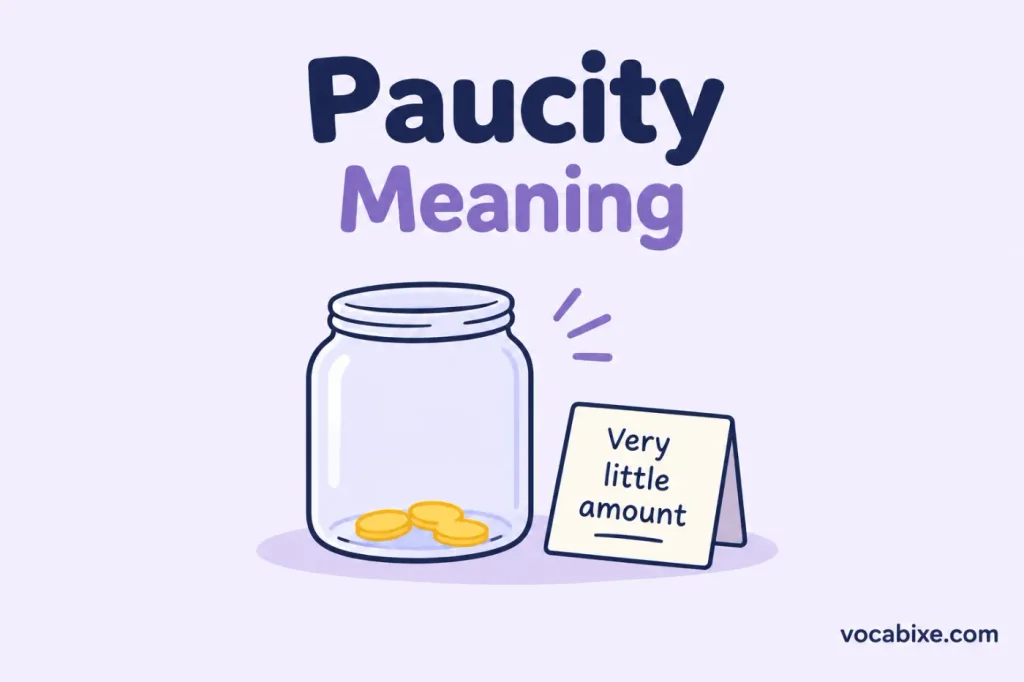
If you are wondering about the word “paucity,” it means a small amount or an insufficient amount of something. In simple words, paucity describes a situation where there is not enough of something that is needed or expected. It is usually used for things that can be counted or measured, such as money, resources, workers, information, opportunities, or supplies.
For example, if a town has very few doctors, you could say, “The town suffers from a paucity of doctors.” This means the town does not have enough doctors to meet its needs.
The word is more formal than everyday expressions such as “lack,” “shortage,” or “not enough.” You are more likely to see it in news reports, academic writing, business discussions, research, and formal conversations. Still, it can be useful in everyday English when you want to describe a clear shortage.
Quick Answer: What Does Paucity Mean?
Paucity means a small amount or a lack of enough of something. It often describes a shortage of something that is needed or expected.
Example: “The project was delayed because of a paucity of funds.”
In this sentence, paucity of funds means there was not enough money to complete the project.
What Is the Simple Definition of Paucity?
A simple definition of paucity is “a very small amount of something” or “a shortage of something.”
The word focuses on the idea of having less than enough. It does not always mean that something is completely absent. There may be some of it, but the amount is too small.
Consider these examples:
- A paucity of food means there is very little food available.
- A paucity of workers means there are too few workers.
- A paucity of evidence means there is not enough evidence.
- A paucity of information means there is too little information.
- A paucity of opportunities means there are very few opportunities.
The exact meaning depends on the noun that follows it.
Is Paucity Positive or Negative?
Paucity usually has a negative meaning because it points to a shortage or an amount that is smaller than needed.
For example:
“The hospital faced a paucity of nurses.”
This suggests that the hospital needed more nurses.
However, the word itself does not always describe something harmful. It simply tells us that there is a small amount. The surrounding sentence gives us the full meaning.
For example:
“The paucity of decorations made the room look simple.”
Here, the small number of decorations may not be a serious problem. The writer is simply describing the room.
What Does Paucity Mean in a Sentence?
In a sentence, paucity usually means “not enough” or “a small amount.”
For example:
“The school has a paucity of computers.”
This means the school has too few computers.
Another example is:
“The researcher complained about the paucity of reliable data.”
This means the researcher did not have enough reliable data.
A useful pattern to remember is:
“paucity of + noun”
Examples include:
- paucity of money
- paucity of resources
- paucity of evidence
- paucity of information
- paucity of jobs
- paucity of teachers
- paucity of food
- paucity of opportunities
This pattern is very common in formal English. Recent article which is related Mark My Words Meaning.
Is Paucity a Noun?
Yes. Paucity is a noun.
It names the condition of having a small or insufficient amount of something.
For example:
“The paucity of water became a serious concern.”
Here, paucity is the noun. It refers to the shortage of water.
Because it is a noun, it can appear after words such as “a,” “the,” “this,” or “the growing.”
Examples:
- a paucity of evidence
- the paucity of evidence
- this paucity of evidence
- the growing paucity of resources
The word is not normally used as a verb or adjective.
How Do You Pronounce Paucity?
Paucity has three syllables. The main stress falls on the first syllable.
The pronunciation is commonly represented as:
/ˈpɔːsəti/
The exact vowel sound can vary slightly between accents, especially between American and British English. The spelling may look unusual at first, but the pronunciation becomes easier with practice.
A common mistake is trying to pronounce every letter exactly as it appears. English spelling does not always give a perfect guide to pronunciation.
What Is the Correct Spelling of Paucity?
The correct spelling is:
P-A-U-C-I-T-Y
Paucity is sometimes misspelled because the beginning “pauc-” is not common in everyday English.
Common incorrect forms may include:
- paucety
- pausity
- paucitty
- paucityy
The correct form is “paucity.”
One useful way to remember it is to connect it with the word “paucous,” which comes from the same Latin family and relates to being few or small in number.
Where Does the Word Paucity Come From?
Paucity comes from Latin “paucitas,” meaning “fewness” or “smallness in number.” It is connected with the Latin word “paucus,” meaning “few” or “little.”
The word entered English through French and developed into the modern English noun “paucity.”
Its history explains why the word has a strong connection with the idea of having too little or too few.
Although its origin is old, the word is still used in modern English, especially in formal writing.
When Should You Use Paucity?
Use paucity when you want to describe a small or insufficient amount of something.
It works especially well when the thing being discussed is important or expected in a certain quantity.
For example:
“The paucity of affordable housing has affected many families.”
The sentence means there are too few affordable homes.
You can also use it in professional writing:
“The company faced a paucity of skilled workers.”
This means the company could not find enough workers with the skills it needed.
In casual conversation, however, most people would probably say:
“There aren’t enough skilled workers.”
Both sentences communicate a similar idea, but “paucity” sounds more formal.
Is Paucity the Same as Lack?
Paucity and lack are closely related, but they are not always identical.
A lack means that something is missing or not available in the needed amount. Paucity usually emphasizes a very small amount or a shortage.
Compare:
“There is a lack of clean water.”
“There is a paucity of clean water.”
Both sentences say that clean water is insufficient. The second sentence sounds more formal and emphasizes the small supply.
The word “lack” is much more common in everyday English. “Paucity” is more formal and often appears in written language.
Is Paucity the Same as Shortage?
Paucity and shortage can often be used in similar situations.
A shortage usually means there is less of something than is needed or wanted. Paucity means a small or insufficient amount.
For example:
“The country experienced a shortage of fuel.”
“The country experienced a paucity of fuel.”
Both sentences describe limited fuel supplies. However, “shortage” sounds more natural in everyday speech, while “paucity” has a more formal tone.
You should choose the word based on your audience. If you are writing a simple message, “shortage” may be clearer. If you are writing a formal report, “paucity” may fit better.
Can Paucity Mean “Few”?
Yes, but there is an important difference.
Paucity describes the condition of having very few or too little of something. The word “few” directly describes a small number.
For example:
“There were few volunteers.”
This directly tells us that the number of volunteers was small.
“There was a paucity of volunteers.”
This describes the shortage of volunteers in a more formal way.
Both can communicate a similar idea, but their grammar is different.
Can You Say “Paucity of People”?
Yes, you can say “a paucity of people” when you mean that there are too few people for a particular purpose.
For example:
“The event suffered from a paucity of people.”
This means very few people attended.
However, depending on the situation, a more natural phrase might be “a lack of people,” “few people,” or “low attendance.”
The phrase “paucity of people” is grammatically possible, but it can sound formal.
What Nouns Commonly Follow Paucity?
Paucity can be followed by many nouns. The most natural choices are usually things that can exist in different amounts.
Common examples include:
- paucity of resources
- paucity of information
- paucity of evidence
- paucity of funds
- paucity of opportunities
- paucity of jobs
- paucity of workers
- paucity of food
- paucity of water
- paucity of research
- paucity of choices
- paucity of supplies
- paucity of data
- paucity of ideas
- paucity of support
The phrase “paucity of” is especially common because paucity itself refers to a small amount.
Section 2: Paucity Usage, Examples, Synonyms, and Common Mistakes
How Do You Use Paucity in Everyday English?
Paucity is not one of the most common words in casual conversation. Native speakers often choose simpler words such as “lack,” “shortage,” “few,” or “not enough.”
Still, understanding paucity is useful because you may see it in articles, reports, books, research papers, or formal discussions.
For example, a newspaper might write:
“The region is facing a paucity of clean drinking water.”
A person speaking casually might say:
“There isn’t enough clean drinking water in the region.”
The meaning is almost the same. The difference is mainly style and formality.
Paucity Examples in Simple Sentences
Here are several examples to make the meaning clear:
- “The village has a paucity of clean water.”
- “The school faces a paucity of teachers.”
- “There is a paucity of information about the new product.”
- “The project failed because of a paucity of funds.”
- “The doctor noted a paucity of available beds.”
- “The library has a paucity of books on the subject.”
- “The report shows a paucity of reliable evidence.”
- “The town has a paucity of public transportation.”
- “The team struggled because of a paucity of skilled players.”
- “The researcher found a paucity of recent studies.”
Paucity Examples in Formal Writing
Paucity is especially useful in formal writing.
For example:
“The study was limited by a paucity of reliable data.”
This sentence sounds suitable for a research paper because the word gives the sentence a formal tone.
Another example:
“The region continues to experience a paucity of medical services.”
This could appear in a report about public services.
A business report might say:
“The company faces a paucity of experienced employees.”
The meaning is that there are not enough experienced employees.
What Are the Best Synonyms for Paucity?
Several words can have a similar meaning to paucity.
Common synonyms include:
- shortage
- lack
- scarcity
- insufficiency
- deficiency
- dearth
- shortage
- small amount
- limited supply
- inadequate amount
The best synonym depends on the sentence.
“Shortage” is common and easy to understand.
“Lack” is also very common and flexible.
“Scarcity” often describes something that is difficult to find or obtain.
“Insufficiency” emphasizes that an amount is not enough.
“Deficiency” can describe a missing or inadequate amount, especially in technical contexts.
“Dearth” is another formal word meaning a lack or shortage.
Paucity vs. Scarcity
The Paucity and scarcity are close in meaning, but they are not perfect substitutes in every sentence.
Paucity focuses on the small amount or number available.
Scarcity often emphasizes that something is rare, limited, or difficult to obtain.
For example:
“The paucity of evidence made the claim difficult to prove.”
“The scarcity of clean water made life difficult.”
The first sentence focuses on the small amount of evidence. The second emphasizes that clean water is limited and hard to obtain.
Both words can describe limited supplies, but “scarcity” often carries a stronger idea of limited availability.
Paucity vs. Dearth
Dearth is another formal word that means a lack or shortage.
For example:
“There is a paucity of information.”
“There is a dearth of information.”
Both sentences mean there is not enough information.
Paucity is often understood as a small amount. Dearth can sound stronger and can suggest that something is seriously lacking.
Both are more formal than “not enough.”
Paucity vs. Deficiency
A deficiency usually means that something is missing or below the required level.
For example:
“The patient had a deficiency of iron.”
“The project suffered from a deficiency of funding.”
Paucity is broader. It simply describes a small or insufficient amount.
Deficiency is often used when a required level or quality is not reached.
Paucity vs. Abundance
Paucity and abundance express opposite ideas.
The Paucity means a small or insufficient amount.
Abundance means a large amount or more than enough.
For example:
“The region has a paucity of water.”
“The region has an abundance of water.”
The first sentence describes a shortage. The second describes a plentiful supply.
Remember this simple contrast:
Paucity = too little.
Abundance = a lot.
Is Paucity Countable or Uncountable?
Paucity is generally treated as an uncountable noun when it refers to the condition of having too little of something.
We commonly say:
- “a paucity of information”
2. “a paucity of evidence”
3. “a paucity of resources”
It is unusual to use “paucities” in ordinary English. The plural form can occur in specialized writing when referring to several separate instances of scarcity, but most learners will rarely need it.
For normal writing, the safest structure is:
“a paucity of + noun”
Can You Say “A Paucity”?
Yes.
You can say “a paucity of something.”
For example:
“The project suffered from a paucity of funding.”
The article “a” is normally used because you are describing one instance or condition of insufficient supply.
You should not normally write “the paucity” unless you are referring to a specific shortage already known from the context.
Compare:
“The company experienced a paucity of skilled workers.”
“The paucity of skilled workers affected production.”
The first introduces the shortage. The second refers to a specific shortage.
What Is the Plural of Paucity?
The plural form is “paucities,” although it is uncommon.
You may see it when a writer is discussing several different shortages.
For example:
“The report identified several paucities in the supply system.”
However, this construction can sound awkward. In many situations, it is clearer to say “several shortages” or “several areas of scarcity.”
Most English learners only need to know the singular form “paucity.”
Common Mistakes With Paucity
One common mistake is using “paucity” to mean exactly the same thing as “zero.” It usually does not mean nothing exists. It normally means there is too little.
For example:
“There is a paucity of food.”
This suggests that some food exists, but the supply is too small.
Another mistake is using it in very casual situations where a simpler word would sound more natural.
For example:
“I have a paucity of pencils.”
This is grammatically understandable, but “I don’t have enough pencils” sounds much more natural in everyday conversation.
A third mistake is forgetting the word “of.”
The common structure is:
“a paucity of resources”
Not:
“a paucity resources”
The phrase “paucity of” is the standard pattern.
Can Paucity Be Used for People?
Yes. Paucity can describe a small number of people when the context calls for a formal expression.
For example:
“The hospital faced a paucity of qualified nurses.”
This means the hospital had too few qualified nurses.
However, in simple conversation, “There were too few nurses” would usually be more natural.
The word is especially useful when writing about staffing, education, healthcare, research, or public services.
Can Paucity Be Used for Money?
Yes.
For example:
“The organization struggled because of a paucity of funds.”
This means the organization did not have enough money.
You can also say:
“The project was delayed by a paucity of funding.”
Both “funds” and “funding” work well with the word.
A simpler version would be:
“The project was delayed because there was not enough money.”
Can Paucity Be Used for Information?
Yes. “Paucity of information” is a natural formal phrase.
For example:
“The paucity of information made it difficult to understand what happened.”
This means there was not enough information.
The phrase is common in situations where researchers, readers, investigators, or decision-makers need more facts.
Can Paucity Be Used for Evidence?
Yes.
“Paucity of evidence” means there is not enough evidence to support a conclusion or claim.
For example:
“The claim remains uncertain because of a paucity of evidence.”
The sentence does not necessarily say that there is no evidence. It says the available evidence is too limited.
This distinction is important.
Does Paucity Mean “Few” or “Little”?
It can relate to both.
Use “few” for things that can be counted:
- a paucity of workers
- a paucity of books
- a paucity of choices
Use “little” for things treated as uncountable:
- a paucity of water
- a paucity of money
- a paucity of information
The central idea remains the same: there is less than needed or expected.
What Is the Opposite of Paucity?
The clearest opposite of paucity is “abundance.”
Paucity means a small or insufficient amount.
Abundance means a large or plentiful amount.
Other possible opposites include:
- plenty
- surplus
- abundance
- plentiful supply
- wealth
- profusion
For example:
“The area has a paucity of resources.”
“The area has an abundance of resources.”
These sentences present opposite situations. Related article Huckleberry Meaning.
Is Paucity Common in American English?
Yes. Paucity is used in American English, particularly in formal and written contexts.
It appears in areas such as education, journalism, business, science, research, government reports, and professional writing.
However, it is not among the most common words in everyday American conversation.
A person might say:
“There isn’t enough evidence.”
A formal report might say:
“There is a paucity of evidence.”
Both are understandable, but the second is more formal.
Is Paucity Used in British English?
Yes. Paucity is also used in British English.
Its meaning is essentially the same in both American and British English. There is no major difference in the basic definition.
The word may appear in formal writing in either variety of English.
For learners, there is no need to learn a separate British meaning or American meaning.
How Can You Remember the Meaning of Paucity?
A simple memory trick is:
“Paucity = not much.”
You can also connect it with the idea of “few.”
If someone says there is a paucity of something, imagine looking for that thing and finding only a small amount.
How Do You Use Paucity Correctly?
The easiest structure is:
“Subject + has/had + a paucity of + noun.”
Examples:
“The school has a paucity of computers.”
“The town has a paucity of doctors.”
“The project had a paucity of funding.”
Another useful structure is:
“Because of a paucity of + noun…”
Example:
“Because of a paucity of resources, the team could not finish the project.”
You can also use:
“the paucity of + noun”
Example:
“The paucity of affordable homes remains a concern.”
These structures cover most normal uses of the word.
When Should You Avoid the Word Paucity?
Avoid it when a simpler word will communicate your meaning more clearly.
If you are talking to a young child, saying “There isn’t enough food” is clearer than “There is a paucity of food.”
In a casual text message, “We don’t have enough time” sounds more natural than “We face a paucity of time.”
Formal vocabulary is useful, but simple language is often better when the situation does not require a formal tone.
The goal is not to use difficult words whenever possible. The goal is to choose the word that fits the situation.
A Simple Rule for Paucity
Remember this rule:
“Paucity describes a small or insufficient amount of something.”
Then remember the common pattern:
“a paucity of + noun”.
FAQs
What does paucity mean in simple words?
Paucity means a small amount or not enough of something. For example, “a paucity of food” means there is not enough food.
Is paucity a positive or negative word?
Paucity usually has a negative meaning because it describes a shortage or insufficient amount. However, the exact feeling depends on the sentence.
What is an example of paucity?
“The school has a paucity of computers” means the school has too few computers for its needs.
What is a synonym for paucity?
Common synonyms include lack, shortage, scarcity, dearth, insufficiency, and deficiency. “Lack” and “shortage” are more common in everyday English.
What is the opposite of paucity?
The most common opposite is “abundance.” Paucity means too little, while abundance means a large or plentiful amount.
Is paucity a noun?
Yes. Paucity is a noun that describes the condition of having a small or insufficient amount of something.
Is paucity used in American and British English?
Yes. Paucity is used in both American and British English with essentially the same meaning. It is more common in formal writing than casual conversation.
What is the correct phrase: paucity of or paucity for?
The standard expression is “paucity of.” For example, “a paucity of information” means there is not enough information.
Conclusion
Paucity means a small or insufficient amount of something. It is usually used when there is less of something than needed or expected. The common structure is “a paucity of,” followed by a noun such as information, evidence, money, resources, workers, or opportunities.
The word is formal, so it appears more often in reports, research, news writing, and professional communication than in casual conversation. In everyday English, words such as “lack,” “shortage,” “few,” and “not enough” are often simpler choices.
Remember the basic idea: paucity means “too little” or “too few.” Once you understand this meaning and the phrase “a paucity of,” you can recognize and use the word with confidence.