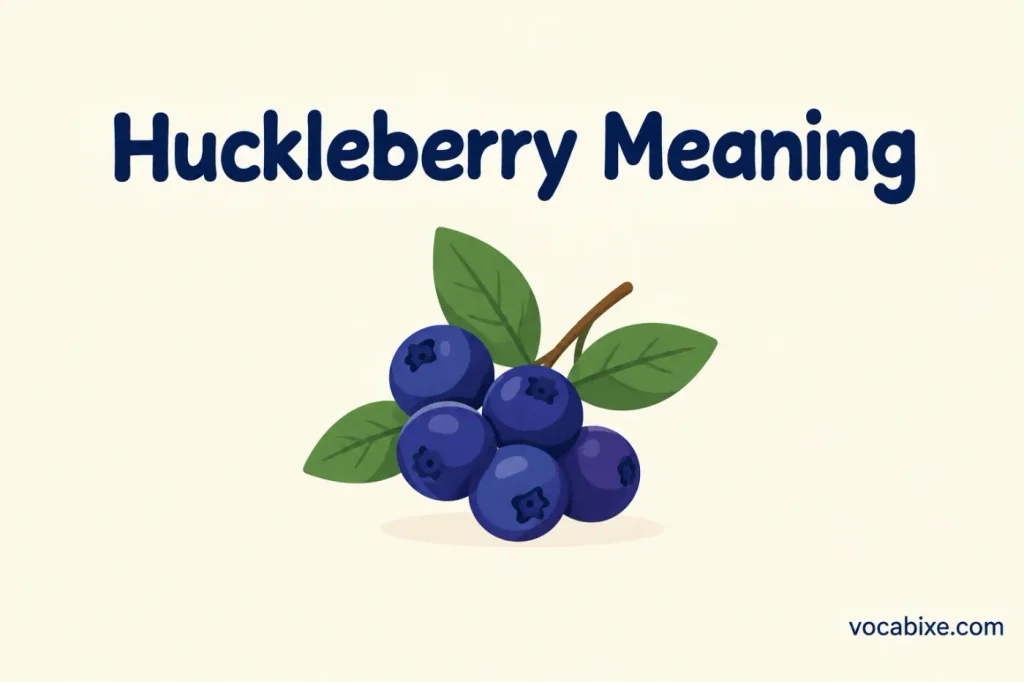
The word huckleberry usually means a small edible berry that grows on certain shrubs. In American English, huckleberries are often dark blue, black, or sometimes reddish, depending on the plant. The word can refer to both the fruit and the shrub that produces it.
In simple terms, a huckleberry is a small wild berry that looks somewhat like a blueberry. The word is especially common in North American English. It can appear in conversations about food, plants, forests, hiking, desserts, and nature.
The word also has a few special uses. Many readers know it because of Huckleberry Finn, the famous fictional character created by Mark Twain. In the expression “your huckleberry,” the word can also have an informal meaning related to being the person who is ready or able to do something. That figurative use is separate from the fruit itself.
Quick Answer: Huckleberry Meaning
Huckleberry is a noun that usually means a small edible berry from certain shrubs, especially plants associated with the genus Gaylussacia. The berry may be dark blue or black and is often compared with a blueberry. The plural form is huckleberries. (Dictionary.com)
Example:
“We picked fresh huckleberries while walking through the forest.”
What Is the Definition of Huckleberry?
The most common definition of huckleberry is a small edible fruit produced by certain shrubs. Dictionaries also use the word for the shrub itself. In American English, the term commonly refers to several plants in the heath family, including shrubs in the genus Gaylussacia.
The fruit is usually small and round. Its color can vary, but dark blue and black huckleberries are common. Huckleberries are known as wild fruits and are often associated with forests, mountains, and natural areas.
The word can also be used more broadly. Some dictionaries list blueberry as another meaning or use of huckleberry, although huckleberries and blueberries are not always the same plant or fruit.
That distinction matters because common names for berries can vary by region. A person in one part of North America may use a berry name differently from someone in another region.
Simple Definition
A simple Grade 5 definition is:
Huckleberry: a small edible berry that grows on certain shrubs, often in the wild.
Huckleberry in a Sentence
Here are some natural examples:
- We found wild huckleberries near the trail.
- She made a huckleberry pie for dessert.
- The children enjoyed picking huckleberries.
- Huckleberries can be used in jams and baked foods.
- The mountain area is known for its wild huckleberries.
These examples show how the word normally works as a noun.
Is Huckleberry a Fruit or a Plant?
Huckleberry can refer to both the fruit and the plant that produces it. This is one reason the word can sometimes seem confusing.
When someone says, “I ate huckleberries,” they mean the fruit. When a person says, “The huckleberry grows in this area,” the word may refer to the shrub.
For example:
Fruit:
“The huckleberries were sweet and dark.”
Plant:
“The huckleberry grows naturally in the forest.”
This type of double use is common in English. Similar words can refer to both a plant and its fruit. On our website the related article to this one is Siring Meaning.
What Does Huckleberry Look Like?
A huckleberry is generally a small, round berry. Many huckleberries are dark blue or nearly black when ripe. Their exact appearance depends on the species.
They can look similar to blueberries, which is why people sometimes confuse the two. However, the names do not always refer to the same plants.
One useful difference is that huckleberries are often described as having larger seeds than typical cultivated blueberries. Dictionary sources also recognize huckleberry as a name used for certain American shrubs with edible dark berries.
A simple way to remember the idea is:
Huckleberry = a small berry, often wild and dark-colored.
How Do You Pronounce Huckleberry?
The pronunciation of huckleberry is commonly represented as /ˈhʌkəlˌbɛri/ in American English. The word has several syllables, with the main stress near the beginning.
huckleberry (HUHK-uhl-ber-ee)
When saying the word, make the first part clear and keep the ending light. It is not normally pronounced as if it were two separate words.
The plural form, huckleberries, adds the regular English plural ending -ies.
What Is the Plural of Huckleberry?
The plural of huckleberry is huckleberries.
The spelling changes from:
huckleberry → huckleberries
This follows a common English spelling rule. When a noun ends in a consonant followed by y, the y usually changes to ies when forming the plural.
For example:
- berry → berries
- cherry → cherries
- strawberry → strawberries
- huckleberry → huckleberries
Correct Example
“We picked several huckleberries.”
Incorrect Common Form
“Huckleberrys” is not the standard plural spelling.
Remember the simple rule:
consonant + y → ies
So huckleberry becomes huckleberries.
Is Huckleberry the Same as Blueberry?
No, huckleberry and blueberry are not always the same thing. They are related in the broad sense that both are small edible berries, but the names can refer to different plants.
Blueberries generally belong to the genus Vaccinium. The word huckleberry is used for several different plants, including shrubs in the genus Gaylussacia.
The confusion becomes stronger because dictionary sources sometimes list blueberry as one meaning or regional use of huckleberry.
A safe everyday explanation is:
| Word | Basic meaning |
|---|---|
| Huckleberry | A small edible berry from certain shrubs |
| Blueberry | A small edible blue berry from blueberry plants |
| Huckleberries | More than one huckleberry |
| Berry | A general word for many small fruits |
So, while the fruits can look similar, you should not automatically assume that every huckleberry is a blueberry.
Where Does the Word Huckleberry Come From?
The history of huckleberry is older than its connection with modern American culture.
Dictionary sources date the word to around 1660–1670 and suggest that it may have developed as an alteration of hurtleberry. The older word hurtleberry dates back to the late Middle English period and was another form associated with whortleberry.
This history shows how English words can change over hundreds of years. Pronunciation, spelling, regional speech, and everyday use can gradually reshape a word.
It is therefore not accurate to assume that the modern word was simply invented because the berry looks or tastes a certain way. Its history is connected to older berry names.
Is Huckleberry an American English Word?
Huckleberry is strongly associated with American English. Dictionary sources specifically label the word as American and describe its use for certain North American shrubs and their fruit.
That means the word is not limited to one variety of English. However, its strongest everyday cultural connection is with North America.
If you are writing for an American audience, huckleberry is a natural word when discussing the berry, wild fruit, or related cultural references.
What Does “Your Huckleberry” Mean?
The expression “your huckleberry” is an informal American phrase that has a different meaning from the fruit.
In this expression, the speaker is essentially saying that they are the person for the job, challenge, or task being discussed.
For example:
“Who wants to help carry these boxes?”
A person might jokingly answer:
“I’m your huckleberry.”
The phrase has an old-fashioned or playful Western flavor for many speakers. It is not normally used in formal writing.
The meaning should therefore be understood from context. If someone is talking about food, gardening, or berries, huckleberry probably means the fruit. If someone says, “I’m your huckleberry,” it may be an idiomatic expression rather than a reference to a berry.
Why Is Huckleberry Associated With Huckleberry Finn?
One of the most famous uses of the word appears in the name Huckleberry Finn, the main character of Mark Twain’s 1884 novel Adventures of Huckleberry Finn.
In this literary context, Huckleberry is part of a character’s name. It does not mean that the character is literally a berry.
The character is commonly called Huck, which is a shortened form of Huckleberry.
This connection made the word especially recognizable to generations of English readers. Someone who has never picked or eaten a huckleberry may still know the word because of Huckleberry Finn.
It is useful to keep the two meanings separate:
- huckleberry = a type of berry
- Huckleberry Finn = a fictional character
- Huck = the character’s common short name
The capitalized form Huckleberry in the character’s name is a proper name, while lowercase huckleberry is normally the common noun for the fruit or plant.
Is Huckleberry a Proper Noun or Common Noun?
The answer depends on how you use it.
When huckleberry means the fruit or plant, it is a common noun.
Example:
“I bought huckleberries at the market.”
When it appears in the name Huckleberry Finn, it is part of a proper name, so it is capitalized.
Example:
“Huckleberry Finn is a famous fictional character.”
This difference is easy to remember:
huckleberry → fruit or plant
Huckleberry Finn → character’s name
Capitalization can therefore change because the grammatical role and meaning have changed.
How Do You Use Huckleberry in a Sentence?
The most common use is as a noun.
Here are several examples:
“We used huckleberries to make a sweet sauce.”
“The hikers saw huckleberry bushes along the trail.”
“My family picked huckleberries during our camping trip.”
“The restaurant sells huckleberry ice cream.”
“I read Adventures of Huckleberry Finn in school.”
Using the informal expression:
“Need someone to fix the old bike? I’m your huckleberry.”
The last example is different because it uses the word idiomatically rather than literally.
Can Huckleberry Be Used as an Adjective?
In ordinary grammar, huckleberry is primarily a noun.
However, English often allows nouns to work before other nouns as modifiers. This means you may see phrases such as:
- huckleberry pie
- huckleberry jam
- huckleberry sauce
- huckleberry syrup
- huckleberry flavor
In huckleberry pie, the word huckleberry tells us what kind of pie it is.
You do not need to turn the word into a special adjective form. English commonly uses nouns this way.
What Are Common Mistakes With Huckleberry?
Several mistakes can happen when people learn this word.
Mistake 1: Writing “huckleberrys”
The standard plural is huckleberries, not huckleberrys.
Correct:
“I picked three huckleberries.”
Mistake 2: Assuming Every Huckleberry Is a Blueberry
Huckleberries and blueberries can look similar, but the terms can refer to different plants. (Dictionary.com)
Mistake 3: Capitalizing the Fruit
The ordinary fruit name is usually lowercase.
Correct:
“We found huckleberries.”
But capitalize it in a proper name:
Huckleberry Finn
Mistake 4: Thinking “Huckleberry” Always Means the Fruit
Context matters. In Huckleberry Finn, it is part of a character’s name. In your huckleberry, it can be part of an idiomatic expression.
Mistake 5: Treating Huckleberry as a Synonym for Every Berry
A huckleberry is a specific type of berry name. Words such as strawberry, blackberry, raspberry, cranberry, and blueberry refer to different fruits.
The word berry is the broader category in everyday language.
What Are Words Related to Huckleberry?
Several words are closely connected to the meaning of huckleberry.
Berry: A general word for small fleshy fruits.
Blueberry: A familiar blue fruit that can resemble a huckleberry.
Whortleberry: An older or regional name associated with certain berry plants.
Bush: A common word for the shrub on which berries grow.
Wild berry: A general description for berries that grow naturally rather than being grown as a typical cultivated crop.
These words are related, but they are not all exact synonyms.
Huckleberry vs. Blackberry: What Is the Difference?
A huckleberry and a blackberry are both edible fruits, but they refer to different types of plants and berries.
A huckleberry is generally a small, round berry associated with certain shrubs. A blackberry is the fruit produced by blackberry plants, which typically have clusters of small drupelets.
The color can also cause confusion. Some huckleberries are very dark and may look almost black. That does not make them blackberries.
For simple vocabulary learning:
Huckleberry = small berry from certain shrubs.
Blackberry = fruit made up of many small drupelets.
Huckleberry vs. Blueberry: A Simple Comparison
The two words are often confused because both can describe small blue or dark berries.
| Feature | Huckleberry | Blueberry |
|---|---|---|
| Basic meaning | A type of edible berry | A type of edible berry |
| Common color | Dark blue, black, or other colors depending on species | Usually blue to blue-black |
| Plant group | Several plants are called huckleberries | Commonly Vaccinium species |
| Typical association | Wild berries and North American regions | Cultivated and wild berries |
| Common confusion | Sometimes treated as another name for blueberry | Sometimes called huckleberry in regional usage |
Dictionary sources note that common naming can overlap, especially in British usage.
Does Huckleberry Have a Slang Meaning?
Huckleberry can appear in informal expressions, but its main dictionary meaning is the berry or the plant.
The phrase “your huckleberry” is the best-known figurative use. It can mean that someone is willing or able to take on a particular task or challenge.
This phrase should not be treated as the ordinary definition of the word. If you see huckleberry in a grocery, gardening, or nature context, the literal fruit meaning is usually intended.
Context is the key.
Is Huckleberry Used in British English?
Yes. British dictionaries recognize huckleberry, although the word has a particularly strong association with American English.
In British usage, it can refer to an American ericaceous shrub and its fruit. Dictionary sources also record uses where huckleberry refers to blueberry or whortleberry.
This is a good example of how the same English word can have slightly different meanings or associations in different regions.
American English readers are more likely to encounter the word in discussions of North American plants, food, outdoor activities, and American literature.
Is Huckleberry a Good Name?
Huckleberry is also sometimes used as a personal or brand name. That use is different from the dictionary meaning of the fruit. You can visit related article I Digress Meaning.
Because the word sounds distinctive and has strong associations with nature and American literature, it can appear as a name for businesses, products, places, fictional characters, or pets.
When it is used as a name, capitalization usually signals that it is being treated as a proper noun.
The meaning then depends on the specific context rather than only on the ordinary dictionary definition.
Why Does Huckleberry Appear So Often in American Culture?
The word has a strong connection with American nature and literature.
Huckleberries are associated with wild landscapes and berry picking in parts of North America. The name also became widely recognizable through Huckleberry Finn.
That literary connection gives the word a cultural meaning beyond food. Someone may use Huckleberry to suggest an outdoorsy, rustic, adventurous, or old-fashioned feeling without literally talking about berries.
The cultural meaning should not replace the basic dictionary meaning, though. The literal sense remains the starting point for understanding the word.
What Is the Meaning of Huckleberry in Simple English?
If you need a very easy definition, use this:
Huckleberry means a small edible berry that grows on certain shrubs.
For a child:
A huckleberry is a small fruit that can grow on a bush.
For a vocabulary test:
Huckleberry is a noun meaning an edible berry from certain shrubs.
For a sentence:
We picked huckleberries in the woods.
These short definitions capture the main meaning without getting into botanical details.
What Is the Meaning of Huckleberry in a Sentence?
The meaning becomes clear from the words around it.
“The pie contains huckleberries.”
Here, huckleberries means the fruit.
“We found a huckleberry bush.”
Here, huckleberry refers to the plant.
“Huckleberry Finn is a famous character.”
Here, Huckleberry is part of a proper name.
“I’m your huckleberry.”
Here, the word is being used in an informal expression.
This shows why context is so useful when learning vocabulary. One word can have a literal meaning and special uses without being a completely different word each time.
Huckleberry Meaning in Literature
The most famous literary connection is Huckleberry Finn, the central character of Mark Twain’s Adventures of Huckleberry Finn.
The character’s name helped make Huckleberry familiar to readers who might otherwise know little about the fruit.
In literary discussion, you may see the shortened form Huck instead of Huckleberry. The two refer to the same fictional character when the context is Mark Twain’s novel.
It is therefore useful to recognize both forms:
Huckleberry Finn → full character name
Huck → common short form
The fruit meaning and literary meaning are connected by spelling, but they should not be confused when reading a sentence.
FAQs
What is the simple meaning of huckleberry?
Huckleberry means a small edible berry that grows on certain shrubs. It can also refer to the shrub itself.
Is a huckleberry the same as a blueberry?
Not always. Huckleberries and blueberries can look similar, but the names can refer to different plants. Some dictionaries also record regional overlap between the terms. (Dictionary.com)
What is the plural of huckleberry?
The plural is huckleberries. The final y changes to ies, just as in berry → berries.
What does “your huckleberry” mean?
“Your huckleberry” is an informal expression meaning that someone is ready or suitable for a particular task or challenge.
Is huckleberry an American word?
Huckleberry is strongly associated with American English, especially North American plants and culture. British English dictionaries also recognize the word.
Why is Huckleberry capitalized in Huckleberry Finn?
In Huckleberry Finn, the word is part of a person’s fictional name, so it is capitalized. The fruit name huckleberry is normally lowercase.
Conclusion
The huckleberry meaning is most commonly a small edible berry that grows on certain shrubs. The word can also describe the shrub itself, and its meaning may vary slightly by region. Huckleberries are often compared with blueberries because they can have a similar appearance, but the two names do not always refer to the same plants.
In everyday English, you may encounter huckleberry when reading about fruit, nature, food, or plants. You may also see it in Huckleberry Finn, where it is part of a famous fictional character’s name. The informal expression “your huckleberry” gives the word another meaning in certain contexts.
The easiest definition to remember is: a huckleberry is a small edible berry from certain shrubs. Once you understand that basic meaning, the other uses of the word become much easier to recognize.