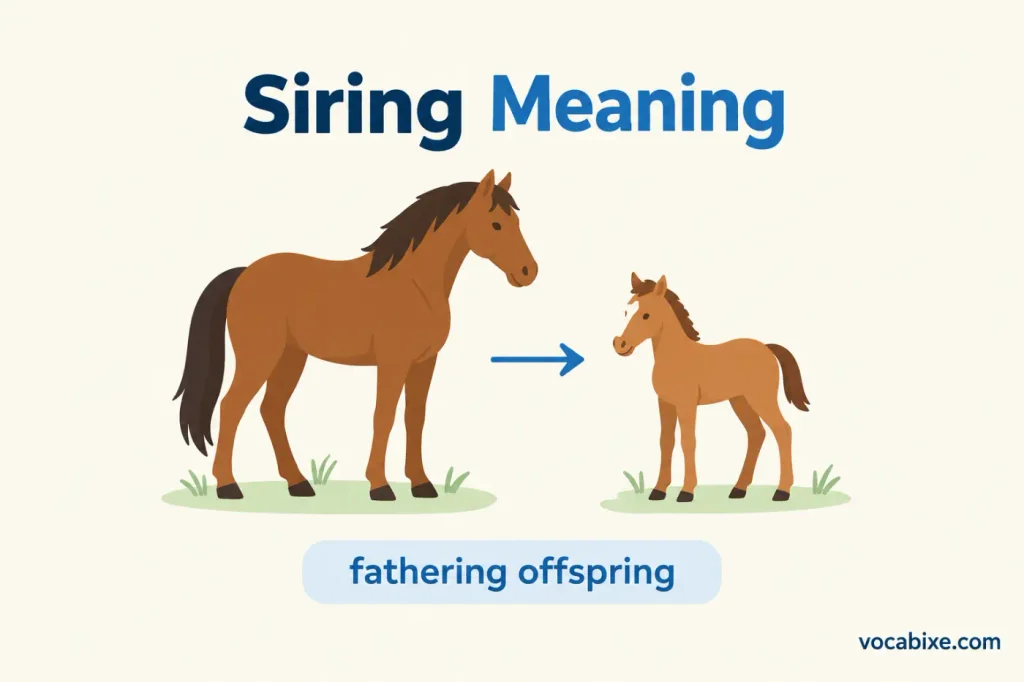
The word “siring” means fathering or producing offspring, especially when a male animal fathers young. It comes from the verb “sire,” which means to become the father of a child or animal. For example, “The champion horse is siring many foals” means the horse is fathering many young horses.
In everyday English, siring is most often used when talking about animals, breeding, genetics, or the family line of a male parent. It can also be used for humans, but that use is less common and can sound formal or biological. The word is the present participle and gerund form of “sire.”
What Does Siring Mean?
Siring means fathering offspring. In simple words, when a male animal produces young by becoming the biological father, he is siring those offspring.
The verb “sire” is usually connected with biological fatherhood. Therefore, “siring a foal” means fathering a foal, while “siring puppies” means fathering puppies.
Here is the basic idea:
- Sire = to father offspring
- Siring = the act of fathering offspring
- Sired = fathered offspring
- Sire = a male parent, especially in animal breeding
For example:
- The stallion is siring several foals.
- The dog has sired three litters.
- That bull is known for siring strong calves.
- The male lion was responsible for siring several cubs.
The word can describe one act or an ongoing breeding role. Its exact meaning depends on the sentence.
What Is the Simple Definition of Siring?
A simple definition of siring is “fathering offspring.”
If a male animal produces young, you can say that he has sired them. The continuous form, siring, describes the action as it happens or as an ongoing activity.
For example:
“The horse is siring a new generation of racehorses.”
This means the horse is being used as a male parent to produce a new generation.
The word does not normally mean simply “having children” in a general sense. It specifically focuses on the male’s role as the biological father.
What Part of Speech Is Siring?
Siring is usually the present participle or gerund form of the verb “sire.”
The forms of the verb are:
- Base form: sire
- Third-person singular: sires
- Present participle: siring
- Past tense: sired
- Past participle: sired
Examples show how these forms work:
- “The horse sires many foals.”
2. “The horse is siring many foals.”
3. “The horse sired many foals.”
In the first sentence, “sires” is the simple present form & in the second, “siring” works with “is” to form the present continuous tense & in the third, “sired” is the past tense.
Siring can also act as a noun-like gerund:
“Siring offspring requires careful breeding.”
Here, “siring” refers to the activity itself.
How Do You Use Siring in a Sentence?
Siring is normally followed by the offspring or children that the male has fathered.
Common patterns include:
- siring offspring
- siring children
- siring foals
- siring puppies
- siring calves
- siring kittens
- siring sons
- siring a new generation
Examples:
“The stallion is siring several foals this season.”
“The bull became famous for siring healthy calves.”
“The breeder selected the dog for siring puppies with desirable traits.”
“The male lion was known for siring many cubs.”
“The athlete became a father after siring his first child.”
The last example is grammatically possible, but it sounds more formal and biological than ordinary conversation. Most people would simply say, “He became a father.”
Is Siring the Same as Fathering?
Siring and fathering are closely related, but they do not always sound the same.
Both words can describe becoming the biological father of offspring. However, “siring” is more strongly associated with breeding, genetics, and male animals.
“Fathering” is more common when talking about humans.
Compare these examples:
“The horse is siring several foals.”
“The man is fathering two children.”
The first sentence sounds natural because horse breeding often uses the word “siring.” The second sentence is understandable, but people usually say “raising,” “having,” or “fathering” depending on the intended meaning.
There is also an important difference in focus. Siring usually focuses on biological reproduction. Fathering can sometimes have a broader meaning connected with being a father.
For example, “He is fathering his children” may refer to his role as a parent, while “He sired three children” focuses on biological parenthood.
What Is the Difference Between Siring and Breeding?
Siring refers specifically to the male’s role in producing offspring. Breeding is a broader term.
For example, a farmer may breed cattle. The male bull sires the calves, while the female cow gives birth to them.
This means:
- Breeding = producing offspring through reproduction
- Siring = the male’s role in fathering the offspring
A sentence such as “The farm breeds horses” does not tell us which male fathered the foals.
“The stallion sired the foals” identifies the male parent.
The distinction is useful when discussing animal genetics, livestock, horse racing, dog breeding, and other areas where parentage matters.
Is Siring Used for Humans?
Yes, siring can be used for humans, but it is much less common than “fathering” or simply “having children.”
When used for people, siring often emphasizes biological reproduction rather than everyday family life.
For example:
“The king was said to have sired several children.”
This means the king was the biological father of several children.
A more natural everyday sentence would be:
“The king had several children.”
In historical, genealogical, literary, or biological writing, siring can sound appropriate. In casual conversation, it may sound unusual or overly formal.
The choice depends on the tone of the writing and what the writer wants to emphasize. The latest article is I Digress Meaning.
Why Is Siring Common in Animal Breeding?
Animal breeding often focuses on the traits passed from parents to offspring. Because of this, breeders need precise words for male and female parentage.
Siring is useful because it clearly identifies the male’s reproductive role.
For example:
“This stallion has sired more than 100 foals.”
This sentence tells readers that the stallion is the biological father of those foals.
The term is especially common with horses, cattle, dogs, sheep, goats, and other animals that are selectively bred.
Breeders may discuss a male animal’s offspring when looking at characteristics such as size, speed, strength, health, appearance, temperament, or other inherited traits.
What Does Siring Mean in Horse Breeding?
In horse breeding, siring means that a male horse, called a stallion, has fathered one or more foals.
For example:
“Thunder King is siring his first group of foals this year.”
The sentence means that Thunder King is the father of those foals.
Horse breeding frequently uses the terms “sire,” “dam,” “foal,” and “siring.”
A sire is the male parent of a horse. A dam is the female parent. A foal is a young horse.
For example:
“The stallion is the sire of the foal.”
“The mare is the dam of the foal.”
“That stallion has sired many successful racehorses.”
These terms are especially useful in pedigrees and breeding records.
What Does Siring Mean in Dog Breeding?
In dog breeding, siring means that a male dog has fathered puppies.
For example:
“The champion dog has sired several litters.”
This means the dog is the biological father of puppies from several litters.
Breeders may use the term when discussing pedigrees, bloodlines, inherited characteristics, or breeding history.
You may see sentences such as:
“The dog sired eight puppies.”
“The breeder chose the male for siring healthy puppies.”
“The champion has sired dogs with strong working abilities.”
In casual conversation, however, people may simply say that the dog is the father of the puppies.
What Does Siring Mean in Genetics?
In genetics, siring can describe the male parent’s contribution to offspring.
A child or animal receives genetic material from both biological parents. When researchers or breeders identify the male parent, they may describe him as the sire.
For example:
“The male was confirmed as the sire through DNA testing.”
This means DNA evidence showed that the male was the biological father.
Siring itself does not mean that a particular trait will definitely appear in every offspring. Traits can depend on genetic material from both parents and other biological factors.
Therefore, saying that a horse sired a group of foals identifies its parentage. It does not automatically explain every characteristic those foals have.
What Is the Origin of the Word Siring?
Siring comes from the verb “sire.”
The noun “sire” has a long history in English. It was traditionally used as a respectful word for a father or male parent. It was also used as a title of respect for a king or lord.
Over time, “sire” became especially common in descriptions of male animals used for breeding.
The verb “sire” developed the meaning “to father” or “to produce as a male parent.” The form “siring” is created by adding “-ing” to the verb.
The spelling changes slightly when the suffix is added:
sire → siring
The final silent “e” is dropped before “-ing.”
This is the same general spelling pattern seen in words such as:
- make → making
- write → writing
- drive → driving
- ride → riding
Therefore, “siring” is the standard spelling.
How Do You Pronounce Siring?
Siring is generally pronounced with two syllables.
The first syllable sounds like the word “sire,” and the second is an unstressed “-ing” sound.
A useful way to think about its pronunciation is that it begins with the same sound as “sire” and ends with the sound found in “running” or “reading.”
The pronunciation is generally the same in American and British English, although individual accents may produce small differences.
If you already know how to pronounce “sire,” the pronunciation of “siring” is fairly straightforward.
Is Siring a Correct Spelling?
Yes, “siring” is the correct spelling.
A common mistake is to write “sireing.” That form is incorrect.
The correct spelling is:
sire → siring
Not:
sire → sireing
The reason is the standard English spelling rule for many verbs ending in a silent “e.” When “-ing” is added, the final “e” is normally removed.
Examples include:
- love → loving
- move → moving
- give → giving
- write → writing
- sire → siring
Remembering this pattern can help prevent spelling errors.
Siring vs. Sireing: Which Is Correct?
“Siring” is correct, while “sireing” is incorrect.
The confusion happens because the base word is “sire.” It may seem logical to keep the final “e” and add “-ing,” but standard English spelling does not do that here.
Correct:
“The stallion is siring a foal.”
Incorrect:
“The stallion is sireing a foal.”
The same rule explains why “writing” is correct rather than “writeing.”
When you add “-ing” to “sire,” remove the final silent “e.”
Siring vs. Sired: What Is the Difference?
“Siring” describes an ongoing action or activity, while “sired” usually describes an action that has already happened.
Compare:
“The stallion is siring several foals.”
“The stallion sired several foals.”
The first sentence uses the present participle and shows the action as ongoing.
The second sentence uses the past tense and tells us that the fathering happened in the past.
Another example:
“The dog is siring puppies this year.”
“The dog sired puppies last year.”
Both sentences refer to fathering offspring, but the time and grammar are different.
Siring vs. Sire: What Is the Difference?
“Sire” can be both a noun and a verb.
As a noun, sire means a male parent, especially the father of an animal.
“The horse’s sire was a famous champion.”
As a verb, sire means to father offspring.
“The horse sired several foals.”
“Siring” is the “-ing” form of that verb.
“The horse is siring several foals.”
So the basic relationship is:
Sire = male parent or to father
Siring = fathering
Sired = fathered
What Are Some Synonyms for Siring?
The closest simple synonym for siring is “fathering.”
Depending on the context, other related expressions include:
- fathering
- producing offspring
- becoming the biological father of
- breeding
- reproducing
These words are not always exact replacements.
“Fathering” is the closest general alternative when referring to biological parenthood.
“Breeding” is broader and can describe the overall reproductive process rather than only the male’s role.
“Producing offspring” is neutral and can apply to males or females depending on the sentence.
“Reproducing” is also broader because it does not specifically identify the male parent.
For precise animal-parentage writing, “siring” is often the clearest choice.
Can Siring Be Used in Formal Writing?
Yes. Siring is common in formal writing about animal breeding, genetics, pedigrees, agriculture, zoology, and family history.
For example:
“The stallion is known for siring offspring with strong racing ability.”
“The bull has been used for siring calves in several breeding programs.”
“The DNA evidence identified the male as the sire.”
The word can also appear in historical or literary writing about human parentage.
However, formal does not always mean better. If your audience is young students or general readers, “fathering” or “becoming the father of” may be easier to understand.
Choose the word that makes the sentence clearest.
Common Mistakes With Siring
Several mistakes can occur when people learn this word.
Writing “Sireing”
This is the most common spelling mistake.
Incorrect: “The horse is sireing a foal.”
Correct: “The horse is siring a foal.”
Using Siring When You Mean Raising
Siring means fathering biologically. It does not mean taking care of or raising children.
For example:
“He is siring his children” focuses on biological fatherhood.
“He is raising his children” focuses on parenting and daily care.
Those meanings are different.
Using Siring as a General Word for Breeding
Siring specifically points to the male parent.
“The farm is breeding cattle” describes a broader process.
“The bull is siring calves” identifies the male’s role.
Assuming Siring Means Producing Any Offspring
The word is normally used for a male fathering offspring. It should not be used as a general replacement for “giving birth” or “reproducing.”
What Are Some Real-World Examples of Siring?
Here are several examples from different contexts:
“The stallion is siring his first foal crop.”
“The bull has sired hundreds of calves.”
“The dog sired a litter of puppies.”
“Scientists used DNA testing to identify the sire.”
“The famous racehorse was responsible for siring many successful offspring.”
“The breeder carefully recorded which male was siring each litter.”
“The king was believed to have sired several children.”
“The male lion had sired cubs with more than one female.”
These examples show that the word can work in animal breeding, genetics, history, and family discussions.
Does Siring Have a Negative Meaning?
No. Siring is a neutral word.
It simply describes the biological act of fathering offspring. The surrounding sentence determines whether the subject is being discussed positively, negatively, or neutrally.
For example:
“The horse has sired many healthy foals.”
This is a neutral statement.
“The study examined the number of offspring sired by each male.”
This is also neutral and scientific.
The word itself does not carry a negative or insulting meaning.
Is Siring Common in American English?
Yes, siring is understood in American English, especially in writing about animals, breeding, genetics, and biological parentage.
It is not one of the most common words in everyday conversation. An American speaker would usually say “fathered” or “had children” when talking about people.
For animals, however, “sired” and “siring” are natural terms in many contexts.
For example:
“The champion horse sired 20 foals.”
That sentence sounds normal in horse-breeding language.
American and British English both use the word, so it is not a spelling difference between the two varieties.
Is Siring Used Differently in British English?
The basic meaning is the same in British English.
British writers may use “sire,” “sired,” and “siring” when discussing horses, livestock, pedigrees, and historical family lines.
There is no major British-versus-American difference in the meaning of the word.
The main difference is context and frequency. Some types of animal-breeding writing may use the word more often than ordinary conversation.
Why Do Writers Use Siring Instead of Fathering?
Writers often choose siring because it is precise and concise.
Compare:
“The stallion fathered 50 foals.”
“The stallion sired 50 foals.”
Both sentences can communicate the same basic idea. However, “sired” is a familiar technical term in horse breeding and pedigree records.
The word also keeps attention on biological parentage.
A writer discussing genetics may prefer “sired” because it clearly identifies the male parent without suggesting anything about parenting behavior. The main article which relates is Awol Meaning.
How Can You Remember the Meaning of Siring?
A simple memory trick is:
“Siring = being the sire.”
A sire is a male parent. Therefore, siring means acting as the biological father of offspring.
You can also remember the three related forms:
- Sire = father
- Sired = fathered
- Siring = fathering
This simple connection makes the word easier to remember.
For spelling, remember:
“Drop the e before -ing.”
So:
sire + ing → siring
Not “sireing.”
Quick Examples to Understand Siring
Here are some short examples with simple meanings:
“The bull is siring calves.”
Meaning: The bull is fathering calves.
“The stallion sired the foal.”
Meaning: The stallion was the foal’s biological father.
“The dog has sired several litters.”
Meaning: The dog has fathered puppies in several litters.
“The DNA test confirmed the horse as the sire.”
Meaning: The DNA test confirmed that the horse was the biological father.
“The breeder is tracking which dogs are siring puppies.”
Meaning: The breeder is tracking which male dogs are fathering puppies.
These examples show how the word works naturally in different sentence structures.
Frequently Asked Questions About Siring
What does siring mean in simple words?
Siring means fathering offspring. It is most often used for male animals, especially in breeding and genetics.
Is siring the same as fathering?
They have a very similar meaning when referring to biological parenthood. Siring is more common in animal breeding and formal discussions of biological parentage.
Is siring a correct word?
Yes. Siring is the correct present participle and gerund form of “sire.”
Is “sireing” or “siring” correct?
“Siring” is correct. “Sireing” is a spelling mistake because the final silent “e” is dropped before “-ing.”
Can siring be used for humans?
Yes, but it is less common. In ordinary conversation, “fathering” or “having children” usually sounds more natural.
What does siring mean in horse breeding?
Siring means that a male horse, or stallion, has fathered foals. The male parent of a horse is called its sire.
What is the past tense of siring?
The past tense of “sire” is “sired.” For example, “The stallion sired three foals.”
What is a simple synonym for siring?
“Fathering” is the closest simple synonym. Depending on context, “producing offspring” can also express a similar idea.
Conclusion
Siring means fathering or producing offspring as a male parent. The word comes from “sire,” which can mean either a male parent or the act of fathering offspring. It is especially common in animal breeding, horse racing, genetics, agriculture, and pedigree discussions.
The correct spelling is “siring,” not “sireing.” When “-ing” is added to “sire,” the final silent “e” is removed. The word can describe humans, but everyday English usually prefers “fathering” or “having children” when people are being discussed.
Remember the simple pattern: sire means father, sired means fathered, and siring means fathering. Once you understand that connection, the word becomes easy to recognize and use correctly.
Pingback: Huckleberry Meaning: Definition, Origin, Usage & Examples - Vocabixe
Pingback: Mark My Words Meaning And How to Use It - Vocabixe