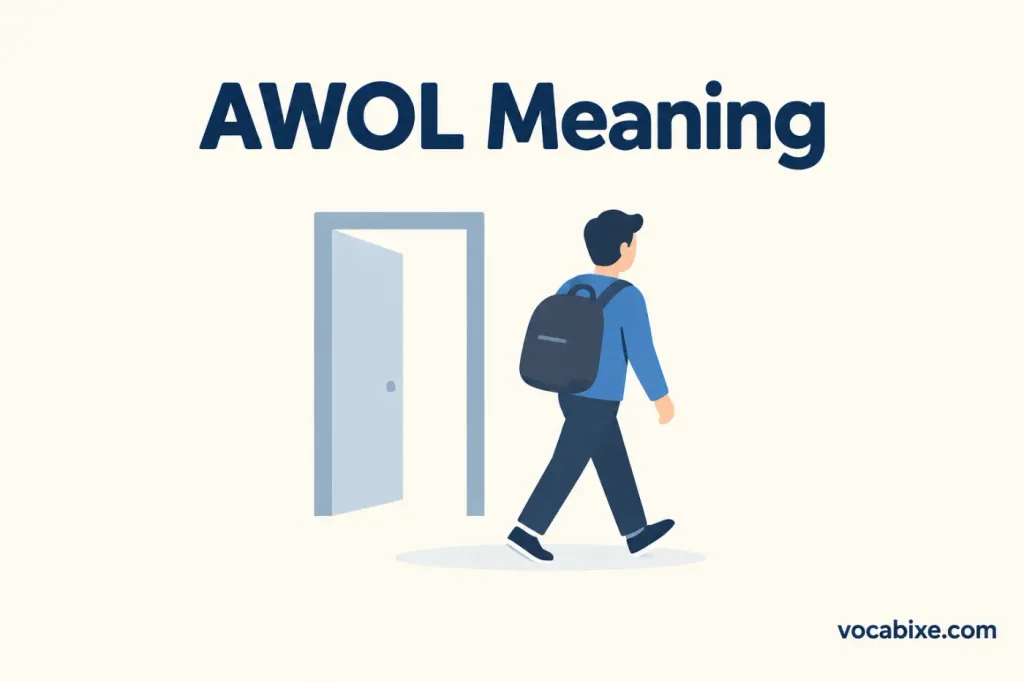
AWOL means “absent without leave.” It describes a person who is away from a place, duty, job, or situation without permission or without telling others. The term originally came from the military, where a service member could be described as AWOL for leaving their assigned place without official permission. Today, people also use AWOL in everyday American English to describe someone who suddenly disappears, stops responding, or fails to show up.
What Does AWOL Mean?
AWOL is an abbreviation of “absent without leave.” In simple words, it means someone is supposed to be somewhere or doing something, but they are not there and do not have permission to be absent.
The word is most strongly connected with military service. A soldier who leaves their assigned duty or location without authorization may be considered AWOL. The term can also be used more casually outside the military.
For example:
- “The soldier went AWOL from his unit.”
- “My coworker has been AWOL all morning.”
- “She went AWOL after the meeting.”
- “The manager was AWOL when we needed help.”
In the first example, AWOL has its original military meaning. In the other examples, it has a more informal meaning: someone is missing, unavailable, or not doing what they are expected to do.
The exact meaning depends on context. In a military setting, AWOL can describe a specific type of unauthorized absence. In everyday conversation, it is often a humorous or informal way to say that someone has disappeared.
What Does “Absent Without Leave” Mean?
“Absent without leave” means being away without official permission. Here, “leave” means authorized time away from duty, work, or a particular assignment.
The word “leave” in this phrase does not mean “to go” or “to depart.” It refers to permission to be absent.
For example, a military member might receive leave to spend several days away from their assigned duties. If that person stays away without authorization or does not return as required, the situation may be described as AWOL.
The phrase can be understood word by word:
- “Absent” means not present.
- “Without” means lacking something.
- “Leave” means official permission to be away.
Put together, “absent without leave” means “not present without permission to be away.”
This is why AWOL is not simply another word for “absent.” Someone can be absent for a completely valid reason. A person who is sick, on approved vacation, or given permission to leave is not necessarily AWOL.
Is AWOL a Word or an Acronym?
AWOL began as an abbreviation made from the initial letters of “absent without leave.” It is commonly written in capital letters as AWOL.
It is also used like a normal word in speech. People commonly say “AWOL” rather than saying the complete phrase every time.
For example:
“John is AWOL today.”
In this sentence, AWOL works as an adjective describing John’s absence.
People may also use “go AWOL” as a phrase:
“She went AWOL after lunch.”
The expression “go AWOL” is especially common in informal English. It suggests that someone became unavailable or disappeared, sometimes suddenly.
Although AWOL has an acronym-like origin, modern speakers often treat it as a regular lexical item.
What Is the Origin of AWOL?
AWOL originated as a military abbreviation for “absent without leave.” The term developed from military language used to describe unauthorized absence from duty.
Military organizations have long needed clear ways to describe whether personnel are present, on authorized leave, or absent without permission. AWOL became a short and practical way to identify unauthorized absence.
Over time, the expression moved beyond military settings. English speakers began using it in ordinary conversation to describe people, objects, services, or even ideas that seem to have disappeared.
For example:
“My motivation has gone AWOL this week.”
Nobody is suggesting that motivation is literally a soldier. The speaker is using AWOL figuratively to say that motivation has disappeared.
This kind of borrowing is common in English. Words that begin in one specialized field can eventually become part of general everyday vocabulary.
How Do You Pronounce AWOL?
AWOL is usually pronounced like “AY-wahl.”
It has two syllables, with the first syllable receiving the main stress.
In normal conversation, speakers usually say the letters as a spoken word rather than pronouncing each letter separately. The pronunciation sounds like the name of the letters “A” and “W” followed by “ol.”
You may hear slight differences in pronunciation depending on a speaker’s accent, but the common English pronunciation remains easy to recognize.
Is AWOL Formal or Informal?
AWOL can be formal in a specific military context, but its everyday use is usually informal.
When discussing an official military absence, AWOL has a precise meaning. In casual conversation, however, people often use it humorously or figuratively.
For example:
“Three soldiers were reported AWOL.”
This has a serious and official tone.
Compare it with:
“My phone charger has gone AWOL again.”
The second sentence is playful. The speaker simply means that the charger cannot be found.
Because of this difference, you should consider the situation before using AWOL. It works naturally in conversation, social media, informal writing, news reports, and some professional contexts. It may sound too casual in a formal report when a more exact term such as “absent without authorization” is needed.
How Is AWOL Used in Everyday English?
In everyday English, AWOL usually means that someone has disappeared, is unavailable, or has stopped doing what they are expected to do.
The person may not literally be breaking a rule. The expression can simply emphasize that their absence is noticeable.
Consider these examples:
“My brother went AWOL during the family party.”
This suggests that he disappeared or could not be found.
“The teacher was AWOL from the group chat.”
This means the teacher was not responding or participating.
“Our team leader went AWOL before the deadline.”
Here, the speaker means that the team leader became unavailable when their help was needed.
“The internet connection has gone AWOL.”
This is a humorous way to say that the internet connection has stopped working.
These examples show why context matters. AWOL can describe people, but informal speakers sometimes extend it to things that seem to have vanished or stopped working.
What Does “Go AWOL” Mean?
“Go AWOL” means to suddenly become absent, unavailable, or difficult to find.
The phrase is often used when someone disappears without warning.
For example:
“Where is Mike?”
“He went AWOL after lunch.”
The sentence does not necessarily mean Mike has committed an official military offense. In casual English, it may simply mean that Mike left and has not returned.
Another example is:
“My friends went AWOL after I sent them the group project.”
This means the friends stopped responding or disappeared when their help was needed.
“Go AWOL” is therefore useful when the disappearance itself is the main point. Last post was related Sans Meaning.
What Does “Gone AWOL” Mean?
“Gone AWOL” means that someone or something has become absent or unavailable.
The expression is usually informal.
For example:
- “Sarah has gone AWOL.”
- “My emails have gone AWOL.”
- “The staff went AWOL during the busiest hour.”
- “My weekend plans have gone AWOL.”
When used for a person, it often suggests that the person is not responding or cannot be located. When used for an object or situation, it is usually figurative.
“Gone AWOL” is similar to saying “disappeared,” but it often adds the idea that the absence was unexpected or inconvenient.
AWOL Examples in Sentences
Seeing the word in different situations makes its meaning easier to understand.
Military examples
“The soldier was reported AWOL after failing to return to his unit.”
This is close to the original meaning of the term.
“The officer investigated why the service member had gone AWOL.”
Here, AWOL refers to unauthorized absence from military duty.
Workplace examples
“Our supervisor has been AWOL all afternoon.”
This informal sentence means the supervisor has been unavailable.
“Two employees went AWOL before the deadline.”
The speaker means the employees stopped showing up or responding.
School examples
“Tom went AWOL during the group project.”
This means Tom stopped participating or became unavailable.
“Our class leader has been AWOL from the study group.”
The sentence suggests that the class leader has not been participating.
Technology examples
“My Wi-Fi has gone AWOL again.”
This is humorous and means the Wi-Fi is not working.
“The file I saved yesterday has gone AWOL.”
The speaker means the file cannot be found.
Social situations
“Jake went AWOL at the party.”
This means Jake disappeared from the party or could not be found.
“She went AWOL after sending that message.”
The sentence suggests that she stopped replying or became unavailable.
What Is the Difference Between AWOL and Absent?
AWOL and absent are related, but they are not exact synonyms.
“Absent” simply means not present. It does not automatically say why the person is missing or whether they had permission to be away.
AWOL carries the additional idea of being absent without authorization in its original sense.
For example:
“Maria is absent from school today.”
This does not tell us whether she is sick, on vacation, or simply staying home.
“Maria went AWOL from her assigned duty.”
This suggests that Maria was expected to be present and left without proper authorization.
In casual speech, however, AWOL can be used more loosely. Someone might say a friend “went AWOL” simply because the friend stopped answering messages.
Therefore, “absent” is broader and more neutral, while AWOL often suggests unexplained, unauthorized, or noticeable absence.
AWOL vs. Missing: Are They the Same?
AWOL and missing can overlap, but they do not always mean the same thing.
“Missing” usually means that a person or thing cannot be found or located.
“AWOL” usually suggests that someone has failed to appear or has disappeared from a place or responsibility where they were expected to be.
For example:
“The child is missing.”
This can be a serious statement about the child’s location.
“My coworker has gone AWOL.”
This is usually a casual statement that the coworker is unavailable or has stopped responding.
Using AWOL for a missing person can sometimes make a serious situation sound humorous or less serious. The context is therefore important.
AWOL vs. MIA
AWOL and MIA are both connected with military language, but they have different meanings.
MIA means “missing in action.” It traditionally refers to a service member whose status or location is unknown during military operations.
AWOL means “absent without leave.” It refers to an unauthorized absence.
The main difference is the reason or situation behind the absence.
Someone can be AWOL because they left their duty without permission. MIA generally means the person’s location or status is unknown in connection with military action.
Both terms have also entered casual English.
For example:
“My boss has been MIA all day.”
This means the boss has not been seen or heard from.
“My boss has gone AWOL.”
This can mean the boss disappeared or stopped responding, often with the added idea that the boss was expected to be available.
MIA is often closer to “nowhere to be found,” while AWOL often carries a stronger sense of leaving an expected duty or responsibility.
Can AWOL Be Used for Objects?
Yes. In informal English, AWOL can be used for objects, although this is figurative.
For example:
“My keys have gone AWOL.”
The keys are not literally absent without leave. The speaker is joking that the keys have disappeared.
Other examples include:
- “My pen has gone AWOL.”
- “The remote control is AWOL.”
- “My motivation went AWOL.”
- “The report seems to have gone AWOL.”
This use is common because AWOL gives ordinary situations a humorous tone.
It is better suited to casual conversation than highly formal writing. In a formal report, “missing,” “unavailable,” or “not located” may be clearer.
Can AWOL Be Used for Work?
Yes. AWOL is often used informally when an employee does not appear for work or becomes unavailable.
For example:
“David has been AWOL since Monday.”
Depending on context, this could mean David has not come to work or has stopped communicating.
However, you should be careful with the expression in professional settings. Saying an employee is “AWOL” can sound judgmental or humorous. A formal workplace document may be better served by a neutral phrase such as “absent without authorization” or “absent without notice.”
The military meaning of AWOL is more specific than ordinary workplace absence. Company policies and employment laws may use different terms for unauthorized absence.
Is AWOL a Bad Word?
No. AWOL is not a swear word or offensive word.
However, it can sound critical depending on how it is used. Calling someone AWOL may suggest that they have failed to meet an expectation or disappeared without explanation.
For example:
“My friend went AWOL after promising to call.”
This may sound mildly annoyed.
“The employee was AWOL for three days.”
This can sound much more serious, especially in a workplace context.
The word itself is not rude, but the situation and tone can make it sound negative.
What Are Common Mistakes With AWOL?
One common mistake is thinking that AWOL simply means “absent.” The original meaning is more specific because it refers to being absent without authorized leave.
Another mistake is assuming that every person who misses work is automatically AWOL. A person may be absent because of illness, approved leave, an emergency, or another valid reason.
Some speakers also use AWOL in serious situations where “missing” would be more appropriate. For example, saying that a missing child has “gone AWOL” could sound insensitive because AWOL often has a casual or humorous tone outside military use.
A third mistake is treating AWOL as if it always refers to military personnel. Modern English allows broader informal uses.
The safest approach is to look at the context and decide whether the expression sounds appropriate.
What Are Synonyms for AWOL?
The best synonym depends on the intended meaning.
For a general absence, you can use:
- absent
- away
- unavailable
- missing
- gone
- not present
Yes for someone who stops responding, you might say:
- disappeared
- stopped responding
- became unavailable
- vanished
- went silent
For a formal unauthorized absence, phrases such as “absent without authorization” may be more precise.
None of these alternatives has exactly the same tone as AWOL. The military sense is especially specific, while the casual sense can be playful.
Is AWOL Used in American English?
Yes. AWOL is well established in American English and is widely understood in the United States.
American speakers use it in military discussions as well as informal everyday conversation.
For example:
“Where has Mark been? He has gone AWOL.”
An American listener would usually understand that Mark has disappeared or become unavailable.
The term is also familiar in British English and other varieties of English. Its military origin gives it broad recognition across English-speaking regions.
The informal tone can vary by situation, though. A phrase that sounds humorous between friends may not be suitable for an official document.
Is AWOL Used in British English?
Yes. British English also uses AWOL, particularly in military contexts and informal speech.
The basic meaning remains the same: “absent without leave.”
British speakers may also use it figuratively to describe someone who has disappeared or stopped responding.
For example:
“The manager has gone AWOL.”
The sentence can work in both American and British English.
There is no major spelling difference between American and British English for AWOL. The same capitalized form is commonly recognized in both varieties.
Can AWOL Be Used as a Verb?
AWOL itself is generally used as an adjective or noun-like expression rather than as a standard verb.
People commonly say:
“He went AWOL.”
“She has gone AWOL.”
“They are AWOL.”
It is less natural to say something like “He AWOLed from work.” Although informal speakers may invent verb forms from abbreviations, such forms are not standard and should usually be avoided.
“Go AWOL” and “be AWOL” are the natural constructions.
Can You Say “Went AWOL”?
Yes. “Went AWOL” is one of the most common ways to use the expression in everyday English.
Examples include:
“James went AWOL after the argument.”
“The employee went AWOL before the meeting.”
“My phone charger went AWOL.”
The phrase normally suggests a change from being available or present to being absent or unavailable.
Similarly, “has gone AWOL” is useful when the absence has happened recently and continues into the present.
What Is the Plural of AWOL?
AWOL does not normally have a special plural form.
You can say:
“Three soldiers were AWOL.”
“The employees were AWOL.”
In these sentences, AWOL describes more than one person without changing its form.
You do not normally need to add an “s” to AWOL when describing multiple people.
Is “AWOL” Capitalized?
AWOL is traditionally written in capital letters because it comes from the initial letters of “absent without leave.”
Examples:
“John went AWOL.”
“The soldier was AWOL.”
“My coworker has gone AWOL.”
Because AWOL is now widely recognized as a word-like expression, lowercase forms may sometimes appear in informal writing, but the standard and most recognizable form is AWOL.
For careful writing, especially when introducing the term, use capital letters.
When Should You Use AWOL?
Use AWOL when you want to describe an unexpected or unauthorized absence, especially when someone was expected to be present.
It works particularly well when:
- discussing military service
- describing someone who suddenly disappears
- talking casually about an unavailable coworker or friend
- joking about a missing object
- describing someone who stops responding
- explaining that something has unexpectedly disappeared
Think about tone before using it. The expression is often casual outside military contexts.
For formal writing, choose a more exact phrase when necessary.
When Should You Avoid AWOL?
Avoid AWOL when the situation is serious and the playful tone could cause confusion.
For example, if a person is genuinely missing and their safety is a concern, “missing” is usually clearer than saying they have gone AWOL.
You should also avoid using AWOL as a formal accusation unless the facts support that meaning.
A person who is absent may have a valid reason. Calling them AWOL can imply that they left without permission.
When the reason for an absence is unknown, neutral language is often better.
Quick Answer: What Does AWOL Mean?
AWOL means “absent without leave.” It originally describes a military service member who is absent from duty without official permission. In everyday informal English, AWOL can mean that someone has disappeared, become unavailable, stopped responding, or failed to show up as expected.
For example: “My coworker went AWOL after lunch” means the coworker disappeared or became unavailable after lunch. Other related posts are Stopped or Stoped.
Conclusion
AWOL means “absent without leave.” The expression began as military language for someone who was away from duty without official permission. Today, its meaning has expanded in everyday English, where people often use it to describe someone who disappears, stops responding, or becomes unavailable.
The phrase “go AWOL” is especially common in casual speech. You can also use “be AWOL” or “has gone AWOL” depending on the sentence. The term can describe people and, in playful informal language, objects or situations that seem to have disappeared.
Remember that AWOL is not simply a synonym for “absent.” Its original meaning includes the idea of being away without authorized leave. In casual conversation, however, that strict meaning is often softened.
Using AWOL correctly is mostly about understanding context and tone. In military writing, it can have a precise meaning. In everyday conversation, it often adds a humorous or informal way to say that someone or something has suddenly disappeared.
FAQs
What does AWOL stand for?
AWOL stands for “absent without leave.” It originally referred to an unauthorized absence from military duty.
What does AWOL mean in simple words?
AWOL simply means being away when you are expected to be present, especially without permission. In casual English, it can mean “disappeared” or “unavailable.”
Is AWOL a military term?
Yes. AWOL originated as a military term for “absent without leave.” It is now also common in informal everyday English.
What does it mean when someone goes AWOL?
When someone goes AWOL, they become absent or unavailable, often without warning. For example, “He went AWOL after the meeting” means he disappeared or stopped responding.
Is AWOL the same as MIA?
No. AWOL means “absent without leave,” while MIA means “missing in action.” AWOL usually involves unauthorized absence; MIA generally refers to someone whose location or status is unknown in a military action.
Can AWOL be used for a person who misses work?
Yes, but usually in an informal way. “My coworker went AWOL” can mean the coworker did not show up or stopped responding.
Can AWOL be used for things?
Yes. Informally, people may say, “My keys have gone AWOL,” meaning the keys have disappeared or cannot be found.
Is AWOL formal or informal?
AWOL is a formal military term in its original context, but its everyday figurative use is usually informal. Choose a more neutral expression in formal writing when needed.
Pingback: I Digress Meaning: Definition, Usage, Examples & More - Vocabixe